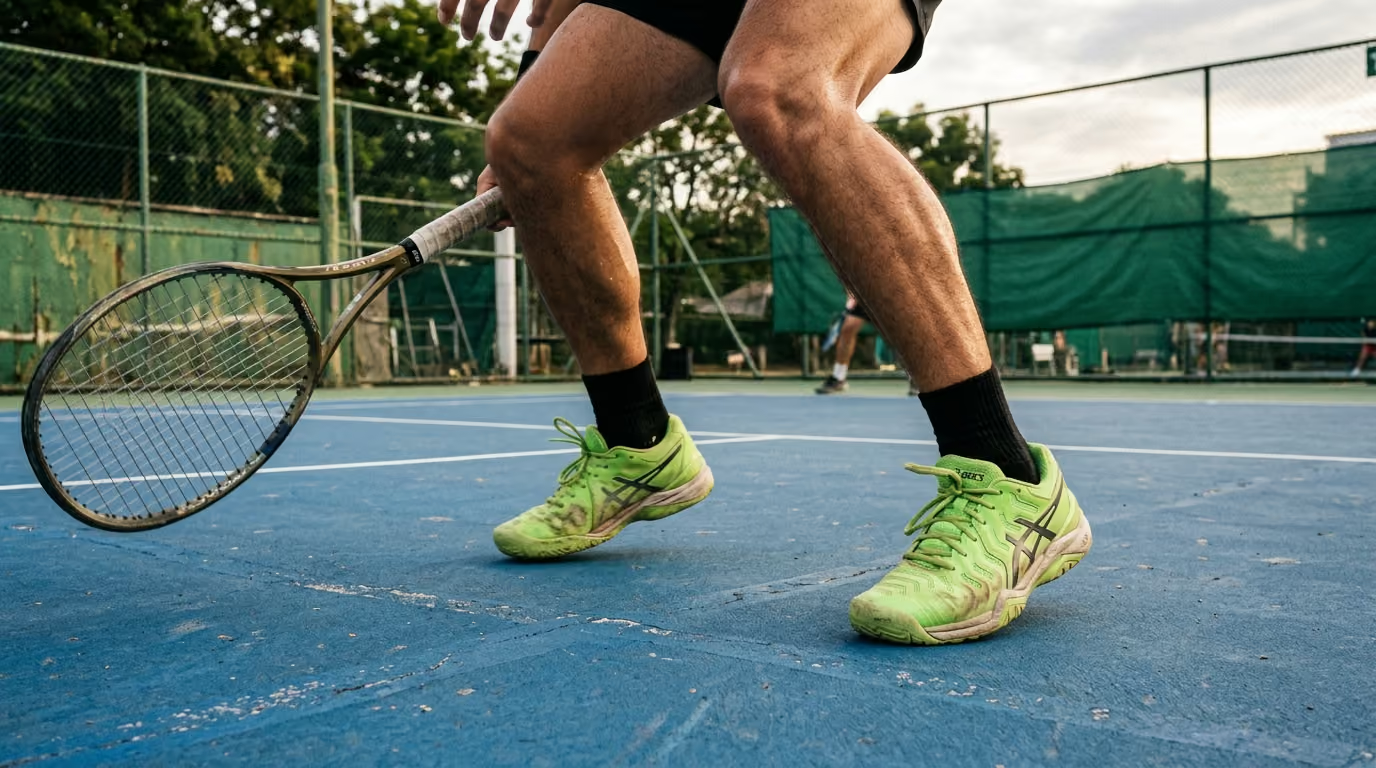
You will learn how to build a comprehensive year-round strength and conditioning plan for racquet sports to enhance performance and prevent injuries.




You walk off the court after a grueling match, and your body feels the heavy toll. Your knees ache, your shoulder feels tight, and your lower back starts to stiffen. Many recreational and competitive players accept this physical drain as an inevitable cost of playing the sports they love.
A successful year-round training plan coordinates strength, power, mobility, and conditioning based on your match schedule rather than treating them as isolated routines. By building physical capacity in the off-season, preserving it during peak play, and prioritizing recovery, you can play consistently without overtraining. This balanced approach supports athletic longevity on the court.
I remember finishing a tough two hour padel match on a cold Tuesday night and waking up the next morning feeling like my lower back was locked in concrete. For a long time, I just accepted this as the price of playing hard in my forties. But once I started spending just ten minutes on targeted hip mobility before heading to the club, the stiffness almost completely vanished. It taught me that we do not have to accept pain as a default state of aging.
Court sports place unique physical demands on the human body. Players must constantly accelerate, decelerate, change direction, and rotate under high speeds. Research from organizations like the United States Tennis Association highlights the importance of multi-planar training. According to the USTA, a complete athlete development model requires the interaction of six key qualities. These are strength, power, mobility, movement, conditioning, and coordination.
These qualities do not work in isolation. Instead, they function as an integrated system. For instance, when you execute a hard forehand, the force begins at the court surface. Your legs and hips absorb and produce this energy, transferring it up through your trunk. Your shoulder girdle and arm then express this force into the ball or paddle.
This sequence is known as the kinetic chain. If one link in this chain is weak or immobile, other areas must work harder to compensate. The Bern Shoulder Injury Consensus emphasizes that deficits in the kinetic chain can increase local stress on the shoulder joint. Therefore, a smart year-round plan aims to keep every link strong and functional.
Current sports science shows that general physical preparation must precede sport-specific training. General preparation builds a solid foundation of tissue capacity, aerobic fitness, and basic strength. Once you have this baseline, you can safely transition to explosive, sport-specific movements on the court. This structured transition reduces the risk of sudden tissue overload during competitive match play.
To build a sustainable program, you must understand the individual pillars of physical preparation. Each pillar serves a distinct purpose in your court movement and longevity.
Strength is your physical foundation. It is the ability of your muscles to produce force against resistance. For racquet athletes, strength is not just about lifting heavy weights. It is about control, stability, and deceleration.
We divide strength into several practical categories. Maximal strength is the greatest force you can produce in a single effort. Relative strength is how strong you are compared to your body weight. Eccentric strength is your ability to absorb force while your muscles are lengthening, which is vital for quick braking.
Your program should target the entire body rather than just your hitting shoulder. Exercises should cover key movement patterns like squats, split squats, hinges, and rotational work. A balanced approach maintains overall structural integrity and prevents common muscle imbalances. You can check our dedicated strength and conditioning resources for specific exercise demonstrations.
Power is force expressed quickly. It dictates your first-step acceleration, lateral push-off, and the speed of your serves or overhead hits. Without power, you will struggle to reach wide balls or react to fast shots.
A meta-analysis on tennis performance published in the Journal of Strength and Conditioning Research suggests that plyometric training can improve serve velocity and agility. However, plyometrics are highly demanding. You must treat them as a systematic progression rather than jumping into advanced exercises immediately.
Begin with simple, low-impact movements like pogo jumps and line hops to prepare your tendons. Move on to snap-downs to teach your body how to land and absorb force. Only after mastering these landing mechanics should you advance to lateral bounds, single-leg hops, and reactive rotational jumps.
Mobility is your usable movement capacity under active muscular control. It is different from passive flexibility, which simply measures how far a muscle can stretch. On the court, you need to access joint range of motion while maintaining balance and strength.
Key target areas for racquet sports include ankle dorsiflexion, hip rotation, thoracic spine rotation, and shoulder rotation. If your ankle is stiff, your knee or lower back will absorb extra stress when you lunge. Dynamic mobility drills before you play will prime these joints for action.
For older players, mobility is a major component of maintaining a fluid stride and preventing stiff joints. Our guide on healthy aging and athletic longevity discusses how joint range changes over time. Keeping these joints mobile ensures you can reach low balls comfortably.
Court sports are characterized by short, intense bursts of movement followed by brief rest periods. This work-to-rest structure means your conditioning must focus on energy system efficiency. You need a mix of aerobic capacity and repeated sprint ability.
Your aerobic system acts as your recovery engine. It helps clear metabolic byproducts and restores your energy between points and games. Repeated sprint training, on the other hand, prepares you for the explosive rallies themselves.
A review of training methods in adolescent tennis players showed that high-intensity interval training is excellent for building cardiovascular endurance. However, this type of training alone does not improve your agility or court-specific footwork. True conditioning must eventually combine cardiovascular challenge with realistic court movement.
To stay healthy and play well year-round, you cannot train with the same intensity every week. You must structure your year into phases. This method, known as periodization, helps you build physical qualities when matches are few and preserve them when matches are frequent.
This phase begins immediately after your most intense playing season or tournament block ends. The goal is physical and mental decompression. It is a time to heal minor aches, catch up on rest, and step away from structured competition.
During this block, which typically lasts one to three weeks, reduce your court time significantly. Focus on light aerobic activities like walking, swimming, or cycling. These low-impact movements keep blood flowing to your muscles without the constant stress of hard court stops.
Use this time to address any joint stiffness or muscle tightness that developed during the season. Light mobility and movement drills are highly beneficial during this phase. Do not worry about lifting heavy or running fast; prioritize systemic recovery.
Once you are rested, the off-season begins. This is your primary window to build muscle, increase maximal strength, and improve your aerobic fitness. Because you are playing fewer matches, your body can tolerate the high physical stress of strength training.
Your weekly schedule should feature two to three full-body strength sessions. Focus on foundational movements like squats, deadlifts, chest presses, and pull-ups. This is also the time to build single-leg strength and stability through split squats and lunges.
In addition to lifting, perform two conditioning sessions per week. These can be tempo runs, rowing intervals, or stationary bike sprints. The objective is to build a large cardiorespiratory base that will support your recovery during long matches later in the year.
As the competitive season approaches, your training must shift from general to specific. You want to convert your newly built strength and fitness into speed and explosive power.
In the gym, reduce your lifting volume slightly and increase the speed of your movements. Introduce medicine ball throws to build rotational power for your groundstrokes. Add lateral bounds and short change-of-direction sprints to replicate court movement.
On the court, technical practice should become more demanding. Move from predictable hitting drills to reactive drills where you must sprint and change direction based on visual cues. USTA periodization guidelines emphasize that this pre-competition phase is critical for building tissue tolerance in the shoulder and legs before match play begins.
Once your league or tournament season starts, your priority is court performance. You cannot afford to be sore or fatigued on match day. Therefore, your training shifts to a maintenance model.
The goal of maintenance is to preserve your strength, power, and mobility with the smallest effective dose of exercise. You do not need hours in the gym to maintain your physical gains. One or two short, high-intensity strength sessions per week are sufficient.
Keep your exercises heavy but low in volume. For example, instead of doing four sets of twelve repetitions, perform two sets of five repetitions. This maintains muscle tension and nervous system activation without causing deep muscular fatigue or soreness. Place these lifting sessions at least 24 to 48 hours away from your competitive matches.
If you have been away from the court due to injury or an extended break, you cannot jump straight back into matches. You must follow a progressive, step-by-step return-to-play framework.
Begin with daily activities and light, pain-free aerobic movement. Next, introduce basic bodyweight strength training to rebuild joint stability. Once you can move without symptoms, start linear running before progressing to lateral shuffles and light court movement.
Before playing an actual match, complete several unrestricted practice sessions. The consensus literature on return-to-sport protocols states that completing a full, normal practice without pain is a key prerequisite for competitive play. Take your time during this phase to avoid re-injury.
Translating periodization theory into daily life requires a practical plan. Here is how you can structure your training sessions and match play.
For a recreational player, balancing work, family, and court time can be challenging. Below are three practical weekly examples based on different phases of the year.
A proper warm-up is your first line of defense against injury. It primes your nervous system, increases your core temperature, and prepares your joints for explosive movements. Skip the traditional static stretching before you play, as stretching cold muscles can temporarily reduce your power output.
Instead, use a dynamic warm-up that lasts ten to fifteen minutes. Start with five minutes of general movement like jogging, side shuffles, and high knees. Next, perform dynamic mobility exercises for your hips, ankles, thoracic spine, and shoulders.
After mobility, activate your key stabilizing muscles. Perform glute bridges, calf raises, trunk planks, and shoulder external rotations with a light resistance band. Finish your warm-up with sport-specific movements like split steps, shadow swings, and short accelerations. This progressive sequence ensures your body is fully ready for the first point.
When time is limited during the competitive season, focus on a minimal full-body routine. You can complete this maintenance workout in thirty minutes, once or twice a week.
Select one primary lower-body movement, such as a goblet squat or split squat. Pair this with a unilateral posterior-chain exercise like a single-leg Romanian deadlift. Add one upper-body pulling exercise, like a dumbbell row, and one pushing exercise, like a push-up or overhead press.
Finish your session with a core anti-rotation exercise, such as a Pallof press, and a quick shoulder stability drill. Keep the weights moderate to heavy, but limit your sets to two or three. This preserves your hard-earned muscle mass without draining the energy you need for your matches.
While all racquet sports share similar movement patterns, each has unique physical demands. Understanding these differences allows you to tailor your training to your specific sport.
Tennis is played on a large court, which requires players to cover significant distances. Points can be long and physically demanding, especially on clay or hard courts. You must be prepared for explosive sprints, deep slides, and sudden braking.
Because tennis matches can last several hours, aerobic and anaerobic endurance are both critical. The serving motion in tennis is also highly demanding on the shoulder, upper back, and core. Your strength program must prioritize shoulder external rotation strength and thoracic extension to handle the high volume of overhead serves.
Deceleration is another major component of tennis movement. When sprinting to a wide ball, your legs must absorb several times your body weight to slow you down. Focus on eccentric lower-body strength to build the brake capacity needed for these hard stops. Read our specialized tennis articles for deeper insights into court-specific movement.
Pickleball is played on a much smaller court, which reduces the need for long-distance sprinting. However, the smaller court space increases the demand for rapid acceleration, quick reflexes, and lateral agility. Points are fast, and players must react in fractions of a second at the non-volley zone line.
The dominant physical stance in pickleball is a low, semi-squat position. To play effectively, you need excellent quadriceps endurance, hip mobility, and calf strength. Frequent reaching and lunging for low dinks can place significant stress on your knees and lower back if your hips are tight.
Epidemiological studies, including data on emergency department visits, show a rising trend in pickleball-related injuries, particularly among older adults. Common issues include Achilles tendon strains, patellar tendon pain, and rotator cuff irritation. Therefore, pickleball players should focus heavily on calf and Achilles tendon capacity, ankle mobility, and single-leg balance. Learn more by checking out our pickleball articles for tactical and physical advice.
Padel is played on a walled court, creating a unique tactical and physical environment. The presence of glass and mesh walls means the ball can rebound from unpredictable angles, requiring constant adjustment, quick pivots, and deep squats.
The movement in padel is highly multidirectional. You must constantly run forward for dropshots, backpedal for overheads, and shuffle laterally to defend the walls. This frequent change of direction places a premium on your hip rotation and ankle stability.
Overhead actions are much more common in padel than in tennis or pickleball. Shots like the bandeja and vibora require repetitive, controlled overhead hitting. This high volume of overhead work demands excellent scapular control, thoracic rotation, and rotator cuff endurance. If you play this fast-growing sport, our padel articles offer specific tips on movement and injury prevention.
The secret to staying on the court is not a magic exercise; it is smart load management. Most injuries do not happen because of a single traumatic event. Instead, they occur when your training load exceeds your body's ability to recover.
To manage your training effectively, you must monitor both external and internal load. External load refers to what you do on the court and in the gym. This includes your total playing time, the number of matches you play, your sprint distance, and your lifting volume.
Internal load is how your body responds to that work. It is influenced by your heart rate, perceived exertion, muscle soreness, sleep quality, and stress levels. Two players can perform the exact same external workout but experience completely different internal loads based on their fitness and recovery status.
According to consensus guidelines from the International Olympic Committee, monitoring both types of load is essential for keeping athletes healthy. A simple way to track this is by rating your session intensity on a scale of one to ten, then multiplying that rating by the duration of the session in minutes. This provides a simple score that helps you track your weekly physical exertion.
The highest risk of injury occurs when you rapidly increase your weekly workload. This is common when players return from a holiday, recover from an illness, or sign up for a weekend tournament with multiple back-to-back matches.
When your muscles and tendons are subjected to a sudden spike in volume or intensity, they can suffer micro-damage that leads to overuse issues. A safe approach is to limit your weekly workload increases to small increments, such as ten percent. This conservative guideline allows your tissues to adapt gradually to the new stress.
If you are returning to play after a break, use a progressive four-week ramp-up strategy. In the first week, play at half your normal volume and moderate intensity. Slowly increase your court time and match intensity over the next three weeks. Studies in professional sports show that these structured ramp-up strategies significantly reduce injury rates.
True injury prevention is about building physical capacity where your body needs it most. For court athletes, this means targeting high-risk areas like the Achilles tendon, the knees, the lower back, and the shoulder.
To protect your Achilles tendon, perform slow, controlled calf raises on a step. To safeguard your knees, build quad and glute strength through split squats and step-downs. Protect your lower back by maintaining mobile hips and a strong, stable core. Finally, keep your shoulders healthy with regular rotator cuff and scapular strengthening exercises. Check our injury prevention resources for detailed anatomical guides.
Even well-intentioned players often make mistakes that limit their progress or lead to injury. Here are the most common pitfalls to avoid.
It is common to see players focusing entirely on their dominant side, performing countless shoulder and forearm exercises. However, racquet sports are whole-body endeavors. The energy for your shots comes from your legs and torso, not just your arm.
Training only your hitting arm leads to severe structural asymmetries. It can cause muscle imbalances between your dominant and non-dominant sides, increasing your risk of shoulder, back, and hip pain. A balanced, full-body strength program is essential for maintaining symmetry and transferring force efficiently.
Many players believe a workout is only effective if they leave the gym completely exhausted and sore for days. In the context of athletic training, this is a mistake. Severe muscle soreness can alter your court movement mechanics, ruin your technical practice, and increase your risk of injury.
Your gym sessions should leave you feeling strong and capable, not broken down. In-season strength training should focus on movement quality and power preservation rather than muscle destruction. Save the high-volume, fatigue-inducing workouts for the early off-season when you have time to recover.
Jump training is excellent for building explosive court speed, but it is highly stressful for your joints and tendons. Many players make the mistake of adding complex jumps, high-intensity bounds, and deep drop jumps too quickly.
This rapid progression can quickly lead to patellar tendinitis, Achilles issues, or shin splints. Your tendons need weeks, sometimes months, to adapt to the high impact forces of plyometric training. Always start with low-level jumps on soft surfaces, master your landing mechanics, and increase your volume very gradually.
Training is only half of the equation; adaptation happens during recovery. If you do not recover well, your performance will decline, and your injury risk will rise. Refer to our recovery science resources for in-depth strategies.
Dehydration reduces your coordination, speed, and decision-making on the court. It also increases the physical stress on your cardiovascular system. To perform at your best, you must stay hydrated before, during, and after your matches.
The USTA recommends consuming approximately one twenty-ounce bottle of fluid for every pound of body weight lost during a match. You can track this by weighing yourself before and after a hard training session. Remember to adjust this guideline based on the local temperature, your individual sweat rate, and your overall body size.
Nutrition is equally important for tissue repair and energy replenishment. Within two hours of a tough match, consume a meal containing both high-quality protein and complex carbohydrates. The protein supports muscle recovery, while the carbohydrates replenish your depleted glycogen stores.
Sleep is the single most powerful recovery tool available to athletes. During deep sleep, your body releases growth hormones that repair tissue damage and strengthen your immune system. Chronic sleep deprivation, or sleep debt, impairs your reaction time and increases your susceptibility to injuries.
To help manage your daily training decisions, use a simple readiness decision tree. This tool helps you assess your physical state every morning and adjust your training plan accordingly.
You cannot manage what you do not measure. Periodic testing helps you track your progress, identify physical weaknesses, and adjust your training plan. Aim to test your physical qualities at the end of the off-season, before the competitive season, and during scheduled maintenance blocks.
To test your lower-body strength, perform a submaximal split squat assessment. Note the maximum weight you can lift comfortably for five repetitions on each leg with perfect form. Look for any significant strength differences between your left and right sides.
For power, use the lateral bound test. Stand on one leg and leap laterally as far as possible, landing stably on the opposite leg. Measure the distance of your leap and compare your performance on both sides. A significant difference indicates a strength or power imbalance that needs attention in the gym.
Test your ankle mobility using the weight-bearing lunging test. Stand facing a wall with your big toe five inches away. Lunge forward to touch your knee to the wall without letting your heel lift off the ground. If your knee cannot touch the wall, you need to focus on ankle dorsiflexion mobility.
To test your shoulder mobility, perform the active external rotation test. Lie on your back with your arm out at a ninety-degree angle and your elbow bent. Rotate your forearm backward toward the floor, noting if you can easily touch the ground without arching your lower back.
A simple, court-specific conditioning test is the repeated sprint test. Perform six twenty-meter sprints, starting a new sprint every thirty seconds. Track your times for each sprint and calculate your fatigue index, which is the drop-off in speed from your first sprint to your last.
You can also track your heart rate recovery. Measure your heart rate immediately after a tough rally or drill, then measure it again exactly one minute later. A faster drop in heart rate indicates a highly efficient aerobic system and excellent physical conditioning.
While a year-round strength and conditioning plan can significantly reduce your injury risk, it is not a substitute for medical care. You must know when to step away from the court and seek professional advice.
Do not try to play through pain. If you experience any of the following warning signs, consult a physical therapist, sports physician, or qualified healthcare provider:
A qualified medical professional can perform a comprehensive assessment to diagnose the root cause of your discomfort. They can design a customized rehabilitation program that addresses your specific tissue limitations and movement patterns.
Working with a professional ensures you return to play safely and avoid chronic, long-term issues. Remember, your long-term athletic longevity is always more important than a single match.
Building a year-round strength and conditioning plan is an investment in your athletic future. By structuring your training phases, prioritizing recovery, and managing your workloads, you can enjoy your favorite racquet sports for years to come.
We recommend returning to this guide whenever you transition to a new training phase, such as moving from the off-season to the competitive season. It is also highly useful to review these protocols if you are recovering from an injury or planning your yearly tournament calendar. Let this framework guide your weekly and monthly routines to support your lifelong movement on the court.
Bookmark this page or check our Evercourts blog for more practical advice on court life, better play, and player health.
Follow Evercourts for practical insights on tennis, pickleball and padel performance, movement, recovery and healthy ageing. Stay connected for new articles, research-led guidance and ideas to help you play well and keep playing for years.


Read practical guidance for better movement, smarter preparation and a game that keeps working for you.
explore the Blog