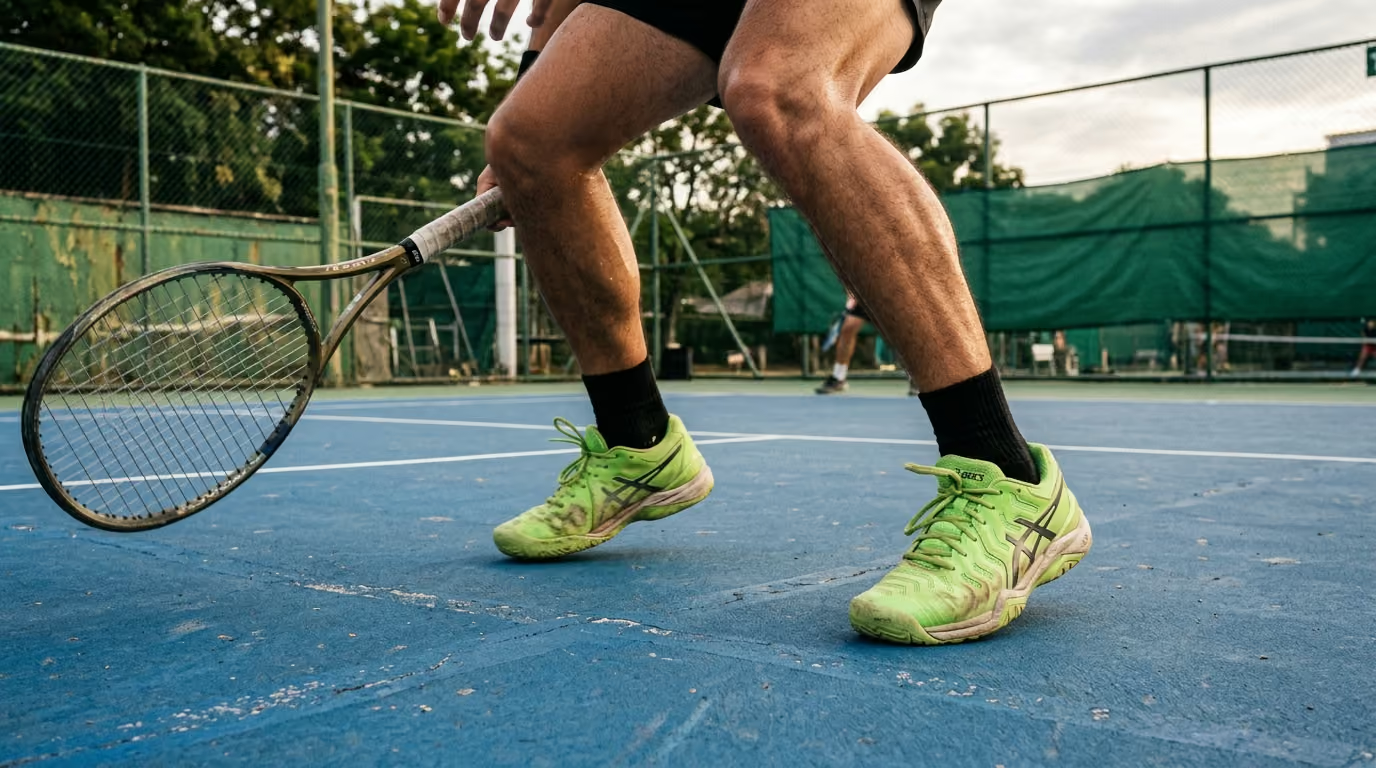

Static stretching before racquet sports is commonly believed to prevent injury, but a targeted daily mobility plan actually builds active control and resilience.




Many competitive court athletes spend twenty minutes stretching their hamstrings before a match, believing this routine will keep them agile and free from injury. In reality, static stretching before explosive action can temporarily reduce power output, decrease force production, and do very little to improve actual movement. Busy players do not need to spend hours holding passive stretches to protect their joints. They need a practical, high-yield movement system that builds active control and fits easily into a crowded schedule.
To maintain your physical capabilities and perform well on the court, you need a time-efficient plan centered on active movement, joint stability, and strength through a full range of motion. This approach involves a five-to-ten-minute daily minimum sequence, targeted weekly sessions of fifteen to twenty-five minutes, and a progressive dynamic warm-up before you play. By focusing on your ankles, hips, thoracic spine, and shoulders, you can build a resilient body that moves with ease and confidence.
Many players use the terms mobility, flexibility, and stretching as if they mean the same thing. To build a plan that keeps you on the court, you must understand how these physical qualities differ.
Flexibility is the passive extensibility of your muscles and connective tissues. If you sit on the floor and pull your toe toward your torso with a strap, you are testing your passive flexibility.
Active mobility is your ability to control and move a joint through its available range without assistance. On the court, you cannot rely on straps or gravity to pull your limbs into position. You must generate internal muscular force to control your joints at deep angles. This active control is what keeps your movement smooth during a deep lunge or a wide reach.
Stability is your capacity to control unwanted movement when your body absorbs or produces force. When you land from a split step, your ankle and knee must resist collapsing inward.
Strength through range is your ability to generate force at deep joint angles. For example, when you lung low for a short ball, your leg muscles must produce enough tension to push you back to the center of the court.
Dynamic preparation involves low-to-moderate intensity exercises that raise your core temperature and prepare your nervous system for sport. This preparation is very different from passive stretching, which relaxes your muscles rather than exciting them.
A review of flexibility research suggests that stretching a muscle past the point of functional requirement does not improve athletic performance. In some cases, excessive passive flexibility can make joints less stable and more vulnerable to strain.
According to a systematic review led by Dr. David Behm, static stretching of sixty seconds or more per muscle group immediately before activity was associated with performance deficits. These deficits can include reduced jump height, slower sprint times, and decreased reactive strength. Conversely, dynamic stretching performed before activity produces small-to-moderate performance improvements.
Furthermore, systematic review evidence published by Dr. Stephen Thacker shows that routine stretching has no clear association with a reduction in total sports injuries. To stay healthy and play well, you must focus on active control and strength through your usable ranges rather than chasing extreme flexibility. This balanced approach supports healthy aging and athletic longevity by keeping your joints capable and secure.
Busy players often skip physical preparation because they believe a routine must be long to be effective. In our experience, a realistic, short plan performed consistently works better than a long session that you only complete once a month. To make your training manageable, divide your preparation into three logical layers.
The foundation of this plan is a daily session lasting only five to ten minutes. This short window is not designed to build massive strength or extreme flexibility. Instead, it serves to maintain your current movement capacity, break up long periods of sitting, and help you find joint restrictions.
You can perform this minimum routine in your living room, at your office desk, or in a hotel room. Think of it as a daily check-in with your joints. Consistent exposure to simple movements helps your central nervous system feel safe at different angles. This baseline of activity is an excellent starting point for improving your dynamic movement on court.
This daily habit also helps you meet general health guidelines. The World Health Organization advises adults to accumulate 150 to 300 minutes of moderate-intensity aerobic activity per week. While your five-minute session is brief, it contributes to your total active time and reduces sedentary behavior.
Two or three times per week, dedicate fifteen to twenty-five minutes to deeper strength and balance work. These sessions allow you to focus on building active control at the end of your joint ranges.
The American College of Sports Medicine recommends performing resistance exercises for major muscle groups on two to three days per week. They also recommend neuromotor exercises that focus on balance, agility, and coordination.
For older adults, the World Health Organization recommends multicomponent physical activity on three or more days per week. This type of training combines functional balance and strength work to help maintain coordination and prevent falls. These weekly sessions are the perfect place to build this strength, helping you stay sturdy during fast transitions.
Your warm-up before a match or practice session should be completely separate from your daily mobility routine. A proper warm-up does not aim to increase your permanent range of motion. Instead, its sole purpose is to prepare your body for the physical demands of your sport.
According to material from the United States Tennis Association, your pre-match sequence should begin with five to ten minutes of low-to-moderate activity. This activity can include walking, slow jogging, or light cycling.
Once your body temperature is elevated, you should progress to dynamic joint movements, footwork drills, shadow swings, and gradual rallies. This structured progression prepares your muscles, joints, and nervous system for sudden accelerations and stops.
To make your daily routine efficient, you must target the specific joints that experience the most stress during racquet sports. Working on arbitrary areas will waste your time and yield poor results on the court. Focus your attention on the six key areas that dictate your movement quality and comfort.
Your ankles and feet are your only contact points with the court. They must absorb massive impact forces and transmit energy into your legs for powerful movements.
Limited ankle dorsiflexion, which is the ability to pull your toes toward your shin, can cause movement compensations. When your ankle cannot bend sufficiently, your body may compensate by turning your foot outward or lifting your heel early. This compensation can place excessive stress on your knees, hips, and lower back.
To improve this area, focus on the knee-to-wall ankle rock. Stand facing a wall with one foot forward and keep your heel firmly on the ground. Slowly bend your knee and push it toward the wall, feeling a deep stretch in your lower calf and ankle joint. Repeat this movement for eight control repetitions on each side.
Additionally, build calf capacity with slow, full-range calf raises. Stand on a step, lower your heels below the edge, and push up slowly to your toes. This active movement builds strength at both ends of your calf muscles, protecting your Achilles tendon from sudden stress.
Your hips are the motor of your court movement. They must rotate, flex, extend, and push laterally to slide you into position.
In our experience, hip stiffness is one of the most common complaints among recreational players. I remember finishing a tough two hour padel match on a cold Tuesday night and waking up the next morning feeling like my lower back was locked in concrete. For a long time, I just accepted this as the price of playing hard in my forties. But once I started spending just ten minutes on targeted hip mobility before heading to the club, the stiffness almost completely vanished. It taught me that we do not have to accept pain as a default state of aging.
Many players appear tight because their hip muscles lack the strength to control wide positions. When the nervous system detects weakness, it tightens the surrounding tissues to protect the joint.
To build active hip rotation, perform quadruped hip circles. Get on your hands and knees, lift one knee off the floor, and draw slow, controlled circles with your thigh. Keep your lower back completely still, forcing your hip joint to do all the work.
To open up your inner thighs, practice adductor rock-backs. Kneel on one knee, extend your opposite leg straight out to the side, and place your hands on the floor. Slowly push your hips back toward your heel until you feel a comfortable stretch in your groin.
Your thoracic spine is your middle and upper back. This section of your spine is designed to rotate, bend, and extend.
Research on tennis biomechanics highlights the kinetic chain, which is the coordinated movement of your legs, hips, trunk, shoulders, and arms. If your thoracic spine cannot rotate freely, your body will seek rotation elsewhere. This often occurs in your lumbar spine, which is your lower back. Your lower back is designed for stability, not rotation, so forcing it to twist can lead to discomfort.
To improve your thoracic mobility, perform side-lying open-book rotations. Lie on your side with your knees bent at ninety degrees and your hands stacked in front of you. Slowly lift your top arm up and rotate it toward the floor behind you, keeping your knees together.
You can also use quadruped thoracic rotations. Place one hand behind your head while on your hands and knees, rotate your elbow toward your opposite wrist, and then rotate it up toward the ceiling. These movements ensure that your trunk rotates safely, allowing you to generate racquet speed without straining your lower back.
Your shoulders must withstand high-velocity movements during serves, overheads, and groundstrokes. The serve involves a complex sequence of preparation, cocking, acceleration, deceleration, and follow-through.
According to an Aspetar sports medicine review, the shoulder and elbow joints experience extreme mechanical loads during the late cocking and acceleration phases. If your shoulder blade, or scapula, does not move in sync with your upper arm, you can experience pinch points and tendon irritation.
To support healthy shoulder movement, practice scapular wall slides. Stand with your back flat against a wall, raise your elbows to ninety degrees, and slowly slide your hands upward. Keep your elbows and wrists in contact with the wall, forcing your shoulder blades to glide smoothly.
Additionally, perform band external rotations. Hold an elastic band in front of you, keep your elbows tucked into your ribs, and pull your hands apart. This movement builds endurance in your rotator cuff, which is crucial for decelerating your arm after a fast swing.
Your forearm muscles must absorb the shock of ball impact, manage off-center hits, and control the angle of your racquet face. Repetitive gripping, topspin swings, and high impact can lead to localized overload.
Biomechanics literature shows that poor wrist stability can increase the mechanical load on your elbow joint. To manage these loads, you need both muscle length and contraction capacity.
To keep this area resilient, perform slow wrist flexion and extension movements. Hold your arm straight out, use your opposite hand to gently pull your fingers back, and hold for twenty seconds. Then, point your fingers toward the floor and apply gentle pressure.
You should also practice isometric gripping. Squeeze a tennis ball or a soft grip trainer at moderate intensity for ten seconds, then release. This isometric contraction strengthens the tendons and muscles around your elbow, improving their ability to handle impact forces.
Every stride, change of direction, and stroke on the court occurs on one leg. If you cannot balance on a single leg, your movement will feel hesitant, and your risk of tripping increases.
The Centers for Disease Control and Prevention recommends that older adults include balance activities alongside aerobic and muscle-strengthening work. Dynamic balance is also highly valuable for younger, competitive players who must decelerate from wide runs.
To train this skill, practice the single-leg stance with racquet reaches. Stand on one leg with your knee slightly bent, hold your racquet in one hand, and slowly reach in different directions. Keep your standing knee aligned over your foot, preventing your ankle from collapsing inward.
You can progress to step-and-stick landing drills. Take a lateral step to the side, land on one leg, and hold your balance for three seconds without shifting your foot. This drill trains your brain and muscles to coordinate under pressure, translating directly to stable court recovery.
Knowing how to move well in your living room is only useful if it improves your play on the court. To maximize the value of your physical preparation, you must apply these concepts directly to your match-day routine. Use this structured approach to transition from daily exercises to competitive play.
Arrive at the club fifteen minutes before your scheduled court time. Do not sit on the bench and stretch your hamstrings. Instead, use this systematic warm-up sequence to prepare your body.
During long matches or cold days, your joints can begin to feel stiff between games or during changeovers. You can use subtle, low-fatigue movements to maintain your joint ranges without draining your energy.
During changeovers, sit tall in your chair and perform five gentle trunk rotations to each side. If your shoulders feel tight, stand up and perform three slow arm circles in both directions. These small inputs keep your nervous system alert and prevent your tissues from tightening during rest periods.
Your post-match routine is the ideal time to perform longer, passive static stretches. After playing, your body is warm, and your nervous system is highly excited. Static stretching can help lower your heart rate, transition your body into a state of rest, and restore resting muscle length.
Focus on stretching your calves, hip flexors, and chest. Hold each stretch for thirty to forty-five seconds at a comfortable intensity. Do not bounce or force your joints into painful positions. This gentle cool-down supports your recovery process and prepares your body for your next session.
While all racquet sports share some movement patterns, the specific physical demands differ based on the court size, equipment weight, and ball speed. To optimize your mobility plan, you must tailor your exercises to the sport you play. You can read more about these differences in our dedicated racquet sports articles.
Tennis is played on a large court, requiring long sprints, heavy deceleration, and deep, low lunges. The heavy yellow ball also places substantial demands on your shoulder and elbow during groundstrokes and serves.
Pickleball is played on a smaller court, but it requires continuous, rapid lateral steps and deep knee bends. The low bounce of the plastic ball means you must spend a lot of time in a low, athletic stance near the kitchen line.
Padel combines explosive sprints, quick wall transitions, and a very high frequency of overhead strokes. The glass walls require you to spin, turn, and bend in unpredictable directions to return rebounds.
Many well-meaning players waste their time on useless routines or inadvertently make themselves more prone to injury. By recognizing these common mistakes, you can streamline your training and protect your joints. For more practical advice on avoiding injury, read our injury prevention resources.
Many players believe that if a small amount of flexibility is good, then a massive amount must be better. This is a mistake.
As discussed by Weldon and Hill in their review of flexibility, excessive range of motion without matching strength can make a joint unstable. Your muscles and ligaments must remain tight enough to hold your joints in place during explosive movements. If you stretch your joints until they are loose, your muscles must work twice as hard to maintain control. This extra work can lead to early fatigue and muscle strains.
Stretching is often promoted as a magical shield against injuries. However, the scientific evidence does not support this claim.
A systematic review of stretching and sports-injury risk found that stretching does not reduce the incidence of overuse or acute injuries. Injuries on the court are usually caused by fatigue, poor landing mechanics, sudden overload, or lack of strength. To protect your body, you must combine your mobility work with progressive resistance training. A mobile joint that is also weak remains highly vulnerable to injury.
We still see many players sitting on the court side stretching their hamstrings before a match. As established by Behm et al. this practice can temporarily reduce your muscle power and speed.
Holding a muscle in a stretched position for a long time relaxes the central nervous system and decreases muscle stiffness. While this relaxation is great for recovery, it reduces your ability to produce force quickly. Always save your static stretching for after your matches or during your evening wind-down.
Some players believe that a stretch must hurt to be effective. This "no pain, no gain" mentality is dangerous.
According to USTA sports medicine guidance, you should never stretch away from pain. If an exercise causes a sharp, pinching, or radiating sensation, stop immediately. True mobility work should feel like a mild, comfortable tension in your muscle belly, not a sharp pain in your joints or tendons.
To make this plan easy to implement, we have created a simple, five-minute template that you can perform every single day. This sequence requires no special equipment, making it easy to fit into your busy schedule. This is a practical example of how to operationalize the general principles of dynamic movement and joint-specific ranges.
The goal of this first minute is to raise your body temperature and wake up your nervous system.
These two minutes target the ankles and hips, which are the base of your court movement.
This minute opens up your chest, thoracic spine, and shoulders.
This final minute integrates your mobility into an active balance drill.
If you have an extra five minutes, add these high-value strengthening exercises to your routine. These additions help meet the World Health Organization guidelines for muscle-strengthening activities.
To ensure you get a balanced mix of mobility, strength, and recovery, use this structured weekly calendar. It is designed to fit around a typical playing schedule of two court sessions per week. You can adjust the days to fit your specific schedule. For more help with structuring your training, check out our strength and conditioning guidelines.
To ensure your mobility plan is working, you must monitor your progress over time. Do not chase arbitrary flexibility benchmarks, such as touching your toes with flat palms, unless that movement is relevant to your court goals. Instead, evaluate how your body feels and moves during your daily life and on the court. Ask yourself these practical questions every few weeks.
Stand in a split stance with one foot forward and one foot back. Slowly lower your back knee toward the floor. If you feel highly unstable or experience sharp pinching in your hips, you may need to focus more on hip stability and single-leg balance.
Sit tall in a chair, cross your arms over your chest, and rotate your torso as far as you can to the right, then to the left. Your rotation should feel equal and smooth on both sides. If you notice a major difference between sides, prioritize thoracic spine mobility on your restricted side.
Stand with your back flat against a wall. Raise both arms straight overhead and try to touch the wall with your thumbs. If you cannot touch the wall, or if you must arch your lower back to do so, you need to work on your thoracic extension and shoulder-blade mobility.
Take a fast lateral step to the side and try to stop instantly on one leg. If your ankle rolls inward, or if your knee collapses, you need to prioritize single-leg landing stability and ankle control in your weekly sessions.
Pay attention to how your body feels during your pre-match warm-up. You should feel progressively looser, warmer, and more confident as you move. If your warm-up exercises feel stiff or painful, your daily routine may be too intense, or you may need more rest.
A generic mobility plan is designed to maintain normal joint movement and support athletic longevity. It is not a substitute for medical treatment or individualized rehabilitation. If you experience persistent symptoms, you should seek guidance from a qualified healthcare provider.
Normal muscle soreness from exercise should resolve within forty-eight to seventy-two hours. If you experience sharp, localized pain that persists for more than two weeks, do not try to stretch it away.
Stretching an inflamed tendon or a damaged ligament can make the injury worse. A physiotherapist can diagnose the underlying issue and provide a targeted rehabilitation plan.
If you notice a sudden drop in strength on one side of your body, seek medical attention. For example, if you can easily perform fifteen calf raises on your left leg but struggle to complete three on your right leg, this is a clear warning sign.
Unilateral weakness, numbness, tingling, or loss of motor control can indicate nerve involvement or structural damage that requires professional evaluation.
Occasional, painless popping or clicking in your joints is usually harmless. However, if a joint swells, locks in place, or feels like it is going to give way during movement, stop your routine.
These symptoms can point to cartilage tears, ligament instability, or joint inflammation that must be assessed by a sports medicine specialist before you return to play.
If you experience a sudden pop, snap, or twist during a match, do not start a self-guided mobility program. Acute injuries require immediate medical evaluation to determine the extent of the damage.
Starting a stretching routine too early can disrupt the healing process and delay your recovery. A professional can guide you through a safe, progressive return-to-play program. If you would like to read more about our approach to research-led guidance, please visit our about page or contact us for further information.
By integrating this practical, research-supported mobility plan into your weekly routine, you can build a resilient body that moves with ease, performs at its best, and remains capable of playing the sports you love for years to come.
Follow Evercourts for practical insights on tennis, pickleball and padel performance, movement, recovery and healthy ageing. Stay connected for new articles, research-led guidance and ideas to help you play well and keep playing for years.


Read practical guidance for better movement, smarter preparation and a game that keeps working for you.
explore the Blog