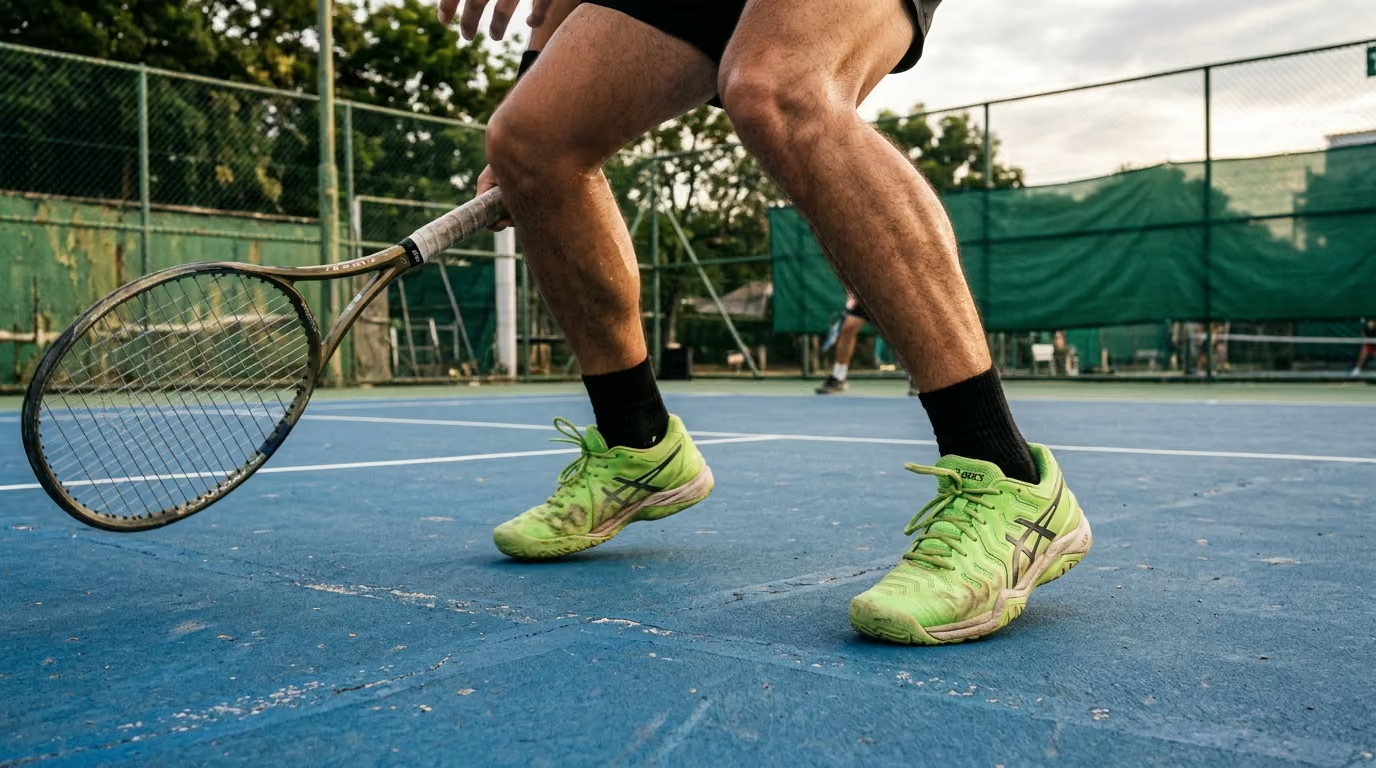
When persistent elbow soreness or knee pain sidelines your racquet sport, a comprehensive audit of your entire playing system can pinpoint the root causes.




If you have ever searched online for solutions to persistent elbow soreness or knee pain after playing, you know how frustrating court injuries can be. Many players struggle with recurring physical setbacks that keep them off the court for weeks or months at a time. The solution is not a single stretch or a magic exercise. You must audit your entire playing system to identify exactly where your physical demands exceed your current physical capacity.
To systematically protect your physical longevity, you must audit the interactions between your physical history, current workloads, technical movement, and equipment setup. Rather than focusing on a single weak muscle, this audit evaluates how your body responds to the specific forces of your sport. By identifying and correcting imbalances in this entire system, you can maintain consistent play and avoid chronic issues.
A racquet sports injury prevention audit should examine the interaction between the player, the stroke, the workload, the environment, the equipment, and recovery. It is a mistake to merely test flexibility or search for isolated muscular imbalances. Tennis injuries have been reported across a wide incidence range in sports medicine literature. Historically, there have been relatively few longitudinal studies capable of establishing direct causal risk relationships, according to research published in the British Journal of Sports Medicine.
To build a reliable prevention strategy, you must distinguish among several key factors. First is risk exposure, which is how much, how often, and under what conditions you perform. Second is physical capacity, which is your ability to tolerate and recover from that exposure. Third is technique and movement strategy, which is how forces are generated, absorbed, and transferred through your body. Finally, you must look at active symptoms, modifying conditions, and risk controls.
A useful operating principle for court athletes is that injury risk is not a fixed personal trait. Instead, it is a constantly changing relationship between your current workload and your current physical capacity. This framework prevents two very common training errors. It stops you from assuming that one weak muscle explains an entire injury, and it prevents you from assuming that a normal screening test guarantees absolute safety on the court.
High acute workload is associated with injury in high level junior tennis. However, its predictive ability is weak when considered entirely alone, showing that workload is important without being a complete explanation. To manage this risk, we must look at the body as an interconnected system. We should analyze how various components of play influence the forces applied to our tendons, muscles, and joints.
Before collecting data for your audit, you must define what an injury actually is. A medical attention injury is a problem that requires assessment by a health professional. A time loss injury is a problem that causes you to miss scheduled training sessions or competitive matches.
A performance limiting injury permits participation but changes your stroke mechanics, movement speed, or overall athletic output. Finally, a pain complaint is a symptom that may not yet have caused time loss but alters how you feel on court. These distinctions are critical because injury surveillance systems produce vastly different results depending on their definitions.
A professional women's tennis surveillance study reported an overall injury incidence of 56.6 per 1,000 match play hours. However, the incidence of injuries causing actual competition time loss was only 12.8 per 1,000 match play hours. If you only track missed matches, you miss the early warning signals of tissue fatigue.
The audit must record both external and internal workloads. External load is the measurable work you perform on the court. This includes court minutes, match minutes, total serves, rallies, sprints, changes of direction, and gym volume.
Internal load is your physiological and perceptual response to that work. It is commonly represented by multiplying your session rating of perceived exertion by the session duration in minutes. This calculation gives you a clear picture of how hard your cardiovascular and musculoskeletal systems worked.
The acute to chronic workload ratio, or ACWR, compares your recent workload with a longer preceding workload window. It can be useful for identifying abrupt changes in your playing habits. However, it should not be treated as an exact injury probability calculator.
In junior tennis, previous week ACWR and injury history predicted injury in one observational study. But these findings do not establish that a particular ratio causes injury. Another high performance junior study found that injury risk increased with higher recent week workload, while also concluding that acute workload alone had low predictive ability.
A load capacity mismatch occurs when the physical stress imposed by your sport exceeds your present ability to tolerate it. This can arise from a sudden workload spike, such as playing a weekend tournament after weeks of inactivity. It can also arise when your capacity falls due to illness, sleep disruption, travel, pain, detraining, or psychological stress.
The audit should therefore ask two separate questions. First, what did the player actually do on the court? Second, what physical condition was the player in when they did it?
We must also distinguish between acute, chronic, recurrent, and persistent problems. Acute injuries have a sudden onset, such as an ankle sprain or a muscle strain. Overuse injuries are gradual onset conditions associated with repetitive loading over time.
Recurrent injuries represent a return of the same or a highly related problem. Persistent symptoms are ongoing complaints that remain despite continued participation in your sport. A comprehensive review found that the lower extremities are generally most frequently injured in racquet sports, followed by the upper extremities and the trunk.
The first step in a personal audit is documenting your historical risk profile. This profile provides the context for all your current training and playing decisions.
You should record every significant prior injury in detail. Note the exact body region, the tissue involved, the date of onset, and the mechanism of injury. Document the time lost from play, the treatments received, and whether you completed a full rehabilitation program.
Importantly, record whether your full training capacity was ever truly restored. You must also note if symptoms tend to recur under specific court conditions or workload volumes.
Previous injury should be treated as a major audit variable rather than a historical footnote. In a junior tennis workload study, a history of previous injury was a significant predictor of injury in the following week.
Do not automatically label yourself as fragile if you have an injury history. Instead, use this information to determine whether that past injury left unresolved deficits. Common lingering issues include reduced strength, limited range of motion, altered movement strategies, or lower load tolerance.
A thorough audit screens for current pain, recent illness, or unexplained fatigue. You should note any medication changes, concussion history, or systemic inflammatory diseases. For female athletes, menstrual and hormonal considerations should be documented where clinically appropriate.
You should also note nutritional habits, history of bone stress injuries, and any vision or balance issues. Relevant neurological symptoms, such as tingling in the fingers or toes, must be recorded.
The purpose of this screen is not to self diagnose. The goal is to identify players who need professional medical evaluation before continuing unrestricted training. If you have active pain or unresolved medical symptoms, you should consult a qualified provider. Explore our comprehensive injury prevention resources to understand how health status links to court performance.
For young athletes, the audit must track growth and developmental milestones. Record the player's chronological age, current growth phase, and recent changes in height or body mass. Track their training age, which is the number of years they have participated in structured training.
In an elite junior program, injury incidence increased with age from approximately 2.0 injuries per 1,000 exposure hours at age 13 to 2.9 at age 18. A separate two year elite national program found the highest injury rate in the under 16 group. This group experienced 12.93 injuries per 1,000 athletic exposures.
These findings do not prove that age itself causes injury. Instead, age reflects changes in match intensity, body size, early specialization, competition demands, and training volume.
You cannot manage injury risk if you ignore the active signals your body sends during and after play. A critical part of the audit is tracking current symptoms, even if they seem minor.
For every symptom you currently feel, document its precise location and onset. Note how long the discomfort lasts and rate its severity on a consistent scale. Track whether the pain occurs during play, immediately after play, or the morning after a session.
Determine if the pain changes with specific movements, such as serves, overheads, backhands, deep lunges, or lateral running. Note whether the symptom alters your technique or affects your sleep quality.
A player who can complete a session but changes their serve, avoids hitting on one side, or shortens their backswing is not fully healthy. This player has a performance limiting issue that requires intervention.
The audit must identify serious symptoms that require immediate medical referral. These red flags include severe or rapidly worsening pain, an inability to bear weight on a limb, or major swelling. Neurological symptoms like numbness, weakness, or unexplained shooting pain are also red flags.
You should seek immediate care for unexplained night pain, systemic illness, or suspected fractures. Recurrent giving way of a joint, chest pain, fainting, or unusual breathlessness also require professional attention.
These are triage principles rather than tennis specific findings. They represent clear reasons for a professional medical assessment, not rules for self diagnosis.
A player may tolerate a hard session because of high motivation, adrenaline, or warm-up effects. However, they may still show a delayed negative response after the load has settled. The audit must compare symptoms during play with symptoms 12 to 24 hours later.
To do this, use a simple morning check. Record your pain levels before training, during training, and after training.
Rate your morning stiffness, perceived recovery, and any changes in your joint range of motion. Finally, note your willingness to perform the same physical task again. This delayed response is often the most accurate indicator of tissue tolerance.
Managing court time is the most effective way to control injury risk. You must track your actual physical exposure systematically rather than relying on memory.
A simple hourly total can easily conceal large differences in actual physical demand. One hour of relaxed baseline hitting is not equivalent to one hour of maximal serving, repeated recovery runs, and high intensity match play.
You should track court minutes, match minutes, sets played, and games completed. For overhead sports, count your serves and overheads.
Track high intensity changes of direction, repeated wide ball drills, and ball machine sessions. Document feeding intensity and any additional practice hitting outside your formal schedule. A professional women's tennis study confirmed that several measures of match load are significantly associated with injury.
Your total physical load includes everything you do off the court. You must track resistance training, plyometrics, sprinting, conditioning, and other recreational sports.
Also, record physical labor, occupational demands, school stress, travel, and tournament commitments. Tennis specific loads and off court physical training loads must be monitored separately.
In a case series of professional players returning after lockdown, all players developed an injury or illness during tennis resumption. One player experienced a spike in tennis specific ACWR despite maintaining a seemingly acceptable total ACWR. This shows how total physical load can conceal an abrupt and risky return of tennis exposure.
The key scheduling question is not merely how many hours you play each week. The critical question is how different this week is from what you have recently tolerated.
Warning patterns include entering a tournament after a low training period, doubling your weekly serve volume, or adding a second daily session. Introducing a new court surface, returning from vacation, or starting intensive fitness training immediately before competition also pose risks. Increasing both your tennis volume and your gym volume in the same week is another common error.
A junior tennis study reported that injured players had, on average, 1.5 times more training load in the preceding week than in the prior four weeks. However, workload ratios should be treated as conversation triggers and monitoring tools. They are not universal, rigid thresholds.
Do not believe that a single ACWR value guarantees absolute safety or certain injury. A United States Tennis Association workload manual recommends keeping your ACWR between 0.8 and 1.3 for optimal adaptation. While this is a practical recommendation, it is not proof of a universal, biological safe zone.
Instead, you should focus on interpreting general trends. Ask if your exposure is rising progressively over several weeks.
Observe if your physical response is deteriorating. Consider if you have successfully tolerated this type of load in the past. Determine if your workload spike is tennis specific, physical, or both.
Tournament play presents unique physical challenges. You must audit consecutive match days, short intervals between matches, and singles and doubles combinations.
Also, consider qualifying matches, travel immediately before competition, practice availability, and time zone changes. Late night finishes and access to medical or recovery support are also critical variables.
The risk in tournaments is not simply playing too many matches. It is the complex interaction between match intensity, incomplete recovery, unfamiliar conditions, and insufficient physical preparation.
To tolerate the high forces of racquet sports, your body must possess adequate strength, power, and mobility. The physical capacity portion of the audit evaluates these qualities.
Your physical capacity should match the mechanical demands of your sport. This requires adequate lower limb force production, eccentric braking capability, and single leg control.
You also need calf capacity, hip abduction, hip rotation, trunk control, and scapular stability. Shoulder function and forearm endurance are also vital.
Tennis injury prevention programs commonly include leg strengthening, trunk rotation, scapular stabilization, and shoulder and wrist co-contraction exercises. If you want to build these qualities, you can read about tailored strength and conditioning plans designed for court longevity.
A strength deficit should never be interpreted in isolation. The practical question is whether you can repeatedly produce and absorb force at the speed, range, and fatigue level demanded by your matches.
Racquet sports require repeated deceleration, landing, braking, and force absorption. Your muscles must work eccentrically to slow your body down during rapid changes of direction.
The audit should examine hamstring eccentric control, quadriceps capacity, calf loading, and adductor tolerance. It should also evaluate your deceleration mechanics and your ability to control your trunk over a planted leg.
A systematic review found that eccentric resistance training was linked with lower reported hamstring injury rates. It was also associated with increased eccentric strength and longer muscle fascicles, although the evidence base remains heterogeneous. Improving this capacity helps your tissues tolerate the high impact forces of hard court play.
Power is the ability to generate force quickly. You need this quality for first step acceleration, split step reactions, lateral push-offs, and open stance recoveries. It is also required for jump serves, overhead preparation, and emergency defensive movements.
A player may test very strongly in slow strength tasks, such as a traditional barbell squat. However, they may still lack the rapid force production required for a late, wide ball recovery. Your audit should note if you feel slow or sluggish during explosive movements on court.
You must be able to sustain repeated high intensity efforts without a major breakdown in your movement technique. Fatigue alters your footwork timing, trunk position, landing stiffness, and shoulder control.
It can also reduce your racquet head speed and delay your recovery positioning. The purpose of conditioning is not to maximize fitness for its own sake. It is to ensure that your technical and movement strategies remain highly reliable late in sessions and matches.
The shoulder audit is critical for players of all overhead racquet sports. It should evaluate internal and external rotation range of motion, side to side differences, and rotator cuff strength.
You must also assess scapular control, thoracic mobility, overhead tolerance, serve volume, and fatigue related loss of control. A systematic review of upper limb tennis injuries identified several possible risk factors. These include prolonged exposure, scapular dyskinesis, muscle fatigue, scapulothoracic characteristics, shoulder kinetics, skill level, and technique.
Serve related research has identified dominant shoulder rotation strength and internal rotation range of motion among potential risk factors. Weekly tennis volume, age, body mass, and height are also relevant. If your shoulder lacks internal rotation, the forces of serving are transferred to other tissues, increasing injury risk.
Overuse injuries of the elbow and wrist are common in racquet sports. You should assess grip strength, grip endurance, and wrist flexor and extensor capacity.
Also, evaluate forearm pronation and supination, pain with gripping, and your tolerance to repeated ball impact. Look at your backhand mechanics, serve mechanics, and racquet setup.
Do not equate tennis elbow with a single faulty grip or one isolated muscle. Upper limb injury is likely to reflect exposure, fatigue, technique, equipment, and individual tissue capacity interacting over time.
The lower extremity joints absorb the impact of every step you take on the court. You should assess hip rotation, hip extension, adductor strength, and single leg squat control.
Evaluate step down control, knee alignment during braking, ankle dorsiflexion, calf endurance, and balance. Note any history of ankle sprains and your confidence during lateral movement.
In professional women's tennis, lower limb injuries represented 51% of all injuries. Muscle and tendon injuries represented 50% of the total, with the thigh, shoulder, ankle, and knee being the most common locations. Learn more about maintaining lower body movement quality by reading our resources on mobility and movement training.
Your trunk connects your lower body to your upper body, allowing force to transfer through the kinetic chain. The audit should assess trunk endurance and your control during rotation and extension.
Evaluate hip to trunk separation and your tolerance to serving and open stance strokes. Note any symptoms after repeated serves and your ability to transfer force smoothly.
In an elite junior program, the lumbar spine was the most commonly and severely injured region in both sexes. The shoulder was the second most common area of concern. Protecting the spine requires a strong, stable trunk that can resist unwanted extension and rotation during high velocity strokes.
The way you move on the court directly determines the stress placed on your joints. Technical audits help identify movement patterns that increase your risk of injury.
Efficient footwork allows you to arrive at the ball in a balanced, stable position. The audit should observe your split step timing, first step direction, and crossover and shuffle choices.
Evaluate your braking distance, recovery to the center, and ability to maintain proper spacing from the ball. Note how you move during emergency situations on wide balls.
Poor footwork may increase injury risk indirectly. It forces late contact, excessive reaching, unstable landings, and abrupt, uncontrolled braking.
You should observe your stroke mechanics under three distinct conditions. First, observe them when you are completely fresh. Second, look at them during match like intensity. Third, evaluate them when you are fatigued.
This comparison is essential because a technically acceptable stroke at low intensity may deteriorate under pressure. Serve biomechanics impose high joint mechanical loads. They may contribute to overuse problems involving the shoulder, elbow, wrist, and lower back.
Key technical checkpoints include the lower body contribution to the serve, trunk rotation, and trunk extension. Observe shoulder position, landing, deceleration, contact point, spacing, timing, and use of the non dominant arm. Teaching appropriate serving technique, selecting suitable equipment, and controlling training conditions may reduce joint forces, though more research is needed.
Fatigue changes how your body moves. Your audit should deliberately test whether your movement strategies alter late in a long session.
Observe if you land differently after a serve or overhead. Note if your serve becomes more arm dominant, or if your trunk over rotates to compensate for tired legs.
Check if you reach for shots rather than moving your feet. Watch if your knee collapses inward during lateral braking. A fatigue related technical change is not automatically dangerous, but it indicates that you are approaching the limit of your current capacity.
Your equipment is the direct interface between your body and the ball. Unsuitable equipment can significantly increase the mechanical stress on your arm and joints.
You should record your racquet mass, balance, and swingweight if it is available. Note the head size, frame stiffness, grip size, and grip shape.
Also, track the condition of your replacement grip, any vibration damping accessories, and the number of racquets you use. Your equipment must match your strength, technique, playing volume, and physical symptoms.
A racquet that is tolerable for a low volume recreational player may be inappropriate when serve and hitting volume rise. A frame that is too heavy or too stiff can place excessive demands on your shoulder and elbow.
The audit must look closely at your string setup. Record the string type, tension, age, and frequency of restringing. Note your breakage pattern, tension changes, and whether your symptoms began after a setup change.
The scientific evidence does not justify declaring one string type or tension universally protective. The correct approach is to identify if a recent equipment change coincided with new symptoms or increased physical effort. Polyester strings, for example, lose tension quickly and become stiff, which can increase the shock transferred to your arm.
Check your grip size, overgrip thickness, and how often you replace your grip. Note if you experience slipping or find yourself squeezing the handle excessively.
Observe if you change your grip properly between different strokes. Document any pain you feel during ball impact.
A player who compensates for a worn, slippery grip by squeezing harder will increase forearm muscle fatigue. This fatigue can eventually lead to tendon irritation at the elbow.
Your shoes must provide adequate support for the intense lateral movements of racquet sports. Audit your shoe type, ensuring it matches the intended playing surface.
Check lateral stability, outsole wear, heel cushioning, and fit. Note the age of your shoes and whether you rotate between multiple pairs.
A tennis injury review identified lateral shoe stability as a key factor in injury prevention. Worn out shoes with poor traction or degraded cushioning can increase the stress on your feet, ankles, and knees.
The surface you play on alters how you move, slide, and brake. Record the court surface, surface condition, moisture, dust, and temperature. Note the ball type, ball pressure, and any transitions you make between different surfaces.
Court surface friction can alter traction and movement demands. One review reported differences in frictional resistance between surfaces, including lower coefficients of friction on clay courts.
Avoid simplistic claims that hard courts cause injury or that clay is always safer. Surface changes alter sliding, braking, bounce height, and rally length. You must prepare your body for the specific demands of the surface you play on.
Heat and humidity should be treated as workload multipliers because they increase physiological strain. This strain can impair your decision making and movement quality.
Travel can also create an indirect risk pathway through altered sleep, reduced recovery time, and unfamiliar court conditions. While some reviews report an association between short sleep and higher injury risk, other systematic reviews of adult athletic populations conclude that the evidence is limited.
The appropriate audit conclusion is that sleep is a modifiable recovery and performance variable. It should be monitored, but current evidence does not support treating sleep duration as a stand alone injury prediction test.
Physical capacity is rebuilt during periods of rest. If your recovery habits are poor, your body cannot adapt to the workloads of training and play.
Track your average sleep duration, sleep consistency, bedtime, and wake time. Note any travel related disruptions, late night matches, perceived sleep quality, and daytime sleepiness.
Sleep should be integrated with your workload decisions rather than used as a rigid, pass or fail screening rule. If you have had several nights of poor sleep, it is sensible to reduce your training intensity or volume for that day.
Evaluate your meals around training sessions, focusing on carbohydrate availability for long sessions and protein distribution. Track your hydration habits and your access to quality food during tournaments.
Note any restrictive eating patterns, recent weight changes, or a history of bone stress injuries. For adolescents, the audit must be alert to the interaction between inadequate nutrition, high training load, growth, and recovery.
If you suspect low energy availability or disordered eating, refer the player to a qualified clinician. Do not attempt to manage these complex issues through generic coaching advice.
Record the amount of time you allow between hard playing sessions. Note any active recovery, mobility work, and how you place your strength training sessions in your schedule.
Track your daily soreness, physical readiness, emotional stress, and academic or occupational load. High levels of lifestyle stress can reduce your body's ability to recover from physical training.
Recovery modalities, such as massage, compression garments, or cold therapy, should not be viewed as substitutes for proper load management. A player cannot reliably compensate for excessive court exposure through passive recovery techniques alone.
The movement demands of racquet sports vary significantly. Your injury prevention audit must account for the specific sport you play. You can read about these sports in detail on our racquet sports blog.
Tennis is characterized by long, high velocity strokes and a relatively heavy racquet. Players must cover a large court, leading to long sprints and intense, high speed deceleration.
The high volume of serving in tennis places unique mechanical stress on the dominant shoulder, thoracic spine, and lower back. Tennis players often experience lower extremity muscle strains, shoulder tendon issues, and lumbar spine irritation.
Pickleball is played on a smaller court with a lightweight paddle and a plastic ball. The game involves rapid, short step movements and quick reaction volleys at the kitchen line.
Because the ball bounces low, pickleball players must spend significant time in deep knee flexion and trunk flexion. Common injuries in pickleball include Achilles tendon issues, knee meniscus irritation, and wrist or elbow strains from quick, flicking movements.
Padel is played in an enclosed glass court, combining elements of tennis and squash. The sport involves frequent overheads, transitions from the back wall, and rapid changes of direction on artificial turf.
The high volume of overhead strokes places significant demand on the shoulder and upper back. Padel players frequently report elbow epicondylitis, calf strains, and knee issues from the rotational movements on sandy courts.
To understand how to apply this audit, let us look at five common player profiles. These examples show how the audit identifies risks and guides practical decisions.
A competitive player takes two weeks off for vacation, returns directly to tournament play, and adds daily serving practice. The principal audit finding is not a weak shoulder. It is an acute tennis specific exposure spike following a period of reduced preparation.
The correct intervention is a progressive return plan that rebuilds serving volume, match play minutes, and lateral deceleration over several weeks. You must track your gym load separately to ensure total physical volume does not hide a sudden spike in court time.
A player passes fresh strength and mobility tests but develops shoulder pain during the final twenty minutes of practice. The audit should compare their fresh serve mechanics with their fatigued serve mechanics.
Count the number of serves hit per session and assess their scapular and rotator cuff capacity under fatigue. Determine if the player's movement becomes more arm dominant as they tire. This helps identify if the issue is a lack of localized muscular endurance.
A growing youth player increases their competition schedule and reports lumbar soreness after serving. The audit should evaluate their growth phase, height changes, trunk control, and hip mobility.
Observe their serve volume, recovery time, school stress, and nutritional intake. Rather than attributing symptoms to poor posture, manage their total playing volume and support their growing body with structured strength work.
A player moves from a clay court to a faster hard court and develops calf and ankle stiffness. The audit should document their footwear, court traction, and lateral braking strategy.
The correct intervention is a gradual surface transition, allowing the body's tissues to adapt to the higher impact forces of the hard court. Ensure their shoes provide adequate lateral stability for the increased friction of the new surface.
A player continues to compete but reduces their backhand pace and tightens their grip on the paddle. The audit should classify this as a performance limiting injury rather than assuming the player is fully healthy.
Examine their racquet weight, string tension, grip wear, and forearm strength. Reduce their repetitive hitting volume and arrange a professional medical evaluation to address the underlying tendon irritation.
Many players make predictable mistakes when trying to protect their bodies. Understanding these common errors can help you avoid unnecessary physical setbacks.
While building strength is valuable, physical strength is only one component of your overall risk profile. Injury risk also depends on court exposure, stroke technique, movement fatigue, prior injuries, and sleep.
The sports medicine literature does not support reducing injury risk to a single physical quality. A very strong player can still get injured if they experience a massive, sudden spike in playing volume.
Many players spend hours stretching in the belief that increased flexibility will protect them from injury. However, joint range of motion must be interpreted alongside strength, control, technique, and workload.
Serve related research shows that both rotation strength and internal rotation range of motion are potential risk factors. This illustrates that static joint flexibility is only one small part of a much larger physical picture.
Using static stretching as a complete warm-up strategy is a common training mistake. A systematic review found moderate to strong evidence that routine static stretching does not reduce overall exercise related injury rates.
Instead, a warm-up should consist of dynamic movements that progressively prepare your body for the speed and intensity of play. Save static stretching for after your sessions as a recovery tool.
A good warm-up prepares your body for the physical demands of play and can improve your acute performance. However, its acute injury prevention effect is not clearly established.
Some positive findings relate to the chronic effect of repeatedly performing a structured, long term neuromuscular program. A single warm-up cannot protect a tissue that is chronically overworked and under recovered.
It is common to hear players claim that clay courts are safe and hard courts are inherently dangerous. While surfaces alter traction and impact forces, injury risk depends on your individual physical adaptation.
A sudden change in surface is often the primary risk factor, rather than the surface itself. You must prepare your body for the specific demands of the court you choose to play on.
An injury prevention audit is a practical tool for self management, but it is not a substitute for professional medical care. You must know when to step off the court and consult a qualified healthcare provider.
If you experience any red flag symptoms, such as an inability to bear weight, severe swelling, or shooting pain, seek immediate medical attention. Unresolved pain that persists for more than two weeks despite reduced playing volume also requires assessment.
A physical therapist or sports medicine physician can diagnose your injury, guide your rehabilitation, and help you safely rebuild your playing capacity. To explore more about maintaining your physical capabilities over time, read our athletic longevity strategies.
To apply this audit to your own play this week, use the following practical checklist:
Follow Evercourts for practical insights on tennis, pickleball and padel performance, movement, recovery and healthy ageing. Stay connected for new articles, research-led guidance and ideas to help you play well and keep playing for years.


Read practical guidance for better movement, smarter preparation and a game that keeps working for you.
explore the Blog