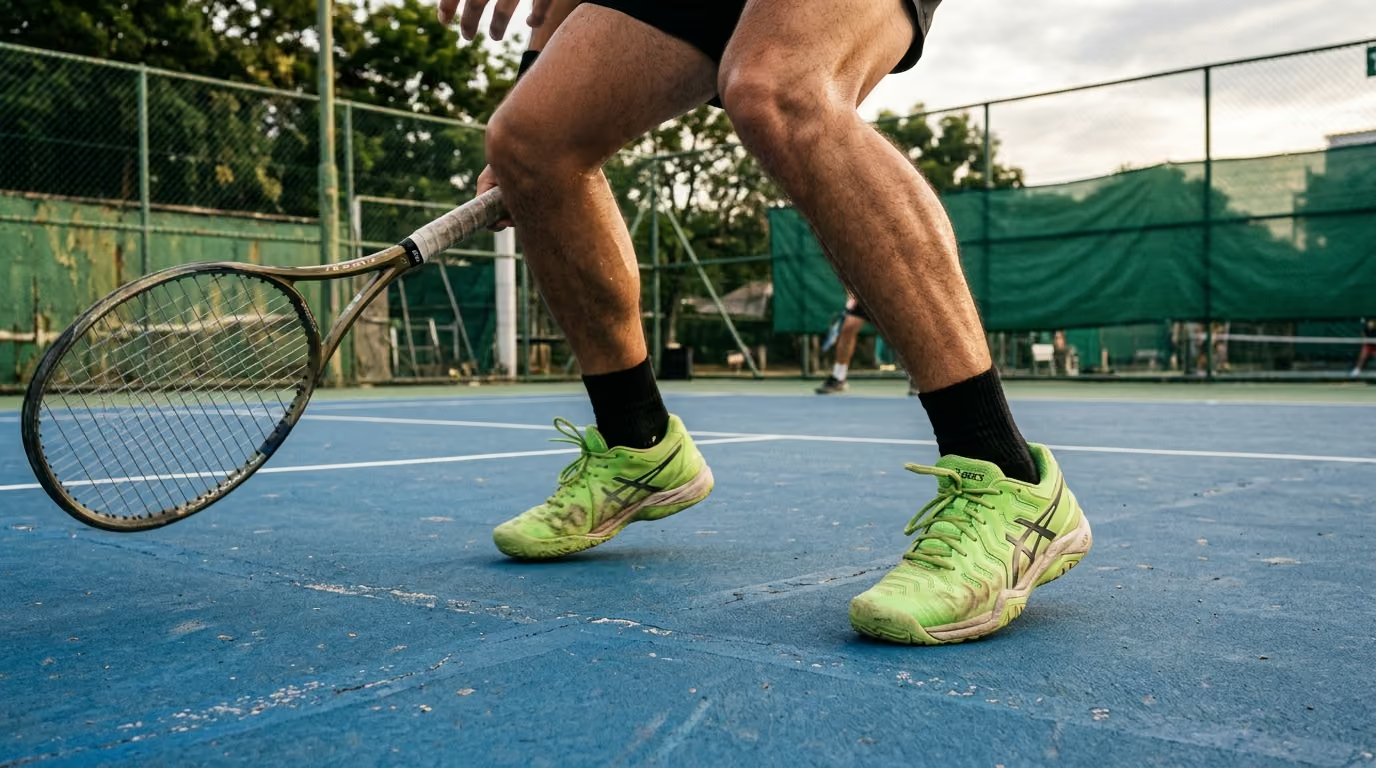
When you step onto the court, understanding essential racquet sports patterns helps you construct points effectively, moving beyond reactive play to a strategic approach.




You step up to the baseline, bounce the ball three times, and look across the net. Your opponent is slightly shaded to the left, anticipating your favorite slice. If you serve without a clear plan for your next shot, you are simply reacting to whatever comes back. For many recreational and competitive players, matches are played this way, as a series of disconnected, reactionary movements. Developing a structured tactical blueprint changes the entire nature of court play.
A tactical pattern is a repeatable, structured sequence where you use an initiating shot to force a predictable reply from your opponent, allowing you to control the subsequent ball. Rather than aiming for immediate winners, these sequences are designed to systematically manipulate court space, buy time, and compromise your opponent's physical balance. By using these structured sequences, you transform a chaotic rally into a manageable decision tree with default choices and clear recovery routes.
To construct points effectively, you must understand how a pattern operates. It is not a rigid script. It is a dynamic series of decisions based on five key steps:
In our experience, players who view court tactics through this positional lens win more points with less physical strain. They do not rely on raw power. Instead, they use court geometry to make the game simpler and more predictable.
Many players believe that long, grinding rallies dominate modern racquet sports. However, sports science research paints a different picture, particularly on faster surfaces. To understand point construction, we must first look at how elite matches are actually decided.
A major study analyzed point-level data from 211 men's and 209 women's singles matches at Wimbledon between 2015 and 2017. The researchers, Fitzpatrick, Stone, Choppin, and Kelley, classified rallies of zero through four shots as short points. They discovered that these quick exchanges make up the vast majority of points played on grass courts.
According to the study, points ending in four or fewer shots represented 72 percent of men's points and 66 percent of women's points. The average number of points per match for each rally length highlights this trend:
The researchers also calculated the Percentage of Matches in which the Winner Outscored the Loser, known as PWOL. For the combined short-point category of zero to four shots, the PWOL was 92 percent for men and 87 percent for women. This shows a massive association between short-point success and winning the match.
However, the study revealed a critical nuance regarding three-shot points. The PWOL for three-shot points was only 48 percent for men and 54 percent for women. This means that outscoring an opponent in three-shot rallies did not reliably distinguish the winner of the match. The researchers suggested that because elite servers practice the serve-plus-one sequence so heavily, both players perform it at a similarly high level, making it a necessary baseline skill rather than a differentiator.
Rally dynamics change when players transition to slower surfaces. A notational analysis of 116 men's singles matches at the French Open examined serve and return strategies on clay. This study, conducted by Gillet and colleagues, showed that clay courts demand different tactical priorities.
The French Open analysis reported that flat serves accounted for 57.6 percent of all serves. Topspin serves made up 24.1 percent, and slice serves accounted for 18.3 percent. Flat serves directed down the center T allowed servers to win significantly more points than other serve types on clay.
When topspin was used as a first-serve strategy, servers won 52.4 percent of those points. On second serves, topspin was used 91.6 percent of the time, typically targeted toward the T in the deuce court and the wide zone in the advantage court.
Crucially, the study found that returns directed toward the central zone allowed receivers to win more points than returns hit to external locations. Central returns won 73.3 percent of points on first serves and 65.9 percent on second serves. This support for central returning highlights how neutralizing the server's angle is a vital component of the return-plus-one framework.
The physical environment dictates how you must position yourself to begin a pattern. A study analyzing 14 ATP 1000 matches, split evenly between hard and clay courts, examined serve and return interactions. The type of surface did not significantly change how points ultimately ended, but it dramatically affected player positioning.
Vertical return positioning was highly surface-dependent. Hard-court returners stood a few steps inside the baseline, whereas clay-court returners positioned themselves much deeper to handle the high, slow bounce. The type of serve also significantly affected how points were decided. The researchers recommended combining aggressive, forward positioning with target accuracy on faster surfaces to take time away from the server.
Further, a Bayesian model analyzing 142,803 return points played by 141 top ATP players identified six distinct return-impact styles. This indicates that there is no single perfect return technique. Instead, elite players customize their return-plus-one patterns based on their personal movement profiles and the physical properties of the court.
Before executing specific court sequences, you need a mental model to evaluate the court in real time. This prevents your tactical choices from becoming mechanical or rigid.
Every racquet sport exchange can be measured in three resources:
A successful pattern always wins at least one of these currencies. For example, a deep, heavy groundstroke down the center may not open up immediate space, but it wins time and compromises your opponent's physical balance.
To keep your patterns responsive, you must categorize every incoming ball before deciding on your next action. We use a simple color-coded hierarchy:
Before initiating any structured pattern on the court, your brain should automatically answer these five questions:
The serve-plus-one sequence is the most critical tactical pattern for any server. It treats the serve and the server's next stroke as a single, combined unit. The goal is to use the serve to elicit a predictable, weak return that can be attacked immediately.
This is a classic space-creation pattern designed to pull the receiver off the court and expose the opposite side.
This pattern exploits the opponent's physical momentum as they attempt to recover toward the center of the court.
This sequence is designed to disrupt the receiver's swing mechanics and use the resulting weak return to close the net.
To counter a strong server, you must use the return-plus-one framework. This sequence allows the returner to neutralize the serve and gain control of the rally on their very next shot.
This pattern is designed to take time away from the server by striking the second serve early.
This is a highly reliable neutralizing pattern supported by French Open clay-court data, which showed high point-winning percentages for central returns.
Once a rally is established, you must use structured patterns to transition from neutral baseline play to an attacking position. These patterns are covered extensively in our court performance resources.
This is a high-margin constraint pattern designed to displace your opponent laterally before you attempt a riskier down-the-line shot.
Many players make the mistake of always hitting short balls into the open court. This pattern exploits the opponent's natural tendency to over-recover.
This net-closure sequence turns a short ball into a controlled, multi-shot finishing position.
This pattern utilizes vertical pressure, forcing your opponent to run forward and backward rather than side to side.
This classic pattern reduces the rally length and puts immediate pressure on the returner's physical precision.
While the tactical concepts of time, space, and balance apply to all racquet sports, court geometry and physical constraints dictate how these patterns are executed. Understanding these sport-specific nuances is critical for long-term success.
Tennis courts feature a high net, a large physical area, and a ball that bounces with high velocity. Because of the vast space, lateral displacement is the primary way to win points. Serve-plus-one and return-plus-one sequences are highly decisive, as demonstrated by the Wimbledon short-point study.
In singles tennis, depth is your primary defensive shield. If you fail to maintain depth, your opponent can easily execute a short-ball attack. You can read more about these physical mechanics in our tennis articles.
Pickleball is played on a much smaller court with a solid paddle and a plastic ball. The presence of the non-volley zone, known as the kitchen, completely changes point construction. You cannot simply drive a short ball for a winner if your opponent is established at the kitchen line.
In pickleball, the return-plus-one sequence is highly standardized:
Therefore, point construction in pickleball is about patience and vertical pressure. You use dinks to move your opponent laterally until they lift the ball, allowing you to hit a finishing smash. For detailed training tips, see our pickleball articles.
Padel is played in an enclosed glass and mesh court, and it is almost exclusively played as a doubles game. This environment alters traditional patterns. The walls mean that a deep, powerful shot can bounce off the back glass, giving your opponent an easy ball to play.
In padel, the primary tactical objective is to win and maintain the net position. The serve-plus-one sequence always involves the server and partner taking the net immediately. The lob is the ultimate transition tool:
Because the glass acts as a reset button, physical patience is highly valued in padel. You must construct points through multiple phases before finding an opening. Explore these unique wall mechanics further in our padel articles.
Even experienced players can fall into common tactical traps that waste energy and lead to unforced errors. Recognizing these pitfalls is the first step toward improving your court performance.
Many players read studies about short points at Wimbledon and conclude that they must hit every ball with maximum power. This is a critical error. The short-point data shows that elite players are highly efficient at forcing errors through placement, spin, and depth, not just raw power. Attempting to hit winners from neutral or defensive positions leads to high error rates and lost matches.
When some players see a short ball, they swing with 100 percent power, aiming for the lines. A short ball is often low, spinning, or wide, making a direct winner highly risky. Instead of forcing a low-percentage finish, use the short ball to hit a deep, controlled approach shot, move to the net, and finish the point with an easy volley.
When moving to the net, many recreational players run in a straight, blind line. This leaves the highest-probability passing lanes completely open. You must always move along the diagonal line of flight of your approach shot, shading toward the side of the court where your opponent is striking the ball.
Using the same return position on clay and hard courts is a common mistake. On clay, you must stand deeper to handle the high, slow bounce and give yourself time to construct a return-plus-one sequence. Standing too close on a slow surface exposes you to heavy kick serves that bounce above your comfortable strike zone.
How you construct points has a direct effect on your physical health and athletic longevity. Players who do not use structured patterns are forced to run significantly farther, scrambing to retrieve balls from defensive positions. This erratic, reactionary style of play puts immense stress on your joints, tendons, and muscles.
Structured point construction allows you to move with anticipation and control. By forcing your opponent into predictable replies, you reduce your overall running distance and minimize sudden, violent changes of direction. This level of movement efficiency is essential for maintaining your physical capabilities as you age.
I remember finishing a tough two hour padel match on a cold Tuesday night and waking up the next morning feeling like my lower back was locked in concrete. For a long time, I just accepted this as the price of playing hard in my forties. But once I started spending just ten minutes on targeted hip mobility before heading to the club, the stiffness almost completely vanished. It taught me that we do not have to accept pain as a default state of aging.
By pairing structured tactical patterns with proper physical preparation, you can enjoy competitive play for decades. If you want to learn more about preserving your body on the court, explore our guides on injury prevention and mobility and movement.
While improving your tactical patterns and movement efficiency can reduce wear and tear, it cannot replace professional medical care when an injury occurs. You must be able to distinguish between normal post-match fatigue and signs of physical damage.
You should consult a qualified physical therapist or healthcare professional if you experience any of the following warning signs:
Ignoring these symptoms and attempting to play through pain will only lead to compensation patterns, which can cause secondary injuries elsewhere in your body. Protecting your health is the most critical factor in achieving true athletic longevity. For more information on physical recovery and conditioning, check out our player health articles.
Bookmark this reference guide and return to it whenever you notice your match play becoming erratic, reactive, or physically exhausting. It is particularly useful to review these patterns at the start of a new league season, when transitioning between different court surfaces, or during your post-match reflection sessions.
Using structured point construction is not about playing robotically. It is about understanding the geometry of the court so you can make intelligent, high-probability decisions that keep you playing the sports you love for years to come.
Follow Evercourts for practical insights on tennis, pickleball and padel performance, movement, recovery and healthy ageing. Stay connected for new articles, research-led guidance and ideas to help you play well and keep playing for years.


Read practical guidance for better movement, smarter preparation and a game that keeps working for you.
explore the Blog