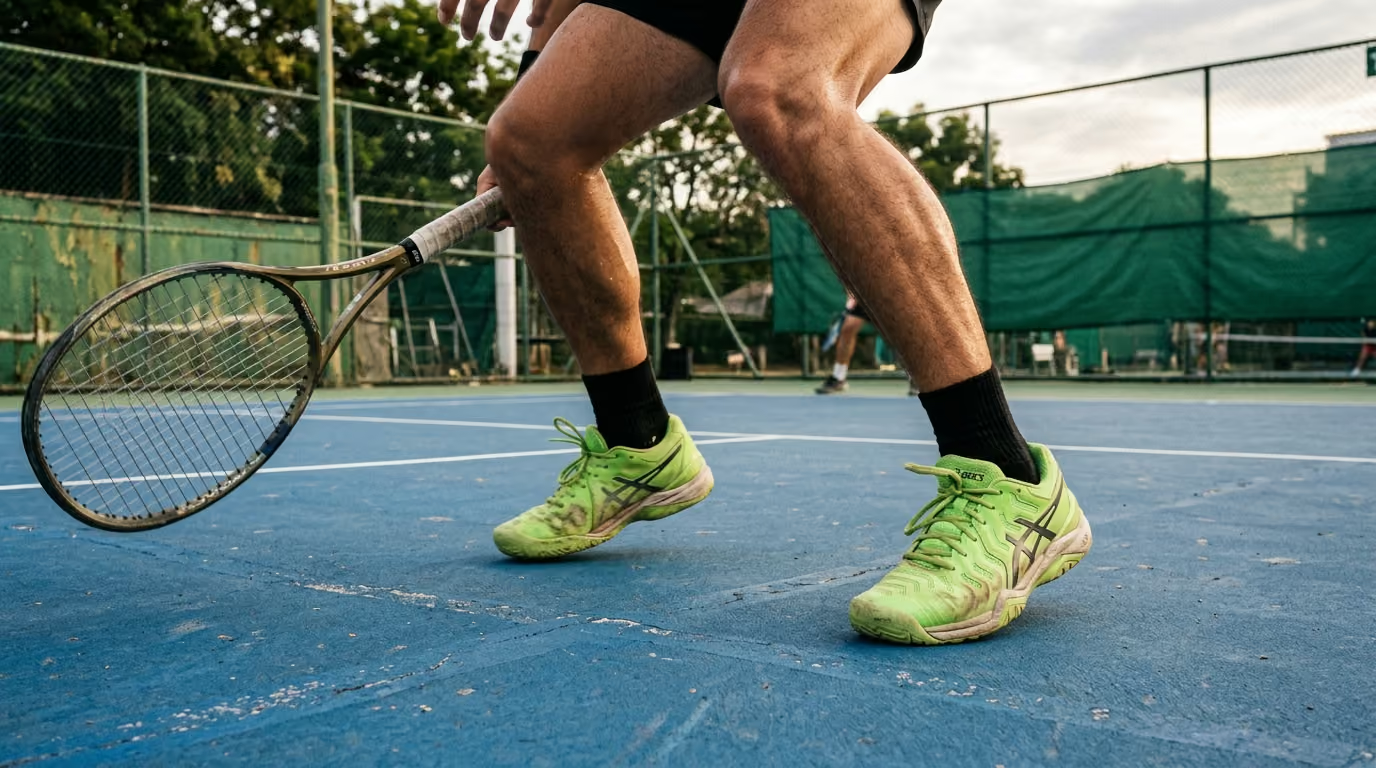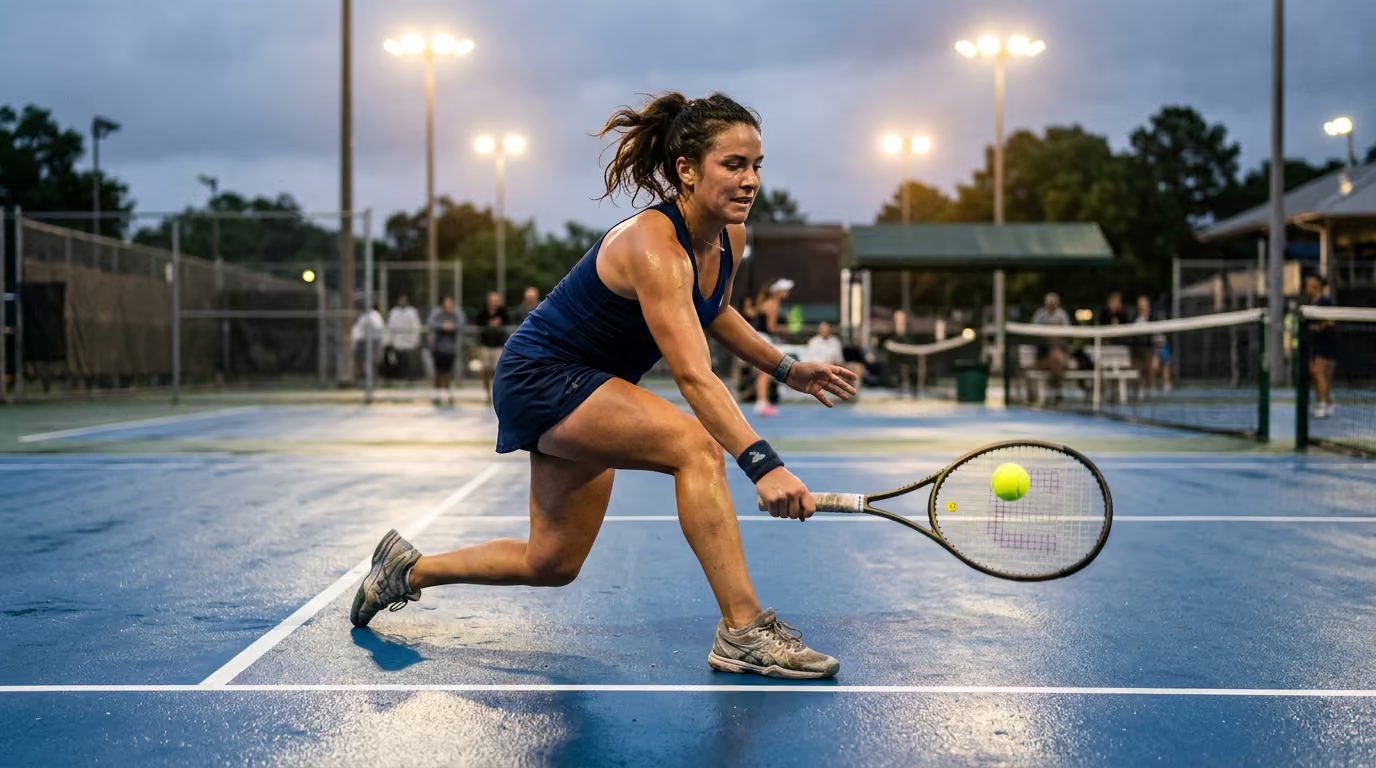

The first three shots of a rally are critical in court sports, with modern sports science showing that early exchanges dictate match outcomes across all levels of play.




Imagine standing at the baseline on a damp evening, preparing to serve. You strike a solid flat serve, but the return comes back deeper and faster than you expected, landing right at your laces. You attempt a low-percentage winner while off-balance, sending the ball directly into the net. This scenario is incredibly common across all racquet and paddle sports. Many players view the serve, the return, and the subsequent stroke as isolated events. In reality, they are deeply connected parts of a single tactical sequence.
By understanding the first three shots as a single unit, you can stop reacting blindly to your opponent. Instead, you can begin directing the flow of the point from the very first strike.
To build a reliable tactical plan, we must first define the opening exchange. The first three shots of any point represent a structured sequence of initiation, response, and conversion.
The first shot is the initiation, which is the serve in all court sports. The second shot is the response, which is the return of serve. The third shot is the first opportunity to convert, which represents the server's first chance to attack or establish a positional advantage.
Whether you play on a large tennis court, a compact pickleball court, or inside a glass-walled padel cage, this sequence remains the fundamental planning unit of competitive play. This framework does not imply that every point will end on the third shot. Instead, a successful opening sequence establishes a structural advantage. It either wins the point immediately, forces a weak defensive reply, or secures dominant court positioning.
Our team views point construction as the deliberate linking of consecutive shots. Each ball you hit should change the opponent's options in your favor. The transition from a reactive mindset to a proactive one begins with a simple question. You must stop asking how to hit a single great shot. Instead, ask what return your current shot will likely produce, and prepare your next move accordingly.
Modern sports science shows that early exchanges dictate match outcomes. In elite court sports, long and grinding rallies make up only a small fraction of total points.
According to a 2021 study of elite grass-court tennis, the three-shot rally is the dominant structure of modern competitive play [17]. Researchers identified the serve-plus-one combination as the primary attacking strategy for successful competitors. A separate research review confirmed that players who win more points during the first four shots of a rally consistently win more matches [18]. This research shows that relying on long, defensive baseline rallies is statistically less effective than mastering early-point patterns.
To measure this, analysts use a metric called serve efficiency [26]. This metric calculates the percentage of first-serve points won within the first three total shots of a rally. When you track your own serve efficiency, you gain a clear picture of your tactical readiness. You see whether your serve actually sets up an advantageous next shot.
On the other side of the ball, return depth acts as a powerful tactical lever. A study on return-of-serve performance showed that deep returns directly reduce the server's ability to hit an aggressive third shot [27]. When a return lands deep in the court, it forces the server to retreat. This removes their ability to step forward and dictate the point.
In paddle sports, the tactical focus shifts from raw power to positional transition. Professional match analysis from the PPA Tour highlights how players use specific shot combinations to move forward. Analysts found that professional players used a third-shot drive followed by a fifth-shot drop in 66 percent of analyzed opportunities [34]. Interestingly, only 17 percent of rallies featuring a third-shot drive ended immediately on the third or fourth shot [34]. This proof shows that a third-shot drive is rarely a point-ending attempt. Instead, it is a deliberate tool used to force a weaker volley, allowing the serving team to transition forward safely.
Statistical data from table tennis also confirms this early-point advantage. Research shows that a server's statistical advantage is concentrated heavily within the first three shots [10]. As the rally extends past the fourth shot, the server's advantage quickly decays, and the point neutralizes. A professional tournament analysis revealed that 56 percent of all played points did not last past the third shot [12]. Additionally, research on elite male players found that side-spin serves were highly effective when paired with a committed third-ball attack [1][5]. This reinforces the idea that serve selection must always serve the needs of the subsequent stroke.
To turn these scientific observations into practical match play, you need a simple framework. This system prevents decision paralysis during fast exchanges. Before you step up to serve or return, you should quickly answer five core questions.
First, what is my primary serve target? Second, what return does that specific target usually invite? Third, what is my first-choice third shot? Fourth, what is my physical fallback option if the return is unexpected? Fifth, where must I recover immediately after hitting my third shot?
This framework transforms a rigid plan into a dynamic decision tree. It allows you to adapt to the ball while maintaining your tactical intentions.
These intentions generally fall into three distinct levels of risk and positioning:
This level applies when you expect a weak, short, or highly predictable response. You step forward and strike the ball with offensive intent, aiming to end the point immediately. Examples include hitting an open-court tennis forehand after a wide serve, or executing a fast third-ball loop in table tennis.
Here, your goal is not to hit a clean winner. Instead, you want to improve your physical position on the court. In pickleball, this is typically a third-shot drop that allows your team to march to the kitchen line. In tennis, it might be a heavy, high-margin loop that pushes your opponent far behind their baseline.
This is your defensive fallback when the return is exceptionally good. If you are stretched, off-balance, or jammed, you must abandon your aggressive plans. Your sole objective is to hit a high-margin ball that restores court balance. This gives you time to recover your positioning.
Every racquet and paddle sport features unique physical constraints, rules, and court dimensions. However, the underlying logic of the first three shots remains remarkably consistent. Let us examine the specific patterns you can deploy in each sport.
In tennis, the opening exchange is defined by court space and court speed. The court is large, meaning lateral movement is highly demanding.
You serve wide to the opponent's forehand or backhand, pulling them past the singles sideline. You anticipate a cross-court return that lacks depth because of their stretched position. You then step inside the baseline and strike your next groundstroke into the vacant half of the court.
The primary failure mode for this pattern is overcommitting too early. If you try to hit a flat winner when the return is deep, you will make an unforced error. You should focus on heavy spin and placement instead of raw power.
You target the receiver's torso or dominant hip with a fast, flat serve. This limits their shoulder rotation and prevents them from extending their arms. You expect a short, weak, or floated return near the center of the court. You then step forward and attack the ball to their weaker side.
You serve down the center T line, which significantly reduces the receiver's return angles. Because they cannot pull the ball wide, you can expect a return that travels down the middle. You then strike a heavy, deep cross-court shot to pin them into one corner. This is a classic positional conversion that builds a steady advantage.
As the receiver, you focus entirely on return depth. You target the middle of the court, deep beyond the service line [24]. This deep placement prevents the server from stepping forward to execute their serve-plus-one attack.
In pickleball, the non-volley zone line dominates every tactical discussion. The team that occupies the kitchen line first holds a massive statistical advantage.
You hit a deep serve to keep the receiver pinned behind their baseline. They respond with a deep, high-margin return as they run forward to the kitchen. You execute a soft, controlled third-shot drop that lands gently inside their kitchen. Under the cover of this low-bouncing ball, you and your partner quickly run forward to establish your net position.
You hit a deep, aggressive serve to invite a shorter, higher return. Seeing the short ball, you strike a hard, low third-shot drive aimed at the opponent's transition zone. You do not expect a winner from this shot. Instead, you use the speed of the drive to force a pop-up, which you then drop on your fifth shot [34].
When both opponents are already comfortable at the kitchen line, you must avoid hitting a hard, flat drive. They will easily block a fast ball down at your feet. Instead, you must use a soft drop or a shaped hybrid drive to force them to hit the ball upward.
If one opponent is slow to transition forward, you should target their feet. Hitting your third shot to the transitioning player keeps them back. This maintains your positional advantage while preventing the forward player from poaching.
Padel introduces the unique challenge of glass walls and mesh fences. The serve must be hit underhand, which changes the dynamic of the opening exchange.
You hit a soft, spinning serve that bounces near the side glass wall. The erratic spin and contact with the glass force a defensive, sliced return. You and your partner, already positioned at the net, anticipate a weak, floating ball. You then hit a controlled volley down the middle to maintain net dominance.
As the receiving team, you face opponents who are already stationed at the net. If the serve is deep or high, you do not try to hit a low passing shot. Instead, you execute a high, deep lob over the net players. This forces them to retreat to the back of the court, allowing you to run forward and steal the net.
If the serve is low and short, you can hit a soft, slow shot directly at the net players' feet. This shot is called a chiquita. Because the ball lands low, they must volley upward, which gives you the perfect opportunity to transition forward.
When serving, you must coordinate with your partner to cover the center line. Many returns will be directed down the middle to test your communication. Your third shot should be a deep volley that restores structural coverage of the center gap.
Even with a clear plan, players frequently make structural errors during early exchanges. Recognizing these pitfalls is the first step toward correcting them.
The most common mistake is attempting to end the point on the very first attacking opportunity. Many players believe that a third shot must be a clean winner. In reality, forcing a defensive error or securing better court positioning is far more valuable. When you hit with maximum power, your physical margin for error drops significantly. You should focus on depth, spin, and placement to build your advantage gradually.
Many returners focus solely on getting the ball over the net. They ignore where the ball actually lands. A short, slow return gives the server complete control over the point. If your returns consistently land short, you are hand-delivering an easy third-shot attack to your opponent. You should prioritize deep, high-margin returns to keep the server on their heels.
A playbook is a set of guidelines, not a contract. Some players predetermine their third shot before they even hit their serve. If your serve is poor, or if the return is unexpectedly brilliant, you must adjust. Trying to execute an aggressive third-shot drive off a ball that is spinning rapidly at your laces is a recipe for an unforced error. You must always match your third-shot choice to the quality of the incoming ball.
Many players stand and watch their own shots. They admire a great third-shot drive or a delicate drop without moving their feet. If you do not recover your court positioning immediately after hitting, you surrender your tactical advantage. Your movement must be continuous, linking the strike of the ball with your next recovery step.
Executing precise, high-speed opening sequences place unique physical demands on your body. The first three shots require sudden acceleration, deep lunges, and rapid rotational forces.
In our experience, players often overlook how physical preparation impacts tactical execution on the court. I remember finishing a tough two hour padel match on a cold Tuesday night and waking up the next morning feeling like my lower back was locked in concrete. For a long time, I just accepted this as the price of playing hard in my forties. But once I started spending just ten minutes on targeted hip mobility before heading to the club, the stiffness almost completely vanished. It taught me that we do not have to accept pain as a default state of aging.
When your hips and lower back are stiff, your ability to execute a low third-shot drop or stretch for a wide tennis return is severely compromised. If your joints cannot move through their full range, your brain will subconsciously alter your stroke mechanics to protect your body. This movement compensation leads to poor shot quality and increases your risk of acute injury.
To maintain healthy aging and athletic longevity, you must prioritize joint mobility and tissue health. A structured warm-up that focuses on hip rotation, thoracic spine mobility, and ankle flexibility is essential for court athletes. If you want to dive deeper into these preparation strategies, you can explore our curated collection of mobility and movement resources.
Additionally, tracking your physical fatigue during matches is highly beneficial. As you tire, your reaction time slows, and your physical movement becomes sluggish. This directly impacts your ability to execute complex, multi-shot sequences. By focusing on your recovery, you can maintain your physical capabilities and continue playing the sports you love for years to come. For more information on physical preparation, feel free to visit our dedicated section on injury prevention and player health.
While minor muscle soreness is a normal part of active court play, you must listen to your body's warning signs. Pain is an active signal that should never be ignored or masked with medication.
You should consult a qualified healthcare provider, such as a physical therapist or sports medicine physician, if you experience any of the following symptoms:
First, any sharp, localized pain that occurs during sudden lateral movements or explosive split-steps. Second, joint swelling, redness, or warmth that persists for more than twenty-four hours after playing. Third, persistent stiffness that does not improve after a thorough warm-up or several days of rest. Fourth, any radiating pain, tingling, or numbness that travels down your arm, shoulder, or leg.
A professional can help identify the root cause of these issues, whether it stems from poor biomechanics, muscle imbalances, or tissue overload. Addressing these concerns early ensures you can return to the court safely and enjoy your sport without physical limitations.
To turn these tactical concepts into instinctive habits, you must train them under realistic conditions. Isolated basket feeding has its place for technical adjustments, but it cannot teach point construction. You must design practice sessions that link consecutive shots together.
We recommend using a structured, three-phase training progression to build and refine your early-point play:
In this phase, you remove all unpredictability. Your practice partner or coach feeds a highly specific ball to a designated spot. For example, in tennis, your partner feeds a short, slow ball to your forehand. You practice stepping forward and striking your plus-one groundstroke into the open court.
This phase allows you to focus purely on the technical mechanics of the shot without any decision-making pressure. You should run this pattern until you can hit the target with high consistency.
Here, you introduce a limited decision-making element. Your partner returns your serve, but they have two options. They can return the ball either deep down the middle or short and wide. You do not know which option they will choose.
You must read the ball as it leaves their racquet or paddle, select the correct tactical response, and execute the shot. This phase bridges the gap between mechanical drilling and live match play.
In this final phase, you play live points under modified scoring rules. The point must begin with a serve and return, but once the third shot is struck, the point is played out completely.
This environment simulates true match conditions, forcing you to manage your positioning, physical fatigue, and mental pressure.
To make your practice sessions more engaging, you can utilize specific scoring systems that reward tactical success. For example, in tennis, you can award two points if you win a rally that was set up by a successful serve-plus-one combination. In pickleball, you can award a bonus point to the serving team if they successfully execute a third-shot drop and establish both players at the kitchen line.
We suggest utilizing a 70/20/10 practice allocation model to structure your training weeks. Spend 70 percent of your training time on your primary patterns and high-margin percentage plays. Dedicate 20 percent of your session to opponent-specific variations, such as playing against a left-handed player or handling deep, heavy lobs. Finally, reserve the remaining 10 percent of your time for surprise plays, riskier attacks, and creative change-ups.
This balanced approach ensures your primary patterns remain rock-solid, while still developing the creative skills needed to handle unexpected match situations. If you are looking for more specific drills and training guides, you can browse our comprehensive library of court performance resources.
To help you apply these principles during your next match, we have created simple, printable playbook cards. You can copy these templates, write down your specific targets, and keep them in your sports bag for quick reference.
If you want to read more about specific court setups and strategic adjustments, explore our curated selection of tennis tactical articles.
For more tactical breakdowns and equipment setup tips, you can view our complete archive of pickleball strategies.
To further refine your understanding of court positioning and wall play, explore our library of padel court placement guides.
The final piece of the point-construction puzzle is tracking your performance over time. You cannot improve what you do not measure. We suggest keeping a simple tactical log in your tennis or paddle bag. After each match, take two minutes to write down your observations.
Did you stick to your primary patterns, or did you play reactively? How many unforced errors did you make on your third shots? Did your serves consistently set up your desired plus-one opportunities?
By answering these questions, you will identify patterns in your own play. You will see which serves are highly effective and which third-shot choices are costing you valuable points. This consistent evaluation is what separates average recreational players from highly effective competitors.
Remember, the goal of this playbook is not to turn you into a perfect, error-free player. Instead, it is designed to help you make smarter, more informed decisions on every single point. When you master the first three shots, you stop hoping for a good result. Instead, you begin systematically constructing your way to victory.
You should return to this tactical playbook whenever you feel your game becoming reactive or chaotic on court. It is especially useful to reread these sections at the start of a competitive season, after a string of close match losses, or when recovering from a minor physical setback. Returning to these core principles will help you simplify your decision-making and restore structural order to your competitive play.
Focus on your movement, trust your patterns, and keep enjoying the game for years to come.
Follow Evercourts for practical insights on tennis, pickleball and padel performance, movement, recovery and healthy ageing. Stay connected for new articles, research-led guidance and ideas to help you play well and keep playing for years.


Read practical guidance for better movement, smarter preparation and a game that keeps working for you.
explore the Blog