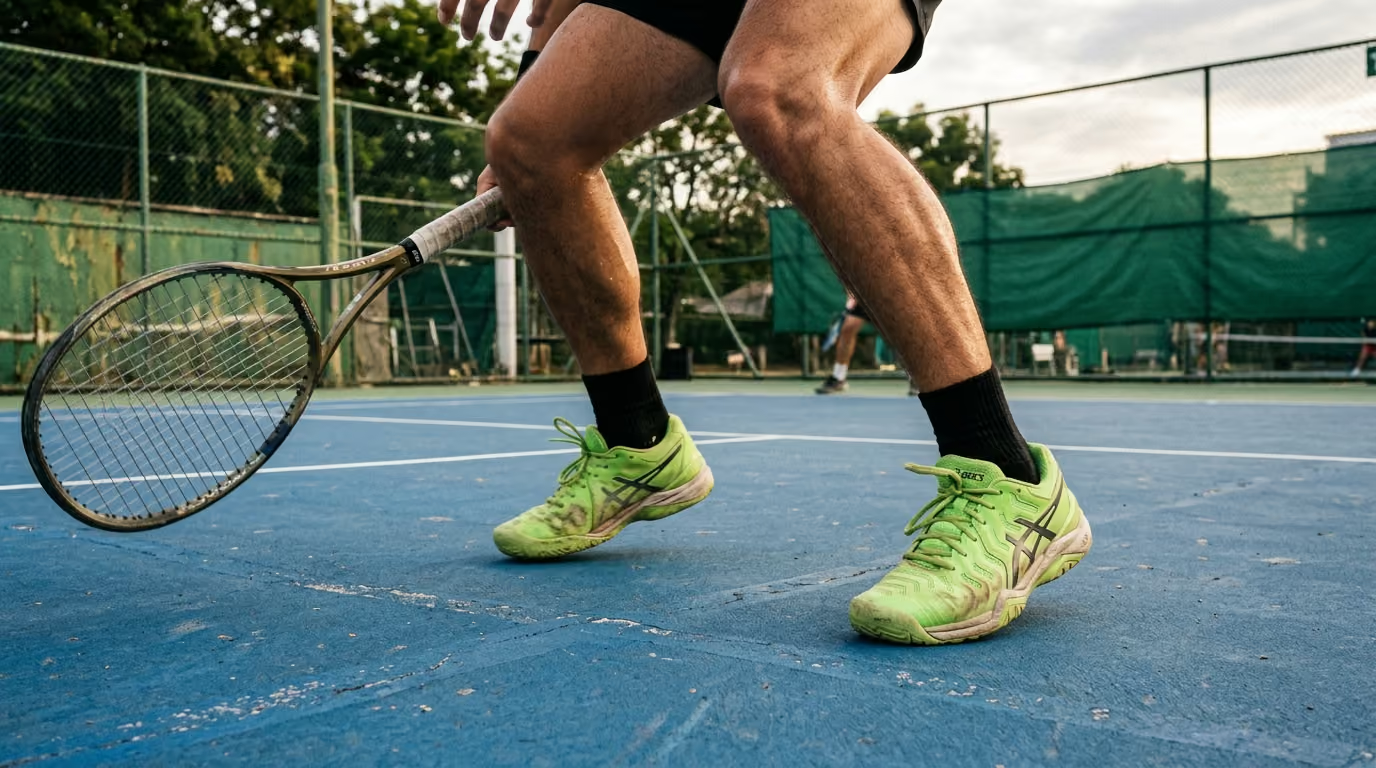
A comprehensive framework outlines a strategy to maintain high-quality racquet sports competition over several decades by treating the body as a managed capacity system.




Many court players search for answers when their shoulders click or their knees ache after a hard match. They wonder if they must accept a steady decline in their performance as they get older. The typical response is to look for a quick fix like a new brace or a special stretching routine. However, the real solution requires a complete shift in how you manage your training and recovery. This guide outlines a comprehensive strategy to help you maintain high-quality competition over several decades on the court.
To play racquet sports for a lifetime, you must treat your body as a managed capacity system rather than a fitness challenge to be beaten. Sustained performance relies on balancing your total training load with your current readiness to prevent injuries. By making smart adjustments to your court time, strength, sleep, and nutrition, you can protect your joints and play at a high level for years.
To build a sustainable court career, you must understand that long-term performance is not about surviving a single hard week. It is about your total availability over months and years. Your future availability on the court is your most valuable athletic asset. If you are injured or exhausted, you cannot practice or compete.
A useful way to think about this is a simple formula. Long-term performance equals the quality of your practice and competition multiplied by your years of uninterrupted participation. This changes how you define a successful training session. A workout is not successful simply because it left you exhausted. It is successful if it improves your skills or fitness without creating a massive recovery debt.
To apply this philosophy, you must understand several key concepts:
This is the absolute maximum physical output your body can produce when you are completely fresh. It includes your top speed, maximum strength, and total cardiovascular endurance.
This is the percentage of your performance capacity that is actually available to you on any given day. Readiness fluctuates constantly based on your sleep, nutrition, stress, and recent matches.
This is your body's ability to tolerate repeated training sessions and competitive matches without structural breakdown. High durability means your tendons, muscles, and joints can absorb court impact week after week.
This is the percentage of your scheduled matches and practices that you are physically able to complete. High availability is the true foundation of long-term improvement.
This is your ability to adjust your tactics, movement patterns, equipment, or schedule as your body changes. Highly adaptable players find new ways to win even when their top physical speed decreases.
This is your psychological desire to keep choosing hard practice and competition over several decades. It requires finding deep satisfaction in the process of playing, rather than relying solely on winning tournaments.
To manage your physical capacity, you must understand the difference between capacity and load. Load is the total stress placed on your body by training, matches, travel, work, and daily life. You cannot measure load solely by counting your minutes on the court. It is a complex combination of several different factors.
A practical monitoring system separates your workload into three distinct categories:
You can monitor your daily load using a simple tool called Session-RPE. To calculate this, you rate the difficulty of your session on a scale of one to ten. Then, you multiply that rating by the duration of the session in minutes. For example, a 60-minute match rated as a 7 out of 10 difficulty results in a workload score of 420. This simple calculation allows you to track your weekly trends.
Research in junior tennis published in physical therapy journals has analyzed training loads and injury rates. This research found that the acute-to-chronic workload ratio is a useful predictor of injury. In these studies, players who suffered injuries often averaged about 1.5 times more training load in the preceding week than their average over the previous four weeks.
However, you should treat these workload ratios as helpful decision-support tools rather than absolute biological laws. A mathematical ratio should never override real-world warning signs. If you experience localized pain, deep fatigue, or declining movement quality, you must reduce your load regardless of what your weekly ratio says.
To prevent sudden physical breakdown, you must understand three training states:
The most important rule of load management is to avoid making your hardest training week also your least-prepared week. This rule is vital when you are returning from an injury or entering a weekend tournament. It also applies when you switch court surfaces, buy a new racquet, or suddenly increase your serve volume.
Intensity is a finite resource that you must manage carefully. To maintain your health, you cannot play every match at maximum physical intensity. You should categorize your court activities into three distinct levels:
This includes technical repetitions, easy hitting, warm-up movement drills, and tactical patterning. It also includes light mobility exercises and recovery cycling. The physical stress is low, allowing you to focus on movement precision.
This consists of controlled drills, point construction practice, and structured aerobic conditioning. It also includes strength training sessions that do not approach muscular failure. These sessions build your foundational fitness without causing extreme fatigue.
This includes competitive match play, maximal serving practice, and repeated explosive change-of-direction drills. It also includes high-intensity interval training. These sessions place a massive demand on your nervous system and joint structures.
A successful long-game strategy does not eliminate high-intensity work. Instead, you must earn and protect these hard sessions by surrounding them with lower-intensity days. A balanced weekly rhythm might feature one or two demanding match days. You then schedule one or two moderate technical sessions and at least one dedicated recovery day.
Match play is vastly different from a structured practice session. During a match, you experience higher emotional stress and unpredictable movement patterns. You also face greater tactical urgency, which often causes you to ignore early signs of physical fatigue. This is why you must understand competition density, which is the number of hard matches compressed into a short recovery window.
A player can typically tolerate three moderate practices spread across a week much better than two long matches played on consecutive days. Tournament weekends create a massive amount of hidden physical load. This load includes long warm-ups, hours of waiting between matches, altered eating schedules, and disrupted sleep.
Epidemiological research on competitive tennis players has highlighted these risks. One study found that injury rates rose significantly when players participated in two matches per week instead of one. The injury rate was 25.6 injuries per 1,000 hours of exposure for the multi-match players, compared to just 4.1 for those playing once a week. While this specific data comes from a competitive cohort, the underlying principle applies to recreational players.
To manage match density, you should plan your competitive calendar in advance. If you know you have a dense tournament weekend coming up, you must reduce your training volume in the preceding week. You can also substitute doubles matches for singles matches during high-volume periods. The most common scheduling error is adding extra matches to your week without subtracting any of your regular practice sessions.
Daily court choices should always prioritize quality over sheer quantity. Before you step onto the court, you should ask yourself four simple questions:
A highly productive training session can be short if you focus entirely on technical precision. Conversely, a longer session is appropriate when you are actively building your aerobic endurance. You must prepare your body gradually for these longer sessions.
You do not need to play high-intensity points in every practice session to maintain your edge. You can develop your skills and tactical sharpness through structured, lower-impact formats. These methods allow you to improve your game while minimizing the mechanical stress on your joints.
As you age, you can maintain your competitive edge by shifting your strategy from raw physical movement to high efficiency. Exceptional players use anticipation, smart positioning, and court geometry to control the point. By reading your opponent's body language, you can start moving before they even strike the ball. This reducing the need for sudden, joint-straining brakes and accelerations. For more on optimizing your court movement, you can read our guide on mobility and movement drills.
Strength training is not about building large muscles for appearance. Instead, it serves as an essential insurance policy for your joints, tendons, and muscles. A well-designed strength program improves your ability to absorb force, decelerate safely, control your trunk, and protect your joints.
The World Health Organization (WHO) provides clear physical activity guidelines for adult health. They recommend that adults perform muscle-strengthening activities that involve all major muscle groups on at least two days per week. For older adults, the guidelines recommend incorporating multicomponent physical activity on three or more days per week. This training should place a strong emphasis on functional balance and strength to enhance physical capacity and prevent falls.
To build an effective strength program for racquet sports, you should focus on several foundational movement patterns:
These movements build strength in your quadriceps, glutes, and hip stabilizers. Split squats are especially valuable because they mimic the unilateral loading patterns of court movement. They prepare your knees and hips to handle the deep lunging required on the court.
Exercises like deadlifts and kettlebell swings strengthen your hamstrings, glutes, and lower back. These muscles are responsible for generating power during your strokes. A strong posterior chain also protects your lower back from the rotational stresses of playing.
Calf raises and tibialis anterior exercises build strength in your lower legs. This strength is vital for protecting your Achilles tendon and plantar fascia. Strong lower legs also improve your ankle stability during rapid change-of-direction movements.
Push-ups, overhead presses, and rows balance the muscular development of your upper body. Rows and pull-downs are especially important for strengthening your upper back and scapular stabilizers. These muscles act as a braking system for your shoulder during high-speed swings and serves.
Racquet sports require a massive amount of rotation. Exercises like medicine ball twists, Pallof presses, and planks teach your core to transfer force efficiently between your lower and upper body. This rotational stability protects your lumbar spine from excessive twisting forces.
As you get older, you should maintain meaningful resistance in your strength training rather than switching entirely to ultra-light weights. Your muscles and tendons require a sufficient mechanical stimulus to maintain their density and strength. However, you must carefully adjust your total volume, recovery time, and exercise selection to match your current capacity. You can find detailed programs in our section on structured resistance training.
Balance training also deserves special attention as part of your weekly routine. The WHO guidelines emphasize that balance-oriented activities help older adults maintain mobility and prevent falls. On the court, superior dynamic balance allows you to recover quickly after hitting a wide ball, reducing your risk of acute ankle or knee sprains.
While all racquet sports share common elements, they place different mechanical demands on your body. Understanding these differences allows you to tailor your training and recovery to your specific sport.
Tennis is played on a large court, which requires long sprint distances and high-velocity runs. It involves significant rotational forces as you transfer power from the ground through your hips, trunk, and shoulder. The service motion is a complex overhead action that places a high eccentric demand on your rotator cuff and abdominal wall.
The court surface also plays a major role in tennis biomechanics. Hard courts offer excellent traction but transmit high impact forces to your knees, hips, and lower back. Clay courts allow you to slide into shots, which reduces peak braking forces but requires greater lateral hip stability and balance.
Pickleball is played on a much smaller court, which reduces the need for long-distance sprinting. However, the game features rapid deceleration, short lunges, and constant lateral shuffling. Because players spend a lot of time near the non-volley line, they must hold a low, bent-knee stance for extended periods.
This low position places a constant isometric demand on the quadriceps and patellar tendons. The fast-paced volley exchanges also require rapid wrist and forearm actions. This high volume of quick, repetitive strokes can lead to overuse issues in the elbow and wrist if your forearm muscles lack endurance.
Padel is played in an enclosed court, combining elements of tennis and squash. It features unique movement patterns because you must react to ball rebounds off the glass walls. This requires frequent, tight turns and rapid changes of direction in confined spaces.
Padel also features an exceptionally high volume of overhead strokes, such as the bandeja and vibora. Unlike the tennis serve, which occurs only at the start of a point, padel players hit overheads constantly during rallies. This high volume of overhead work places a unique endurance demand on the posterior shoulder muscles and the thoracic spine.
Many dedicated players fall into predictable training traps that limit their athletic longevity. By identifying these common mistakes early, you can adjust your habits and protect your body from unnecessary wear. You can learn more about avoiding these issues in our guide on injury prevention methods.
Just because you can survive a high-volume week of play does not mean your body is successfully recovering from it. The true cost of an excessive training load often shows up days or weeks later. It can manifest as declining sleep quality, slower reaction times, persistent joint stiffness, or a sudden soft-tissue strain.
Competitive matches are highly unpredictable, high-stress events. They should be treated as a primary stressor that requires recovery, not as a tool to build basic cardiovascular fitness. If you want to improve your stamina, you should use structured aerobic or anaerobic conditioning sessions where you can control the movement patterns.
Some players believe that as they get older, they should stop lifting weights and focus exclusively on playing and stretching. This is a major mistake. Aging muscles and tendons require resistance training to preserve their structural integrity. Without strength work, your joints lose their active stabilization system, placing more stress on your cartilage and ligaments.
Static stretching can help you maintain basic joint range of motion, but it does not prepare your body for the dynamic forces of court play. To prevent injuries, you need a combination of mobility, strength, and coordination. Stretching a joint without strengthening the muscles that control that joint can actually increase your risk of instability.
Recreational players often copy the training volumes, equipment choices, and recovery strategies of professional athletes. However, elite players have exceptional genetic gifts, years of physical preparation, and dedicated medical support teams. Trying to match their training habits without their recovery resources is a fast path to overtraining and injury.
Mathematical formulas like the acute-to-chronic workload ratio are helpful guides, but they cannot capture every variable. They do not account for a sudden drop in sleep quality, a stressful week at work, or the difference between playing on clay versus concrete. You must always combine workload tracking with an honest assessment of how your body feels.
Many players ignore mild, dull aches in their shoulder or elbow, hoping the discomfort will simply go away on its own. By the time an overuse issue causes severe, sharp pain, the tendon may have undergone structural changes that require months of rehabilitation. Modifying your court volume at the first sign of persistent soreness is a much smarter strategy.
If you have a string of poor matches, you might assume you are losing your skills or getting too old to compete. Often, poor performance is simply a sign of accumulated physical or mental fatigue. Instead of forcing yourself to practice harder, the correct response is often to take a short recovery break to restore your energy.
Observational studies show a strong association between playing racquet sports and living a longer, healthier life. However, these studies do not prove that playing the sport is the sole cause of these benefits. Racquet sports players often have higher incomes, better healthcare access, and stronger social networks. You must still manage your individual physical health and training load to achieve these longevity benefits.
To support your court performance and long-term health, you must view recovery as an active part of your training plan. The two most powerful recovery tools available to any athlete are high-quality sleep and structured nutrition. You can find more detailed recovery strategies in our section on recovery science principles.
A comprehensive consensus review on athlete sleep published in the British Journal of Sports Medicine highlights the importance of rest. The authors reported that increasing your sleep duration through nighttime extension or strategic daytime naps is one of the most effective ways to improve athletic performance. The consensus also cautioned against forcing every athlete into a rigid seven-to-nine-hour target. Instead, you should focus on an individualized assessment of your sleep needs.
To optimize your sleep for court performance, you should adopt several practical habits:
Your nutritional habits should support energy availability, tissue repair, and optimal hydration. The American College of Sports Medicine (ACSM) position stand on nutrition emphasizes consuming adequate food and fluids before, during, and after exercise to support blood glucose levels and recovery.
The ACSM position stand lists common daily targets for active individuals:
During prolonged or highly intense court sessions lasting longer than an hour, your body benefits from active fueling. Sports nutrition research supports consuming 30 to 60 grams of carbohydrates per hour during long matches. This carbohydrate intake helps maintain your blood glucose levels, preserves your cognitive decision-making, and prevents sudden drops in speed and coordination.
Hydration guidelines should also avoid rigid, one-size-fits-all recommendations. The International Society of Sports Nutrition (ISSN) notes that while day-to-day hydration can often be guided by simple thirst, longer matches in hot or humid conditions require planned fluid and electrolyte replacement.
To manage your hydration effectively, you should track your individual sweat rate by weighing yourself before and after a hard match. Any weight lost during play is primarily water loss that you must replace. If you are a heavy sweater or notice white salt rings on your clothing, you should incorporate sodium into your court fluids to maintain your electrolyte balance and prevent muscle cramping.
Looking at how other players navigate these challenges can help you apply these principles to your own routine. Here are five common case patterns that demonstrate the long-game framework in action. You can read more about these real-world adaptations in our collection of articles on athletic longevity for court players.
A 45-year-old tennis player typically practices once a week for 90 minutes. They decide to enter a local weekend tournament and end up playing three singles matches in 48 hours. On Monday morning, they wake up with severe lower back stiffness and a strained calf muscle.
The issue here is not the player's age. The problem is the massive difference between their habitual weekly load and the sudden physical demands of the tournament. Their chronic capacity was simply too low to handle that acute spike in volume.
To prevent this, the player should spend four to six weeks gradually increasing their court volume before the tournament. They can add a second weekly practice session and include short, tennis-specific movement drills. During the tournament, they should prioritize carbohydrate intake between matches, perform light active warm-ups, and use gentle recovery walks rather than sitting still for hours between rounds.
A 60-year-old player is technically excellent and remains highly competitive. They play single-court tennis three days a week, perform maximum-effort serves during practice, and lift heavy weights in the gym on consecutive days. They feel strong but develop a persistent, dull ache in their dominant shoulder that worsens during serves.
This player has exceptional physical capacity, but they are distributing their high-intensity work poorly. They are forcing their shoulder joint to handle maximal rotational forces day after day without adequate recovery windows.
The solution is to restructure their weekly calendar to separate their highest-stress activities. They can schedule their hard serving practice on the same day as their singles matches, leaving the following day for low-intensity groundstroke drills or recovery. In the gym, they should shift their focus toward strengthening the posterior rotator cuff and improving thoracic spine rotation. This approach preserves their competitive edge while reducing the mechanical stress on the shoulder joint.
A player suffers a moderate ankle sprain during a competitive match. After three weeks of rest, the swelling subsides, and they can walk without pain. They immediately return to their regular schedule of playing competitive matches three times a week. Within two matches, they develop Achilles tendon pain in the same leg.
This player returned to high-intensity competition before restoring their foundational physical capacities. While the ankle ligament had healed enough for daily walking, the muscles of the lower leg had weakened from disuse. The lack of ankle mobility and strength forced the Achilles tendon to absorb excessive forces during sudden stops.
A sustainable return-to-play progression should follow a structured loading sequence:
A player participates in a competitive evening league, finishing matches after 9:00 PM. They arrive home wired, watch television to wind down, and sleep for only five hours. The next morning, they consume multiple cups of coffee to get through work, then head to the court for a high-intensity practice session, interpreting their physical sluggishness as a sign they need to train harder.
This player is treating physical fatigue as a fitness problem rather than a recovery deficit. Using caffeine to mask sleep loss and forcing the body through hard training sessions increases the risk of an acute injury or chronic overtraining.
The appropriate intervention is to treat sleep loss as a major addition to their physical load. Following late matches, the player should use a structured wind-down routine that excludes bright screens to help their body prepare for sleep. If they have a short night of sleep, they should reduce the intensity of their next workout, focusing on light technical work rather than explosive movement. They can also use a short afternoon nap to restore their cognitive focus and physical readiness.
A 65-year-old player finds that they can no longer cover the court as aggressively in singles play. Instead of retiring from the sport or feeling frustrated by their physical changes, they shift their focus. They begin playing more doubles, refine their ball placement, work on their anticipation, and master the use of spin to control the tempo of the game.
This is a perfect example of successful athletic adaptation. The player recognized that while their maximum physical speed had decreased, their tactical understanding and technical skill remained highly valuable.
By shifting their focus to positioning and anticipation, they cover less physical distance while remaining incredibly effective on the court. They also utilize high-quality equipment, such as softer strings strung at a lower tension, to reduce the impact forces transmitted to their elbow and shoulder. This intelligent approach allows them to continue enjoying the competitive and social benefits of racquet sports for many years to come.
While managing your own training load is highly effective, you must also recognize when a physical symptom requires professional medical evaluation. Ignoring serious warning signs can lead to long-term structural tissue damage and extended periods away from the court.
To help guide your daily decision-making, you can use a simple green-yellow-red model:
You experience normal muscular fatigue that resolves predictably within 24 to 48 hours. Your joints feel stable, your movement is fluid, and you have no localized pain during or after playing. Your mood, sleep, and motivation are stable.
You experience elevated muscular soreness, mild joint stiffness, or a dull, localized ache that improves once you warm up. You feel slightly sluggish on the court, or your movement timing is off.
In this state, you should modify your training. You can shorten your session, avoid high-stress movements like maximal serving, or switch to a lower-impact format like cooperative hitting.
You experience sharp, localized pain that alters your running or swing mechanics. You notice acute joint swelling, bruising, or a feeling of joint instability. You experience neurological symptoms like radiating pain, numbness, or tingling in your arms or legs.
You should also stop immediately if you experience chest pain, dizziness, fainting, or an unusual shortness of breath.
You should consult a qualified physical therapist, sports physician, or healthcare provider if you experience any of the following symptoms:
A professional assessment can provide you with an accurate diagnosis and a customized rehabilitation plan. Early intervention is always the most effective way to protect your physical capacity and keep you playing the sports you love.
To apply this long-game framework to your routine this week, use this actionable checklist:
Follow Evercourts for practical insights on tennis, pickleball and padel performance, movement, recovery and healthy ageing. Stay connected for new articles, research-led guidance and ideas to help you play well and keep playing for years.


Read practical guidance for better movement, smarter preparation and a game that keeps working for you.
explore the Blog