
A single high-effort set performed two to three times per week is sufficient to produce significant strength gains for racquet sports players.




You pull into the club parking lot and feel a familiar stiffness in your lower back before you even open the car door. A hectic week at work, combined with late-night emails and delayed flights, has taken its toll on your physical energy. You want to stay fast on the court, yet the thought of spending an hour lifting heavy weights in a crowded gym feels completely impossible. This is the reality for most dedicated adult players who try to balance real life with their passion for court sports.
You do not need exhaustive, multi-hour gym routines to protect your joints and maintain your court speed. By utilizing a minimum-effective-dose training strategy, you can preserve your athletic qualities in a fraction of the time. This approach respects your busy schedule while ensuring you stay on the court for years to come. It allows you to build a resilient body without sacrificing your energy for actual match play.
An effective training plan uses the smallest amount of physical training required to maintain your athletic qualities and protect your joints. For busy racquet sports players, this means prioritizing high-value movements like split squats, rows, and rotational throws performed with high intent. This strategy preserves your court performance while avoiding unnecessary fatigue and soreness.
A minimum effective dose is not about doing as little as possible. It is a highly structured prioritization framework designed to protect your athletic longevity. It requires you to define your target physical outcomes, identify the smallest training volume needed to keep them, and schedule those efforts when they offer the most value. You only add more training when your recovery, sleep, and calendar comfortably allow it.
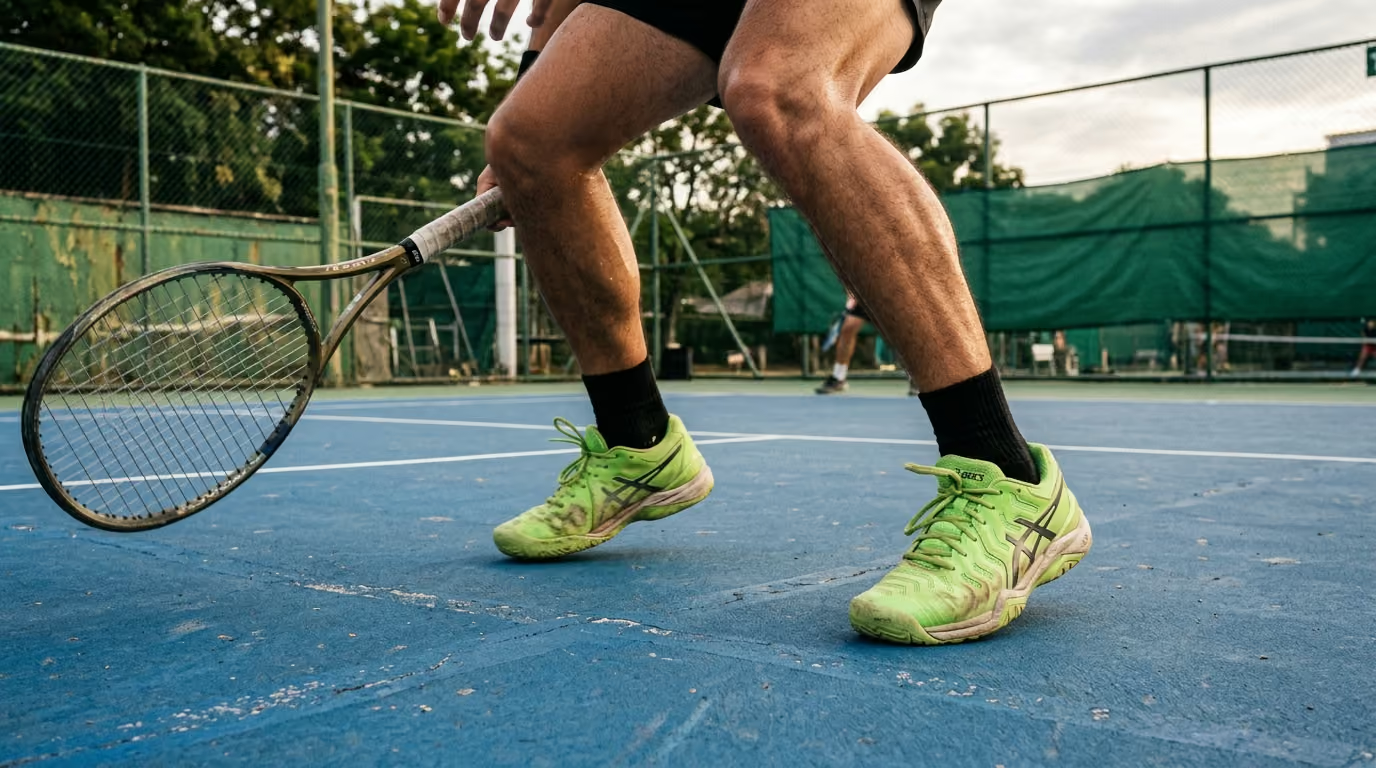
For racquet sports players, this approach is highly appropriate. Tennis, pickleball, and padel already subject your body to repeated accelerations, sudden decelerations, and high-velocity changes of direction. Your joints also absorb significant rotational forces and impact from jumping or lunging. Your strength and conditioning work should support your court play, not compete with it for physical recovery.
Current sports science research supports the effectiveness of low-volume training. A systematic review published by Androulakis-Korakakis and colleagues examined the minimum dose required to improve strength in resistance-trained men. The researchers found that a single high-effort set performed two to three times per week was sufficient to produce significant strength gains. While these gains were lower than those achieved with higher volumes, they demonstrate that minimal training can still produce meaningful results.
There is a major difference between the dose required to build a physical quality and the dose required to maintain it. A comprehensive review by Spiering and colleagues on maintaining physical performance showed that you can preserve strength and muscle size for long periods on surprisingly low volumes. Younger populations can often maintain their physical adaptations for up to 32 weeks with just one strength session per week, provided they maintain their training intensity.
This maintenance requirement changes as we age. Research focusing on older populations suggests that maintaining muscle mass and general function requires a slightly higher dose. To preserve these qualities, older adults typically need at least two weekly sessions with two to three sets per exercise. This finding highlights why a flexible, age-appropriate framework is necessary for players focused on athletic longevity.
The primary mechanism behind this efficiency is training intensity. When you reduce your weekly training volume, you must maintain the weight on the bar or the speed of your movement. If you drop both volume and intensity, your physical qualities will begin to decline. By keeping the load high but reducing the total sets, you signal your body to keep its muscle and strength without causing deep fatigue.
To build a useful minimal program, you must understand the specific physical demands of court play. Racquet sports require a combination of force production, rapid power, deceleration capacity, and rotational control. Your training should focus on these qualities rather than trying to mimic a bodybuilder's routine.
Lower-body strength is the foundation of all court movement. It allows you to push off the ground to start a sprint, stabilize your body during a split-step, and drive through your legs during a shot. Without sufficient force production, your joints absorb more impact, which can lead to chronic knee or hip discomfort.
Power is your ability to produce force very quickly. On the court, you rarely have time to build force slowly. The updated resistance training guidelines from the American College of Sports Medicine associate power development with moderate loads, which are typically 30 to 70 percent of your one-repetition maximum, moved with maximal concentric speed. Training this quality requires explosive movements like jumps, lateral bounds, and light medicine ball throws.
Every rapid acceleration on the court is followed by an equally rapid deceleration. When you run to chase a drop shot, your muscles must act like brakes to slow your body down. This braking action relies heavily on eccentric strength, particularly in your quadriceps, hamstrings, and calves. Unilateral movements like split squats, step-downs, and lateral lunges are excellent tools for building this capacity.
Every stroke you hit requires a transfer of force from the ground up through your hips, trunk, and shoulders. Rotational training helps you transfer this energy efficiently while protecting your spine from excessive twisting. You need a mix of rotational power, which helps you rotate quickly, and anti-rotation, which helps you resist unwanted movement when you are off-balance.
The repetitive nature of hitting a ball puts immense stress on your shoulder, elbow, and wrist. Your upper-body training should focus on shoulder blade control, rotator cuff strength, and forearm endurance. This support helps your joints handle the high-speed deceleration of the racquet after you strike the ball.
To keep your training consistent during busy times, you should establish a minimum viable training week. This is the absolute smallest weekly structure that will keep your most important physical qualities intact. It prevents a busy schedule from completely ruining your physical preparation.
To organize this week, use a simple tier system:
This tier consists of the absolute minimum work required to preserve your strength and protect your joints. It typically includes one short full-body session per week lasting no more than thirty minutes. It focuses on heavy, compound movements that cover major patterns like pushing, pulling, squatting, and hinging.
This is your standard training structure when your life and schedule are relatively normal. It includes two full-body strength sessions and one brief power or movement session. This volume is sufficient to make slow, steady improvements in your physical capacity without causing excess fatigue.
This work is reserved for periods when your sleep is excellent, your work stress is low, and you have no competitive matches. It can include extra conditioning, sport-specific mobility work, or auxiliary exercises for minor muscle groups. If life gets busy, this tier is the first thing you remove from your schedule.
By structuring your week this way, you remove the guilt of missing a complex workout. If you only have time for Tier 1, you can complete it knowing you have successfully preserved your hard-earned progress. This shifts your mindset from an all-or-nothing approach to a sustainable, lifelong habit.
While all racquet sports share common physical demands, each sport has unique movement patterns that require specific physical preparation. Understanding these differences allows you to tailor your minimal training dose to your specific game.
Tennis is played on a larger court, which means you must cover greater distances and sprint at higher speeds. Points often involve longer rallies with repeated accelerations and deep lateral lunges into open stances. The serve in tennis also demands significant shoulder mobility and rotational power.
To support these demands, your minimal plan should place a strong emphasis on lateral lunges to prepare your hips for deep defensive positions. You should also include single-leg Romanian deadlifts to build hamstring strength, which helps protect your knees during sudden stops. If you want to dive deeper into tennis preparation, you can view our dedicated tennis articles for more specific movement strategies.
Pickleball is played on a smaller court, which reduces the need for long sprints but increases the demand for rapid, low-stance lateral adjustments. You spend a significant amount of time in a deep split-stance at the kitchen line, which places high isometric demands on your quadriceps and glutes. The game also requires exceptionally fast hand speed and reflex reactions.
Your minimal plan for pickleball should prioritize knee stability, ankle mobility, and calf strength. Movements like step-downs and holds in a low squat position are highly effective for building endurance in your court posture. To read more about tailoring your physical preparation for this fast-growing game, check out our collection of pickleball articles.
Padel is played in an enclosed glass cage, which leads to highly dynamic, unpredictable rallies. You must constantly adjust to ball rebounds off the walls, which requires rapid pivots, backward running, and sudden changes of direction. The game also features a very high density of overhead smashes and volleys.
To prepare for padel, your minimal plan should focus on rotational trunk strength and upper-body power. Exercises like rotational medicine ball throws and single-arm presses help build the necessary trunk stiffness for powerful overheads. You also need excellent ankle reactivity to handle the quick, tight turns off the glass. For more detailed insights on mastering these dynamic physical movements, you can read our padel articles.
The following routines are designed to deliver maximum results with a minimal time commitment. They can be adjusted based on your daily energy levels and the equipment you have available.
This routine is ideal for players who want to maintain or slowly build their physical qualities during the active season. It separates your training into two distinct sessions, which helps manage localized muscle soreness.
When your week is incredibly busy, this single thirty-minute session will preserve your physical qualities until your schedule clears.
If you are traveling for work or vacation, this bodyweight routine requires zero equipment and can be performed in any small space.
A successful physical preparation plan must adapt to the unpredictable nature of adult life. You cannot train at your absolute limit when your sleep, travel, or work stress is compromised. If you want to learn more about structuring your physical preparation around a busy schedule, read our comprehensive guide on strength and conditioning.
Sleep loss has a measurable impact on your court performance. A study published in Physiology & Behavior examined the effects of sleep restriction on tennis players. The researchers found that just one night of restricted sleep led to significant decreases in serve and groundstroke accuracy. Interestingly, while the players' raw physical strength remained relatively stable, their precision and coordination dropped sharply.
If you have slept poorly, you should adjust your training session using a simple traffic-light model. On a "Yellow" day, where you slept less than six hours but feel decent, reduce your total training sets by half. Focus on moving with excellent technique and avoid training to absolute failure. On a "Red" day, where you are completely exhausted, skip the gym entirely and prioritize easy walking, light mobility, or a nap.
Travel introduces unique stressors like long periods of immobility, dry cabin air, and disrupted schedules. If you cross time zones, you also face circadian misalignment, which is commonly known as jet lag. A consensus statement from the British Journal of Sports Medicine recommends managing these challenges with carefully timed sleep, light exposure, and meal times.
When you arrive at a new destination, avoid the temptation to perform a high-volume, high-intensity workout immediately. Your coordination and joint lubrication are often compromised after a long flight, which increases your risk of injury. Instead, spend your first twenty-four hours doing light mobility work, easy walking, and hydration. Save your heavy lifting and explosive jumps until you have secured at least one night of normal, high-quality sleep.
If you are unable to get on the court due to weather, travel, or court availability, do not try to replicate a full match through exhausting running drills. You cannot easily replicate the exact cognitive demands, rapid footwork, and technical timing of match play in a commercial gym.
Instead, use your gym time to maintain your physical foundations. Perform your short full-body strength sessions to preserve your joint integrity. Use shadow footwork in a small space to keep your brain connected to your movement patterns. Once you return to the court, rebuild your playing volume gradually over one to two weeks to avoid overloading your Achilles and patellar tendons.
When players transition to a minimum-effective-dose approach, they often make a few common mistakes. Recognizing these errors helps you keep your training safe and highly productive.
Many players believe that a workout is only successful if they feel incredibly sore the next day. This is a major misconception. Delayed onset muscle soreness is simply a reaction to novel movements or high volumes of eccentric loading.
For a court athlete, excessive soreness is actually counterproductive. If your legs are incredibly stiff, your court movement will slow down, and your stroke mechanics will suffer. Your minimal training should make you feel strong and energetic, not beat you down. To explore more about how recovery affects your court play, visit our section on recovery science.
To make up for low training volume, some players push every single set to absolute muscular failure. While some research on minimal training used high-effort sets to failure, doing this consistently can be highly taxing on your central nervous system.
A safer and more sustainable approach is to leave one to three repetitions in reserve on your strength lifts. This means you stop the set when you feel you could only perform one to three more reps with perfect form. This preserves your strength adaptations while drastically reducing your recovery time and joint fatigue.
Your body does not distinguish between different types of stress. It responds to work deadlines, relationship stress, poor nutrition, and heavy court matches in the same physiological way.
If you try to layer a rigid gym routine on top of a highly stressful week, your body will eventually break down. A monitoring consensus from the International Olympic Committee recommends tracking your total training load, including matches, practice, and strength work. If your court play or work stress increases, your gym volume must decrease to keep your overall stress in a healthy zone. To prevent issues before they start, you can read our resources on injury prevention.
Many players believe they need to perform long, slow jogging sessions or high-intensity interval training to build their court endurance. However, if you are already playing several matches or practice sessions per week, you are already getting a significant conditioning stimulus.
Adding extra conditioning on top of heavy court play can lead to an interference effect, which can limit your strength and power gains. Research on concurrent training suggests that you can reduce this interference by allowing at least six hours of rest between your strength and conditioning sessions. For most recreational players, the best conditioning tool is simply playing more high-intensity points on the court.
If you have an important tournament or match coming up, you can use a brief tapering period to maximize your physical readiness. Tapering is the practice of reducing your training volume before a major event to allow your body to shed accumulated fatigue and express its true physical capacity.
A meta-analysis published in Medicine & Science in Sports & Exercise showed that an effective tapering strategy involves reducing your weekly training volume by forty to sixty percent over a one-to-two-week period. During this time, you should keep your training intensity and frequency relatively stable. For a court athlete, this means you keep the weights on your main lifts heavy, but you cut your sets in half.
You should also remove any unfamiliar exercises or high-repetition endurance circuits from your routine during a taper. This prevents any unexpected muscle soreness from affecting your court movement. By preserving a small amount of explosive, high-intensity work, you keep your nervous system primed and ready for fast reaction times.
The ideal minimal training dose changes based on your age, training history, and physical limitations. Adjusting your plan for these factors ensures long-term safety and consistency.
As we age, our bodies experience a natural decline in muscle mass, bone density, and tendon elasticity. To combat this, older players require a slightly higher maintenance dose than younger athletes. Research indicates that while younger adults can maintain muscle size with one weekly session, older adults generally need at least two sessions per week.
Older players should also place a higher priority on single-leg balance, calf strength, and foot mobility. These qualities are critical for maintaining a stable base and preventing falls on the court. Ensure you allow for longer recovery intervals between heavy lifts to protect your joints. For more practical strategies on maintaining your physical capabilities as you age, explore our athletic longevity resources.
If you are returning to the court after an injury, your minimal training plan must act as a bridge back to full activity. Do not immediately jump back into explosive movements or heavy, loaded lifts.
Begin with slow, controlled isometric holds to build strength in specific joint angles without irritating the tissue. Gradually transition to slow bilateral movements before attempting dynamic, single-leg exercises. Ensure your movement is entirely pain-free before you increase the load or speed of your exercises.
If you play several competitive matches per week, your gym routine should focus almost entirely on joint maintenance and recovery. You do not need to build more strength or power during a congested match schedule.
Your single weekly session should focus on horizontal pulling to support your shoulder health, calf raises to protect your Achilles tendon, and gentle mobility work for your hips. Keep your reps low and stay far away from muscular failure. This approach preserves your physical integrity without taking away from your competitive energy on the court.
To ensure your minimal training plan is working, you must track a few key physical and performance variables. This helps you make objective decisions about when to hold, increase, or decrease your training dose.
You do not need a complex tracking system to monitor your physical readiness. At a minimum, keep a simple training journal where you record:
Tracking these variables allows you to spot negative trends before they turn into overuse injuries. If you notice your sleep quality dropping while your joint soreness is increasing, it is a clear sign to reduce your training dose.
Use these four simple rules to guide your training progression:
While a minimum-effective-dose plan is a highly effective way to manage your physical fitness, it is not a substitute for professional medical care. You must pay close attention to your body's feedback and know when to seek help.
You should consult a qualified physical therapist or sports medicine physician if you experience any of the following warning signs:
A professional can help identify the root cause of your discomfort and design a targeted rehabilitation plan. Once your joints are healthy and stable, you can safely return to your minimal training framework.
You should bookmark and return to this guide whenever your life schedule changes, such as during busy work quarters, travel seasons, or when returning to court play after a break. It serves as a practical reminder that consistency is always more valuable than intensity.
Your physical fitness is a lifelong journey that should support your love for the game. By utilizing a minimum-effective-dose strategy, you protect your joints, maintain your speed, and ensure you can enjoy the competition and camaraderie of court sports for decades to come.
Follow Evercourts for practical insights on tennis, pickleball and padel performance, movement, recovery and healthy ageing. Stay connected for new articles, research-led guidance and ideas to help you play well and keep playing for years.


Read practical guidance for better movement, smarter preparation and a game that keeps working for you.
explore the Blog