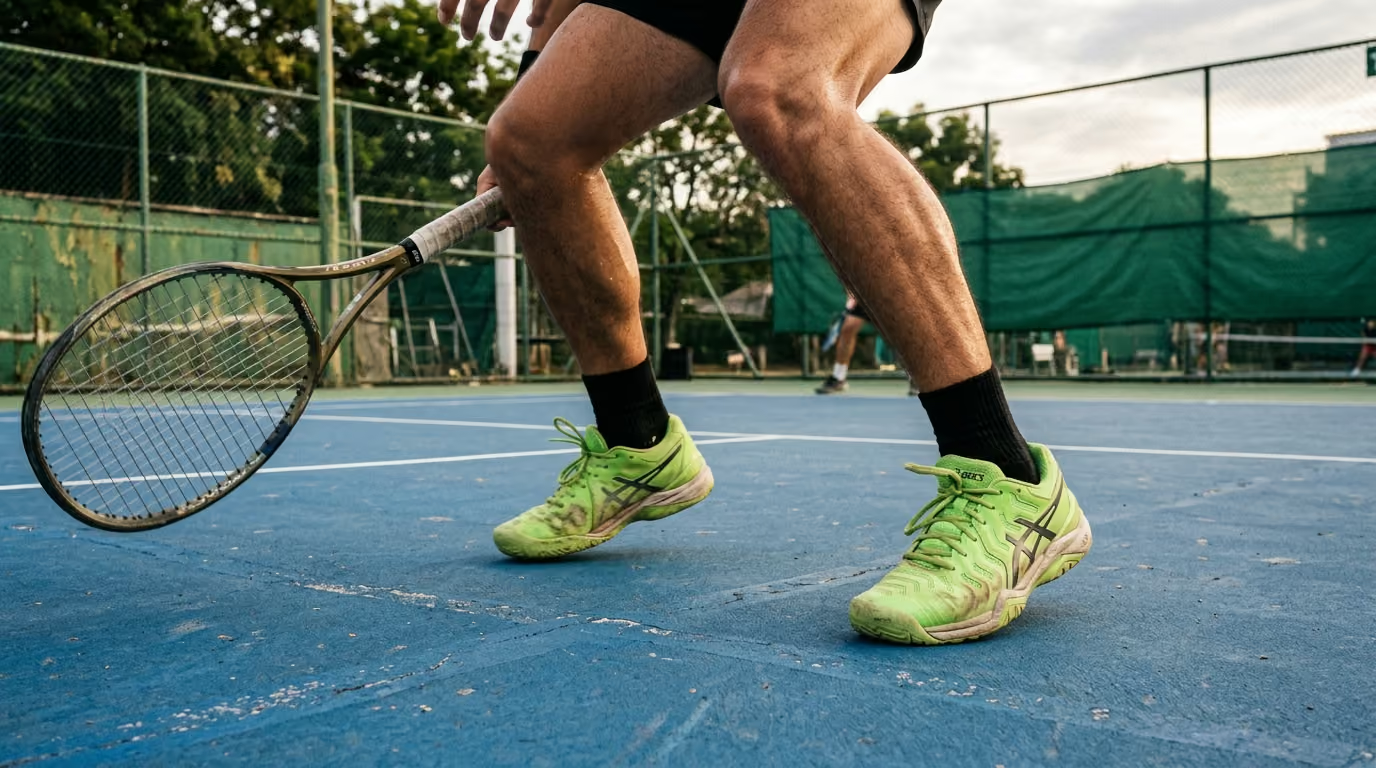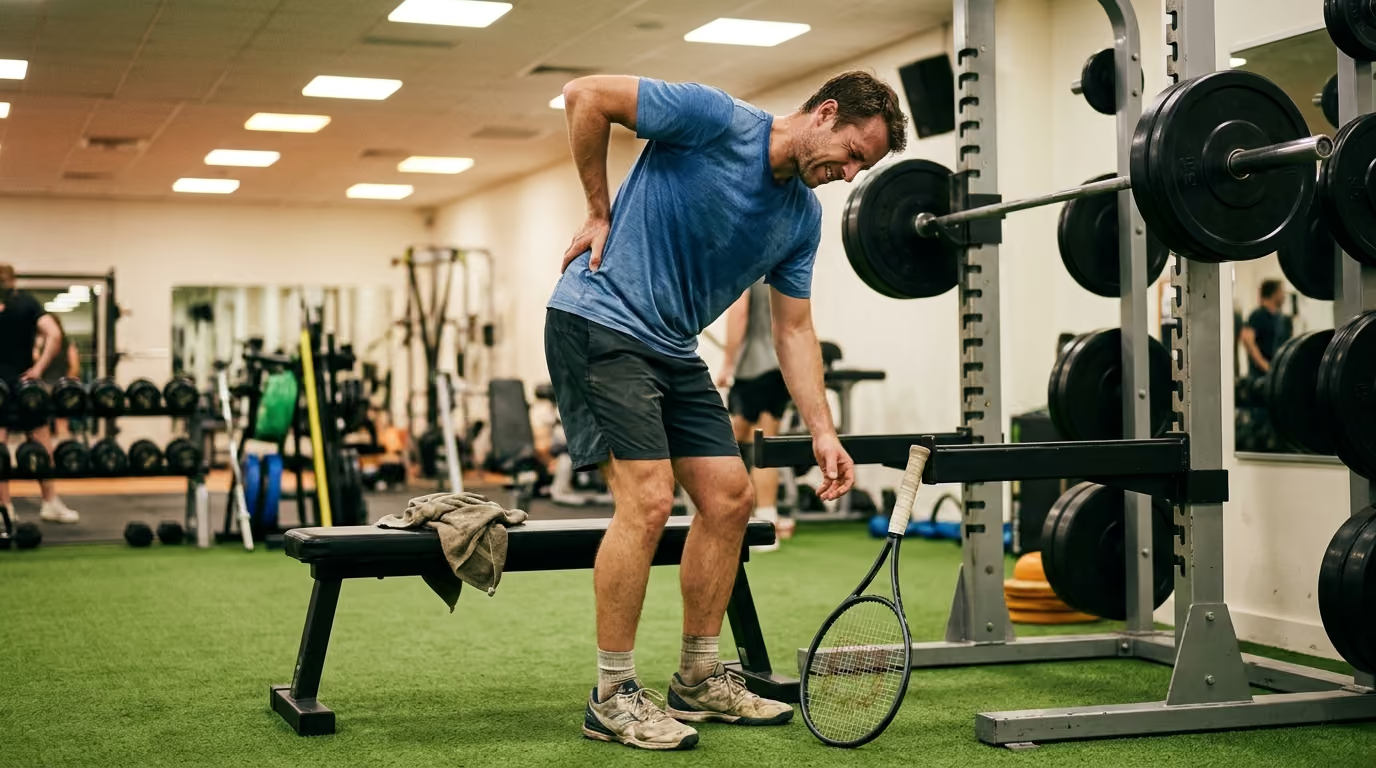

While many racquet sports players assume their gym efforts suffice, common strength training mistakes often hinder performance and lead to injuries.




Why do my knees and lower back hurt after playing racquet sports even though I lift weights? This is a classic frustration for court athletes who spend hours in the gym yet still face stubborn injuries and performance plateaus.
The issue is rarely a complete absence of physical training. More often, players train with poor exercise sequencing, insufficient progression, excessive fatigue, or an inadequate alignment between gym work and the demands of court movement. Correcting these errors requires shifting from random, sweat-inducing circuits to a structured plan that builds force production and braking control.
By understanding the physiological demands of your sport and applying systematic training principles, you can build lasting resilience. This comprehensive guide details the most common strength-and-conditioning errors racquet sports players make and provides practical, evidence-based training principles to replace them.
Racquet sports combine repeated acceleration and deceleration, lateral movement, unilateral loading, overhead actions, trunk rotation, and highly variable match durations. To build a body capable of handling these forces, your training must follow a structured process.
The most useful framework for court athletes involves a clear progression: identify the sporting demand, select the physical quality, dose the training stimulus, progress it systematically, monitor fatigue, and recover. If your gym sessions are a collection of random exercises, you are likely missing out on key physical adaptations.
Adaptation depends on the biological principle of progressive overload. This is the gradual increase of training demand so that your body continues to receive a sufficient stimulus to grow stronger. In resistance training, overload can be created by increasing load, repetitions, sets, movement complexity, or velocity demands.
The American College of Sports Medicine (ACSM) progression model describes this systematic manipulation of training variables as the foundation for continued physical adaptation. It identifies periodization as the planned variation of volume and intensity across time.
A critical distinction must be made between variation and progression. Variation simply changes the exercise, while progression increases your capacity to perform a meaningful task. A player who performs a different lunge variation every week may experience novelty, but they will not necessarily show improvements in force production or movement control.
Our team emphasizes that your training must also respect the principle of specificity. This means training adaptations are highly related to the specific demands of the exercise and the physical quality being trained.
Maximal strength, rate of force development, repeated-sprint ability, eccentric braking capacity, shoulder endurance, and aerobic recovery are related but distinct qualities. A heavy bilateral squat may improve general lower-body force, but it does not automatically teach you how to brake from a wide lateral position or stabilize on one leg.
To organize your training effectively, you should categorize your exercises into four distinct preparation phases. General preparation builds foundational strength, mobility, and work capacity. Directional preparation targets lateral, diagonal, crossover, and backward movement patterns.
Sport-specific preparation focuses on braking and reacceleration patterns, stroke-linked rotation, split-step timing, and repeated point demands. Finally, competition preparation involves high-quality actions performed under realistic fatigue and decision-making conditions.
Applying these phases systematically allows you to transfer your gym-built strength directly to the court. For structured guidance on designing this balance, you can refer to our dedicated strength and conditioning resources.
Many racquet sports players believe that their gym work must look exactly like their court work. This belief leads to sessions filled with a chaotic mix of agility ladders, cone shuffles, band walks, reaction drills, and random medicine-ball throws.
While these drills feel athletic and energetic, they often fail to develop measurable strength or movement capacity. They consume valuable training energy that would be better spent on progressive strength, eccentric loading, or shoulder capacity.
A drill must have a clearly defined physical objective, a planned progression, and a direct relationship to your current physical limitations. Accumulating random movements does not create a systematic training stimulus.
Neuromuscular training reduces lower-limb injury risk in athletic populations, but the evidence is strongest when programs are structured and consistently performed. To avoid the trap of endless variety, you should use a small menu of exercises organized by specific training objectives.
By categorizing your exercises, you can ensure that every movement serves a distinct purpose. This prevents your sessions from becoming a collection of uncoordinated drills.
Another common mistake is changing exercises before your body can adapt to them. A player might perform goblet squats one week, banded squats the next, and jump squats the following week. This constant variation prevents you from establishing technical competence or measuring genuine strength improvements.
You should adopt a strategy of retaining, progressing, and rotating. Retain foundational movements for several weeks to allow your neuromuscular system to adapt. Progress these movements by increasing load, repetitions, range of motion, or movement velocity.
Rotate the variations only when you reach a plateau, accumulate joint stress, or enter a new training phase. For example, you might perform a basic split squat for three weeks, increase the load for the next three weeks, and then transition to a lateral split squat in the subsequent phase.
This structured approach ensures that you have a visible training history and measurable progress. It allows you to build a foundation of tissue capacity before introducing more complex, high-velocity movements.
Many players treat their strength sessions as high-intensity conditioning circuits. They perform heavy lunges immediately followed by burpees, run through agility ladders with minimal rest, or combine high-repetition squats with court shuttles.
The justification is usually that because racquet sports require endurance, gym sessions must also challenge cardiovascular capacity. However, short rest periods reduce force output and technical quality.
This is particularly problematic for maximal strength, power, and deceleration training. The primary objective of these qualities is to produce and control high forces, which requires a fresh nervous system.
When you train under extreme fatigue, your movement mechanics deteriorate, and your ability to produce force declines. A meta-analysis of tennis players found that fatigue has large-to-moderate negative effects on physiological parameters, physical fitness, and stroke performance.
This evidence supports a crucial training distinction: fatigue can be useful when deliberately prescribed, but uncontrolled fatigue is not automatically productive. Strength sessions should not routinely turn into conditioning circuits where technique, force output, and landing quality suffer.
High-skill and high-velocity exercises belong early in your training session when your central nervous system is fresh. Conditioning should be treated as a separate objective, scheduled either at the end of the session or on a dedicated day.
To protect movement quality, organize your sessions with a clear hierarchy. Begin with movement preparation, follow with high-velocity or reactive work, and then proceed to your main strength and unilateral exercises.
Conclude the session with upper-body capacity work, trunk control, and, if necessary, dedicated conditioning. This structure ensures that you perform your most complex and demanding movements under optimal conditions.
Treating muscle soreness as the primary measure of a successful workout is a related error. Soreness is simply a byproduct of novel movement or eccentric stress, and it is not a direct indicator of physical adaptation.
In fact, excessive soreness can interfere with your court movement, technical practice, sleep quality, and subsequent training sessions. This is especially true for recreational athletes who must balance multiple weekly matches and practice sessions.
Instead of judging a session by how sore you feel, evaluate your training based on objective performance outcomes. Track whether your lifting loads are steadily increasing, your movement control is improving, or your deceleration is becoming more efficient.
Look for subjective improvements, such as reduced joint irritation after matches, better physical recovery, and more stable movement on the court. Our editorial guidelines encourage players to use systematic injury prevention methods to guide their training rather than relying on muscular fatigue as a badge of honor.
Most racquet sports training programs focus heavily on acceleration, jumping, sprinting, and concentric lifting. Players spend significant time learning how to move fast, but they neglect the physical capacity required to stop.
Racquet sports require players to arrive in position, brake rapidly, hit a controlled shot, and recover back to the center of the court. This braking phase involves large eccentric demands through the quadriceps, hamstrings, gluteals, calf complex, and trunk muscles.
If you train only acceleration, you develop a physical mismatch. You become faster at producing momentum without becoming better at controlling or absorbing it.
This imbalance increases technical errors on court and imposes excessive mechanical stress on the ankles, knees, hips, and lower back. Research involving court athletes demonstrates that eccentric strength measures explain a significant portion of the variance in change-of-direction performance.
Specifically, eccentric capacity explains approximately 25.1 percent of the variance in a 90-degree test and 37.4 percent in a 180-degree test. Furthermore, systematic reviews indicate that eccentric training improves sport-specific movement speed and change-of-direction ability across several athletic populations.
To build effective braking capability, you must train the deceleration phase explicitly. You can structure this progression across four distinct phases.
Focus on slow, controlled eccentric movements to build tissue tolerance. Examples include the squat-to-stick, basic step-downs, and lateral step-and-hold drills.
Introduce dynamic single-leg landings and controlled deceleration. Exercises like lateral bounds with a stable stick, reverse lunges with a five-second lowering phase, and single-leg landings are ideal here.
Incorporate movement velocity into your deceleration work. Practice a five-meter acceleration followed by a controlled stop, crossover runs into a lateral brake, or diagonal approaches into a split stance.
Introduce unpredictability and court-specific skills. This phase includes coach-directed movement drills, random ball feeds, and approach-brake-strike-recover sequences.
Progressing through these phases ensures that your joints and muscles are prepared for the intense eccentric forces of competitive match play.
A related mistake is confusing instability with athleticism. Many players perform complex exercises on unstable surfaces like Bosu balls or balance boards because they believe it mimics the balance demands of court movement.
However, unstable surfaces reduce the amount of force your muscles can produce. This makes them poorly suited for developing maximal strength or power.
While instability training has a valid role in early-stage rehabilitation and specific ankle-sprain prevention, it should not replace stable, progressively loaded strength work. To build true athletic stability, you should develop force in stable positions first, then challenge balance and reactivity through dynamic, sport-relevant tasks.
While lower-body power is essential for court movement, racquet sports place extraordinary demands on the upper body and trunk. Many players focus exclusively on leg strength and core endurance while ignoring the upper-body kinetic chain.
Epidemiological reviews of racquet sports show that shoulder overuse conditions, elbow tendinopathy, wrist problems, and abdominal strains are highly prevalent concerns. A systematic review of tennis-serve injury risk identified dominant-shoulder rotational strength, internal-rotation range of motion, weekly tennis volume, age, and body mass as key risk factors.
When you strike a ball, force is generated by your legs, transferred through your pelvis and trunk, and finally delivered through your shoulder, elbow, and wrist. A weakness or movement restriction anywhere along this chain forces other joints to work harder to generate power.
For example, restricted thoracic mobility or poor scapular control can force the shoulder rotator cuff to work under excessive mechanical stress. This often leads to subacromial impingement or SLAP lesions over time.
To protect your upper body, you must train your shoulders for repeated force production and joint centering rather than simply lifting heavy weights. A comprehensive upper-body program should incorporate horizontal pulling to balance forward hitting volume, scapular upward-rotation exercises to support overhead strokes, and targeted external-rotation strengthening.
Serratus anterior activation work and controlled overhead pressing are also highly beneficial when structured appropriately. Finally, you should include specific forearm and grip conditioning to protect the elbow and wrist from repetitive vibrations.
Another common upper-body mistake is treating the core as an engine for endless abdominal crunches and sit-ups. Racquet sports athletes do not need excessive trunk flexion.
Instead, they need a trunk that can transfer force between the lower and upper extremities, resist unwanted motion, and coordinate rotation safely. The primary role of the trunk during a match is to provide stability while the limbs move.
A systematic review of core-strength training in racket-sport athletes shows that structured trunk training improves motor coordination, movement quality, and stroke efficiency. To train your core effectively, you should focus on the four primary movement patterns of the trunk:
Focusing on these functional patterns allows your trunk to act as a powerful force transmitter, improving your stroke power and protecting your spine from repetitive rotational wear.
Many players return to court sports after a prolonged break and immediately resume their previous training volumes. They jump straight into competitive singles matches, heavy lower-body gym sessions, and high-volume serving practices without a gradual ramp-up phase.
Abrupt increases in training workload are among the most common causes of soft-tissue injuries and systemic overtraining. In racquet sports, lower-limb trauma and shoulder overuse syndromes are frequently linked to rapid spikes in weekly playing volume.
The International Olympic Committee (IOC) consensus statement on training load identifies rapid changes in volume, density, and intensity as primary risk factors for illness and athletic injury. The body requires time to adapt structurally to physical stress, and tendons, ligaments, and cartilage adapt much slower than muscle tissue.
To manage your training load safely, you should ramp your physical exposure progressively by adjusting only one or two variables at a time. If you are increasing your weekly match volume, you should temporarily reduce your gym intensity or lower your plyometric contacts.
Conversely, if you are introducing heavy lifting to your routine, keep your court sessions focused on technical drills rather than exhausting matches. This systematic approach ensures that your total physical stress remains within your body's current capacity to adapt and recover.
Training through technical breakdown is a closely related mistake. Many players believe that completing a prescribed number of repetitions is the absolute goal of a set, regardless of how poor their technique becomes.
If your knee collapses inward during a split squat, your pelvis rotates excessively during a lunge, or your landings become noisy and unstable, you are no longer training the intended physical quality. Instead, you are teaching your nervous system to adopt compensatory movement patterns under fatigue, which increases joint stress.
You should establish strict quality-based stopping rules for every exercise in your program. Stop or modify your set immediately if your movement velocity drops significantly, your technical form changes, or you experience any joint pain. This is particularly critical for high-speed plyometrics, unilateral landings, and overhead movements where technical precision is paramount.
Additionally, many competitive recreational players misuse physical testing. They repeatedly test their one-repetition maximums (1RM) or perform exhausting vertical jump assessments during periods of dense competition.
This practice adds unnecessary physical fatigue and increases injury risk without providing actionable programming insights. Testing is only valuable when it directly informs your training structure.
Instead of frequent maximal testing, focus on monitoring repeatable, submaximal performance markers. Track your movement quality at a consistent submaximal load, evaluate your landing symmetry during a low-effort jump, or monitor your subjective recovery using session ratings of perceived exertion (RPE).
These practical metrics provide valuable insights into your physical readiness without compromising your energy levels or joint health. For a deeper understanding of how fatigue impacts your performance, consider reading about recovery science principles.
Balancing gym-based strength training with court practices and competitive matches requires careful weekly planning. A common mistake is scheduling heavy lower-body lifting sessions the day before a high-intensity match, which leaves your legs fatigued and increases your risk of movement errors.
To optimize your physical performance and recovery, you must structure your training week with clear high-intensity and low-intensity days. High-intensity days should combine your heavy strength training and hard court play, while low-intensity days should focus on active recovery, mobility, or light technical practice.
I remember finishing a tough two-hour padel match on a cold Tuesday night and waking up the next morning feeling like my lower back was locked in concrete. For a long time, I just accepted this as the price of playing hard in my forties.
But once I started spending just ten minutes on targeted hip mobility before heading to the club, the stiffness almost completely vanished. It taught me that we do not have to accept pain as a default state of aging.
By dedicating time to preparing your tissues before you play, you can significantly reduce post-match stiffness and maintain high movement quality throughout your session.
To help you structure your training week, review the following sample schedule patterns. These are designed to balance physical development with court availability.
Managing your recovery is just as critical as managing your training load. Real physical adaptation does not occur while you are lifting weights; it occurs when you sleep, eat, and rest.
The European College of Sport Science (ECSS) and ACSM overtraining consensus states that successful athletic development requires a delicate balance of progressive overload and structured recovery. If you neglect sleep, hydration, and nutritional planning, your body will eventually enter a state of maladaptation and chronic fatigue.
Recovery is not about expensive wellness gadgets or complicated therapy routines. It is a fundamental load-management problem that is solved through consistent sleep, adequate caloric intake, proper hydration, and the logical spacing of high-intensity training sessions.
While tennis, pickleball, and padel share many basic physical requirements, each sport imposes distinct mechanical stresses on the body. Understanding these differences allows you to tailor your strength training to the specific demands of your chosen sport.
Tennis involves a large playing court, high-velocity running, sliding on various surfaces, and deep eccentric loading. The weight of a tennis racket is heavier than a pickleball paddle, which increases the mechanical torque on the dominant shoulder, elbow, and wrist.
Additionally, the tennis serve demands repetitive, high-velocity overhead actions that require excellent thoracic mobility and shoulder rotator cuff capacity. Strength training for tennis must prioritize maximal force production in the lower body, lateral braking power, robust upper-body pulling strength, and overhead tolerance.
To learn more about tailoring your gym work for the court, read our detailed guide on tennis specific training.
Pickleball is played on a smaller court, which reduces the need for long-distance sprinting but significantly increases the frequency of rapid, short-distance reactions. Players spend a large portion of a match in a deep, static squatting position near the non-volley zone line, commonly referred to as kitchen play.
This constant low-squatting stance places high isometric demands on the quadriceps, gluteals, and lower back. Furthermore, pickleball requires rapid hands, quick lateral shuffles, and repetitive low-to-high paddle movements that strain the wrists and elbows.
Physical preparation for pickleball should emphasize quadriceps endurance, lateral hip stability, ankle stiffness, and forearm capacity. Discover more practical advice in our resource section on pickleball physical preparation.
Padel is played within an enclosed glass court, combining rapid multi-directional running, sudden wall transitions, and a exceptionally high volume of overhead strokes, such as bandejas and viboras. The sport is highly repetitive, and the court surface is typically concrete covered with artificial turf, which increases the vertical impact forces on your joints.
The repetitive overhead swinging in padel places immense mechanical stress on the dominant shoulder, thoracic spine, and contralateral hip. Padel athletes must focus on overhead rotational power, trunk anti-rotation stability, calf and Achilles tendon resilience, and thoracic mobility.
For targeted advice on protecting your joints while playing, view our section on padel mobility work.
While structured strength training is highly effective for improving performance and reducing injury risk, it is important to recognize the limitations of self-directed exercise. Many players make the mistake of attempting to train through persistent, sharp joint pain or structural instability, hoping the issue will resolve on its own.
Continuing to load a compromised joint can lead to chronic tissue damage, prolonged recovery times, and extended periods away from the sport you love. You must listen to your body's signals and understand when to consult a qualified healthcare professional.
You should seek immediate guidance from a certified physical therapist, sports physician, or orthopedist if you experience any of the following symptoms:
A professional evaluation can provide you with an accurate physical assessment, identify any underlying structural issues, and guide you through a safe, individualized rehabilitation plan. Managing physical symptoms early is one of the most effective strategies for ensuring your long-term athletic longevity on the court.
To apply this knowledge and improve your weekly strength routine, use the following actionable step-by-step checklist.
By systematically applying these steps, you can move away from random, exhausting workouts and transition toward a purposeful, structured training program. This shift will not only improve your performance on the court, but it will also protect your body, enhance your physical recovery, and support your athletic longevity for many years of play.
Follow Evercourts for practical insights on tennis, pickleball and padel performance, movement, recovery and healthy ageing. Stay connected for new articles, research-led guidance and ideas to help you play well and keep playing for years.


Read practical guidance for better movement, smarter preparation and a game that keeps working for you.
explore the Blog