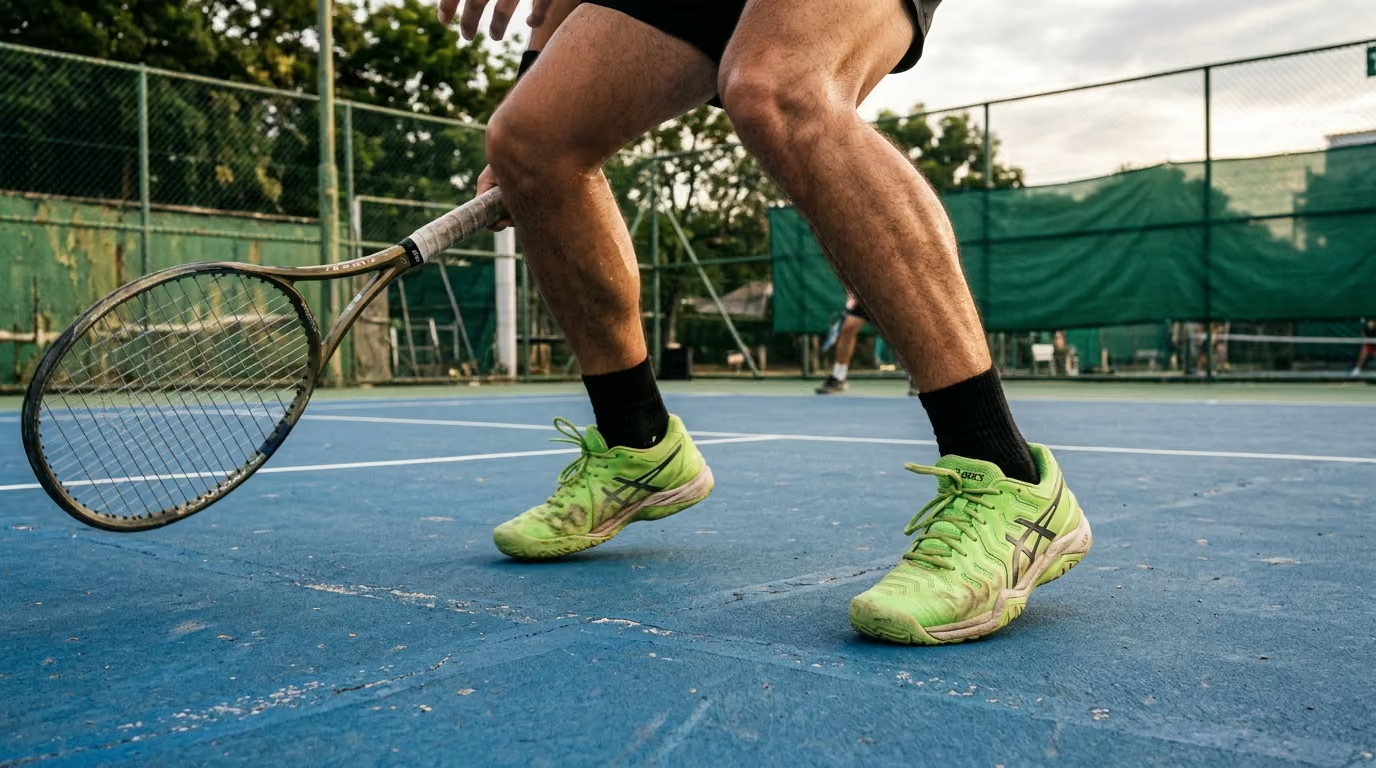
When playing racquet sports, the body functions as a kinetic chain where each joint's movement influences the next, impacting performance and injury risk.




Have you ever Googled why your elbow aches after a long match, or why your knee feels stiff the morning after playing? Many players search for isolated stretches or braces to address these specific trouble areas. However, court sports require a unified sequence of movement where every joint affects the next.
To move efficiently and play without persistent aches, you must treat your body as a coordinated kinetic chain. By understanding how mobility and stability alternate from your feet to your wrists, you can distribute court forces evenly across your entire system. This structural balance preserves your joints and supports your long-term athletic longevity on the court.
In court sports, movement is a whole-body event rather than an isolated limb action. Your body operates as a linked kinetic chain that transfers energy from the ground up through your legs, pelvis, and trunk. This force finally moves through your shoulder, elbow, wrist, and racket.
A breakdown in any single segment can disrupt this entire sequence. According to a clinical review on tennis injuries published in the Journal of the Croatian Medical Association, pathology in the groin, hip, abdominal musculature, or core can significantly increase mechanical stress on the shoulder and upper limb. When your lower body fails to generate sufficient force, your upper body must work harder to compensate. This compensation pattern often leads to chronic overuse conditions in the shoulder and elbow.
The joint-by-joint model provides a helpful framework for understanding these demands. This model shows that your joints alternate between needing primary mobility and needing primary stability. Mobility refers to the range of motion required to reach wide balls, load your tissues, and rotate through strokes. Stability is your ability to control this motion under heavy braking forces, racket inertia, and fatigue.
While biomechanical research strongly supports this kinetic chain concept, exact injury prediction remains complex. Sports scientists recognize that there is no single ideal movement profile for every player. Your individual anatomy, playing style, and injury history all influence how you distribute joint loads. However, maintaining adequate joint capacity and structural balance is universally accepted as a primary requirement for athletic longevity.
Your lower body serves as the foundation for every shot you hit. It absorbs the shock of hard court surfaces, decelerates your body weight, and initiates the power required for deep groundstrokes.
Your feet are your only contact point with the court surface. They must adapt to the ground instantly during a split-step, but they must also become rigid levers to propel you forward. This dual function relies on the concept of the tripod foot.
The tripod foot refers to three-point contact maintained by your heel, the base of your first metatarsal under your big toe, and the base of your fifth metatarsal under your pinky toe. When these three points remain grounded, your foot can distribute forces evenly. If your foot collapses inward excessively, it triggers internal rotation of your shin and knee.
Your toes contribute to balance and propulsion. Your big toe must extend adequately to allow a smooth push-off during transitions. Keeping pressure distributed across your forefoot during active play helps you react quickly, but you should avoid staying locked on your toes continuously. A better approach is to maintain an athletically ready posture where pressure can shift dynamically as needed.
The ankle joint must alternate between mobile flexibility and stiff stability. Ankle dorsiflexion is the movement where your shin travels forward over your foot. Adequate dorsiflexion is critical for deep lunges, low ready positions, and effective braking.
If your ankle dorsiflexion is restricted, your body will find other ways to lower your center of mass. This restriction often forces your heel to lift off the ground, placing excessive stress on your knee joint. The ankle also requires robust lateral stability to resist rollover during sudden side-to-side transitions.
The calf and Achilles tendon complex acts as a powerful spring. This tendon stores elastic energy when you land or brake, then releases it to propel you into your next step. Repetitive jumping, lunging, and stopping place immense stress on this complex. When ankle control is poor, this spring mechanism can become overloaded.
The knee is primarily a hinge joint designed to move in flexion and extension. However, it must also tolerate substantial rotational and lateral forces on the court. Knee control means keeping your knee aligned with your foot and hip during rapid movement.
Uncontrolled inward collapse, often called knee valgus, is a common movement error. This collapse occurs when your hip muscles fail to stabilize your thigh bone, or when your ankle lacks the flexibility to bend properly. While minor inward movement is natural during dynamic changes of direction, repetitive uncontrolled collapse under speed can stress your joint tissues.
A classic case pattern involves a player who arrives late to a wide ball. They plant their outside foot far ahead of their center of mass, allowing the knee to cave inward. The stress on the patellar tendon increases dramatically during this faulty deceleration pattern. To protect the knee, you must address your positioning, split-step timing, and hip strength. For more information on movement preparation, you can view our mobility and movement resources.
The middle of your kinetic chain connects your lower-body engine to your upper-body hitting arm. This region must generate rotational force while protecting your spine from excessive torsion.
Your hips are ball-and-socket joints designed for a wide range of motion. They must absorb massive braking forces during wide steps and produce horizontal power during your strokes.
Adequate hip internal and external rotation is essential for clean court movement. During an open-stance forehand, you must rotate your pelvis over a planted back leg. This action loads your gluteal muscles and hip rotators, preparing them to release that energy into the ball. If your hips lack rotational mobility, your body will look for rotation elsewhere, usually in your lower back.
Furthermore, groin and hip capacity is directly linked to upper-body health. Weakness or restriction in your hip abductors and adductors limits your lateral recovery speed. This delay forces you to reach farther with your arm, increasing the load on your shoulder.
Your lumbar spine consists of five large vertebrae designed primarily for stability and weight bearing. It is not built to tolerate high degrees of rotation.
A common biomechanical error is forcing your lower back to twist to create power. This error usually occurs because your hips or upper back are stiff. When your lumbar spine is subjected to repetitive twisting under load, the risk of tissue stress increases.
Trunk stability in racquet sports is not about holding a rigid, static posture. Instead, it is the ability to resist unwanted motion while allowing purposeful rotation through your upper body. Your core muscles must coordinate to keep your pelvis and lower back stable as you reach and swing.
Your thoracic spine is your mid-to-upper back, consisting of twelve vertebrae. Unlike your lower back, this region is anatomically designed for rotation and extension.
You need thoracic rotation to prepare your racket during the backswing. You also need thoracic extension to reach overhead for serves and high volleys. If your mid-back is stiff and rounded, your shoulder cannot move freely. This restriction can lead to shoulder impingement, as your arm struggles to reach the correct height. To protect your body over decades of play, refer to our healthy aging and athletic longevity guides.
Your upper limb is responsible for positioning your racket, managing impact forces, and guiding the ball. It relies entirely on the stability of your shoulder blade and the power of your trunk.
Your shoulder is your most mobile joint, which also makes it vulnerable to instability. The key to shoulder health is the coordination between your upper arm bone and your shoulder blade, known as the scapula.
During overhead actions like the serve, your scapula must rotate upward and tilt backward. This movement creates space for your arm to elevate without pinching your rotator cuff. The rotator cuff muscles must stabilize the ball of your arm bone within its shallow socket.
During the follow-through of a stroke, your shoulder must decelerate your arm rapidly. This deceleration requires immense eccentric strength in your posterior shoulder muscles. A lack of scapular control or posterior shoulder strength can cause your arm bone to slide forward, stressing your anterior joint tissues.
Your elbow acts as a bridge that transmits forces from your hand to your shoulder. It must manage repeated submaximal impacts without becoming overloaded.
The elbow is highly sensitive to technical errors and timing issues. If you strike the ball late, your elbow must absorb the force of impact in a compromised, bent position. This late contact frequently overloads the forearm tendons, leading to lateral epicondylitis, commonly known as tennis elbow.
Elbow stress is rarely a local problem. It is often caused by a heavy racket, an incorrect grip size, or a lack of power generation from your legs and trunk. When your kinetic chain fails, your elbow is forced to work as a primary power generator.
Your wrist and hand control your racket face, regulate spin, and manage fine touch. They must remain stable at the moment of impact to prevent the racket from twisting.
Repetitive flicking of the wrist to generate spin can strain your forearm muscles. The tendons running through your wrist can become irritated from excessive deviation and twisting. Maintaining a relaxed grip between shots helps relieve this constant tension.
Additionally, your hand and wrist are your primary defense during a fall. Many hand and wrist injuries occur when a player reaches out with a rigid arm to break a fall. Learning to lower your center of mass and step toward the ball can prevent these sudden balance losses. Developing structural tolerance is a key aspect of racquet sport injury prevention.
While all three racquet sports share general kinetic chain principles, they place distinct movement demands on your joints. Understanding these differences allows you to tailor your training specifically to your sport.
Tennis is played on a large court that requires longer, high-velocity sprints. Research in tennis physiology recommends training stop-start efforts of no more than twenty meters. Rallies typically resemble match-play efforts of five to twenty seconds, requiring work-to-rest ratios of 1:3 to 1:5.
An analysis of tennis matches shows that players cover approximately 3,160 meters over the course of a full match. However, your movement patterns change depending on whether you are serving or returning. The median rally distance is 5.2 meters when serving, but it increases to 6.2 meters when returning.
The serve is the most strenuous stroke in tennis, producing the highest peak muscle activity in your shoulder and forearm. This high physical demand explains why tennis injury patterns often show acute injuries in the lower extremity and chronic overuse injuries in the upper extremity. The high-velocity decelerations load your knees and ankles, while repeated serving stresses your shoulder and elbow.
Pickleball is played on a much smaller court, but this compact space does not eliminate physical demands. The movement profile of pickleball is dominated by short lateral steps, rapid weight shifts, and low postures near the non-volley line.
Because the non-volley zone, or kitchen line, restricts forward movement, players spend prolonged periods in a deep squat position. This posture places high, continuous isometric demands on your quadriceps, knees, and hips. Reaching for low dinks requires rapid lateral lunges and deep ankle dorsiflexion.
A five-year study from a tertiary academic center analyzed 164 pickleball-related injury cases. In this clinical sample, knee injuries were the most common at 52 cases, followed by foot and ankle injuries at 32 cases, and wrist and hand injuries at 30 cases. Interestingly, distal radius fractures after falls accounted for 60% of all hand and wrist injuries. Hand and wrist injuries were also more common among female patients, who represented 77% of those cases. These statistics highlight the importance of balance, footwork, and safe fall techniques on the pickleball court.
Padel is a fast-paced game played within an enclosed glass court. It combines short-court acceleration with frequent rotation, wall rebounds, and overhead shots. Because the court is small and enclosed, 80% of all accelerations and decelerations occur over a short distance of just one to two meters.
Padel tracking research shows that players cover substantial distances despite the court size. In one professional study, the median total distance covered was 3,430 meters, with a median distance of 2,401 meters per hour. The study also revealed that winning players covered more distance per hour and performed more accelerations than losing players. This finding suggests that repeated acceleration capacity is a key performance factor in padel.
Padel injury reviews consistently list the elbow as the leading injury location, followed by the shoulder and lower back. The knee is the most common site for lower-limb issues. The repetitive jumping required for overhead shots places high eccentric stress on the Achilles tendon during landings. Additionally, the fast-paced, twisting nature of the game can easily stress your lower back if your hips lack mobility.
To improve your movement on the court, you must first assess how your joints function. You can perform several simple, self-directed screenings at home or on the court to identify potential movement limitations.
To check your ankle dorsiflexion, perform the knee-to-wall test. Stand facing a wall with your big toe exactly five inches away from the baseboard. Keep your heel flat on the floor and attempt to bend your knee forward until it touches the wall. If your heel lifts or your knee caves inward before touching, your ankle dorsiflexion may be restricted.
To assess your thoracic rotation, sit upright on a chair with your knees squeezed together to lock your pelvis in place. Hold a golf club or racket across the front of your shoulders. Slowly rotate your trunk as far as you can to the right, then to the left. You should be able to rotate at least forty-five degrees in each direction without moving your hips or neck.
To test your hip internal rotation, sit on a high table with your thighs supported and your knees bent at ninety degrees. Keep your pelvis level and rotate your lower leg outward away from your other leg. A normal range of motion allows your lower leg to swing outward about thirty-five degrees, indicating healthy internal rotation at your hip joint.
A dynamic warm-up prepares your kinetic chain for the explosive demands of play. Static stretching before a match can temporarily reduce muscle power. Instead, use a progressive sequence that moves your joints through their natural ranges of motion.
Begin with three minutes of light, multidirectional movement. Start with a slow forward jog, transition into lateral shuffles, and finish with easy backward steps. This initial movement increases your heart rate and warms up your joint fluid.
Next, perform the three-dimensional lunge matrix to prepare your lower body. Take five controlled steps forward, keeping your trunk upright. Follow this with five lateral lunges to each side, focusing on keeping your trailing leg straight and your hips pushed back. Finish with five rotational lunges, stepping backward and outward at a forty-five-degree angle to open your hips.
Finally, integrate your upper body with thoracic windmills. Stand with your feet wider than your shoulders, bend forward slightly at your hips, and let your arms hang down. Rotate your trunk to reach one hand toward your opposite foot while extending your other arm toward the sky. Perform ten slow, controlled repetitions on each side to prepare your spine for rotation.
To improve your split-step timing, stand at the baseline while a partner feeds balls. Focus on jumping slightly as your partner begins their swing. Your feet should make contact with the court just after they strike the ball. Land with your feet wide, your knees slightly bent, and your weight distributed across your forefoot.
To practice deceleration control, set up three cones in a diagonal line spaced three meters apart. Sprint forward to the first cone, plant your outside foot, and lower your hips to stop. Immediately push off that outside leg to shuffle laterally to the second cone. This drill teaches your hips and ankles to absorb and redirect force efficiently, protecting your knees from rotational stress.
Many players make simple errors in their movement patterns that limit performance and increase joint strain. Recognizing these pitfalls is the first step toward correcting them.
Coaches often tell players to stay on their toes to remain quick. However, holding a rigid forefoot posture continuously can cause excessive calf fatigue and restrict your ankle's natural range of motion. It also prevents your heel from contacting the ground, which is necessary to absorb impact during landing and braking.
A better approach is to keep your feet athletically ready. Your heels should remain slightly off the ground during preparation, but they must be allowed to contact the court to absorb forces during heavy stopping movements.
When a joint feels tight, the natural reaction is to stretch it aggressively. However, passive flexibility without muscle control can actually increase your risk of strain. Your body needs strength at the end of your range of motion to control the joint.
Instead of only performing passive stretches, focus on active mobility exercises. For example, follow a hip stretch with single-leg balance work or loaded lunges. This combination ensures that your muscles can actively support the joint through its entire movement.
Generating power solely from your arm is a major cause of elbow and shoulder issues. When you swing without rotating your hips or pushing off the ground, your upper body must work twice as hard to create ball speed.
Focus on initiating your stroke from your lower body. Drive your back foot into the court, rotate your pelvis, and allow your torso to lead your arm. Your arm should act as a whip that transfers the power generated by your legs, rather than acting as the sole engine.
A common fitness myth is that your knees must never travel past your toes during a lunge or squat. While this rule can protect the knees in static weightlifting, it is impractical on the court. Reaching a low ball near the net requires your shin to tilt forward, forcing your knee past your toes.
Instead of avoiding this position, you should build the ankle flexibility and quad strength to control it. Your body is capable of handling these deep positions if you train your joints to tolerate the load progressively.
Your movement efficiency on the court directly affects how well your body recovers after a match. When you move efficiently, forces are distributed evenly across your entire kinetic chain, reducing local wear and tear.
When you fatigue, your movement mechanics begin to change. A study on tennis serve biomechanics notes that fatigue can alter joint loading and timing. As your leg muscles tire, your leg drive decreases, forcing your shoulder and arm to work harder to maintain serve speed. This shift increases the risk of overload in your upper body.
Muscles and tendons recover at different rates. Muscle tissue has a rich blood supply and typically recovers within twenty-four to forty-eight hours. Tendons have a much lower blood supply, meaning they require more time to adapt to training loads. Repetitive, fatigued movement can place excessive stress on tendons, leading to chronic irritation.
Understanding how tissue demands change with fatigue can be explored in our recovery science articles. To protect your joints, you must balance your playing volume with adequate rest and recovery. This balance ensures that your tissues can adapt and grow stronger, rather than breaking down over time.
While self-care and proper movement patterns can resolve many minor aches, some symptoms require evaluation by a qualified healthcare professional. Recognizing these warning signs can prevent minor issues from turning into major setbacks.
You should consult a certified physical therapist, sports physician, or orthopedic specialist if you experience any of the following:
A qualified professional can perform specific diagnostic tests to identify the root cause of your symptoms. They can design a customized rehabilitation program to address your specific movement limitations and safely guide your return to play.
Applying this knowledge to your routine this week can make a significant difference in how your joints feel. Use this checklist to guide your progress:
By taking these practical steps, you can protect your joints, improve your performance, and enjoy the physical and social benefits of racquet sports for many years to come.
Follow Evercourts for practical insights on tennis, pickleball and padel performance, movement, recovery and healthy ageing. Stay connected for new articles, research-led guidance and ideas to help you play well and keep playing for years.


Read practical guidance for better movement, smarter preparation and a game that keeps working for you.
explore the Blog