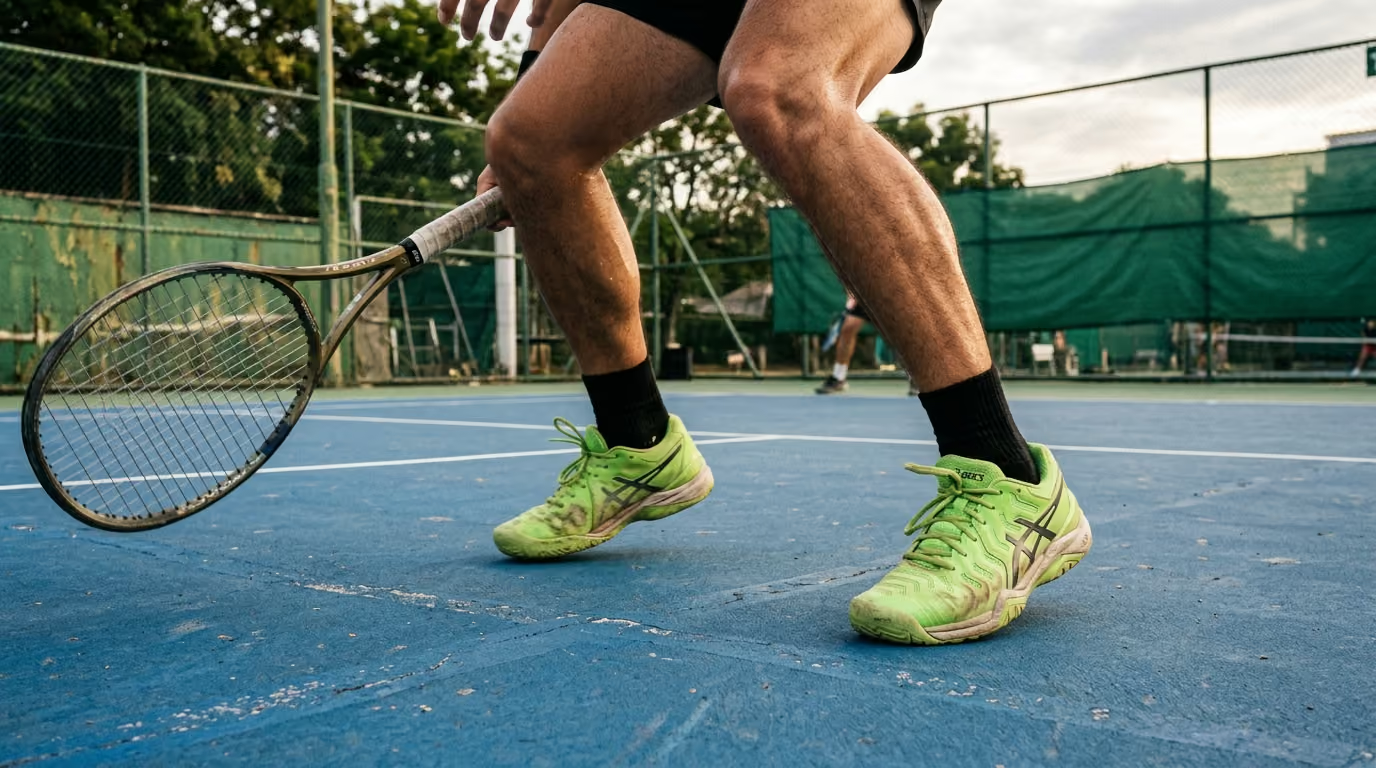
When a racquet sports athlete needs to move efficiently, strike with control, and resist injury over a long match, targeted physical preparation is essential.




Racquet sports physical preparation is the targeted development of specific physical qualities that allow an athlete to move efficiently, strike with control, and resist injury over a long match. It is not generic endurance running, bodybuilding, or high-intensity fitness classes that fatigue the body without building court-specific capacities. This guide outlines the science and practice of developing relative strength, rapid force production, deceleration capacity, and repeatable speed for the court athlete.
Racquet-sport performance is driven by a combination of relative strength, rate of force development, elastic power, and repeated-sprint ability. To train these qualities effectively, players must focus on moving their own body weight quickly, learning to decelerate safely, and maintaining movement efficiency under fatigue. A balanced program combines structured resistance training, progressive plyometrics, and court-specific movement drills.
To build a body that can handle the physical demands of court play, athletes must look beyond basic cardio and light stretching. True physical readiness requires a systematic approach to athletic development.
Many recreational and competitive players believe that spending hours on a treadmill or performing high-repetition light-weight exercises is the path to better court fitness. However, racquet sports do not consist of continuous, moderate-intensity movement. Instead, they are defined by highly explosive, intermittent efforts. A player must sprint, stop, change direction, and strike a ball, all within a few seconds.
General physical preparation should focus on building specific biomotor abilities. It is not about training to failure or sweating for the sake of exhaustion. It is about improving your body's ability to produce force against the ground. It is about learning to absorb that force when you need to stop quickly.
We must also understand what athletic longevity means in this context. It is not about finding a magic formula to halt the calendar. It is about maintaining high movement quality and joint tissue tolerance over several decades. By focusing on targeted physical preparation, you can protect your joints and continue playing the sports you love.
This guide provides a comprehensive blueprint for developing these qualities. We will examine the physiological demands of court play and outline concrete training methods. Whether you play tennis, pickleball, or padel, these principles will help you move better and play longer.
Racquet sports require short bursts of acceleration, jumping, lunging, braking, and striking interspersed with brief recovery periods. Tennis-specific reviews describe the sport as a combination of speed, agility, and power performed over prolonged match durations. This means you need both a high power output for individual plays and a highly developed recovery system.
To understand these demands, we must look at the energy systems used during play. The immediate energy for a five-second rally comes from stored phosphagens. During the rest periods between points, your aerobic system works to replenish these energy stores. If a match lasts for three hours, your aerobic fitness determines how well you can repeat those explosive movements in the final games.
Court surface and playing level also change the physical demands of the game. A systematic review found that rallies were approximately 22% longer on clay than on hard courts. This led to greater playing time, higher heart rates, increased blood lactate, and higher perceived exertion on clay. If you play on clay, your training must emphasize greater aerobic capacity and muscular endurance.
The same review reported that first-and second-serve speeds for international male players averaged 182 and 149 kilometers per hour, respectively. International female players averaged 156 and 134 kilometers per hour. These high speeds require incredible force production through the legs, trunk, and shoulder. On faster surfaces like hard courts or grass, first-step speed and rapid reaction times are even more critical.
This creates a hybrid conditioning problem. A player may possess excellent laboratory aerobic fitness but still lose effectiveness on the court. This happens because of poor acceleration mechanics, inadequate eccentric strength, or low repeat-sprint ability. To address this, players can access specialized strength and conditioning resources designed for court athletes.
Relative strength is the amount of force an athlete can produce relative to their body mass. It is calculated by dividing absolute strength by body mass. This is the most critical strength metric for court players because you must constantly accelerate, decelerate, and redirect your own weight.
Absolute strength is the total force produced regardless of body weight. It is useful for absorbing heavy impacts and stabilizing the spine during hard rotations. However, if an increase in absolute strength comes with a large increase in non-functional body mass, your relative strength may decrease. This can make you slower on your first step and increase the impact forces on your joints.
A recent study reported that relative strength correlated strongly with relative peak power output, while body-fat percentage showed a negative correlation with that performance measure. The same study found that the relationship between relative strength and power was curvilinear. This means that performance gains appear to plateau beyond a certain strength level. You do not need to lift like a competitive powerlifter to get the benefits of strength training.
A complete racquet-sport strength profile should target several key areas. First, you need bilateral lower-body strength to build general force capacity. Exercises like squats and trap-bar deadlifts teach your body to produce high force against the ground. This foundation helps you absorb high landing forces during play.
Second, unilateral strength is critical because court movement is almost entirely single-leg dominant. When you lunge for a low volley or push off to run down a lob, you rely on one leg at a time. Split squats, rear-foot-elevated split squats, and single-leg deadlifts are highly effective. These exercises target the glutes, quadriceps, and hamstrings in a pattern that mimics court movement.
Third, lateral and frontal-plane strength must be addressed. Most traditional gym programs focus only on forward and backward movements. Racquet sports require constant side-to-side movement. Lateral lunges and lateral step-downs build strength in the hip abductors and adductors. This lateral stability is vital for protecting the knees during quick changes of direction.
Fourth, trunk and pelvic strength are required to transfer force from the lower body to the upper body. The core must resist unwanted motion and transfer energy efficiently. Training should focus on anti-extension, anti-rotation, and controlled rotational exercises. You can learn more about managing these movement patterns by exploring mobility and movement resources.
Fifth, shoulder and scapular strength are essential for long-term joint health. The rotator cuff and scapular stabilizers must be strong enough to decelerate the racquet after a high-speed stroke. Tennis injury reviews describe large, repetitive loads at the shoulder and elbow, particularly during serving. Exercises like face-pulls, external rotations, and row variations help balance the repetitive strain of hitting.
Finally, grip and forearm capacity contribute to racquet control and impact absorption. While you get a high volume of grip work from playing, targeted forearm exercises can support elbow health. This is especially important for players who suffer from repetitive strain issues in the elbow.
Rate of force development, or RFD, describes how rapidly force rises after the beginning of a muscle contraction. It is represented as the change in force divided by the change in time. This concept is crucial because a typical court movement occurs in less than 250 milliseconds.
You may have a very high maximum squat, but if you cannot access that force quickly, you will still be slow to the ball. The first 50 to 75 milliseconds of an explosive contraction are driven by rapid neural activation. This is known as early RFD. It depends heavily on how fast your brain can send signals to fire your motor units.
Later RFD occurs after 100 milliseconds and is more influenced by maximal force capacity and muscle structure. Both qualities are important, but early RFD is what gives you that explosive first step. It is the physical quality that allows you to react to a split step and move instantly.
To train RFD, you should follow a progressive path. You must first build a foundation of general strength with controlled, heavy lifts. Once you have a strength base, you must focus on the intent to move quickly. Even when lifting moderate loads, you should perform the concentric phase of the lift with maximal speed.
Next, introduce ballistic movements where you actually leave the ground or release an object. Jumps, hops, and medicine-ball throws are highly effective ballistic exercises. These movements teach your nervous system to fire muscles rapidly without decelerating at the end of the range of motion.
Finally, you can apply this speed to sport-specific movements. This includes lateral push-offs, reactive starts, and medicine-ball rotational throws that mimic the stroke path. Remember that RFD testing is difficult to measure without expensive force plates. Instead of worrying about precise laboratory scores, focus on the quality and velocity of your explosive movements.
Elastic power is the ability of your musculoskeletal system to store and release energy. This process relies on the stretch-shortening cycle, or SSC. The SSC consists of a rapid eccentric lengthening phase, a brief amortization transition phase, and a fast concentric shortening phase.
Think of your tendons as rubber bands. When you land from a split step, your tendons stretch and store elastic energy. If you transition quickly, that stored energy is released to propel you in the opposite direction. This mechanism makes court movement highly efficient and reduces the metabolic cost of sprinting.
A systematic review of plyometric training in racquet-sport athletes found a small positive effect on muscle power. A broader umbrella review reported that plyometric training can produce improvements ranging from trivial to large in jump height and sprint times. Another meta-analysis reported a substantial improvement in standing long-jump performance. These findings show that plyometrics are highly effective for developing horizontal and vertical power.
To build elastic power safely, you must follow a structured progression. Beginners should start with low-intensity preparation. This includes pogo hops, skipping, line hops, and landing hold drills. These movements build tissue tolerance in the Achilles tendon and calf muscles.
Once you can land with stable alignment, you can progress to moderate-intensity development. Exercises like countermovement jumps, broad jumps, and lateral bounds are excellent choices. During these movements, focus on minimizing your contact time with the ground while maintaining a stiff ankle joint.
Advanced players can eventually incorporate high-intensity plyometrics. This category includes depth jumps, single-leg bounds, and reactive hurdle hops. These exercises place extreme demands on the tendons and nervous system. They should only be performed when you are fully recovered and have a strong foundation of lower-body strength.
During all plyometric training, landing quality is the most important factor. Your knees should track over your toes, and your hips should absorb the impact smoothly. If you experience joint discomfort, reduce the intensity or volume immediately. For more guidance on protecting your joints, refer to these injury prevention resources.
Straight-line sprint speed is only a small component of court speed. A track athlete focuses on reaching top velocity over 100 meters. A court athlete rarely runs in a straight line for more than 10 meters. Court speed is a complex mix of perception, reaction, acceleration, and deceleration.
First-step speed requires a low center of mass and an explosive push-off angle. You must drive your feet into the court at an angle that pushes you forward or sideways. This requires high relative strength in the calves, quadriceps, and glutes. It also requires excellent coordination between your arms and legs.
Deceleration is the most neglected aspect of court speed. Every aggressive acceleration must be followed by a rapid deceleration so you can strike the ball from a balanced position. Deceleration requires high eccentric strength, which is the ability of your muscles to produce force while they are lengthening.
If you lack eccentric strength, you will take extra steps to slow down. This makes you late for the next shot and increases the load on your patellar and Achilles tendons. Deceleration training should teach you to lower your center of mass and use wide, stable foot placements to absorb momentum.
To train deceleration, you can use progressive braking drills. Start by sprinting five meters and stopping on a specific line, holding the final position for two seconds. You can perform this drill forward, backward, and laterally. As your control improves, increase the sprint distance and speed before initiating the stop.
Measuring agility can be challenging. A systematic review of agility testing in tennis, badminton, and squash identified 28 different tests. However, none of the sport-specific tests demonstrated both high reliability and validity in the reviewed literature. For this reason, players should use a combination of simple physical tests and on-court observations to track their movement speed.
Repeated-sprint ability, or RSA, is the capacity to perform repeated short sprints with minimal rest while maintaining high performance. In a typical match, you may need to perform several high-intensity recoveries in a single long game. If your RSA is poor, your sprint times will slow down, and your movement quality will degrade.
In competitive male tennis players, approximately two hours of match play produced clear reductions in 15-meter repeated-sprint ability. It also reduced explosive power and leg stiffness. These physical qualities returned to baseline approximately 24 hours into recovery. This shows that match play causes significant neuromuscular fatigue that persists long after the match ends.
A systematic review of elite junior tennis players reported that standard training sessions do not always reproduce the physiological demands of tournament match play. Competing in multiple matches on the same day negatively affected jump height, sprint speed, and change-of-direction performance. This highlights the need for dedicated conditioning that prepares your body for the unique demands of tournament play.
A systematic review found that strength training and complex training performed twice weekly for six to twelve weeks improved sprint times. However, these strength interventions did not improve the fatigue index. This means that while strength training makes your individual sprints faster, it does not automatically stop you from slowing down late in a match.
To build repeatable match endurance, you need a mix of conditioning methods. Extensive intermittent work is excellent for general preparation. This includes court movement circuits and technical drills with moderate work-to-rest ratios. These sessions build your aerobic base, which is crucial for recovering between points.
Intensive intermittent work is more demanding and should be used as you approach competitive phases. This involves short, five-second explosive sprints followed by incomplete recovery periods. You can also perform rally simulations where you are forced to move continuously for 30 to 45 seconds.
The most specific conditioning combines high-intensity movement with actual stroke execution. For example, you can perform a drill where you sprint to a wide ball, hit, recover to the center, and immediately repeat the sequence. This teaches your brain to maintain technical control and stroke accuracy even when your muscles are heavily fatigued. To learn more about managing physical fatigue, you can review our recovery science resources.
Integrating physical preparation into a busy playing schedule requires careful planning. You should not try to perform heavy strength work, high-intensity plyometrics, and long court sessions all in the same day. Instead, structure your week so that you can recover between high-demand sessions.
Before every match or practice session, you must perform a thorough dynamic warm-up. Static stretching before a match can actually reduce your power output and slow your reaction times. A dynamic warm-up should increase your heart rate, joint mobility, and nervous system excitability.
Begin with five minutes of light movement, such as jogging, side shuffles, and skipping. Next, perform dynamic mobility exercises like leg swings, lunges with a twist, and arm circles. Finally, perform neural activation drills like pogo hops, rapid foot fire, and short three-meter accelerations. This entire process should take 10 to 15 minutes and prepare your body for explosive action.
During your practice sessions, you can intentionally structure drills to target specific physical qualities. If you want to train speed and agility, perform short drills with full recovery. For example, execute a three-shot movement drill, then rest for 30 to 45 seconds before the next repetition. This ensures that every movement is performed at maximal velocity.
If your goal is conditioning, you can reduce the rest periods. Perform a continuous multi-ball drill for 45 seconds, then rest for only 15 seconds. Repeat this sequence for several sets to simulate a long, grueling game. Keep in mind that technical quality will decline as you fatigue, so monitor your stroke mechanics closely.
For a recreational player who plays twice a week, a simple off-court routine can be highly effective. You can perform two short strength sessions per week, focusing on unilateral leg strength, trunk stability, and shoulder resilience. These sessions do not need to take hours. A focused, 30-minute workout can produce significant improvements in your court performance and joint durability.
While all racquet sports share some physical requirements, the specific movement demands and joint loads differ significantly between tennis, pickleball, and padel. Understanding these differences allows you to tailor your training program to your specific sport.
Tennis is played on the largest court of the three sports, which means you must cover substantial distances. You will frequently perform long, linear sprints to chase down drop shots or deep lobs. The deceleration demands are extremely high, especially on hard courts where there is no slide.
The service motion in tennis is one of the most physically demanding movements in sports. It requires a powerful leg drive, deep trunk extension, rapid rotation, and high shoulder-deceleration force. This action places immense stress on the lower back, dominant shoulder, and elbow. Tennis players must prioritize shoulder-stabilization work, thoracic mobility, and lower-body power.
Pickleball is played on a much smaller court, which changes the movement profile. You rarely perform long sprints. Instead, the game is defined by rapid, short-distance lateral shuffling and quick reaction steps near the kitchen line. The volume of low-slung, deep squatting postures is incredibly high.
Because you must constantly stay low to hit low-bouncing balls, pickleball places a high muscular endurance demand on the quadriceps and glutes. The rapid paddle exchanges at the net require exceptional wrist and forearm reactivity. Pickleball players should focus on hip mobility, single-leg stability, and lateral movement speed to support their long-term participation. For more on maintaining physical capacity as you age, explore these healthy aging and athletic longevity resources.
Padel is played in an enclosed glass court, creating a highly unpredictable and erratic movement environment. You must constantly adjust your body to play balls off the back and side walls. This requires frequent rotational shifts, backing up, and rapid change-of-direction in tight spaces.
The volume of overhead strokes, such as the bandeja and vibora, is extremely high in padel. Unlike the tennis serve, these overheads are hit while moving backward or sideways, placing unique demands on balance and core stability. Padel players need excellent thoracic rotation, shoulder-endurance, and multi-directional lunging capacity to handle the physical challenges of the glass court.
Many court athletes hold back their own progress by falling into common training traps. Recognizing these mistakes is the first step toward building a more effective preparation strategy.
Many players believe that going for a long, slow run is the best way to get in shape for their sport. While jog sessions do build baseline cardiovascular health, they do not prepare your body for the explosive demands of court play. Slow running trains your muscles to move slowly and does not develop the eccentric strength needed to stop quickly.
Instead of slow, steady-state running, focus on interval training and repeat-sprint drills. These methods train both your aerobic and anaerobic energy systems in a way that matches the actual play-and-rest cycles of your sport. This approach will make you faster and more resilient on the court.
Most players focus entirely on how fast they can sprint to the ball. They ignore the physical qualities required to slow down, balance, and recover. This lack of deceleration capacity leads to poor hitting positions, extra steps, and high joint stress.
When you cannot brake efficiently, your knees and lower back absorb the impact forces. This increases your risk of developing patellar tendinopathy or lower-back strain. To fix this, incorporate landing drills, drop landings, and controlled stopping drills into your routine.
Poor conditioning and lack of strength directly impact your recovery time. When your muscles are weak, your tendons, ligaments, and joints must absorb more of the impact forces from playing. This leads to micro-damage in these connective tissues, which takes much longer to heal than simple muscle fatigue.
By improving your relative strength and tendon stiffness, you protect your joints from excessive wear and tear. Stronger muscles can handle more work before they become fatigued, which means you will experience less muscle soreness after a hard match. This allows you to return to the court sooner and maintain a higher training volume.
While physical preparation can significantly reduce your risk of injury, it cannot eliminate it entirely. It is critical to listen to your body and recognize the signs that indicate you need professional medical guidance. You should never try to play through pain that alters your movement mechanics.
If you experience localized joint swelling, sharp or radiating pain, or pain that worsens during play, you should seek a professional medical evaluation. Persistent morning stiffness that does not resolve with light movement is another warning sign. These symptoms can indicate a more serious issue, such as a tendon tear or joint cartilage damage.
Sensations of joint instability, such as a knee or ankle giving way, catching, or locking, require immediate attention. These mechanical symptoms often point to ligamentous laxity or internal joint disruption. A qualified physical therapist or orthopedic specialist can perform specific clinical tests to assess the integrity of your joints.
Remember that trying to train through structural pain will only lead to compensatory movements. This can cause secondary injuries in other parts of your body. For more information on identifying and managing court-related aches, you can read our player health articles.
Yes, you can perform strength training on the same day you play, but you must structure the timing carefully. If your priority is a competitive match, you should perform your strength workout after your match or on a separate day. This ensures that you are not fatigued when you step onto the court. If you must train before playing, keep the volume low and focus on neural activation rather than muscular fatigue.
You do not always need extremely heavy weights to build relative strength, especially if you are new to training. Bodyweight exercises, resistance bands, and moderate weights moved with high velocity can build significant strength. However, as your body adapts, you will eventually need to introduce progressive overload to continue making gains. This can be achieved by increasing the resistance, changing the leverage, or performing single-leg variations.
Improvements in court speed can occur within four to six weeks of starting a structured training program. Initial improvements are typically driven by neural adaptations, such as better motor unit recruitment and improved movement coordination. Long-term changes in muscle tendon stiffness and maximal force production usually take eight to twelve weeks of consistent training to become fully apparent.
As you age, your recovery capacity and tendon elasticity naturally decrease, but you can still maintain high physical performance. Your training should place a greater emphasis on joint mobility, eccentric strength, and progressive recovery. You may need to reduce your overall training volume and increase the rest days between high-intensity sessions. Do not avoid strength or plyometric training; simply scale the intensity and volume to match your current physical capacity.
Follow Evercourts for practical insights on tennis, pickleball and padel performance, movement, recovery and healthy ageing. Stay connected for new articles, research-led guidance and ideas to help you play well and keep playing for years.


Read practical guidance for better movement, smarter preparation and a game that keeps working for you.
explore the Blog