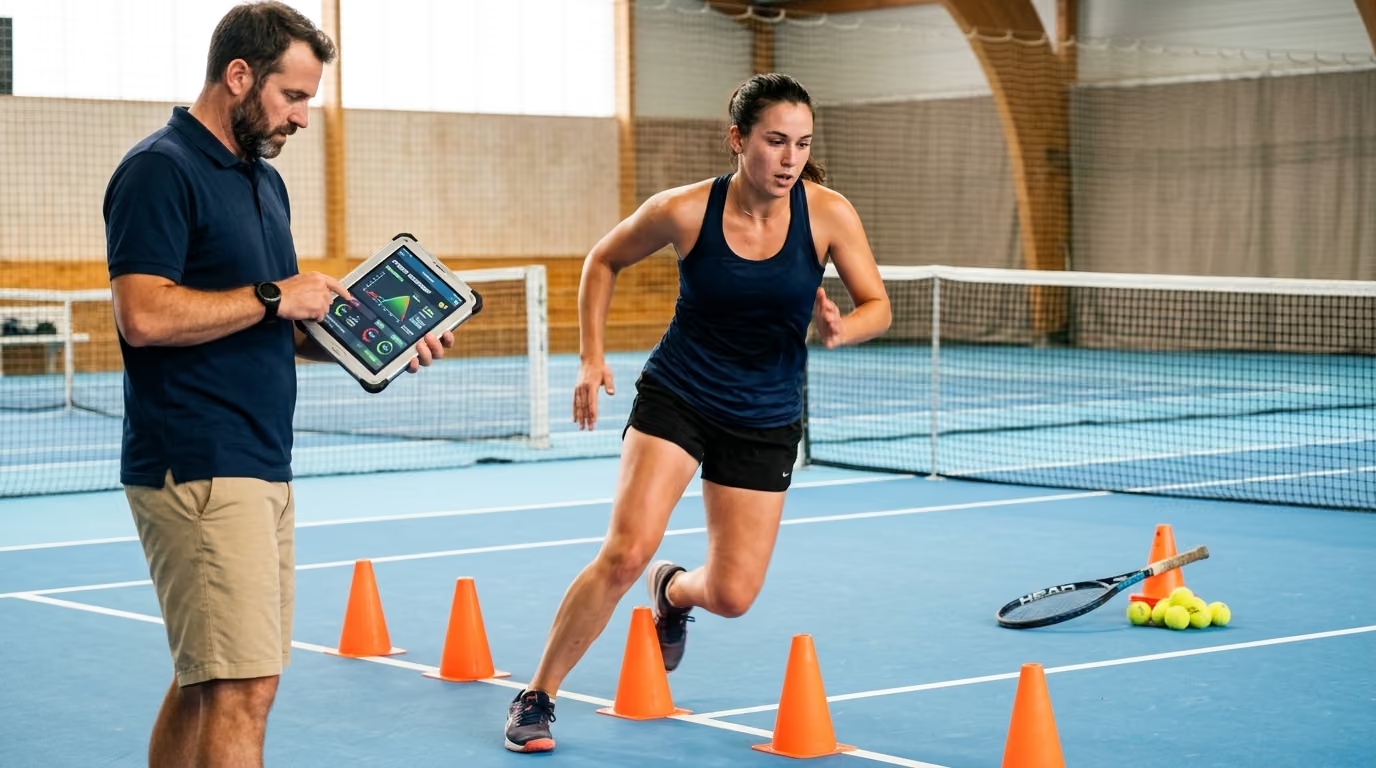

You will learn how to accurately assess your strength, power, speed, agility, and endurance for racquet sports to improve your athletic performance and longevity.




Imagine stepping onto the court for a deciding set. Your lungs are burning, and your legs feel like lead. You try to push off for a wide groundstroke, but you are just a fraction of a second too slow. You realize your current training is not keeping up with the physical demands of the sport. To build a physical foundation that lasts, you need a systematic way to measure where you stand.
Many players guess their fitness levels based on how tired they feel after a match. However, fatigue is not an accurate measurement of specific athletic qualities. This handbook provides a practical guide to testing your strength, power, speed, agility, and endurance. By using standardized field assessments, you can identify your physical limitations and track your progress over time.
A racquet sports fitness assessment is a structured battery of physical tests. It measures your mobility, strength, and power on the court. It also evaluates your speed, agility, and cardiovascular endurance. By testing these qualities, you can target specific training areas to support your athletic longevity.
To design an effective program, you must understand the difference between assessment, monitoring, and evaluation. An assessment is a comprehensive physical snapshot of your capabilities. It is typically conducted at the start of a training season or before beginning new strength and conditioning plans.
Monitoring is a brief, low-burden process. You might perform a simple jump test once a week to track your daily readiness. Evaluation is the process of reviewing your progress after completing a training block. It determines whether your program successfully changed a specific physical quality.
Court sports do not resemble long, continuous running. Instead, they require brief, high-intensity efforts separated by short recovery periods. Research shows that typical tennis rallies last between four and ten seconds. These explosive bursts are followed by ten to twenty seconds of rest.
This intermittent work relies heavily on your anaerobic energy systems. The phosphagen pathway provides immediate, explosive energy for quick sprints. Meanwhile, your aerobic system works continuously to restore this energy between points. Over a multi-hour match, a strong aerobic base prevents your power output from dropping.
Physical demands also vary based on the playing surface. A systematic review of junior tennis players found that rallies on clay courts were twenty-two percent longer than those on hard courts. This led to longer playing times and higher average heart rates. It also caused greater blood lactate accumulation and higher perceived exertion.
Other racquet sports have distinct physiological profiles. Competitive badminton requires high average aerobic and anaerobic intensities. Research shows that badminton players average over seventy-three percent of their peak oxygen uptake during competition. Their mean heart rates can reach eighty-nine percent of their maximum value.
In contrast, squash demands continuous lateral lunging and high-force eccentric braking. Wheelchair tennis introduces unique movement dynamics. Research shows a work-to-rest ratio of approximately one to four point one on hard courts. This highlights the importance of wheelchair propulsion speed and upper-body power.
To build an effective assessment, you must understand validity and reliability. Validity refers to whether a test actually measures the physical quality it claims to measure. For example, a complex movement drill might measure your memory of the pattern rather than your actual agility. Reliability refers to the consistency of the test scores across different trials.
Absolute reliability represents the measurement error in the same units as the test. This is often expressed as the typical error or the standard error of measurement. If a test has high absolute error, it cannot detect small, meaningful physical changes. Relative reliability shows whether players maintain their rank order across multiple testing sessions.
When choosing your personal test battery, follow a simple four-step framework:
To evaluate physical changes, you must establish the smallest worthwhile change. This represents the minimum improvement needed to prove your training is working. Compare this number with the typical error of the test. If your improvement is smaller than the test noise, you cannot be certain your fitness has changed.
The following field tests are reliable, valid, and easy to perform on a standard court. They require minimal equipment, such as a tape measure, cones, and a stopwatch. Perform these assessments in the order listed to manage physical fatigue.
This test measures the mobility of your ankle joint. Limited ankle mobility can cause your knees to collapse inward during deep lunges. This compensation increases stress on your patellar tendons and lower back.
Overhead racquet athletes require excellent shoulder stability. The Athletic Shoulder test, often called the ASH test, evaluates isometric strength in key positions. Research shows this test has high reliability, with correlation coefficients between 0.93 and 0.98.
Court sports require unilateral leg strength to support deep lunges and rapid directional changes. This assessment evaluates single-leg strength endurance.
The countermovement jump measures vertical lower-body power. This quality is essential for explosive acceleration and overhead smashes.
This test measures your acceleration and first-step speed. These qualities determine how quickly you can react to a drop shot or a deep lob.
The Modified T-Test evaluates your ability to change directions forward, laterally, and backward. This closely mimics the movement patterns used during baseline rallies.
The Spider Drill measures multidirectional agility and sport-specific court coverage. It requires you to sprint to five different locations on the court and return to the center.
This test measures your high-intensity aerobic capacity. It evaluates your ability to recover from repeated, explosive efforts. Research shows this test has high test-retest reliability, with correlation coefficients up to 0.98.
To make your fitness data useful, you must standardize your testing conditions. If you change your environment, your scores will reflect external factors rather than your physical adaptations. Use this written protocol to ensure consistent results.
Record your physical state before starting your fitness tests. Try to test at the same time of day to account for circadian rhythms. Ensure your sleep duration, hydration levels, and nutritional intake are similar for each session. Avoid consuming caffeine or energy drinks before testing, as stimulants can artificially inflate your speed and power scores.
Document your training load from the previous forty-eight hours. Testing your physical limits while sore or fatigued will produce inaccurate baseline data. Use the Evercourts court life blog to find helpful recovery schedules for busy match weeks.
The physical environment can alter your movement efficiency. Perform your retests on the same court surface, such as hard court or clay. Changes in traction can significantly affect your change-of-direction times.
Wear the same style of court shoes for every testing session. Different sole compounds modify your grip and slide characteristics. Record the temperature and wind conditions if you are testing outdoors. Extreme heat or strong winds can lower your cardiorespiratory endurance scores.
A standard warm-up prepares your nervous system and standardizes your physiological baseline. Use a simple, repeatable sequence before every assessment.
Follow a consistent testing order to prevent fatigue from spoiling later results. Begin with low-fatigue mobility assessments. Move to short sprints, vertical jumps, and change-of-direction drills. End your session with highly fatiguing conditioning tests, such as the Yo-Yo test.
Establish clear rules for valid and invalid trials. For example, if your heel lifts during the ankle lunge test, that trial is invalid. Predefine the rest intervals between your attempts. Rest sixty seconds between power jumps, two minutes between sprints, and three minutes between agility drills.
Once you have gathered your testing data, you must translate the scores into actionable training adjustments. Avoid comparing your results directly to elite professional players. Instead, focus on comparing your current scores against your own historical baselines.
Use your scores to create a comprehensive player profile. This profile should highlight your physical strengths and your primary limiting factors.
Analyze the relationships between your different test results. If you perform well on the ten-meter sprint but poorly on the modified T-test, your linear acceleration is sufficient. However, your braking and redirection mechanics require attention.
In this scenario, shift your training toward eccentric strength. Focus on split squats, lateral bounds, and deceleration drills. If you have excellent change-of-direction times but a low Yo-Yo test score, prioritize your aerobic base. Add low-intensity, long-duration cycling or running to your weekly routine.
Asymmetry is common among racquet sports players. The repetitive nature of swinging a racquet leads to natural differences between your dominant and non-dominant sides. For example, your dominant shoulder may have more external rotation but less internal rotation.
Do not automatically assume that every asymmetry is a major problem requiring corrective exercise. A side-to-side difference under ten percent is normal for court athletes. However, if a strength or mobility difference exceeds fifteen percent, it warrants attention. Focus on unilateral exercises, such as single-leg split squats, to balance your physical foundation. This approach supports your long-term health and keeps you playing without unnecessary interruptions.
While all racquet sports share some physical demands, each sport places unique stresses on your body. Tailor your fitness assessments and training focus to match your primary game.
Tennis requires high-force deceleration, explosive rotational power, and substantial aerobic capacity. Because tennis matches can last several hours, players must maintain their power output under deep fatigue. Sprints are longer than in other court sports, often averaging eight to twelve meters.
Your testing battery should emphasize horizontal power, linear acceleration, and high-intensity aerobic endurance. Incorporate the Yo-Yo Intermittent Recovery Test to measure your recovery capacity. Utilize tennis specific physical preparation to build the endurance needed for long, physical clay-court rallies.
Pickleball is played on a much smaller court, which alters its movement demands. Linear sprints are extremely short, rarely exceeding three or four meters. Instead, pickleball requires rapid, short-step lateral shuffling, quick hand-eye coordination, and deep knee flexion.
Your assessments should focus on ankle mobility, reaction time, and lateral agility. Tests like the hexagon test are highly relevant. They measure your ability to make rapid, micro-adjustments with your feet. Use pickleball performance guides to design training programs that prepare your knees for the deep squats required at the kitchen line.
Padel is a fast-paced sport played within an enclosed glass court. The presence of walls requires players to make rapid, rotational movements and immediate directional changes. It also demands high vertical power for frequent overhead smashes.
Your fitness battery should prioritize thoracic spine mobility, vertical jump height, and short-distance change of direction. Focus on the modified T-test to evaluate your lateral and backward movement efficiency. Apply padel fitness adjustments to strengthen your core rotation, which helps you react to unpredictable ball rebounds off the glass.
To get the most value out of your fitness testing, avoid these common procedural errors.
Testing your physical limits too often is a common mistake. It turns your training sessions into constant physical evaluations, which can create mental anxiety. It also reduces the time you have available for actual skills practice and strength development.
Limit comprehensive fitness assessments to once every six to eight weeks. This timeframe gives your body enough time to adapt to your training program. For weekly tracking, use a single, low-fatigue test like a vertical jump to monitor your physical readiness.
Many players use the terms change of direction and reactive agility interchangeably. However, they measure different physical qualities. A preplanned change-of-direction test, like the modified T-test, measures your physical capacity to decelerate and turn.
Reactive agility adds a cognitive component. It requires you to read a stimulus, make a decision, and then execute a movement. Improving your time on a memorized cone drill does not guarantee you will move faster during a live rally. Balance your physical testing with open-loop, reactive drills on the court.
Changing small details in your testing setup can make your data useless. For example, if you measure your sprint times with a manual stopwatch during one session, do not compare those scores to digital timing gates later. Hand-timed sprints are often faster due to human reaction error.
Keep your starting positions, timing methods, and footwear identical across all sessions. If you change your warm-up or test on a different surface, flag those results. Treat them as a new baseline rather than a direct comparison to your past scores.
Regular fitness assessments do more than track your performance. They also provide valuable information about your physical recovery and joint health. A sudden drop in your test scores can serve as an early warning sign of chronic fatigue.
If your countermovement jump height drops by more than ten percent, your central nervous system may be fatigued. This indicates that your body has not fully recovered from your recent match play or gym sessions. Continuing to train at high intensities during this state increases your risk of developing overuse injuries.
By identifying these performance drops early, you can adjust your weekly schedule. You might choose to replace a high-intensity sprint workout with a light mobility session. This proactive approach supports your connective tissues, protects your joints, and ensures your long-term athletic longevity on the court. To learn more about managing your training load, read our injury prevention strategies.
This handbook is designed to help you track your physical fitness. However, self-testing should never replace professional medical advice or clinical diagnosis.
If you experience persistent, sharp pain during any of these tests, stop immediately. Do not attempt to push through joint discomfort to finish a fitness assessment. Consult a licensed physical therapist or sports medicine physician if you experience any of the following signs:
A qualified professional can identify the underlying cause of your symptoms. They can provide a personalized recovery plan to help you return to the court safely and confidently. To learn more about our commitment to research-led, practical player guidance, visit the About Evercourts page.
Revisit this handbook at the start of each new training block, or when transitioning between competitive seasons. Keeping your assessment methods consistent over time is the key to measuring genuine physical progress and maintaining your athletic longevity.
By testing your fitness systematically, you can build a resilient, powerful body that allows you to enjoy your favorite racquet sports for years to come.
Follow Evercourts for practical insights on tennis, pickleball and padel performance, movement, recovery and healthy ageing. Stay connected for new articles, research-led guidance and ideas to help you play well and keep playing for years.


Read practical guidance for better movement, smarter preparation and a game that keeps working for you.
explore the Blog



