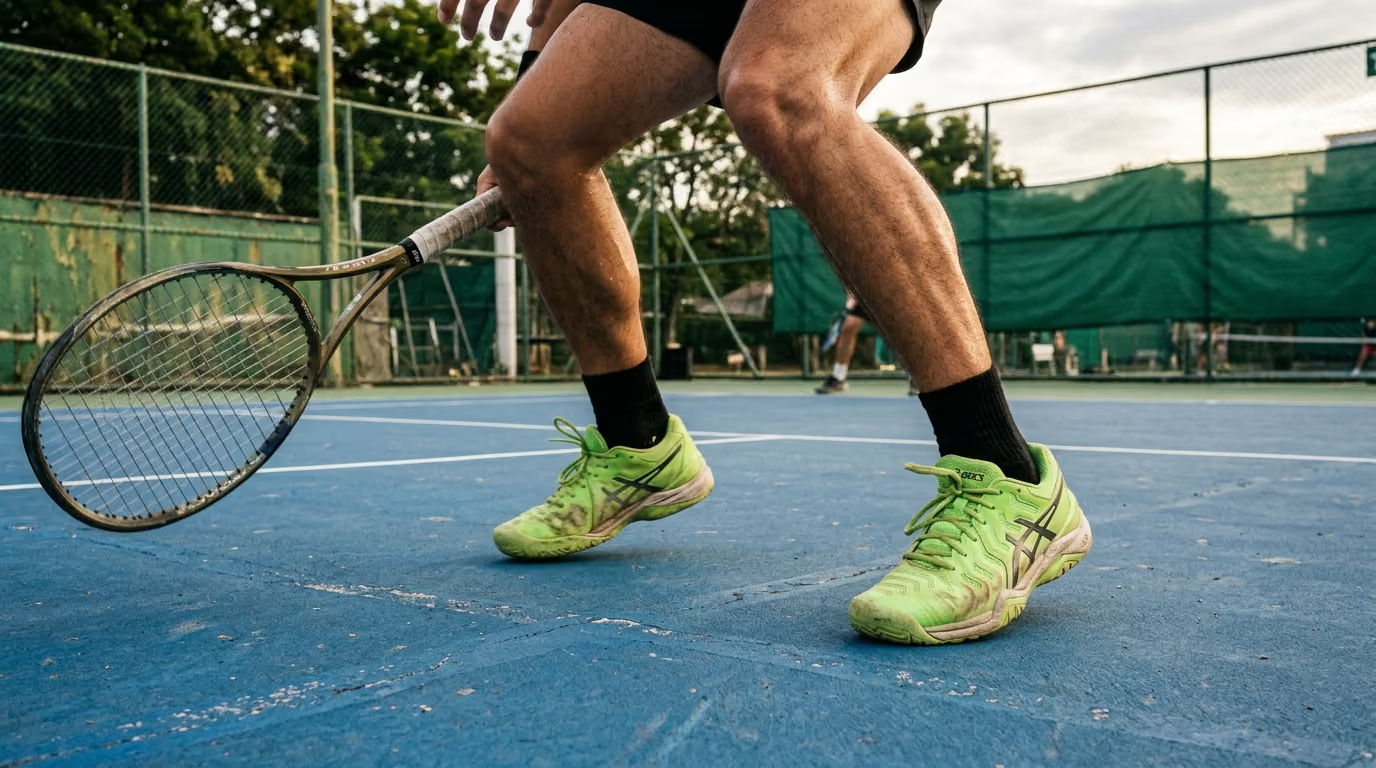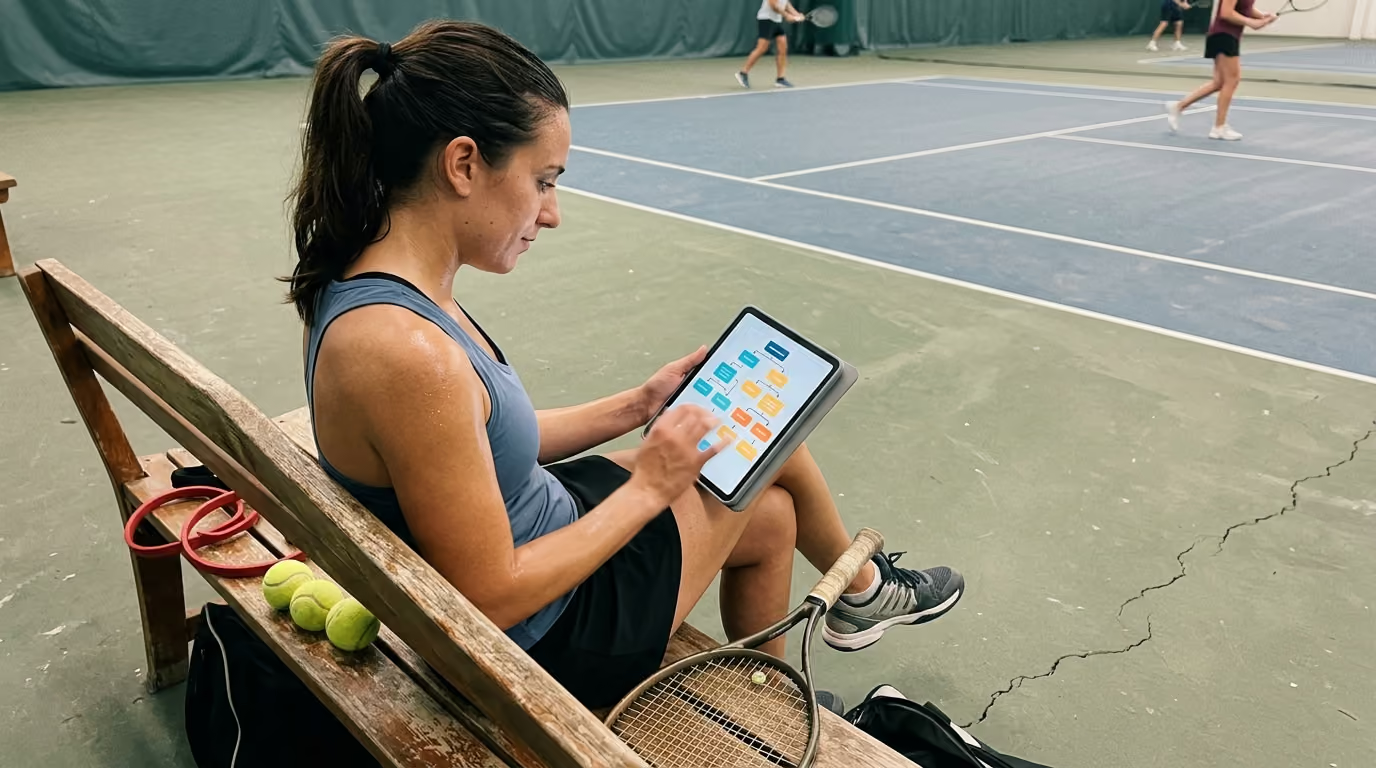

While many believe injury prevention in racquet sports involves a single solution, it actually requires a structured decision-making process.




If you have ever searched for solutions to lingering knee stiffness or shoulder discomfort after a long match, you have likely encountered conflicting advice. Some sources suggest complete rest, while others recommend immediate equipment changes, technique overhauls, or complex stretching routines. The most effective approach to remaining on the court is not a single corrective measure but a structured sequence of choices.
Injury prevention in racquet sports is a staged decision-making process. Players can maintain their athletic longevity by identifying symptoms early, analyzing recent training load spikes, and modifying the least disruptive variable first. If relative rest, technical refinement, or minor equipment adjustments do not resolve the issue, a professional clinical assessment is the necessary next step.
To manage physical symptoms effectively, you must understand the relationship between the demands of your sport and the current capacity of your body. Physical symptoms rarely appear without a reason. They typically occur when the physical demands of play exceed what your muscles, tendons, and joints can tolerate.
We can define this relationship using three simple concepts: demand, capacity, and reserve. Demand is the sum of all forces and stress placed on your body during play. Capacity is the amount of repetitive loading your tissues can tolerate before breaking down. Reserve is the physiological safety margin between your current capacity and the immediate demands of your sport.
When demand exceeds capacity, your physical reserve disappears, and the risk of tissue irritation increases. To measure these factors, sports scientists divide training load into two categories.
External load is the objective work you perform on and off the court. It is easily measured and tracked over time. Key measures of external load include:
According to the International Olympic Committee consensus on load in sport, tracking these objective metrics is the first step in understanding training stress.
Internal load is your body's physiological and psychological response to that external work. The same two hours of singles play can represent vastly different internal stress for different players. Your response depends on sleep quality, age, nutritional status, and stress levels. Internal load indicators include:
An sudden rise in internal load while external load remains the same often indicates that your body is struggling to recover. For adult players focused on healthy aging and athletic longevity, tracking both external and internal metrics helps prevent minor issues from becoming chronic conditions.
A systematic review of high-performance tennis injuries published in 2025 outlines a clear picture of how injuries occur on court. The review identified three distinct prevention clusters: load control, kinetic chain conditioning, and technical or equipment adjustments. This classification supports the idea that injury prevention is a multi-layered process rather than a single habit.
Epidemiological data shows that injury rates vary depending on the level of play and age. Junior tennis players experience between 2.1 and 3.5 injuries per 1,000 hours of practice. For adult recreational and competitive players, estimates range from 1.25 to 56.6 injuries per 1,000 hours. This wide range reflects differences in how studies define an injury, with some tracking only time lost from play and others tracking every minor complaint.
Research highlights that lower-extremity injuries are highly prominent across all racquet sports, followed closely by upper-extremity and trunk issues. In competitive junior players, seasonal injury prevalence reaches up to 54%, indicating that nearly half of all active players manage some form of physical complaint during the year.
Workload spikes are particularly influential in these statistics. A notable study on competitive adolescent tennis players, known as the SMASH cohort study, tracked shoulder injuries over a season. Researchers found that each sudden spike in external workload was associated with a hazard-rate ratio of 1.26 for both shoulder complaints and acute shoulder injuries.
Another study focusing on high-performance junior players demonstrated a 1.62-fold increase in injury risk for every standard increment of acute workload increase in the most recent week. However, the researchers emphasized that acute workload is a risk marker rather than a perfect diagnostic tool. High workload alone cannot predict whether an individual player will experience pain, as individual physical capacity and recovery habits play a massive role.
When a physical symptom appears, you should follow a systematic decision tree to determine your next step. This sequence prevents you from making random changes or ignoring warning signs.
The first step is to rule out serious medical issues. If you experience visible joint deformity, an inability to bear weight, rapid swelling, joint locking, or significant loss of sensation, stop playing immediately. These symptoms are not suitable for self-management and require professional medical evaluation.
If there are no red flags, identify how the symptom started. Did it follow a specific traumatic event, such as a fall, a sudden twist during a split step, or a sudden pop in a joint? Traumatic onset requires caution, and if you cannot perform basic daily tasks without pain, you should see a healthcare provider. If the pain developed gradually over several weeks, you can proceed to load and technique analysis.
Look back at your training calendar over the last three weeks. Have you suddenly increased your playing hours, joined a new tournament, or switched from doubles to singles? If you identify a sudden increase in external load, the first and most logical step is to reduce your playing volume back to a tolerable level.
Determine if the pain is linked to a specific movement on the court. Does your shoulder only hurt when serving, or does your elbow flare up during a late backhand contact? If the symptom is stroke-specific, you can modify that particular stroke rather than stopping all tennis, pickleball, or padel activity.
When pain is linked to a specific stroke, technical errors are often a contributing factor. Biomechanical efficiency allows you to transfer force from the court surface through your body and into the ball with minimal joint stress.
The kinetic chain refers to the coordinated transfer of energy through connected body segments. In a tennis serve or a padel smash, force is generated by pushing off the ground with the legs. This force travels through the hips, trunk, shoulder, elbow, and finally the wrist.
If any link in this chain is weak or mistimed, the distal joints must compensate to generate ball speed. For example, if you do not bend your knees or rotate your hips during a serve, your shoulder and elbow must work harder to accelerate the racquet. A systematic review of upper-limb tennis injuries highlights kinetic chain integrity and scapular mechanics as key factors in reducing joint strain.
Contacting the ball late is a common source of elbow and wrist strain. When you hit the ball behind your body, your forearm muscles must contract forcefully to stabilize the wrist against the impact. Keeping contact well in front of your body allows you to use the larger muscles of the shoulder and trunk to absorb the shock.
Excessive grip tension is another critical technical error. Many players hold the racquet or paddle too tightly throughout the entire swing. This constant muscle contraction can overload the tendons at the elbow, leading to lateral epicondylitis, commonly known as tennis elbow.
You should aim to hold your handle with just enough tension to prevent it from slipping, relaxing your grip between hits and tightening only at the moment of impact.
Serve-related shoulder pain is often associated with a low toss or poor trunk positioning. A toss that is too low forces you to hit the ball with a bent elbow, reducing the leverage of the arm and increasing strain on the rotator cuff.
Similarly, excessive backbending at the lumbar spine, rather than extending through the thoracic spine and hips, can overload the lower back. Working with a qualified coach to review your toss height, body rotation, and follow-through is a practical way to manage serve-specific symptoms.
One of the most common mistakes court athletes make is adopting an all-or-nothing approach to recovery. Many players believe they must either play through pain or stop playing entirely. Clinical guidance on tendon issues suggests that relative rest is far more effective than complete inactivity.
Relative rest involves reducing or replacing aggravating activities while maintaining a tolerable level of loading. Complete rest can cause your muscles and tendons to decondition, making them less capable of tolerating court demands when you return. By keeping your tissues active within a pain-free range, you promote blood flow, maintain mobility, and preserve your fitness.
To implement relative rest, you can use a simple hierarchy of training modifications:
Tracking your daily training parameters can help you identify trends and manage your relative rest effectively. A practical tracking log does not need to be complicated. You can record the following details in a simple journal:
The primary goal of tracking these metrics is to spot patterns. If your next-morning soreness consistently rises above a mild level, your current court workload is likely too high, and you should reduce your playing time. For advice on balancing court activity and physical recovery, you can read our specialized recovery science resources.
If you have modified your workload and technique but still experience symptoms, your equipment may be contributing to the problem. Racquets, strings, shoes, and court surfaces all influence how forces are transmitted to your body.
The weight, stiffness, and balance of your racquet or paddle directly affect joint loading. A racquet that is too light can actually increase tissue strain because it lacks the mass to absorb ball impact, forcing your arm muscles to absorb more shock. Conversely, a racquet that is too heavy can cause early fatigue, leading to technique breakdown.
Frame stiffness is another key factor. Stiff frames transfer more impact vibration to the hand, wrist, and elbow. If you struggle with arm pain, switching to a more flexible frame can reduce this vibration.
Additionally, string material and tension play a major role in tennis. Polyester strings are highly durable but very stiff, transferring significant shock to the arm. Soft multifilament or natural gut strings, combined with a slightly lower string tension, provide a more forgiving feel and reduce the force of impact.
The size of your grip is also worth evaluating. A grip that is too small forces you to squeeze the handle tightly to prevent twisting, while a grip that is too large limits wrist snap.
However, scientific evidence on grip size is mixed. While some studies suggest that an optimal grip diameter minimizes tendon loading, other reviews show that a modest deviation in grip size does not significantly alter forearm muscle activity. It is wise to adjust grip size based on personal comfort rather than rigid formulas.
Your lower joints are heavily influenced by the interaction between your shoes and the court surface. Racquet sports require constant acceleration, sudden deceleration, and rapid lateral changes of direction. The frictional resistance at the shoe-surface interface determines how smoothly you can stop and start.
If your shoe outsole is worn out, you may slip, placing sudden, unpredictable demands on your groin, hamstrings, and ankles. Conversely, if your shoes have too much grip on a dry hard court, your feet can stick to the surface, transferring rotational forces up into your knees and hips.
Ensure you are wearing court-specific shoes designed for your specific playing surface. Running shoes, for example, lack lateral support and have tread patterns that do not allow for controlled sliding, making them highly unsuitable for court sports.
To enjoy racquet sports for years, you must actively build your body's physical capacity. Relying solely on playing to stay fit is a common path to overuse issues. A structured off-court training routine can help you build the physical reserve needed to handle high match demands.
For a comprehensive approach to building court-specific strength, you can read our strength and conditioning programs guide.
Lower-extremity issues, including ankle sprains, Achilles tendinopathy, and patellar tendon pain, are common across all racquet sports. Building capacity in these tissues requires targeted loading:
The shoulder is a highly mobile joint that relies on muscles for stability. High-velocity strokes like serves, overheads, and hard volleys require a strong rotator cuff to stabilize the humeral head within the joint socket.
To support shoulder health, incorporate exercises that target the posterior rotator cuff and scapular stabilizers. Cable or band external rotations, face pulls, and prone Y-raises help balance the shoulder joint, offsetting the repetitive forward-swinging motions of play.
Focus on high-repetition endurance rather than maximum strength, as these muscles must remain active throughout long, multi-set matches.
If you play sports that require rapid wrist action, building local muscular capacity in the forearm is highly beneficial. Simple wrist curls, reverse wrist curls, and forearm pronation/supination exercises using a light dumbbell can build resilience in the tendons around the elbow.
Ensure these exercises are performed in a pain-free range of motion. Progression should be gradual, starting with light weights and focusing on controlled movements.
Racquet sports require excellent dynamic balance to hit clean strokes while moving. Adding single-leg balance exercises, soft-landing plyometrics, and controlled lateral shuffling to your off-court routine can improve your movement efficiency. These exercises teach your nervous system to absorb landing forces through your muscles rather than your joints.
If you are new to off-court training, you can read about preparing your joints for lateral demands in our guide on mobility and movement preparation.
While tennis, pickleball, and padel share many similarities, each sport places unique biomechanical demands on your body. Understanding these differences allows you to customize your prevention strategy.
Tennis is characterized by large swinging motions, high-velocity overhead serves, and explosive movement across a large court. The high volume of overhead serving makes tennis players particularly vulnerable to shoulder rotator cuff irritation and lower-back strain.
The larger court size also means players must cover more distance, leading to higher impact forces on hard court surfaces. Tennis players should prioritize rotator cuff endurance, thoracic spine mobility, and deceleration strength to handle these high-velocity demands.
Pickleball is played on a smaller court with a lighter, solid paddle and a plastic ball. Because the court is smaller, players cover less total distance but engage in rapid, short-duration lateral movements.
The low bounce of the plastic ball forces pickleball players to spend significant time in a deep crouch, lunging forward to reach low dink shots. This constant knee flexion can place high demands on the patellar tendon and the lower back.
Additionally, the stiff paddle and plastic ball transfer high-frequency vibrations to the arm. Pickleball players should focus on hip mobility, quadriceps capacity, and forearm strength to manage low lunges and paddle vibration.
Padel is a fast-paced game played in an enclosed glass court, utilizing a solid, perforated racket. The sport is characterized by a very high volume of overhead strokes, including the bandeja and the vibora, which are unique to padel.
These repetitive overhead motions place consistent demands on the shoulder, chest, and upper back. Additionally, players must frequently rotate their bodies to play balls rebounding off the glass walls, placing rotational strain on the knees and spine.
Padel players should focus on thoracic rotation mobility, shoulder stability, and rapid deceleration strength to handle court transitions and repetitive overhead actions.
When managing minor physical complaints, avoid these common mistakes that can delay your recovery.
Many players stop all physical activity the moment they feel discomfort. While complete rest may temporarily reduce pain, it does not address the underlying issue.
When you rest completely, your muscles, tendons, and joints lose capacity. When you return to the court, your tissues are actually less capable of handling the demands of play, often leading to a return of the symptom.
Unless you are managing an acute traumatic injury or red-flag symptoms, relative rest and modified play are far more effective for long-term health.
It is tempting to blame your pain on a single technical error, a specific racquet model, or a lack of stretching. In reality, injuries are almost always caused by a combination of factors.
Your pain may be the result of a recent workload spike, poor sleep, a stiff racquet, and a slightly late contact point all occurring together. Focusing on only one variable can lead to frustration if your symptoms do not improve.
Use a holistic approach, addressing training load first, followed by technique, equipment, and conditioning.
Some training advice suggests using strict formulas, such as the acute-to-chronic workload ratio, to predict your injury risk. While these calculations are useful in academic research, they have low predictive value for individual recreational players.
Do not rely on a spreadsheet to tell you if you are healthy enough to play. Listen to your body, monitor your morning stiffness, and adjust your court hours based on your personal response to training.
A thorough warm-up is excellent for preparing your nervous system and increasing blood flow to your muscles before a match. However, a warm-up cannot prevent injuries caused by chronic overloading or poor physical conditioning.
Spending ten minutes stretching before a match will not protect your shoulder if you have doubled your serving volume over the last week. View your warm-up as a preparation tool rather than an injury-prevention shield.
To see how the decision tree works in real life, let us examine four common court scenarios.
A recreational tennis player develops lateral elbow pain after switching to a stiffer racquet and increasing their singles play from once to three times a week.
First Actions: Reduce singles play back to once a week, swapping the other sessions for controlled doubles or light groundstroke drills. Ensure contact is made well in front of the body, and avoid squeezing the handle too tightly. Review the racquet setup, and consider lowering the string tension or using a softer multifilament string.
A competitive junior player adds multiple dedicated serving sessions to prepare for an upcoming tournament and develops shoulder pain late in practice.
First Actions: Temporarily stop hitting full-velocity serves and overheads during practice. Maintain cardiovascular fitness and leg strength through groundstroke drills and off-court agility work. Assess the player's kinetic chain sequencing to ensure they are using their legs and trunk to generate power. Gradually reintroduce serving at low volume once the shoulder is completely pain-free.
An adult player transitions from soft clay courts to hard indoor courts and develops knee pain during deep lunges and lateral braking.
First Actions: Reduce the intensity of match play, replacing some games with cooperative drills that require less explosive stopping. Check the player's footwear to ensure the outsoles are not worn, as slipping can cause awkward muscle contractions. Incorporate single-leg balance and hamstring-focused strengthening exercises off court to improve landing mechanics.
A player returns from a winter break and immediately resumes a full schedule of singles matches and heavy gym training, resulting in lower-back stiffness.
First Actions: Reduce playing time by half for the next two weeks to allow the body to adapt. Break up the return by separating court sessions and heavy gym sessions on different days. Focus on gentle movement and walking to manage mild stiffness, avoiding prolonged sitting immediately after matches. Rebuild playing hours gradually, adding no more than ten to fifteen percent of court time each week.
For more detailed advice on managing recovery during a return to sport, you can browse our curated injury prevention resources.
While self-management and relative rest are highly effective for minor, predictable symptoms, you must know when to seek professional medical advice. If you experience any of the following signs, stop playing and arrange an assessment with a qualified physiotherapist, sports physician, or healthcare provider:
Seeking an early professional assessment for these warning signs can prevent minor issues from developing into chronic injuries that keep you off the court for months.
To apply this knowledge to your own play, focus on these practical actions this week:
If you would like to read more about the Evercourts philosophy of evidence-led, practical court longevity, please visit our about page or reach out to us directly through our contact page.
Follow Evercourts for practical insights on tennis, pickleball and padel performance, movement, recovery and healthy ageing. Stay connected for new articles, research-led guidance and ideas to help you play well and keep playing for years.


Read practical guidance for better movement, smarter preparation and a game that keeps working for you.
explore the Blog