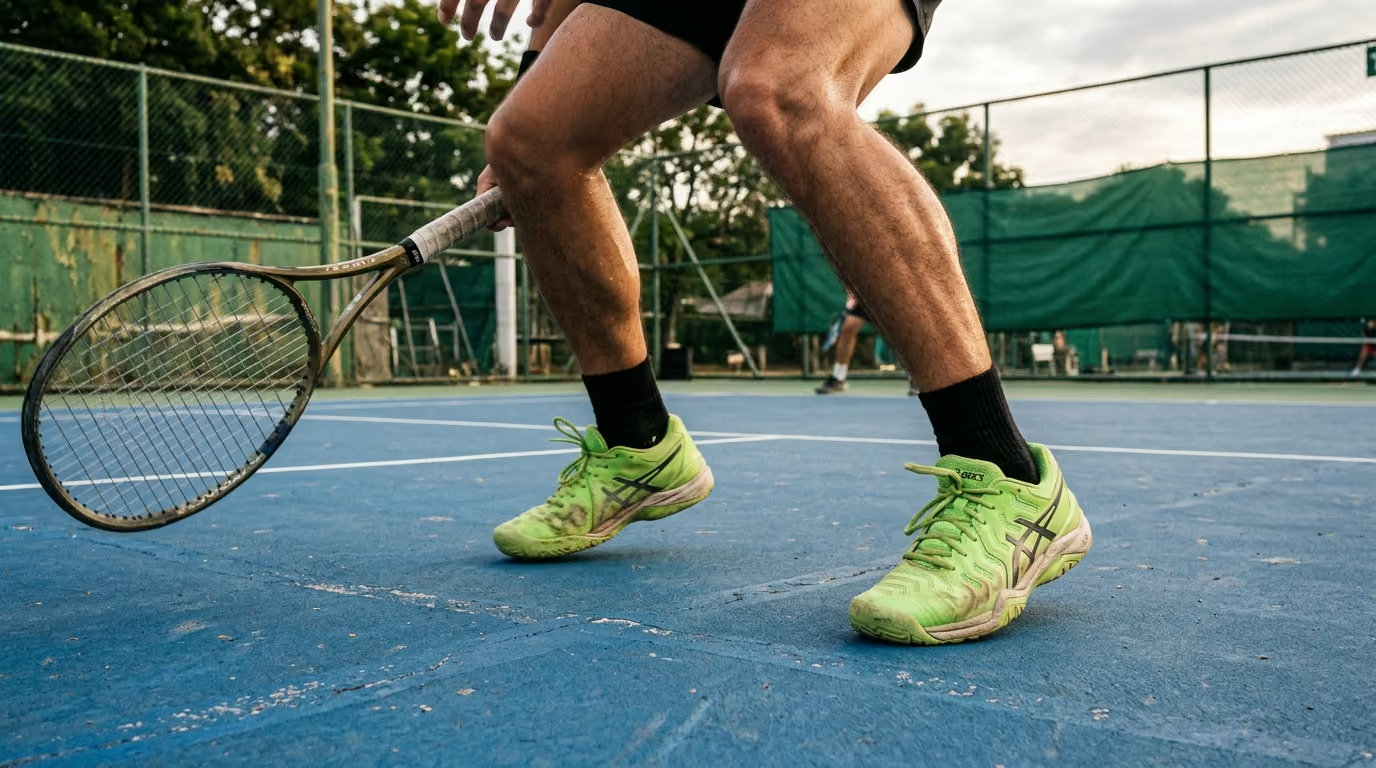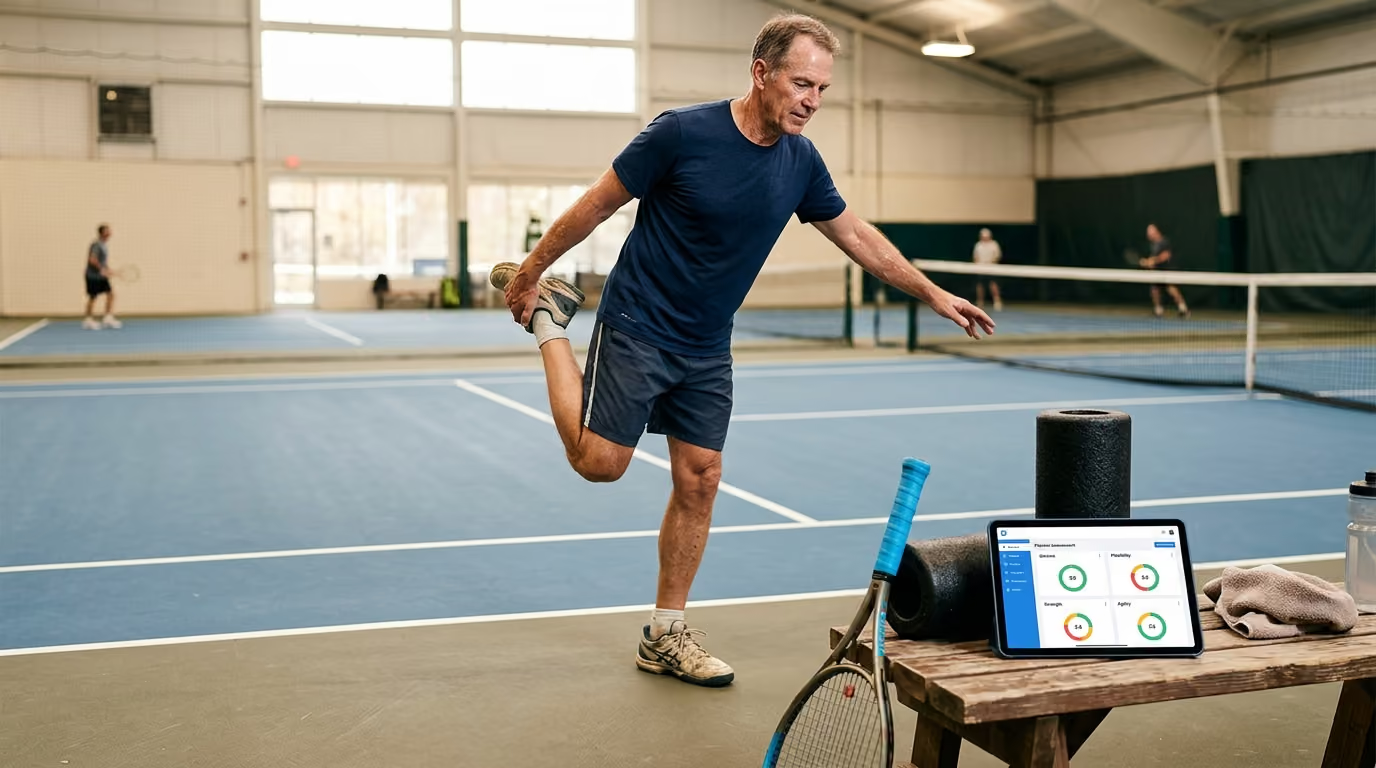

While many assume chronic soreness is an inevitable part of racquet sports, a structured self-assessment offers a clear path to identify and address physical limitations.




If you have ever searched for why your knees ache after tennis or how to resolve morning stiffness after a long match, you are not alone. Many players assume that chronic soreness is an inevitable consequence of getting older on the court. A structured self-assessment offers a clear path to identify physical limitations before they turn into injuries.
To evaluate your physical preparation for racquet sports, you must measure your movement control, strength, balance, and recovery. This self-assessment serves as a decision-making tool to identify which areas require targeted training or volume modifications. By systematically addressing these bottlenecks, you can build a reliable foundation for lifelong play.
Let us address the relationship between racquet sports and long-term health. Large observational studies have linked racquet sports with impressive health benefits. Research published in the American Journal of Epidemiology studied cohorts to find associations with lower all-cause mortality. For instance, accumulating 7.5 to less than 15 MET-hours per week of racquet sports was associated with a hazard ratio of 0.84 for all-cause mortality compared with nonparticipation.
While this observational data is promising, it does not prove that playing racquet sports is a direct cause of a longer life. It suggests that individuals who maintain the physical capacity to play these sports regularly tend to enjoy better overall health. The true challenge for the active player is managing the physical costs of playing. If you cannot tolerate the repeated forces, you cannot accumulate the court hours required to experience these longevity benefits.
Tennis, pickleball, and padel impose unique physiological stresses. Sports medicine literature shows that the lower extremity is the most common region for acute injuries. Ankle sprains, calf strains, and knee issues occur frequently due to sudden direction changes. Conversely, chronic overuse problems tend to affect the upper limb, including the shoulder, elbow, and wrist.
To play without disruption, your training must match the specific stresses of your sport. This requires a shift in how we view physical preparation. Rather than simply trying to play more, we must intentionally build physical capacity. A comprehensive assessment allows us to transition from guessing to targeted training. Learn more by browsing our healthy aging resources to understand how to keep your body moving well.
Before you begin any physical testing, you must establish whether it is safe to do so. A standardized health screen ensures you do not aggravate an underlying condition. The American College of Sports Medicine preparticipation model focuses on three key variables. These are your current physical activity level, the presence of signs or symptoms of cardiovascular, metabolic, or renal disease, and your desired exercise intensity.
This approach is far more practical than using age alone as a barrier to exercise. A highly active seventy-year-old player has different physical capabilities than an inactive thirty-five-year-old. The first phase of this framework is a symptom checklist. You must evaluate whether you experience any of the following during or after exertion:
If you experience any of these symptoms, do not proceed with physical testing. Instead, consult a qualified medical professional to obtain clearance. If you are symptom-free, you can classify any minor physical discomfort you currently feel. This classification helps determine how to proceed with the movement and strength tests.
We recommend sorting your current physical state into four distinct categories:
To ensure your results are reliable, you must standardize your testing environment. Perform the tests at the same time of day, wearing your typical court shoes. Use a consistent warm-up of five minutes of light movement before you begin. Avoid testing immediately after a strenuous match, and keep your hydration and caffeine intake consistent across testing dates.
Court sports require you to access deep, challenging joint angles under speed. If your joints lack the necessary range of motion, your body will find that movement elsewhere, often by overloading your lower back or knees. By evaluating your basic movement patterns, you can identify these hidden mobility restrictions. Use our resources on mobility and movement to address any restrictions you find.
A standard body-weight squat is a fundamental pattern for any court athlete. To perform this test, stand with your feet shoulder-width apart and lower your hips as deep as comfortable. Observe whether your heels lift off the ground, which suggests limited ankle mobility. Note if your knees cave inward or if your trunk collapses forward.
For older adults, the 30-second chair-stand test is a reliable, functional measure. Sit on a standard chair with your arms folded across your chest. Stand up and sit down as many times as possible in thirty seconds. This test combines strength, balance, and movement confidence.
Rather than comparing your score to abstract age-adjusted norms, focus on your individual progress. Note whether you can complete the movement symmetrically without leaning to one side. Record your score and use it as a personal baseline to track over time.
The hip hinge is essential for retrieving low balls and absorbing impact when landing. To test this pattern, stand with your feet hip-width apart and push your hips backward while keeping your spine long. You should feel a stretch in your hamstrings rather than tension in your lower back.
Inability to load the hips often leads to excessive bending through the lumbar spine. While we do not advocate for a rigid, single posture on the court, a player must be able to load the posterior chain comfortably. If you cannot bend from the hips without significant back rounding, your lower back may tolerate excessive stress during long rallies.
Lunging is the primary way racquet players decelerate and reach for distant balls. To evaluate this capacity, perform five controlled forward lunges on each leg, followed by five lateral lunges. Observe whether you can maintain control of your knee alignment.
Your knee should stay in line with your second toe rather than collapsing inward. It is perfectly acceptable for the knee to travel past the toes, provided you have the ankle mobility to support it. Note if you experience pain, apprehension, or a loss of balance on either side.
Single-leg balance is critical because court sports are played almost entirely on one leg at a time. The lower-quarter Y-Balance Test is a highly reliable measure of dynamic neuromuscular control. Research indicates that this test has high adult intrarater reliability, with intraclass correlation coefficients between 0.85 and 0.91.
To perform a simplified home version, stand on one leg and reach your opposite foot as far forward as possible, tapping the toe lightly before returning. Repeat this reach diagonally backward and outward, and then diagonally backward and inward. Measure the distance of your reach and compare your left leg to your right leg.
Keep in mind that minor asymmetries are normal in racquet sports. However, a massive difference in reach distance or significant instability on one side highlights an area that needs attention. Do not treat dynamic reach as a perfect injury predictor, but use it to guide your balance training.
Your shoulder, upper back, and neck must rotate smoothly to generate racquet speed. To assess upper-body mobility, stand with your back flat against a wall. Raise both arms overhead, attempting to touch the wall with the back of your hands without arching your lower back.
Next, test your shoulder rotation by holding your elbows out at shoulder height, bent at ninety degrees. Rotate your forearms backward to touch the wall, measuring external rotation. Then rotate your forearms forward and downward, measuring internal rotation. Note any pain, pinching, or significant differences between your dominant and non-dominant sides.
Court sports demand more than just cardiovascular fitness. Your muscles, tendons, and joints must be strong enough to absorb the impact of running, stopping, and hitting. We must evaluate strength across several major regions of the body. Refer to resources on strength and conditioning to help improve these baseline metrics.
To assess your lower-body strength endurance, perform a single-leg split squat. Place one foot behind you on a low step and lower your back knee toward the floor. Count how many controlled repetitions you can complete on each leg before fatigue compromises your technique.
For calf and Achilles tendon capacity, perform single-leg calf raises on the edge of a step. A competitive court athlete should aim for twenty-five to thirty controlled, full-range repetitions on each leg. Note if one calf tires significantly faster than the other, as calf weakness is a common contributor to Achilles issues.
The European Working Group on Sarcopenia in Older People (EWGSOP2) uses specific strength thresholds for health screening. For example, taking more than fifteen seconds to complete a five-repetition chair stand is an indicator of low muscle strength. While these are clinical screening values for older populations, they provide a valuable absolute baseline for healthy aging on the court. To maintain athletic longevity, you should comfortably exceed these basic clinical markers.
Grip strength is essential for controlling the racquet and preventing elbow strain. While a hand dynamometer provides the most objective measurement, you can evaluate your capacity through functional holds. Try holding a heavy weight, such as a kettlebell or a dumbbell, in one hand for thirty seconds.
In the EWGSOP2 framework, low grip strength is defined as below 27 kilograms for men and below 16 kilograms for women. Again, these are geriatric screening thresholds rather than performance targets for active court players. A healthy player should aim for symmetrical grip strength, though your dominant arm may be slightly stronger due to years of play.
Overuse injuries of the shoulder and elbow are common in all racquet sports. To assess your upper-body endurance, perform a standard push-up test, modifying to an incline on a bench if necessary. Focus on your shoulder blade movement during the exercise.
Your shoulder blades should move smoothly across your rib cage without winging or flaring outward. To test rotator cuff endurance, lie on your side with a light weight in your top hand. Keep your elbow tucked against your side and rotate your forearm upward toward the ceiling. Count the repetitions until fatigue, comparing your dominant arm to your non-dominant arm.
Your core muscles act as a bridge, transferring force from your legs to your upper body. To test trunk endurance, perform a side plank on your elbow and feet, holding a straight line for as long as possible. A healthy court player should be able to hold a side plank for forty-five seconds on each side.
Compare your hold times to check for significant asymmetry. A weakness on one side of your trunk can cause your body to twist unevenly during high-speed rotational movements. This asymmetry can increase the stress placed on your lumbar spine during hard groundstrokes or overhead shots. You can learn more about managing these patterns through injury prevention strategies.
Most court injuries do not happen when you are speeding up. They happen when you are trying to stop or change direction quickly. If your body cannot absorb force efficiently, your joints and connective tissues will bear the brunt of the impact.
To safely evaluate your braking ability, use a progressive testing protocol. Perform each step only if the previous step was completely pain-free and controlled.
During these tests, observe your movement mechanics. Note how many steps you require to come to a complete stop. Watch for any inward collapse of your knee, or any tendency for your trunk to tilt excessively forward or sideways.
A controlled, multi-step deceleration is often much safer than a sudden, jarring stop that overloads your joints. If you feel apprehension, instability, or pain during any phase of this protocol, stop immediately. This indicates that your braking capacity is currently a limiting factor in your movement.
Court conditioning is highly specific. It is not simply a matter of being able to jog for a long distance. You must be able to perform short bursts of intense effort, recover quickly during the brief rest between points, and maintain this capacity over several hours.
To evaluate your aerobic base without needing expensive laboratory equipment, you can use a simple talk test. Move at a moderate pace, such as brisk walking, cycling, or light court drilling, for twenty minutes. During this time, attempt to speak in full sentences.
If you can talk comfortably but cannot sing, you are working at a moderate intensity. If you must gasp for breath between words, you have crossed your aerobic threshold. Note how long you can maintain a moderate pace before your breathing becomes labored.
For a more structured test, complete a submaximal step test. Step up and down on a twelve-inch bench at a steady pace for three minutes. Immediately after finishing, sit down and measure your heart rate. Check your heart rate again after one minute and two minutes of rest to see how quickly your cardiovascular system recovers.
To assess your sport-specific endurance, perform an intermittent shuttle test on the court. Set two markers ten meters apart. Shuffle sideways between the markers for twenty seconds, rest for ten seconds, and repeat this cycle ten times.
During this test, monitor your movement quality. Note if your footwork becomes sloppy, if your reaction time slows down, or if you begin to experience muscle tightness. This profile will help you understand whether your conditioning limits your performance during long matches. Refer to our court performance guides to learn how to structure your cardiovascular training.
Even the best training plan will fail if your body cannot adapt to the workload. Recovery is not a passive state, it is an active capacity that determines how well you respond to training. We must track both your recovery habits and your recent weekly playing volume. Explore our recovery science resources to design a balanced recovery routine.
Sleep is the single most effective recovery tool available to athletes. Research published in Clinical Journal of Sport Medicine indicates that chronic short sleep of seven hours or less per night is associated with a 1.7 times greater risk of musculoskeletal injury when sustained for two weeks or more.
While this research is associative, the practical lesson is clear. If you are consistently sleeping poorly, your tissues are more vulnerable to the repetitive strain of court play. Track your sleep duration and consistency for one week to establish your baseline.
To monitor your recovery daily, score the following areas from zero to ten every morning:
Add these scores to create a daily readiness rating. Use this rating to adjust your training volume. On days with low scores, focus on low-intensity movement or mobility work rather than intense match play.
In our experience, ignoring these early morning signals is the quickest path to chronic issues. We remember finishing a tough two hour padel match on a cold Tuesday night and waking up the next morning feeling like my lower back was locked in concrete. For a long time, I just accepted this as the price of playing hard in my forties. But once I started spending just ten minutes on targeted hip mobility before heading to the club, the stiffness almost completely vanished. It taught us that we do not have to accept pain as a default state of aging. By tuning into your morning readiness, you can make smarter decisions before stepping onto the court.
To manage your injury risk, you must audit your training load. Write down your total playing and training hours over the last four weeks. Include matches, practice sessions, gym workouts, and even demanding physical work around the house.
The International Olympic Committee consensus statement on injury prevention has discussed the acute-to-chronic workload ratio (ACWR). This ratio divides your recent weekly load by your rolling four-week average. Some sports medicine literature suggested that ratios above 1.5 were linked to a higher risk of injury.
However, subsequent research has highlighted significant statistical limitations with this model. You should not treat a single workload ratio as a guaranteed mathematical formula for injury prevention. Instead, focus on the broader principle of avoiding sudden, dramatic spikes in your playing time or intensity. If you have played only two hours a week for a month, do not suddenly play eight hours in a single weekend.
While all racquet sports share common physical demands, each sport places unique stresses on the body. Your self-assessment should emphasize different areas depending on your sport of choice.
Tennis is played on a large court, requiring longer sprints and high deceleration forces. The overhead serve is a major biomechanical stressor, placing repetitive strain on the shoulder and lower back.
If you are a tennis player, your assessment must prioritize shoulder external-rotation endurance, scapular control, and hamstring capacity. You must also have excellent ankle mobility to handle the high-speed lateral sliding and stopping required on clay or hard courts. Learn more on our tennis articles page.
Pickleball is played on a smaller court, which reduces the need for long sprints but increases the demand for rapid, short movements. The game requires a high volume of deep squatting and lunging to retrieve low balls near the kitchen line.
If you play pickleball, focus your assessment on knee control during deep squats, single-leg balance, and wrist stability. The rapid-fire volleys require quick reaction times and excellent hand-eye coordination. Visit our pickleball articles section for sport-specific insights.
Padel is played in an enclosed court, combining elements of tennis and squash. The presence of glass walls means points are often longer, requiring superior aerobic endurance and repeated-sprint capacity.
Padel involves a very high volume of overhead lobs and rotational movements as you react to ball rebounds off the walls. If you are a padel player, your assessment should emphasize trunk rotation, side plank endurance, and thoracic mobility. Read our padel articles for detailed training advice.
When performing a self-assessment, it is easy to fall into common traps that can skew your results or lead to inappropriate training decisions.
Racquet sports are inherently asymmetrical. You swing with one arm and lunges often favor one side of your body. Expecting perfect symmetry on all strength and mobility tests is unrealistic.
The goal is not to force both sides of your body to look identical. Instead, look for major, painful, or worsening imbalances that limit your functional movement. A slight difference in shoulder rotation is normal, but a massive restriction that causes pain requires attention.
A self-assessment is designed to measure your baseline capacity, not to push you to the brink of collapse. Performing tests to failure can compromise your technique and increase your risk of injury during the assessment itself.
Always prioritize control over volume. If your movement quality begins to deteriorate during a test, stop immediately. Record that point as your functional limit rather than trying to squeeze out a few more sloppy repetitions.
To help you interpret your self-assessment results, let us examine several common player profiles and how their assessment results shape their training plans.
This player is forty-five years old and has excellent cardiovascular fitness. They can run for hours without fatigue, but they develop persistent shoulder pain whenever they increase their serving volume.
This player is thirty-eight years old and lifts heavy weights regularly in the gym. They can perform heavy squats and deadlifts easily, but they feel slow and clumsy when moving laterally on the court.
This player is sixty-eight years old and plays doubles three times a week. They sleep well, feel motivated, and report no joint pain, but they feel they are losing their physical quickness.
This player is a competitive singles player who trains hard five days a week. They perform exceptionally well on physical tests but feel constantly sore, irritable, and struggle to recover between matches.
This player is returning to the court after a moderate ankle sprain. They feel fine when jogging in a straight line, but they experience apprehension when moving quickly sideways.
Use this self-evaluation scorecard to document your findings. Grade each section based on your performance and use the results to build your training priorities.
While this self-assessment is designed to help you manage your physical capacity, it is not a substitute for professional medical care. You should consult a qualified healthcare provider, such as a physical therapist or sports physician, if you experience any of the following:
A qualified professional can provide an accurate diagnosis and design a targeted rehabilitation plan. Do not ignore persistent symptoms in the hope that they will simply go away. Addressing minor issues early is the most effective way to protect your long-term athletic longevity. For general inquiries about our physical guides, you can visit our contact page.
Use this simple checklist to begin applying this self-evaluation framework to your playing routine this week:
Follow Evercourts for practical insights on tennis, pickleball and padel performance, movement, recovery and healthy ageing. Stay connected for new articles, research-led guidance and ideas to help you play well and keep playing for years.


Read practical guidance for better movement, smarter preparation and a game that keeps working for you.
explore the Blog