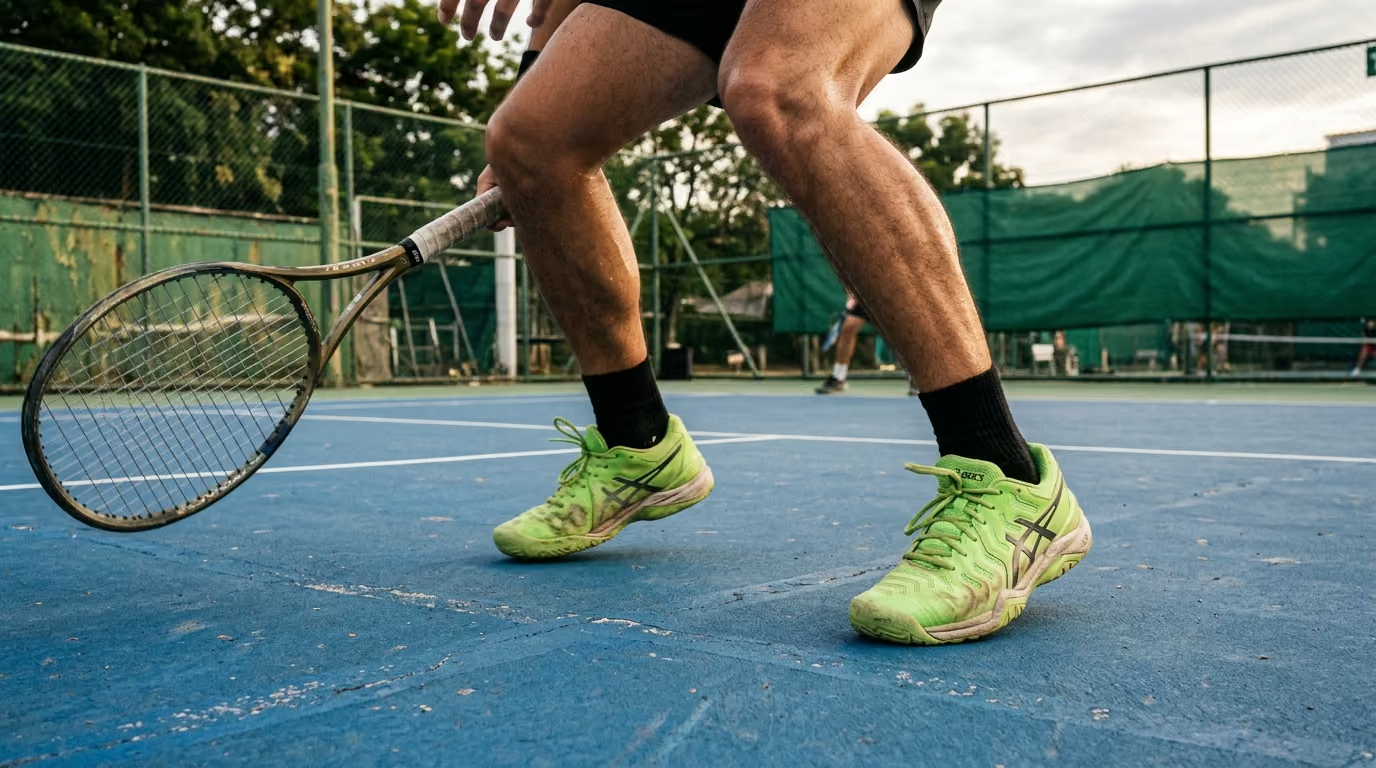

Many assume complicated routines or expensive gadgets are needed for racquet sport longevity, but a simple personal tracking system effectively protects your body.




How can I keep playing my favorite racquet sport as I get older without my knees and shoulders constantly aching? Many players search for an answer to this question after a hard match on the court. The search for a solution often leads to complicated fitness routines or expensive recovery gadgets. However, the most effective way to protect your body is to establish a simple, personal tracking system. By watching a few key areas of your training, physical strength, and recovery, you can make minor changes before minor irritations turn into long-term injuries.
A racquet sports longevity scorecard is a personal monitoring system designed to track training exposure, physical capacities, and recovery markers over time. By tracking simple metrics such as weekly match minutes and grip strength, you can notice patterns before they lead to injury. This practical dashboard allows you to make minor adjustments to your weekly play, helping you maintain your movement on the court for years to come.
To understand why tracking matters, we must look at the science of healthy aging and physical activity. Researchers have long been interested in how specific activities impact our overall lifespan and physical health. A major cohort study published in the British Journal of Sports Medicine examined the association between different types of exercise and mortality rates. The researchers analyzed data from over 80,000 adults to see how their choice of sport affected their long-term health.
The results showed that racquet-sport participation was associated with a strong reduction in mortality risks. Specifically, the study reported that racquet-sport participation was associated with a 47 percent lower risk of death from any cause compared to not participating. It also showed a 56 percent lower risk of death from cardiovascular disease or stroke. Another analysis of international athletes reported that racquet sports were associated with an extended lifespan of several years.
However, we must interpret these findings carefully. This was an observational study, which means it cannot prove that playing racquet sports is the direct cause of a longer life. The players in the study may have had other healthy habits. They may have had higher incomes, better access to healthcare, or stronger social connections. Therefore, racquet sports should be viewed as one part of a balanced lifestyle, not a single cure for aging.
To build a sustainable routine, you must balance your time on the court with other healthy behaviors. The World Health Organization recommends that adults complete 150 to 300 minutes of moderate-intensity aerobic activity per week. Alternatively, you can complete 75 to 150 minutes of vigorous-intensity aerobic exercise. The guidelines also state that adults should perform muscle-strengthening activities involving major muscle groups at least two days per week.
For older adults, the World Health Organization emphasizes the addition of balance-focused activities to prevent falls. Racquet sports provide excellent aerobic benefits and multi-directional movement, but they do not automatically cover all your strength and balance needs. A personal scorecard helps you see if your training meets these complete recommendations. You can find more structured advice on balancing court time with physical preparation by visiting specialized healthy aging and athletic longevity resources online.
The first domain of your personal longevity scorecard is training volume and match load. To manage your physical strain, you must measure how much stress you are placing on your tissues. Many players only track the number of matches they play each week. However, match count does not tell the whole story. A two-hour singles match in hot weather is much more demanding than an hour of friendly doubles.
To get an accurate picture, you should track both external load and internal load. External load describes what you actually did on the court. This includes your total playing minutes, the number of matches completed, and the format of play. Internal load describes how demanding that activity felt to your body. You can estimate your internal load using a simple calculation.
First, rate the intensity of your session on a scale of 1 to 10, where 1 is extremely easy and 10 is maximal effort. This rating is known as your Rate of Perceived Exertion. Next, multiply your session duration in minutes by your intensity rating. This calculation gives you a single number representing your session load in arbitrary units.
Using this method consistently allows you to compare the physical stress of different weeks. In sports science, researchers often compare your acute workload to your chronic workload. Your acute workload is the total load accumulated over the last seven days. Your chronic workload is the average weekly load over the last three to six weeks.
Earlier sports literature suggested that keeping these two workloads in balance could help manage injury risk. However, recent scientific critiques argue that rigid ratios are not reliable predictors of injury. Every individual has a unique baseline, and personal circumstances change constantly. Instead of using complex formulas, you should use a simple load-change flag system to monitor your training.
A green flag means your current weekly load is similar to your recent average, and you feel well recovered. A yellow flag indicates that your weekly load has increased significantly, or you have played several intense matches close together. A red flag occurs when a sudden spike in playing time happens alongside poor sleep or persistent muscle soreness. This flag system tells you when to schedule an extra rest day or reduce your playing intensity. Managing these flags is a vital part of using established injury prevention strategies to keep your joints healthy.
Strength is one of the most important pillars of athletic longevity. Muscle tissue acts as a shock absorber for your joints during quick stops and sudden changes of direction. Without adequate strength, your tendons and ligaments must absorb all the impact of court movement. This repetitive strain can lead to chronic irritation in the knees, hips, and shoulders.
Your scorecard should track several simple physical capacity markers. These tests do not require expensive gym equipment and can be performed easily at home. You should focus on grip strength, lower-body endurance, and single-leg balance.
Grip strength is a highly useful general marker of physical function and healthy aging. Systematic reviews show that low grip strength is consistently associated with premature mortality, disability, and longer hospital stays in older adults. It functions as a proxy for your overall muscle mass and functional reserve.
For racquet athletes, grip strength also has direct practical value. A strong grip protects your elbow from the repetitive shock of hitting a ball. You can measure your grip strength using a simple hand dynamometer. Record the best of three trials for each hand once a month. Track any significant declines from your personal baseline, as well as differences between your dominant and non-dominant hands.
To move safely around the court, you need strength in your thighs, hips, and calves. A simple way to track lower-body strength is the timed sit-to-stand test. Sit on a standard chair with your arms crossed over your chest. Record how many times you can stand up completely and sit back down in 30 seconds.
You should also track your calf-raise endurance. Stand on one leg on the edge of a step and raise up onto your toes. Count how many controlled repetitions you can complete on each leg before fatigue sets in. A significant difference between your left and right legs can point to an asymmetry that needs attention. Incorporating structured strength and conditioning programs can help balance these discrepancies.
Power is your ability to produce force quickly, which is essential for your first step on the court. You can monitor your power using a simple standing broad jump or a low-impact lateral shuffle test. Rather than chasing maximum performance, focus on consistency and movement quality. A sudden drop in your jump distance, especially when accompanied by apprehension or minor pain, is a clear sign that your tissues are fatigued.
Mobility is often confused with passive flexibility. Flexibility refers to the passive range of motion around a joint, such as how far someone can push your leg during a stretch. Mobility is your ability to actively control your movement through a functional range of motion under real-world conditions.
On the court, passive flexibility is of little use if your nervous system cannot control your body during a deep lunge. A systematic review of flexibility interventions in older adults found that while stretching can improve range of motion, the link to daily functional improvement is inconsistent. This highlights the importance of tracking active movement quality rather than passive flexibility alone.
You should assess your mobility using functional movements that mimic court demands. Track your ankle dorsiflexion, hip rotation, and thoracic spine mobility once a month.
Balance is another critical metric for the racquet athlete. Every stroke you hit requires you to transfer weight onto a single leg while rotating your torso. You can test your balance by performing a single-leg stance test with your eyes closed. Stand on one leg on a flat surface, cross your arms, and close your eyes. Track how many seconds you can maintain this position without moving your standing foot or opening your eyes.
Finally, pay attention to your gait speed. Walking speed is a powerful health marker in older adults, with slower speeds associated with higher risks of cardiovascular issues. For your scorecard, perform a simple timed walk over a set distance once a month. A steady or improving walking speed indicates that your physical capacity and coordination are remaining stable. You can learn more about preserving your movement patterns by exploring specialized mobility and movement exercises designed for court athletes.
No training program is complete without adequate recovery. Your body does not grow stronger during your matches, but during the rest periods that follow them. If you do not prioritize rest, your performance will decline and your tissues will become vulnerable to overuse.
Your scorecard must track your sleep duration and sleep quality. The American Academy of Sleep Medicine recommends that healthy adults obtain at least seven hours of sleep per night on a regular basis. Consistently sleeping six hours or less is associated with reduced physical performance, slower reaction times, and increased pain sensitivity.
In athletic populations, sleep extension has shown clear benefits. A study on collegiate basketball players found that extending sleep to approximately nine hours per night improved sprint times, shooting accuracy, and overall mood. While you may not need nine hours, tracking your nightly sleep duration helps you identify when you are running a sleep deficit.
Alongside sleep, you should track your subjective feelings of recovery using a daily check-in. Before you step onto the court, rate the following areas on a scale of 1 to 10:
Using these ratings helps you understand how your lifestyle is affecting your athletic readiness.
Sports science research indicates that these subjective wellness scores are highly sensitive to sudden changes in training load. However, they do not have a strong ability to predict injuries in isolation. A single poor recovery score should not cause you to cancel your matches. Instead, use these scores to look for trends. If your soreness and fatigue remain elevated for several days in a row, it is a clear sign that you need to schedule a dedicated rest day or focus on improved nutrition and sleep.
When planning for athletic longevity, we often focus entirely on physical metrics like strength and sleep. However, your psychological state is just as important for your long-term participation. If you do not enjoy your time on the court, you will eventually stop playing.
Scientific reviews on exercise adherence in older adults consistently highlight the role of enjoyment and social connection. Players who find their activities fun and socially rewarding are much more likely to maintain their exercise habits over many years. Conversely, high pressure to compete, mismatched opponents, or constant physical discomfort can cause a player to drop out.
To keep track of this psychological domain, add a weekly enjoyment rating to your scorecard. Ask yourself these four simple questions:
Rate each question on a scale of 1 to 10. If you notice your enjoyment scores dropping below 6 for several weeks in a row, take some time to investigate the cause.
You can record the reasons for this decline in your log. It may be due to a nagging injury, a stressful competitive environment, or simply a lack of variety in your games. Recognizing these trends early allows you to change your playing environment, switch partners, or focus on cooperative practice drills rather than high-stakes matches.
To make this scorecard useful, you must incorporate it into your weekly and monthly routine. It should not feel like an extra chore. A simple notebook, a digital spreadsheet, or a basic notes application on your phone is all you need to maintain your dashboard.
The easiest way to organize your tracking is to break it down into a daily log, a weekly review, and a monthly check-in.
Take two minutes each morning or evening to write down a few simple numbers. Do not overcomplicate this process. You only need to record:
At the end of each week, take five minutes to summarize your daily entries. Look at your total weekly playing minutes and calculate your weekly average sleep. Review your daily soreness ratings to see if they resolved within 24 to 48 hours after your hardest sessions.
You can organize your weekly summary using this simple, bulleted format:
Compare these weekly numbers against your previous four-week average. If your court minutes are 50 percent higher than your average, or if your sleep has dropped significantly, write down a plan to modify your training for the coming week.
Once a month, schedule a 15-minute session to test your physical capacities. Perform your grip strength test, sit-to-stand repetitions, single-leg balance, and selected mobility checks.
Record these physical baseline scores in your log. Because strength and mobility change slowly, comparing these scores month-over-month provides a clear picture of whether your physical capacities are being preserved.
Your scorecard is a decision-support tool. Its primary value is helping you recognize specific physical patterns and apply practical adjustments. Here are five common patterns you may observe and how to handle them.
You are a recreational player who normally plays twice a week. You enter a weekend tournament and play four matches in two days. Your acute training load is suddenly much higher than your recent chronic average.
If your daily log shows elevated calf soreness, poor sleep quality, and a drop in your single-leg balance test, your body is fatigued. Rather than heading back to the court for your regular matches on Monday, modify your schedule. Spend the next week doing light mobility work, walking, and getting extra sleep. This allows your tissues to recover from the tournament stress before you resume normal play.
Your monthly check-in reveals that your sit-to-stand repetitions have dropped from 22 to 15 over the last three months. At the same time, you notice that you feel less confident when lunging for low balls on the court.
This pattern shows that playing your sport is not enough to maintain your lower-body muscle mass. To address this, add two short, 15-minute strength sessions to your weekly schedule. Focus on basic exercises like controlled squats, step-ups, and calf raises. You can find useful guidelines on how to structure these brief workouts by reviewing strength and conditioning programs tailored for older players.
Your weekly review shows that your playing volume has remained stable, but your average nightly sleep has dropped from 7.5 hours to 6.2 hours due to a busy work project. Your daily log shows that your average muscle soreness has risen, and your matches feel much harder than usual.
Instead of trying to push through the fatigue, prioritize your sleep schedule. Go to bed 30 minutes earlier, or schedule a short weekend nap. If your sleep cannot be increased, temporarily reduce your match intensity by playing doubles instead of singles.
You record a mild, dull ache in your dominant elbow during your daily log. The discomfort is only a 3 out of 10, but it has been present for three weeks and occurs every time you hit a serve. You notice that you are slightly changing your technique to avoid the pain.
Because this pain is localized and has persisted for several weeks, it requires action. Reduce your weekly serving volume by 50 percent and check your racquet string tension. If the pain does not improve within another week, seek professional medical guidance.
Your weekly review reveals that your physical strength and sleep are excellent, but your enjoyment rating has dropped from a 9 down to a 4. You realize that you have been playing in a highly competitive league where every match is stressful.
To protect your long-term participation, change your playing environment. Schedule a casual hitting session with a friend, focus on cooperative drills rather than keeping score, or try a different racquet sport for a week. Restoring your sense of fun is just as important as protecting your joints.
While all racquet sports share common movement patterns, each place distinct physical demands on your body. Your longevity scorecard should reflect the specific requirements of the sport you play most often.
Tennis is played on a large court, which requires significant running, accelerating, and high-velocity deceleration. This high external load places substantial stress on your lower-body joints, especially your knees and hips.
Furthermore, tennis involves longer match durations and a heavier ball, which increases the torque on your shoulder and elbow. If you are a tennis player, your scorecard should place a high priority on tracking:
Pickleball is played on a much smaller court, which reduces the total running distance. However, it requires constant quick reactions, rapid lateral shifts, and deep, repetitive lunges to hit low balls near the kitchen line.
This low stance places continuous stress on the quadriceps, knees, and lower back. Because of the quick reflex exchanges, wrist and elbow strain from off-center hits is also common. If you are a pickleball player, you should focus on tracking:
Padel is played in an enclosed glass court, combining elements of tennis and squash. It involves continuous changes of direction, rotations to play the ball off the walls, and a high frequency of overhead smashes.
The court surface is typically artificial turf with sand, which can be slippery and demands excellent ankle stability. If padel is your primary sport, your scorecard should emphasize tracking:
By tailoring your scorecard to these specific demands, you can ensure that you are measuring the physical capacities that matter most for your game.
When building a personal dashboard, it is easy to fall into a few common traps. Avoiding these errors will make your tracking more sustainable and prevent unnecessary frustration.
Many players wear smartwatches or rings that track sleep stages, calories, and daily readiness. While these devices are excellent for identifying long-term trends, they are not 100 percent accurate.
If your device tells you that you had a poor night of sleep, but you feel energetic and ready to play, do not cancel your match. Your subjective feelings and physical symptoms should always carry more weight than a wearable device's algorithm.
Some athletes try to calculate their acute-to-chronic workload ratio down to the decimal point. They worry if their ratio rises slightly above a theoretical "danger zone."
As sports science research has demonstrated, these generic ratios do not establish direct causation for injuries. Use your workload history as general context to spot sudden spikes, rather than trying to follow a rigid mathematical formula.
It can be tempting to test your maximum grip strength, jump height, or walking speed every single week. However, frequent maximal testing can become a source of physical fatigue and mental stress.
Your physical capacity changes slowly over time. Testing your physical markers once a month, or even once a quarter, is more than enough to capture meaningful trends.
Some players believe that the safest way to avoid injury is to keep their training volume as low as possible. They avoid all high-intensity matches, strength training, and challenging movements.
However, avoiding physical challenges leads to a gradual decline in your strength and physical capacity. If your chronic training load is extremely low, your body will be unprepared for the sudden demands of an unexpected lunge or a fast-paced rally. The goal is controlled progression, not permanent avoidance of physical intensity.
Using a longevity scorecard has a profound impact on your body's recovery times and tissue health. When you track your training load and recovery metrics, you learn to identify the early warning signs of systemic fatigue.
Repetitive training without adequate rest leads to a state of chronic inflammation in your tendons and muscles. This persistent stress reduces the blood supply to your connective tissues, making them stiffer and less resilient. By monitoring your daily soreness and making timely training adjustments, you allow your tissues to complete their natural repair cycles.
Furthermore, tracking sleep and recovery helps protect your nervous system. Chronic fatigue impairs your reaction times, spatial awareness, and movement coordination on the court.
By ensuring you play only when your recovery markers are favorable, you maintain clean movement mechanics. This reduces the likelihood of awkward landings, joint sprains, or sudden muscle pulls during intense matches. Ultimately, understanding how sports recovery methods support your body allows you to maintain your athletic longevity year after year.
A personal scorecard is an excellent self-reflection tool, but it is not a substitute for professional medical care. You should never use your dashboard to self-diagnose an injury or push through persistent physical limitations.
Consult a qualified healthcare provider, such as a physical therapist or sports medicine physician, if you experience any of the following warning signs:
A professional assessment can help you identify the root cause of these symptoms. They can provide an individualized rehabilitation plan to help you return to your sport safely.
To begin building your personal racquet sports longevity scorecard this week, follow this simple checklist:
By taking these small, practical steps, you can create a clear picture of your physical readiness. This simple habit will help you protect your joints, improve your recovery, and keep playing the racquet sports you love for many years to come.
Follow Evercourts for practical insights on tennis, pickleball and padel performance, movement, recovery and healthy ageing. Stay connected for new articles, research-led guidance and ideas to help you play well and keep playing for years.


Read practical guidance for better movement, smarter preparation and a game that keeps working for you.
explore the Blog