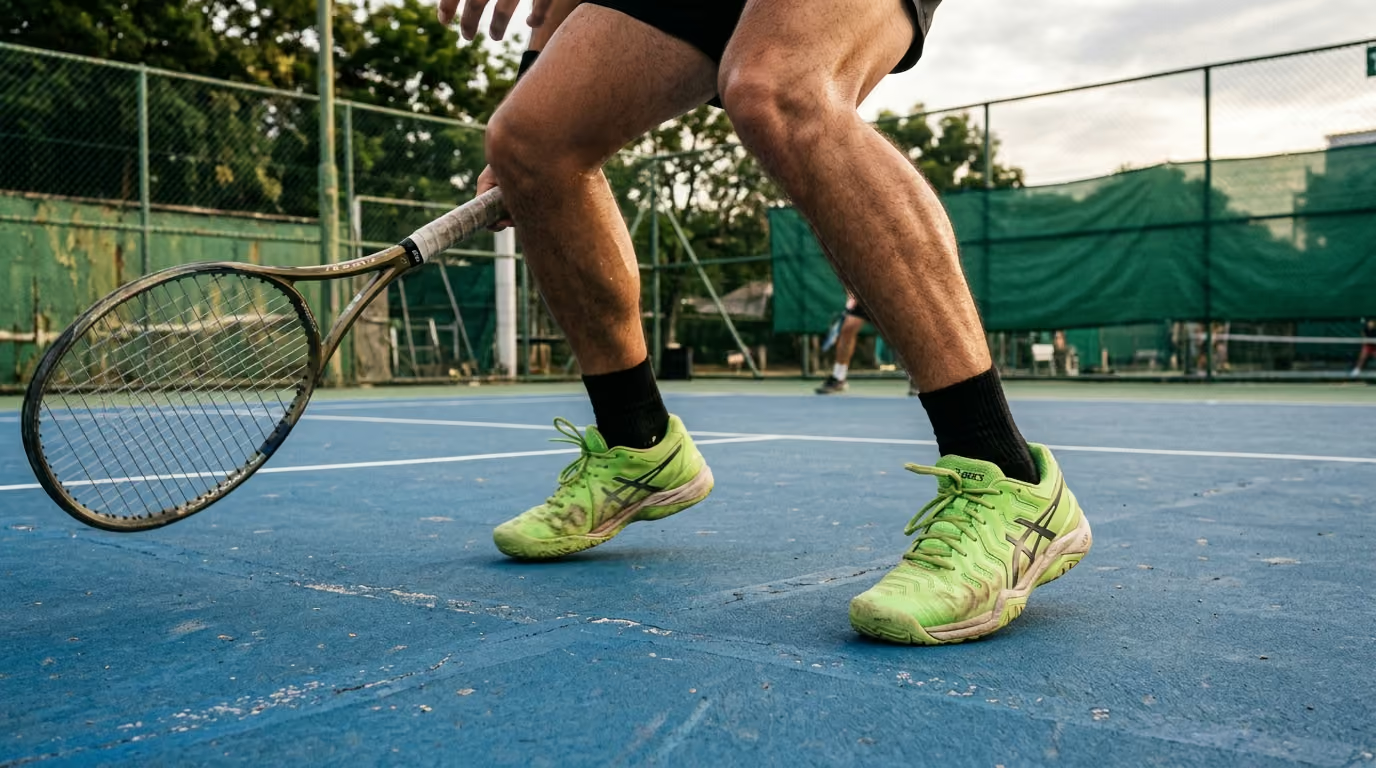
An effective off-season for racquet sports involves a planned transition to reduce training volume and repetitive impact while preserving strength and power.




How do you transition out of a demanding competitive season without losing your hard-earned court fitness? If you have spent hours searching for a way to rest your aching joints while keeping your court speed, you are not alone.
An effective off-season is not a period of total inactivity, nor is it a continuation of intense match play. It is a planned transition that reduces total training volume and repetitive impact while preserving muscular strength, explosive power, and movement capacity. By strategically lowering court time and maintaining high-quality resistance training, you can allow your tissues to heal while preparing your body for the physical demands of the next competitive cycle.
The off-season represents a planned transition from tournament play to structured physical preparation. We must view this period as a load-management phase rather than a complete physical shutdown. In our experience, stopping all physical movement leads to a rapid loss of structural capacity.
I remember finishing a tough two hour padel match on a cold Tuesday night and waking up the next morning feeling like my lower back was locked in concrete. For a long time, I just accepted this as the price of playing hard in my forties. But once I started spending just ten minutes on targeted hip mobility before heading to the club, the stiffness almost completely vanished. It taught me that we do not have to accept pain as a default state of aging. Focus on active maintenance rather than passive resting to keep your body resilient. Refer to our mobility and movement resources for structured ways to integrate these habits into your routine.
To manage this transition, we must distinguish between external and internal training loads. External load refers to measurable actions like minutes spent on court, sprint distance, jump counts, and serve volume. Internal load is the psychological and physiological stress those actions impose on your body, often measured using heart rate or perceived exertion. Research suggests monitoring internal load using a session rating of perceived exertion (RPE) helps identify injury risk. [17]
We must also understand the concepts of training monotony and training strain. Training monotony is a measure of how similar daily training loads are across a typical week. High monotony combined with high training volume creates high training strain. Reducing court-based training and adding movement variety during the off-season reduces both monotony and overall strain, allowing tissues to adapt and rebuild.
To design a successful off-season plan, we must understand the exact demands of court play. Racquet sports are defined by intermittent high-intensity efforts. Points typically last between four and ten seconds, followed by ten to twenty seconds of rest. [6] Research shows that in-point activity only occupies about 20% to 30% of total match time. [12]
Consequently, continuous jogging is not the most efficient way to build court endurance. Players need an aerobic system that quickly restores energy between points, combined with high muscular power for acceleration and braking. Change-of-direction ability is crucial. Australian Open match analysis shows players perform an average of 1.6 changes of direction per point. [15]
During these points, players cover roughly 4.8 meters per change of direction. [15] This movement requires incredible eccentric strength in the quadriceps and hips to decelerate the body. Prolonged match play causes significant neuromuscular fatigue, which decreases leg stiffness and reduces quadriceps voluntary strength by 10% to 13%. [12] Without regular strength exposure, these physical qualities decay rapidly. Consult our strength and conditioning resources to learn more about how to combat this decline.
An effective off-season should be divided into five distinct phases. This systematic progression allows you to heal while building a stronger physical foundation.
This phase lasts from several days to two weeks. The primary goal is to reduce psychological burnout and soothe irritated joints. Stop playing matches and reduce repetitive hitting.
Instead, prioritize low-impact active rest. A collegiate tennis training model recommends two weeks of active rest using cycling, swimming, elliptical training, or gentle yoga. [27] This strategy lowers joint impact while keeping the cardiovascular system active. Do not turn cross-training into a high-volume conditioning block. Keep the intensity low and focus on physical and mental refreshment.
This phase lasts one to three weeks. Focus on correcting asymmetries and restoring normal joint range of motion. It is the perfect time to build endurance in the rotator cuff and scapular muscles.
Target the hip abductors, adductors, and calf muscles. These areas are heavily loaded during lateral court movement but are often neglected during the competitive season. Use targeted exercises to rebuild tissue tolerance without the stress of match play. Review the latest injury prevention resources for specific corrective routines.
This phase lasts three to six weeks. The goal is to build maximal force production through the lower body and trunk. Research indicates that a training block of at least six weeks is highly effective for physical development. [26]
Structure your training around foundational movement patterns. Include squats, lunges, hip hinges, horizontal pushes, and vertical pulls. Use a moderate to heavy load of 70% to 85% of your maximum capacity. Perform three to four sets of six to ten repetitions. This phase builds the muscular engine required for explosive court movement.
This phase lasts two to four weeks. Now we must convert raw strength into explosive sport-specific power. Reintroduce jumping, medicine-ball throwing, and rapid deceleration.
Begin with low-level plyometrics such as ankle hops and bilateral countermovement jumps. Progress to single-leg hops and planned lateral changes of direction. Always perform power work when you are fresh. Fatigue from heavy lifting will compromise landing mechanics and reduce your rate of force development.
This phase lasts two to four weeks. The goal is to safely transition back to full-speed play. Gradually rebuild your hitting volume and serve count.
Start with controlled technical hitting. Progress to movement drills, practice sets, and finally simulated matches. This progressive build-up ensures your joints can handle the high eccentric forces of competitive movement. It prevents the sudden spikes in training load that often lead to early-season tendon injuries.
You do not need to spend hours in the gym to keep your athletic gains. A maintenance program should prioritize high-intensity work while reducing total training volume. Junior tennis guidelines recommend just one to two weekly strength sessions during busy periods. [36]
These sessions can preserve strength and power by using two to four sets of three to eight repetitions. Research in elite field sports shows strength levels can be maintained for up to three weeks of complete detraining. [33] However, power and rate of force development decay more quickly.
To avoid this loss, perform a few explosive movements before your strength lifts. Keep the resistance high but reduce the total number of exercises and sets. This approach keeps your nervous system sharp while giving your joints a break. It is the key to balancing recovery and athletic longevity. Find out more about maintaining performance in our healthy aging and athletic longevity resources.
The off-season plan must be tailored to the specific court sport you play. Each sport features distinct movement profiles, court dimensions, and equipment weights.
Tennis involves a larger court, longer sprints, and higher running speeds. The surface you play on also changes the physical demands. Research shows that playing on clay increases rally durations by 22% compared to hard courts. [11]
Clay-court players require greater aerobic capacity and muscular endurance. Hard-court players experience greater joint impact and need exceptional eccentric strength for braking. Adjust your conditioning and lower-body strength work to match your primary competitive surface.
Pickleball is played on a much smaller court, which reduces sprinting distances. However, it requires constant low-squatting positions and rapid lateral shuffling. The reaction times are incredibly fast at the kitchen line. For more guidance on managing these physical demands, check our dedicated pickleball articles.
Focus your off-season training on quadriceps endurance, hip mobility, and calf strength. The quick, repetitive paddle actions require excellent wrist and forearm stability. Incorporate grip-strengthening exercises to protect the elbow from chronic strain.
Padel matches feature long rallies with frequent changes of direction and overhead shots. The glass walls require players to turn, twist, and read complex ball paths constantly. The frequent overhead smashes place high demands on the shoulder and core.
Your off-season should emphasize rotational core strength and upper-body power. Dedicate extra time to thoracic mobility and rotator cuff endurance. This preparation helps you tolerate the high volume of overhead movements. You can find more helpful advice in our padel articles.
Specific anatomical regions bear the brunt of racquet sports. Your off-season program must address these areas directly to prevent chronic wear and tear.
The overhead serving motion and high-velocity groundstrokes place extreme stress on the shoulder. Your off-season plan must build capacity in the rotator cuff and scapular stabilizers. Focus on external rotation strength and lower trapezius endurance. Upward rotation of the scapula is essential for keeping the shoulder joint healthy during overhead hits.
Repetitive racquet impact can lead to lateral epicondylitis, commonly known as tennis elbow. Equipment choices and stroke mechanics play a major role in elbow health. [22]
Strengthen the wrist extensors and flexors using controlled eccentric exercises. Use grip-strengthening drills to build muscular endurance in the forearm. This protection ensures your elbow can absorb the shock of off-center hits.
The core is not just about abdominal strength. Its main job is to transfer force from the legs up to the racquet. Exercises should focus on anti-rotation, anti-extension, and lateral stability.
Use exercises like Pallof presses, deadbugs, and plank variations. Rotational medicine-ball throws can be added later in the off-season. These movements train the body to generate and control rotational power safely.
Your hips, knees, ankles, and feet are your foundation on the court. Focus on building strength in the quadriceps, hamstrings, and gluteal muscles. Calf and soleus strength is vital for protecting the Achilles tendon.
Single-leg exercises like split squats and single-leg deadlifts are highly valuable. They mimic the unilateral nature of court movement. They also help identify and correct strength imbalances between your legs.
To keep your training safe, you must monitor how your body responds. A simple tracking system can prevent you from overtraining.
Track your session rating of perceived exertion (RPE) on a scale of one to ten. Multiply this score by the session duration in minutes to calculate your daily training load. [17] This quick calculation gives you an objective view of your training stress over time.
Keep a simple daily wellness journal. Rate your sleep quality, muscle soreness, fatigue, and stress levels. Consistent drops in these markers indicate that you need to reduce your training load.
You can also track performance metrics like vertical jump height or short sprint times. If your performance drops significantly, your nervous system may be fatigued. Use this data to make smart adjustments to your weekly program. You can read more about recovery protocols in our recovery science resources.
Many players make critical mistakes during the off-season that hinder their progress. Avoiding these errors will ensure you return to the court fresher and stronger.
Taking several weeks completely off sounds tempting. However, this causes a major drop in tissue capacity and aerobic fitness. When you return to the court, your body will not be ready for the impact. This gap between capacity and exposure is a primary cause of early-season injuries.
Some players stop playing racquet sports but start running long distances. This does not give the joints a break. Running on hard pavement still subjects your knees and Achilles tendons to repetitive impact. Instead, use low-impact alternatives like cycling or swimming.
Focusing solely on heavy lifting can make you feel slow on the court. Racquet sports require rapid, explosive force. You must include jumps, throws, and sprint mechanics in your off-season plan. This training ensures your strength translates to court speed.
The acute:chronic workload ratio is a popular tool. It compares your current week of training to your past four weeks. However, it should not be treated as a perfect injury calculator. [23] Sleep, stress, and previous injury history are equally important factors to consider.
The off-season is the best time to focus on systemic recovery. This process goes beyond muscle repair. It involves restoring the health of your tendons, ligaments, and joint cartilage.
Tendons require a longer recovery time than muscles because they have less blood supply. High-volume, repetitive hitting can cause micro-tears in the tendon matrix. The off-season provides the necessary time window for collagen synthesis and tissue remodeling.
Prioritize sleep, as it is the most powerful recovery tool available. Aim for seven to nine hours of high-quality sleep per night. Proper hydration and a balanced diet rich in protein and micronutrients also support tissue repair.
Here is a sample weekly schedule for a player in the middle of their off-season. This program balances strength development, low-impact conditioning, and active recovery.
It is normal to experience some muscle soreness when starting a new strength program. However, you must distinguish between normal training fatigue and potential injury.
If you experience sharp joint pain, swelling, or pain that worsens during exercise, stop immediately. Persistent night pain that disrupts your sleep is a significant warning sign. Tingling, numbness, or a loss of strength in your limbs also requires attention.
Do not try to push through these symptoms. Consult a qualified healthcare professional, such as a physical therapist or sports medicine physician. They can provide an accurate diagnosis and a safe path forward. Taking care of these issues early prevents minor strains from becoming chronic problems.
Use this simple checklist to guide your transition this week.
For more helpful guides on court longevity, visit the main Evercourts homepage.
Follow Evercourts for practical insights on tennis, pickleball and padel performance, movement, recovery and healthy ageing. Stay connected for new articles, research-led guidance and ideas to help you play well and keep playing for years.


Read practical guidance for better movement, smarter preparation and a game that keeps working for you.
explore the Blog