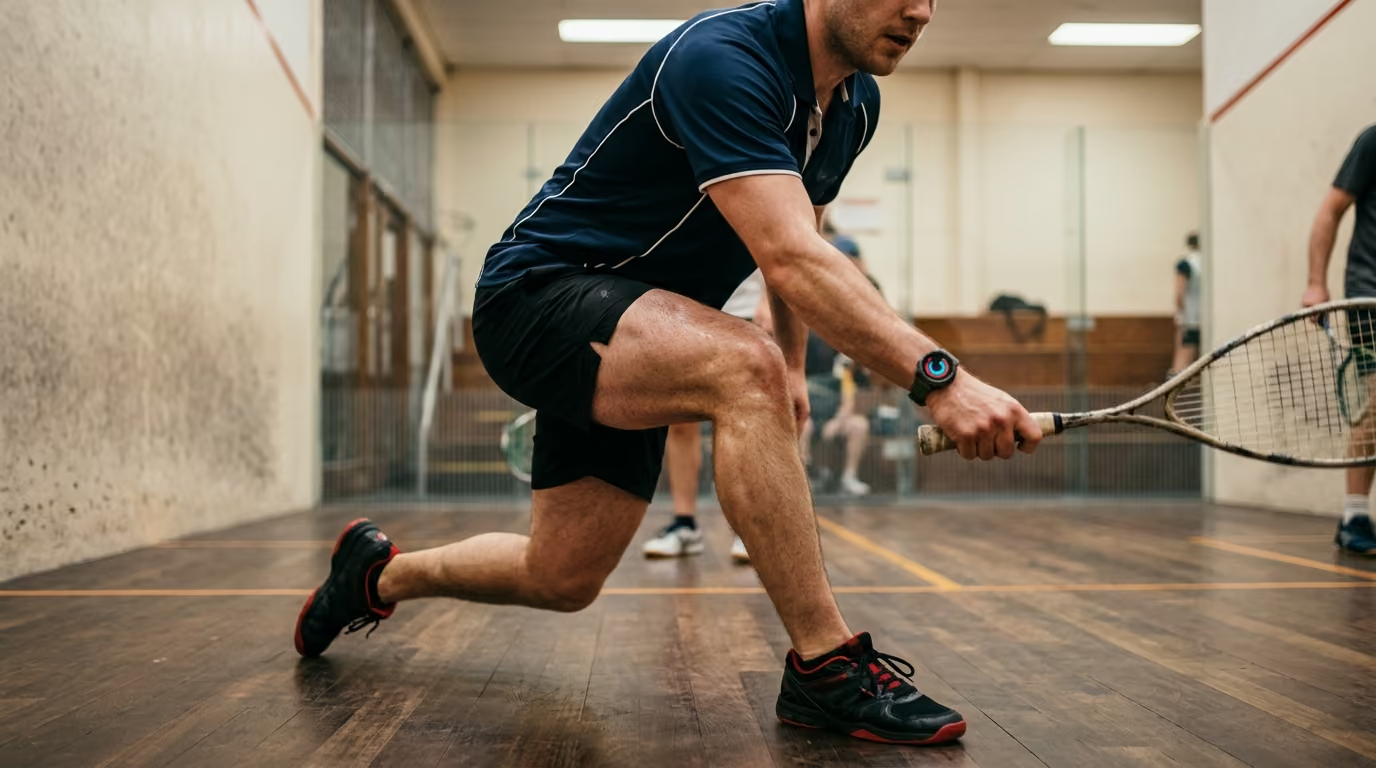

Waking up with deep muscular fatigue after a racquet sports match often stems from mechanical loading, not just total distance covered during play.




Many racquet sports players track their physical workload by looking at the steps or distance on their smartwatches after a match. Yet they still wake up the next morning with deep muscular fatigue, local joint stiffness, and a general lack of power.
The physical toll of court sports is not determined by the total distance you cover during play. Instead, the true recovery cost of racquet sports is driven by mechanical loading from repeated braking actions, deep lunges, and high-velocity torso rotation. This physical work taxes your muscles and connective tissues far more than steady jogging.
To manage your physical fatigue, you must separate external work from your internal physiological response. External work represents the physical actions you perform on the court. This includes your sprint count, deceleration count, serve volume, and match duration.
Your internal response represents how your cardiovascular and muscular systems react to that work. Factors like heart rate, muscle soreness, and joint stiffness show this response. A player can finish a match with a low step count but have high recovery needs due to heavy mechanical forces.
According to the International Olympic Committee consensus on athlete load, physical recovery is not just a cardiovascular process. Your heart rate might return to normal within minutes of a hard match. However, your muscles, tendons, and joints require days to repair their structural tissues.
This mismatch often leads players to return to play before their tissues are fully restored. Understanding mechanical load is essential for long-term health on the court. You can read more about these concepts in our recovery science resources.
Court sports are dominated by rapid acceleration and deceleration cycles. Research shows that up to ninety percent of court movement consists of short, highly intense braking and starting actions. Most of these movements occur at moderate running speeds between zero and twelve kilometers per hour.
Because of this, average running speed does not reflect the real stress on your lower body. The braking phase of a step is often more costly than the acceleration phase. To stop your forward momentum, your quadriceps and calves must contract eccentrically.
During an eccentric contraction, your muscle fibers are forced to lengthen while trying to shrink. This action generates exceptionally high force per unit of muscle area. Research on tennis match play shows that these forces cause measurable reductions in leg performance.
After matches lasting over two hours, players show a ten to thirteen percent reduction in quadriceps strength. Their leg stiffness and sprinting speeds also decline. In badminton, studies on repetitive lunges show that deceleration forces produce significant neuromuscular fatigue.
This fatigue occurs even when blood markers of muscle damage remain relatively low. Your nervous system simply loses its ability to coordinate rapid movements. This neuromuscular drain leaves you moving slower during your next match.
To maintain your speed and coordination, you must understand the stress of change-of-direction movements. Research on international players shows that matches can feature over four hundred changes of direction. For some matches, this number exceeds six hundred movements.
Every single one of these direction changes requires your adductors, glutes, and knees to absorb multiple times your body weight. This is why focused conditioning is so valuable. To build your physical capacity for these movements, check out our strength and conditioning resources.
The physical cost of racquet sports is not limited to your legs. Your upper body must handle repetitive rotational forces during every stroke. The tennis serve is a prime example of this complex kinetic chain.
This movement relies on energy transfer from your feet up through your legs, trunk, shoulder, and arm. The serve has five key phases: preparation, cocking, acceleration, deceleration, and follow-through. Each phase places unique mechanical demands on your shoulder joint.
During the cocking phase, your shoulder is placed in extreme external rotation and abduction. Research shows that your shoulder stabilizers must work incredibly hard during this phase. The supraspinatus muscle operates at fifty-three percent of its maximum contraction capacity.
Your infraspinatus works at forty-one percent of its maximum capacity. Your subscapularis and biceps reach twenty-five and thirty-nine percent respectively. Meanwhile, the serratus anterior operates at seventy percent to stabilize the shoulder blade.
The acceleration phase then creates rapid internal rotation torque to strike the ball. Once contact is made, your muscles must immediately reverse this force to slow your arm down. The follow-through phase produces massive compressive forces across your shoulder joint.
This repetitive braking of the arm is a major contributor to rotator cuff wear. Research shows that a three-hour tennis match reduces passive shoulder internal rotation. It also decreases your overall shoulder range of motion and serve speed.
If your hips or thoracic spine lack mobility, your shoulder must work harder to compensate. This compensation increases the mechanical load on your rotator cuff and elbow. To keep your upper body moving freely, consider using our mobility and movement resources.
Muscles adapt to physical training relatively quickly because they have an abundant blood supply. Connective tissues like tendons, ligaments, and cartilage adapt much slower. This difference in adaptation speed is critical for court athletes.
Tendons are designed to store and release elastic energy like a spring. The Achilles tendon and patellar tendon handle massive loads during jumps and landing steps. When you change directions quickly, these tendons undergo a rapid stretch-shortening cycle.
If your training volume increases too fast, your tendons cannot recover in time. This lack of recovery leads to micro-structural changes and chronic soreness. Because tendons have limited blood flow, they require more recovery time than muscles.
You may feel that your muscle soreness has completely disappeared after a tough match. However, your patellar or Achilles tendons might still be highly sensitive to load. This makes subjective muscle soreness a poor guide for tendon health.
Over time, repeated overloaded sessions can degrade your joint cartilage and capsule. This issue is particularly relevant for the lumbar spine. Repetitive rotation under compression can stress your intervertebral discs.
To ensure athletic longevity, you must monitor tendon response to weekly play. Progressive load management is the best way to keep these tissues healthy. This approach helps you maintain joint integrity as you age.
The type of court you play on changes the mechanical and metabolic cost of your matches. Many players assume that hard courts are always more taxing on the body. While hard courts offer high joint impact, clay and slower surfaces present different challenges.
Research shows that junior tennis matches on clay feature twenty-two percent longer rallies than those on hard courts. This increased rally length leads to higher playing times and elevated heart rates. Players also show higher blood lactate levels and greater perceived exertion on clay.
Slower surfaces increase your metabolic demand because you must hit more strokes. You also spend more time running and shifting your weight. Conversely, hard courts increase the immediate impact force on your joints.
The lack of slide on hard courts requires abrupt, high-force braking steps. Clay allows you to slide into shots, which distributes the deceleration force over a longer time. This slide reduces the peak impact on your knees and hips.
However, sliding requires excellent pelvic control and adductor strength. If you lack this strength, sliding can strain your groin muscles. The surface you play on dictates which tissues will experience the most stress.
Each racquet sport has a unique movement profile that shapes its physical recovery cost. Tennis, pickleball, and padel place distinct demands on your muscles and joints. Recognizing these differences allows you to tailor your recovery strategies.
Tennis is characterized by large-scale court coverage and high-velocity movements. Players must cover a wide area, leading to long sprints and deep, sliding decelerations. The heavy racquet increases rotational torque on the shoulder, elbow, and wrist.
In contrast, pickleball is played on a much smaller court. This smaller space reduces your total sprinting distance and high-speed running. However, pickleball features a high density of rapid, shallow lunges near the kitchen line.
Players spend long periods in a low, crouched position. This stance places a high isometric demand on your quadriceps and patellar tendons. The lighter paddle reduces shoulder strain but increases the demand for rapid wrist reactions.
Padel combines elements of both sports within an enclosed glass court. The game features frequent overhead smashes and rapid changes of direction off the walls. This combination increases the load on your shoulder and calves.
I remember finishing a tough two hour padel match on a cold Tuesday night and waking up the next morning feeling like my lower back was locked in concrete. For a long time, I just accepted this as the price of playing hard in my forties. But once I started spending just ten minutes on targeted hip mobility before heading to the club, the stiffness almost completely vanished. It taught me that we do not have to accept pain as a default state of aging.
This experience highlighted how local stiffness can accumulate from specific court movements. In padel, the frequent lobbing requires you to constantly look up and rotate your spine. This action increases mechanical strain on your lower back and neck.
Whether you play tennis, pickleball, or padel, your body experiences highly specialized stresses. Matching your recovery to these specific demands is key. For more tailored strategies, visit our main platform at Evercourts.
To apply this knowledge, you should classify your court sessions by their dominant physical stress. This prevents you from overtraining when you feel cardiorespiratorily fresh. A simple session classification model can guide your weekly schedule.
You can categorize your practices into five distinct loading profiles:
Using this classification, you can adjust your training when your body is fatigued. For example, if you complete a high-braking session, your quadriceps will be tired. Your next session should avoid deep lunges or intense change-of-direction drills.
Instead, focus on light technical hitting or controlled serving work. This allows your lower-body muscles to recover while you still practice your skills. If you had a serve-heavy session, prioritize baseline rallies the next day.
This approach protects your rotator cuff from excessive repetitive strain. You can also monitor your daily readiness with a simple checklist. Track your sleep quality, muscle soreness, and joint stiffness before you step onto the court.
If your shoulder feels tight or your serve speed drops, reduce your overhead volume. Listening to these subtle performance cues is crucial for long-term health. Learn more about protecting your body with our injury prevention resources.
Many recreational players fall into predictable traps when managing their recovery. The most common mistake is treating distance as the complete measure of workload. A player might look at their smartwatch and see they only covered two miles.
They assume this means the session was easy on their body. However, that distance might have included hundreds of hard braking steps and deep lunges. The mechanical strain of those movements is far higher than a two-mile jog.
Another frequent error is assuming that a low heart rate means low tissue stress. A serve-heavy practice or a dink-only pickleball session might keep your heart rate low. Yet, these activities place intense local stress on your rotator cuff and knees.
Relying on heart rate alone will lead you to underestimate your actual recovery needs. Some players also treat muscle soreness as the only indicator of tissue damage. They assume that if their muscles do not ache, they are ready to play again.
As we have seen, tendon and joint irritation can persist long after muscle soreness resolves. Returning to intense play too soon can lead to chronic tendon issues. Finally, do not treat the acute-to-chronic workload ratio as a perfect safety calculator.
This ratio compares your current weekly training to your past several weeks of work. While useful, it cannot predict injuries with absolute certainty. Use it as a general guideline rather than a rigid rule for your body.
Understanding recovery timelines for different tissues helps you plan your play. Your cardiovascular system and energy stores recover relatively quickly after a match. Within twenty-four hours, your glycogen levels and hydration can return to normal.
Your muscles generally require forty-eight to seventy-two hours to recover from heavy eccentric damage. This timeline depends on the intensity of the braking movements during your match. If you performed many deep reactive lunges, recovery may take longer.
Tendons and joint capsules require even more time to adapt and repair. Because they have limited blood supply, their metabolic rate is much slower. A single high-load session can leave your tendons vulnerable for several days.
If you play high-intensity matches on consecutive days, you risk overloading these tissues. This chronic overload can lead to tendinopathy or joint cartilage wear. To support athletic longevity, you must allow adequate rest between high-load sessions.
This does not mean you must sit on the couch and do nothing. Light, non-impact movement can actually promote blood flow and aid your recovery. Activities like swimming, cycling, or light mobility work are excellent choices.
These low-impact options keep you active without adding mechanical stress to your joints. Balancing active recovery with structured rest is the key to staying on the court.
While physical fatigue and mild muscle soreness are normal, some symptoms require professional care. You should not try to push through pain that alters your movement mechanics. If you must change your stride or stroke to avoid discomfort, stop playing immediately.
Seek guidance from a qualified physical therapist or sports medicine physician. Watch for localized joint swelling, clicking, or catching sensations during movement. These signs can indicate ligament, cartilage, or meniscus issues that need attention.
Persistent tendon pain that lasts longer than two weeks is another clear warning sign. This is especially true if the pain is sharp during your first few morning steps. Sharp pain in your shoulder, elbow, or heel should never be ignored.
Any numbness, tingling, or radiating pain down your arms or legs requires immediate evaluation. These neurological symptoms often stem from spinal nerve compression or peripheral nerve entrapment. A professional can provide an accurate diagnosis and a safe recovery plan.
They can also help you identify movement patterns that may be contributing to your pain. Early intervention is the best way to prevent acute issues from becoming chronic. Protecting your body ensures you can continue playing the sports you love for years.
To help you apply these principles this week, we created a simple checklist. Use these steps to guide your post-match habits and protect your joints.
Follow Evercourts for practical insights on tennis, pickleball and padel performance, movement, recovery and healthy ageing. Stay connected for new articles, research-led guidance and ideas to help you play well and keep playing for years.


Read practical guidance for better movement, smarter preparation and a game that keeps working for you.
explore the Blog



