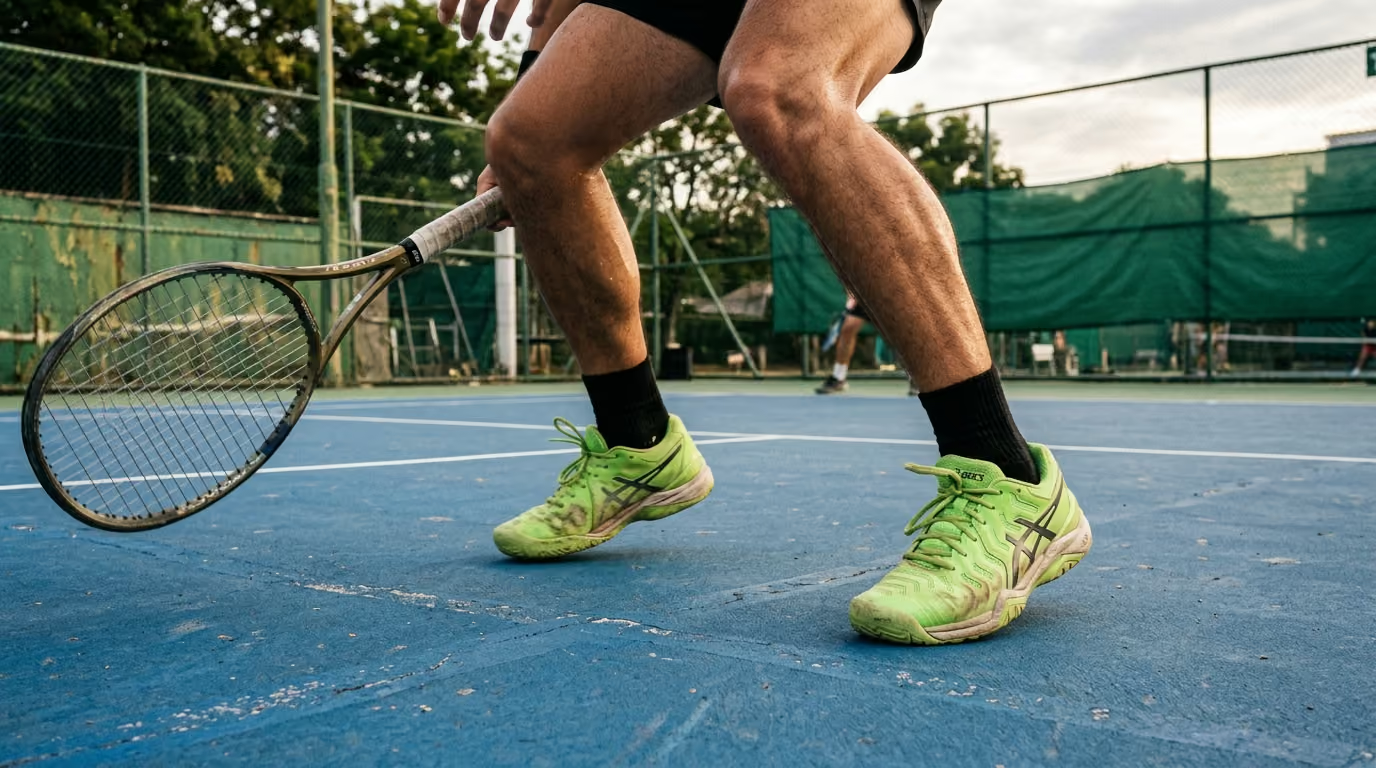
The split step in racket sports is a low, economical movement that optimizes court movement and reduces injury risk through precise timing and technique.




Many tennis, pickleball, and padel players treat the split step as an aggressive jump designed to make them look explosive. In reality, launching yourself high into the air is one of the most inefficient things you can do on a court. The most effective split step is actually a low, quiet, and highly economical movement that barely clears the ground.
A properly executed split step is a precise, low-altitude landing timed to coincide with the opponent's strike, allowing you to convert existing momentum into a balanced position for rapid redirection. It functions as a physical transition rather than a vertical jump, pre-loading your muscles so you can move in any direction immediately. By landing softly on both feet as early ball-flight information becomes readable, you distribute ground forces evenly and protect your joints from isolated stress.
To understand why this movement is so critical to athletic longevity, we must look beyond basic coaching tips. We need to examine how court dimensions change the demands on your body, how specific tissues absorb the shock, and how to train your nervous system to time the landing with millisecond accuracy. This handbook provides a complete blueprint for building a repeatable, low-load split step that keeps you on the court for years to come.
We must look closely at what happens in the muscles during this brief landing. When your feet touch the court, your lower-limb muscles experience a rapid eccentric loading phase, where the muscle fibers stretch under tension. This is immediately followed by a concentric propulsion phase, where the muscles contract to push you toward the ball. This combination is known as the stretch-shortening cycle, and it acts like a natural spring in your ankles, calves, and hips.
Research from sports scientists shows just how powerful this mechanism can be. In a study simulating tennis responses, researchers found that players using a split step were 13.1% faster over a close-range movement of 2.70 meters than players starting from a static position. The biggest difference occurred right at the start, with a 43.6% reduction in the time from the reaction signal to the onset of actual force production.
However, this speed comes with a physical price that players must manage. The same study revealed that using a split step increased mean vertical forces by 15.7% and peak vertical forces by 60.0% compared to moving from a standstill. This demonstrates that while the split step makes you much faster, it does not make physical forces disappear. Instead, it concentrates those forces into a rapid landing and redirection task that your muscles and tendons must absorb safely.
Understanding this trade-off is essential for athletic longevity. If you jump too high, you increase these vertical forces unnecessarily and place massive stress on your joints. If you land with stiff knees, you fail to use your muscles as shock absorbers and send that impact directly into your skeletal system. The goal is to develop responsive stiffness, which is the ability to keep your joints firm enough to redirect quickly but compliant enough to absorb the impact smoothly.
You can read more about how to manage these physical demands in our Injury Prevention Resources.
To master this movement, you must break it down into four distinct events rather than treating it as one sudden jump.
The initiation begins just before your opponent strikes the ball. You compress your knees slightly and push off the ground to begin the hop. This initiation should be timed so you reach the apex of your jump just as the opponent's racket makes contact with the ball.
During the flight phase, you are briefly airborne, but you should not be high off the ground. Your feet should clear the court by only an inch or two. This low-amplitude flight minimizes the time you spend in the air and reduces the impact force when you land.
You land on both feet, with your weight distributed across your midfoot and forefoot. Your knees and hips flex slightly to absorb the ground-reaction forces. This landing must happen just as you perceive the early flight path of the incoming ball.
As soon as your feet make contact, you push off with one foot while stepping in the desired direction with the other. The landing serves as a launchpad, allowing you to release your weight immediately without a second bounce. If you get stuck in a deep squat, your transition has failed.
Timing is the most difficult aspect of the split step. If you land at the wrong moment, you lose all the mechanical advantages of the stretch-shortening cycle.
If you land before your opponent has even struck the ball, you will be forced to stand still or perform a second bounce. This wastes energy and increases muscle fatigue. Your body loses its elastic tension, meaning you must start your next movement from a dead stop.
If you land after the ball has already traveled several meters, you will still be in the air when you need to change direction. You cannot push off while airborne, which delays your first step significantly. This delay forces you to make emergency lunges, putting high stress on your knees and groin.
The ideal timing window allows you to land exactly as early ball-flight information becomes readable. In a choice-reaction study of collegiate tennis players, researchers found that players reached their target in 764 milliseconds when using an appropriately timed split step. This was significantly faster than the 868 milliseconds recorded without a split step.
Furthermore, the study highlighted a critical trade-off between speed and accuracy. When players landed too early, they suffered from an error rate of 7.8% because they had to guess the ball's direction. When they synchronized their landing within the appropriate window, their error rate dropped to just 0.8%, demonstrating that correct timing improves both speed and precision.
The court you play on dictates how you must adjust your split step. Tennis, pickleball, and padel have vastly different dimensions, reaction times, and movement patterns.
The official tennis court, regulated by the International Tennis Federation, is 23.77 meters long and 8.23 meters wide for singles, expanding to 10.97 meters wide for doubles. These large dimensions mean you must cover significant distances, requiring a split step that prepares you for explosive lateral or diagonal runs.
At the baseline, you are often several meters behind the court surface, giving you slightly more time to read the ball. Your split step can be moderate in amplitude, helping you transition into a lateral shuffle or a crossover step. You must time your landing to your opponent's contact and immediately release your weight toward the ball.
For serve returns, the split step is your shield against high-velocity serves. A study on world-class tennis players showed that elite athletes initiate their split step right around the server's racket-ball contact and land when early ball-flight information is available. If you land too early, you lose your momentum; if you land too late, you will still be in the air when the ball whizzes past.
At the net, your reaction time is cut in half. Your split step must become smaller, quicker, and more compact. You cannot afford a high jump here because the ball travels too fast, meaning you need a low, quiet split step to handle rapid volley exchanges.
To learn more about managing court movement, check out our Court Performance Resources.
The USA Pickleball Official Rulebook defines the court as 20 feet wide by 44 feet long for both singles and doubles, with a non-volley zone (the kitchen) extending 7 feet from the net on each side. The small court size means that reaction times are incredibly short, and the distance you need to travel is very small.
Because of these tight dimensions, a traditional, high tennis-style split step is highly inefficient in pickleball. If you jump high, you waste valuable milliseconds in the air while a fast ball crosses the kitchen line. Instead, pickleball players should utilize a "micro-split."
A micro-split is a subtle unloading of weight where your feet barely leave the court. It is a quiet, bilateral landing that keeps you low and balanced, ready to react to quick speed-ups or soft dinks. When moving through the transition zone from the baseline to the kitchen, you should perform these micro-splits each time your opponent prepares to strike, allowing you to stop your forward momentum and react to lobs or drop shots.
For more practical tips on pickleball movement, visit our Pickleball Articles.
A systematic review of padel mechanics describes the padel court as 20 meters long by 10 meters wide, fully enclosed by glass and mesh walls. This enclosure completely changes how you must think about your movement and timing. You cannot simply split step when your opponent hits the ball; you must often split step based on the ball's interaction with the back and side walls.
In padel, you frequently have to split step before the ball hits the glass, track its rebound, and then make a second physical adjustment to strike. If you land your split step too early, you will be stuck waiting for the ball to bounce off the wall, losing all your elastic energy. If you land too late, you will be unable to turn and run backward safely to play the ball off the glass.
Because padel involves constant acceleration, deceleration, and rotation within a small space, it places immense physical strain on your lower limbs. A scoping review of padel injuries identified the knee as the most affected lower-limb region, with muscles, tendons, and joints bearing the brunt of the load. Practicing a quiet, well-timed split step in padel is crucial for protecting these tissues from the high-frequency braking forces of wall play.
Learn more about managing these unique court demands in our Padel Articles.
Even experienced players can fall into bad habits that undermine their movement efficiency and increase their risk of injury.
Many players do not start their split step until after the opponent has already hit the ball. This means they are still in the air when the ball is halfway across the court. By the time they land, they have lost precious milliseconds and must rush their shot, leading to poor positioning and high-stress deceleration.
When you land too early, you are forced to stand still or bounce a second time, which ruins your timing and increases muscle fatigue. A more appropriate timing window reduced the error rate to a mere 0.8% in collegiate studies. Focus on synchronizing your landing with the moment early ball flight becomes readable.
As sports science research has demonstrated, the split step significantly increases the vertical forces placed on your body. If you jump high, you increase these forces even further, putting massive, unnecessary stress on your knees and Achilles tendons. Keep your feet close to the ground to keep your landings quiet and low-impact.
The stuck landing occurs when a player lands with their feet too wide and their knees bent in a deep, static squat. While this looks athletic, it actually locks your body in place. You must land with a responsive knee angle that allows you to push off instantly, rather than trapping you in a deep position that requires extra effort to exit.
A split step is not just a lower-body movement. If your upper body is rigid and tense, or if your racket is held low and away from your center of mass, you will struggle to move efficiently. Your upper body should remain stacked and relaxed over your pelvis, with your hands ready to move the racket as soon as you land.
You do not need to split step before every single shot, especially if you are already running at full speed to reach a distant ball. Trying to force a bilateral hop while sprinting can break your running stride and increase your risk of slipping or tripping. In these scenarios, transition steps, crossover steps, or slide-cut movements are much more appropriate.
Because the split step involves repeated, high-force landings, your muscles, tendons, and joints must have the physical capacity to handle the load. This is particularly true for older athletes or those returning to the court after a long break. To build this capacity and support your athletic longevity, you should implement a progressive conditioning framework.
The calf muscles (gastrocnemius and soleus) and the Achilles tendon act as the primary springs during a split step. In tennis, abrupt changes in direction are a frequent cause of "tennis leg," which is an acute strain of these calf structures. To build resilient calves, follow this step-by-step progression, moving to the next stage only when the current one is completely comfortable and pain-free:
Your knees absorb a massive amount of lateral and vertical force during a split step. If your hips are weak, your knees may cave inward (valgus collapse) during the landing, which places high stress on the patellofemoral joint and the anterior cruciate ligament. Use these drills to improve your knee tracking:
The high-frequency impacts of the split step can cause micro-damage to your muscle fibers and tendons, which is a normal part of training. However, if you do not allow enough recovery time, this micro-damage can accumulate and lead to overuse injuries like patellar tendinopathy or Achilles tendinitis.
Pay close attention to next-day stiffness. If your calves or Achilles tendons feel excessively stiff or sore the morning after a match, it is a sign that your current playing volume or intensity exceeds your tissues' capacity. Consider reducing your match frequency, lowering your split-step amplitude, or spending more time on soft court surfaces like clay to allow your tissues to adapt.
To learn more about recovery protocols, check out our Recovery Science Resources.
To successfully integrate a repeatable, low-load split step into your actual matches, you should not simply try to do it all at once during a high-stakes game. Instead, use this structured four-stage learning model to build the movement pattern systematically.
Start with no ball, no racket, and no opponent. Stand in a neutral athletic stance on the court. Practice performing a low, quiet hop, focusing entirely on landing softly on both feet with your knees and hips slightly flexed. Your main goal in this stage is to make your landing as silent as possible, which indicates that your muscles are actively absorbing the impact forces rather than passing them to your joints.
Once you can perform a quiet landing consistently, introduce a partner or coach. Have them stand across the net and simulate a groundstroke swing. As their racket hand begins its forward movement, they should call out "Hop!" and as they complete the swing, they should call out "Land!" This verbal rhythm helps your brain link the physical movement of the split step with the visual timing of an opponent's stroke.
In this stage, your coach or partner will call out a direction (left, right, forward, or backward) just as you land your split step. You must land softly and immediately push off in the designated direction. This trains your nervous system to transition instantly from the force-absorption phase of the landing to the propulsion phase of your first step, preventing the "stuck landing" common in recreational players.
Finally, transition to a live drilling scenario. Have your partner feed balls to different areas of the court. You must read their racket face, body language, and early ball flight to determine where to move. This is the ultimate test of your split step, as you must now synchronize your landing with real-time decision-making, ensuring that you land just as the ball's trajectory becomes readable.
While developing a better split step can significantly improve your court movement and overall play, it is not a cure-all or a guarantee against injury. You must be able to distinguish between normal muscle fatigue and structural pain that requires professional medical evaluation.
If you experience sudden, sharp pain in your knee, calf, ankle, or Achilles tendon during a split step, stop playing immediately. Do not attempt to "play through" the pain, as this can turn a minor strain into a severe tear. Particular red flags include a popping or snapping sensation, immediate swelling, visible bruising, or an inability to bear weight on the affected leg.
If you have persistent, low-grade discomfort that does not improve after a few days of rest, or if you experience morning stiffness in your Achilles tendon that lasts for several weeks, you should consult a qualified healthcare provider. A physiotherapist, sports medicine physician, or orthopedic specialist can assess your joint mobility, muscle strength, and movement mechanics to provide an individualized recovery plan.
For general information on staying active and healthy as you age, you can view our Healthy Aging & Athletic Longevity Resources.
The type of court surface you play on has a massive impact on the physical demands of your split step. Hard courts, clay courts, grass courts, and artificial turf all interact differently with your footwear, altering how forces are transmitted up your leg.
Most public tennis and pickleball courts are constructed of concrete or asphalt coated with an acrylic surface. These hard courts offer excellent, predictable traction, but they provide almost no shock absorption. When you perform a split step on a hard court, the ground-reaction forces are at their peak, meaning your muscles and joints must work much harder to cushion the landing. On hard courts, minimizing your jump height and focusing on a quiet, compliant landing is absolutely critical to protect your knees and lower back from chronic stress.
Clay courts, common in tennis, offer a much softer playing surface that naturally absorbs impact forces. However, they also have much lower traction, which allows players to slide into their shots. Your split step on clay must account for this instability. You must maintain a slightly wider, lower center of mass during your landing to prevent your feet from slipping out from under you, and you must use the slide as a deceleration tool rather than trying to stop abruptly.
Padel courts are typically constructed of artificial turf filled with a layer of fine silica sand. This surface offers a unique combination of moderate impact absorption and variable traction. If there is too much sand on the court, you may slip during your split-step landing; if there is too little, your shoes may catch abruptly on the turf, increasing the torque placed on your knees. Padel players must pay careful attention to their footwear, choosing shoes with specific tread patterns designed to manage the sand-and-turf interface safely.
Every athlete is unique, and a movement pattern that works for a young professional may need to be adapted for other populations.
As we age, our tendons naturally lose some of their elasticity, and our reaction times may slow down. For older recreational players, trying to perform an explosive, airborne split step can be counterproductive and increase the risk of tendon injury. If you are an older player or are returning to the sport after a long period of inactivity, start with a "weight-shift" split step rather than an airborne hop. Instead of leaving the ground, simply perform a quick, subtle shift of your weight onto the balls of your feet as your opponent strikes, which provides the benefits of readiness without the impact forces of landing.
If you carry more body mass, the physical forces of every landing are multiplied. A heavy player performing high-amplitude split steps puts extreme stress on their knees, plantar fascia, and Achilles tendons. If you fall into this category, prioritize low-amplitude micro-splits and focus heavily on developing hip and quadriceps strength to help absorb those forces. Additionally, avoid sudden increases in your weekly playing time, as your tendons need weeks or months to safely adapt to the mechanical loads of court movement.
As you tire near the end of a long match, your movement mechanics will naturally deteriorate. Fatigue causes your landings to become louder, your knees to bend less, and your reaction times to slow, meaning your joints take a much heavier beating. If you feel your technique slipping or notice that your split steps are becoming heavy and sluggish, it is better to reduce your split-step volume or focus on a simple weight shift rather than forcing a poorly executed jump that could lead to an acute injury.
If you want to read more about maintaining your physical health on the court, explore our Player Health Articles.
To bring these technical rules to life, let us examine how two real-world player patterns can be analyzed and corrected.
The Scenario: A 45-year-old tennis singles player constantly struggles to reach wide baseline groundstrokes, despite feeling like they are moving as fast as they can. Video analysis shows that they perform a high split step and land long before their opponent's ball has crossed the net.
The Problem: Because they land too early, their muscles lose the stored elastic energy of the stretch-shortening cycle before they can use it to push off. They are forced to stand still in a loaded stance, essentially starting their sprint to the ball from a dead stop.
The Intervention: We delay their split step. We instruct them to wait until the opponent's racket is actively moving forward before they begin their hop. This ensures they are at the peak of their flight at racket-ball contact and land just as the ball's direction becomes readable, allowing them to instantly redirect their momentum.
The Scenario: A competitive pickleball player experiences chronic calf soreness and Achilles stiffness after playing. Observation shows they are performing large, tennis-style split steps at the non-volley zone line during fast dinking rallies.
The Problem: The pickleball court's small dimensions (20 by 44 feet) and the close-range nature of kitchen play make high jumps completely unnecessary. The player is wasting energy, spending too much time in the air, and subjecting their calves to excessive vertical landing forces.
The Intervention: We replace their high hop with a "micro-split." We train them to keep their feet within half an inch of the court surface, focusing on a quick, quiet unloading of their weight. This preserves their readiness for fast exchanges while immediately reducing the physical stress on their lower limbs.
With the right balance of timing, technique, and physical capacity, you can develop a repeatable split step that improves your court performance while protecting your lower limbs for years of comfortable play.
Follow Evercourts for practical insights on tennis, pickleball and padel performance, movement, recovery and healthy ageing. Stay connected for new articles, research-led guidance and ideas to help you play well and keep playing for years.


Read practical guidance for better movement, smarter preparation and a game that keeps working for you.
explore the Blog