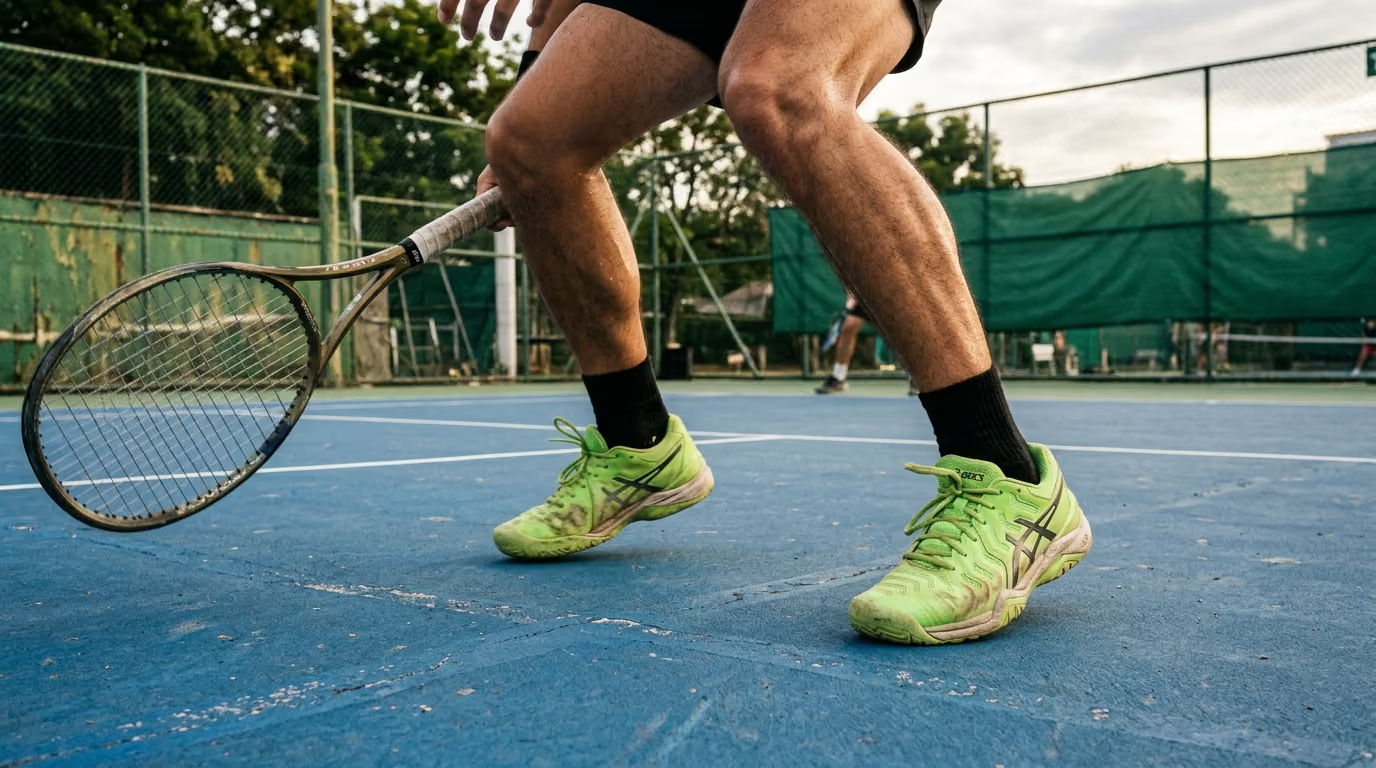
Court athletes can significantly reduce their risk of common injuries and enhance performance by implementing progressive strength training.




If you have ever searched for ways to stop shoulder irritation after serving, or how to manage sore knees after a long match, you are not alone. Many court athletes believe that playing their sport is enough to stay fit, but the repetitive demands of the court often tell a different story.
The most reliable way to protect your body and maintain your performance is to build a foundation of progressive strength training. By systematically preparing your muscles, tendons, and joints to produce and absorb force, you directly increase your capacity to handle the specific physical demands of court play. This approach is not about building muscle bulk, but about building physical durability so you can keep playing for years.
Understanding how strength training protects your body requires looking at the available sports science. While no training program can make an athlete completely injury-proof, the evidence supporting resistance training is compelling. Research demonstrates that building muscle and tendon strength is one of the most effective ways to lower your risk of sports injuries.
A major systematic review and meta-analysis of randomized trials evaluated various injury-prevention methods across athletic populations. The researchers found that strength-training interventions were associated with a substantial reduction in sports injuries. They reported a cluster-adjusted relative risk of 0.338, which indicates a highly meaningful protective effect. Furthermore, the analysis revealed a dose-response relationship, meaning that a ten percent increase in strength-training volume was associated with more than a four-percentage-point reduction in injury risk.
However, it is important to interpret this data with care. The meta-analysis included only six studies covering five specific interventions, none of which were performed exclusively on tennis, pickleball, or padel players. Therefore, we should view strength training as an evidence-informed strategy rather than a sport-specific guarantee. It is a highly effective tool, but it works best when combined with sensible load management and proper technique.
To apply this science to racket sports, we must also look at how different types of muscle contractions protect the body. A 2024 review focused on non-professional tennis players examined the impact of various training methods. The authors reported that concentric, eccentric, and isometric strength training were all associated with a lower prevalence of repetitive-trauma injuries. Interestingly, general muscular endurance training did not show the same protective response in this review.
This suggests that actual strength, rather than just high-repetition endurance, is key to protecting joints and tendons. Concentric strength helps you produce movement, while eccentric strength helps you control lengthening under load. Isometric strength allows you to maintain stable joint positions under stress. Because this literature was a review of existing observational studies, we should avoid claiming that one contraction type is universally superior to the others. Instead, a balanced program should include all three types of muscle action to build comprehensive joint resilience.
To move efficiently and protect your joints on the court, you must understand how your body transfers energy. Racket sports are not played using isolated muscle groups. When you strike a ball, the energy does not originate in your shoulder or your wrist. Instead, it is generated from the ground up through a coordinated sequence of muscle actions.
This sequence is known as the kinetic chain. For a typical groundstroke or serve, the flow of energy follows a highly integrated pathway. Ground force is first generated by the legs and hips. This force then travels through the pelvis and trunk, moves into the shoulder blade and shoulder, and finally accelerates through the elbow and wrist into the racket or paddle.
This sequence serves as a practical coaching framework rather than a rigid mechanical rule. If any link in this chain is weak or restricted, the energy flow is disrupted. When this happens, other joints must work harder to compensate. For instance, if your hips lack the strength to drive your body forward, you will likely use excessive arm swing to generate power. Over time, this compensation can lead to shoulder or elbow strain.
This is why focusing solely on local areas of pain, such as the rotator cuff, is rarely effective. A shoulder may be exposed to excessive stress simply because your lower body is fatigued or your trunk lacks stability. By training the entire kinetic chain, you distribute the forces of play across your entire body. This integrated approach is a cornerstone of practical injury prevention guides designed for long-term athletic health.
To build an injury-resistant body, you must also manage your overall tissue capacity. Tissue capacity is the total amount of physical load a muscle, tendon, ligament, or bone can tolerate before damage occurs. This capacity is constantly changing based on your training history, age, sleep quality, and recent physical workload.
The primary rule of athletic longevity is to progress your physical capacity faster than, or at least in line with, the demands of your sport. If you play only once a week, your tissues adapt to that specific level of stress. If you suddenly enter a weekend tournament with multiple matches, the physical demand will likely exceed your current capacity. This is when injuries typically occur.
This relationship is best understood by looking at your acute-to-chronic workload ratio. Your acute load represents your recent physical exposure, such as the matches played in the past week. Your chronic load represents your longer-term training history, which establishes your baseline tolerance.
A 2025 systematic review of high-performance tennis players identified abrupt increases in this workload ratio as a major predictor of injury. The reviewed literature identified danger thresholds when the acute-to-chronic workload ratio rose above 1.3 in junior players and 1.5 in adult players. While these exact thresholds come from high-performance tennis and remain debated, they highlight a universal truth. Rapid spikes in playing volume, intensity, or tournament density are highly risky. To stay healthy, you must increase your playing time gradually while using targeted strength training to raise your underlying tissue capacity.
While tennis, pickleball, and padel share many movement characteristics, each sport places distinct physical demands on the body. Understanding these differences allows you to tailor your strength training to the injuries most common in your specific sport.
Tennis is a sport of high velocities, wide lateral movements, and repetitive overhead actions. A classic review of tennis injury epidemiology highlights that most injuries occur in the lower extremities, followed by the upper extremities and the trunk. The review also noted that few high-quality longitudinal studies have tested risk factors, and no large randomized controlled trials had evaluated tennis-specific prevention programs at the time of publication.
According to a 2025 systematic review of high-performance tennis players, lower-limb trauma represents forty-eight to fifty-six percent of all injuries. Lumbar spine problems account for twelve to thirty-nine percent, while shoulder overuse syndromes remain a constantly recurring issue. The review also identified intrinsic risk factors such as reduced glenohumeral internal rotation, scapular dyskinesis, and poor core stability.
This data shows that tennis players must prepare for both acute injuries and overuse syndromes. Acute injuries, such as ankle sprains or hamstring strains, often happen during sudden changes of direction on clay or hard courts. Overuse injuries, such as patellar tendinopathy or rotator cuff irritation, develop when repeated serving and hitting exceed the body's recovery limits.
Pickleball is often described as a gentle sport, but injury data paints a more complex picture. Because of the sport's rapid growth and older average demographic, emergency-department visits related to pickleball have risen dramatically. An analysis of United States emergency-department cases from 2013 to 2022 estimated a total of 66,350 pickleball injuries. The data showed a massive increase from an estimated 611 annual injuries in 2013 to 13,690 in 2022.
A separate analysis of older adults aged sixty and older found that slips, trips, falls, and dives accounted for 63.3 percent of pickleball injury mechanisms. In this older demographic, strains and sprains represented 33.2 percent of diagnoses, while fractures accounted for 28.1 percent. Another study of emergency data from 2020 to 2022 estimated a ninety-one percent increase in annual injuries and a 257 percent increase in hospital admissions.
These findings show that pickleball is not inherently low impact. The combination of a small court, quick paddle exchanges, and sudden forward lunges places high demands on balance and reaction time. For older or deconditioned players, a lack of single-leg strength and braking control can easily lead to a fall. Therefore, pickleball players should prioritize balance, eccentric braking, ankle stability, and gradual conditioning.
Padel is played on a smaller, enclosed court, leading to rapid rallies, frequent wall rebounds, and a very high volume of strokes. A systematic review of eight padel studies involving over two thousand players reported an injury rate of approximately three injuries per one thousand hours of training. This rate rose to eight injuries per one thousand hours of match play, with overall injury prevalence across studies ranging from forty to ninety-five percent.
The elbow was identified as the most common anatomical site of injury in padel, followed closely by the knee, shoulder, and lower back. Tendon and muscle injuries were the most frequently reported injury types. A separate scoping review confirmed this pattern, identifying the elbow as the primary trouble spot, with knee injuries dominating the lower-limb data.
Padel's unique court dimensions and glass walls require players to execute constant overhead smashes and low, compact defensive shots. This high repetition of overheads explains the prominent rates of elbow and shoulder tendinitis. While padel prevention literature recommends strength, balance, and core training, researchers emphasize that high-quality clinical trials in padel remain limited.
To build an effective strength routine, you must focus on how your body moves during play. Racket sports require four primary physical actions: acceleration, deceleration, rotation, and hitting. By training these four movement domains, you prepare your body for the precise demands of every rally.
Acceleration is the ability to start moving quickly from a stationary position. On the court, this occurs when you split-step, react to a ball, and push off the ground to sprint forward or laterally. Efficient acceleration requires your muscles to produce force rapidly, which is supported by strong hips, active calves, and stiff ankles.
To train acceleration, you must focus on both bilateral and unilateral leg strength. Exercises like squats and lunges teach your muscles to push hard against the floor. As you progress, you can add explosive movements to improve how quickly your muscles can produce that force. This progression from slow strength to fast movement is essential for a quick first step on the court.
While accelerating gets you to the ball, deceleration is what allows you to stop under control so you can hit a balanced shot. Deceleration is highly demanding because your muscles must absorb force while they are lengthening. This is known as eccentric loading, and it is a major factor in lower-limb injury prevention.
When you brake suddenly, your hips, knees, and ankles must bend in a controlled manner to dissipate the impact. If your muscles lack the eccentric strength to slow you down, the force of stopping is transferred directly to your joints and ligaments. This can lead to knee pain, patellar tendinitis, or ankle sprains. To prevent this, you must train your body to land quietly, lower your center of mass, and align your knees over your feet.
A systematic review of neuromuscular training programs, which emphasize landing control and balance, showed impressive results in broader athletic groups. The researchers found pooled risk reductions of fifty-four percent for acute knee injuries and fifty percent for ankle sprains. While this is transferable rather than racket-specific evidence, it highlights how much deliberate braking practice can protect your lower limbs.
Every forehand, backhand, and serve relies on rotation. Your core muscles must transfer energy from your lower body through your trunk to your arm. However, rotational training is not just about twisting your torso as hard as possible. You must also train your body to resist unwanted rotation and to slow down after a powerful swing.
A balanced rotational routine should include exercises for anti-extension, anti-rotation, and controlled active rotation. Anti-rotation exercises, like holding a resistance band steady against a lateral pull, train your deep abdominal muscles to stabilize your spine. This stabilization prevents excessive spinal twisting, which is a common cause of lower-back pain in court athletes.
Repetitive hitting, especially serving and smashing, places immense stress on the upper body. The shoulder joint is highly mobile but inherently unstable, meaning it relies heavily on surrounding muscles for support. Specifically, the rotator cuff muscles must stabilize the shoulder joint while your larger chest and back muscles accelerate the racket or paddle.
To protect your hitting arm, you must strengthen the muscles that control your shoulder blade and support your rotator cuff. Additionally, your forearms and wrists require targeted conditioning to absorb the shock of ball impact. This is particularly true for padel and pickleball players, who face rapid, repetitive ball contact at close range.
You do not need an expensive gym membership or heavy weight machines to build an injury-resistant body. A highly effective training program can be performed at home using simple, space-efficient equipment.
By utilizing bodyweight, resistance bands, a single kettlebell or dumbbell, and a sturdy step, you can perform exercises that target every major movement pattern. The key is to focus on movement quality and progressive loading rather than the variety of your equipment.
To ensure your home program is complete, you should select exercises from six primary movement pillars. These pillars cover every physical demand you will face on the court.
These exercises focus on bending at the knees and hips to build strength in your quadriceps, glutes, and calves. They are essential for driving out of low positions and accelerating forward.
These movements target your posterior chain, including your glutes, hamstrings, and lower back. They are critical for generating power during strokes and supporting your lower back.
Because court sports are played side-to-side, you must train your muscles to produce and absorb force laterally.
These exercises build resilience in your upper back, chest, shoulders, and rotator cuff to support healthy hitting biomechanics.
These movements train your midsection to transfer energy efficiently and protect your spine from excessive twisting.
These movements build stiffness in your tendons and teach your body to absorb sudden landing forces safely.
Building strength safely requires a structured progression model. You should not begin with fast, explosive movements if you cannot control basic bodyweight exercises. Instead, progress your training systematically based on your control, capacity, and strength.
To design your program, consider the recommendations of the American College of Sports Medicine (ACSM). For individuals looking to build general strength and capacity, the ACSM suggests using resistance that corresponds to an eight-to-twelve repetition maximum. This means you should select a weight or resistance band that makes the final repetitions challenging but allows you to maintain perfect technique.
When you can easily complete your target repetitions with excellent control, it is time to progress. The ACSM recommends increasing your resistance by approximately two to ten percent once you can exceed your repetition target by one or two repetitions in consecutive workouts. This gradual increase ensures your muscles and tendons adapt safely without being overwhelmed.
To structure this progression, you can move through five distinct stages of development:
In this initial stage, the goal is to master basic movement patterns. Use bodyweight or very light resistance, perform movements at a slow and deliberate tempo, and utilize external support like a wall or chair if needed. Focus entirely on alignment, balance, and breathing.
Once you can move with control, focus on building local muscular endurance. Increase your repetitions, perform more sets, and introduce mild external resistance, such as a light dumbbell or backpack. You should experience moderate muscular fatigue, but your form must remain perfect.
At this stage, you focus on building deeper muscular force. Use heavier resistance, lower your repetitions to six to eight per set, and allow for longer recovery times between exercises. There is no need to train to absolute muscular failure, as repeatable quality is what protects your joints on the court.
With a strong foundation established, you can begin training your rate of force development. Use light to moderate loads and perform the concentric, or pushing, phase of the exercise as fast as possible. Keep your volume low and ensure you are fully recovered between sets so every repetition is explosive.
This final stage prepares you for the unpredictable nature of match play. Introduce reactive drills, such as responding to a visual cue or practicing a sudden split-step before accelerating. These exercises bridge the gap between structured strength training and the chaotic demands of a real game.
To make this practical, here are two sample templates you can use to structure your training week. These programs are designed to be performed at home with minimal equipment.
For more structured routines, you can explore our targeted strength and conditioning resources which provide specific guidance on sets and repetitions.
This routine divides your training into two distinct sessions, allowing for ample recovery between workouts. Space these sessions at least forty-eight hours apart.
During a busy playing season, your focus should shift from building new capacity to maintaining your current strength. Your workouts should be shorter and less fatiguing so they do not interfere with your performance on the court. A brief maintenance routine performed once or twice a week is highly effective.
A typical maintenance session should include one knee-dominant exercise, one hip-dominant exercise, one upper-body pull, and one core stability exercise. Keep your sets to two or three, and avoid training to failure. It is also wise to schedule your demanding lower-body or plyometric sessions away from your most competitive match days to ensure your legs are fresh.
If you are recovering from a long layoff or a minor injury, your progression should be even more gradual. According to clinical return-to-play guidelines, you should first focus on restoring your full joint range of motion. Next, rebuild your basic strength using stable, slow movements. Once you can move pain-free, add low-intensity technical practice, and only then progressively increase your hitting speed and serving velocity.
When starting a strength routine, many court athletes fall victim to common training myths. Avoiding these mistakes will save you time and protect you from unnecessary strain.
Many players worry that lifting weights will make them bulky and slow on the court. In reality, unless you are consuming a large surplus of calories and training with high bodybuilding volumes, you will not gain excessive muscle bulk. Properly dosed strength training improves your ability to produce force rapidly, which actually makes you faster and more explosive on the first step.
Traditional sit-ups and crunches only train your abdominal muscles to flex your spine forward. On the court, your core must work in three dimensions to transfer energy and protect your spine. A complete core routine must include exercises that teach your midsection to resist movement, such as side planks and Pallof presses.
While having a functional range of motion is important, flexibility without control is highly risky. Stretching a joint into a wide range of motion does not protect it unless you have the strength to control that position. For long-term health, prioritize building active strength through your entire usable range of motion rather than focusing on passive stretching.
You can find more detailed discussions on this in our resources covering joint mobility routines.
If your shoulder is sore, it is easy to assume the problem is in the shoulder itself. However, as the kinetic chain model shows, the shoulder is simply the transmitter of force generated by your legs and core. If you only perform shoulder exercises, you ignore the foundation of your stroke power, which can lead to continued irritation.
Many athletes assume that if they do not feel pain during or immediately after a session, they are safe. However, tendons and joints often react slowly to overuse. A massive spike in playing volume may not cause pain until days or weeks later, once the tissue's capacity has been repeatedly exceeded. Monitoring your total playing time and keeping your weekly increases gradual is the best way to avoid these delayed overuse issues.
Because pickleball is played on a smaller court, many beginners assume it does not require physical preparation. However, the rapid reactions, quick lateral steps, and low lunges can easily strain unprepared tissues. The high rate of falls and sprains in older pickleball players shows that building lower-body strength and balance is essential for players of all ages.
A thorough warm-up is excellent for increasing blood flow and preparing your nervous system for play. However, a ten-minute warm-up does not load your muscles and tendons heavily enough to trigger structural adaptations. To actually increase your tissue capacity and build long-term resilience, you must perform dedicated resistance training.
To learn more about how recovery and training load interact, consider reviewing our guides on modern recovery science.
To see how these principles apply to real-world scenarios, let us examine five common player profiles and the programming adjustments that can help them.
A recreational tennis player normally plays once a week for ninety minutes. They decide to enter a local weekend tournament, playing four matches over two consecutive days. By the third match, they experience severe calf tightness and lower-back fatigue, which eventually leads to a minor strain.
A sixty-five-year-old beginner takes up pickleball and plays three times a week. During a rapid rally, they try to change direction quickly to retrieve a short ball, lose their balance, fall, and suffer a wrist fracture.
An avid padel player plays four times a week and loves to play aggressively with frequent overhead smashes. Over several months, they develop persistent pain on the outside of their elbow, making it painful to hold the paddle.
A dedicated gym-goer lifts weights three times a week, performing heavy squats and deadlifts. However, when playing tennis, they repeatedly roll their ankle during lateral movements.
A recreational player decides to improve their serve by practicing fifty extra serves twice a week. Within three weeks, they experience sharp irritation in the front of their hitting shoulder during the acceleration phase of the serve.
While progressive strength training is highly effective for building durability, it is not a substitute for medical care. You should not attempt to train through sharp, sudden, or worsening pain.
If you experience any of these symptoms, stop playing and seek an assessment from a qualified physical therapist or sports medicine physician. They can provide a precise diagnosis and design a rehabilitation plan tailored to your specific recovery needs.
To help you apply these principles this week, here is a practical checklist you can follow to begin building your injury-resistant routine:
By dedicating just thirty to forty minutes twice a week to these foundational strength principles, you can support your athletic longevity programs and continue enjoying tennis, pickleball, or padel with confidence and control.
Follow Evercourts for practical insights on tennis, pickleball and padel performance, movement, recovery and healthy ageing. Stay connected for new articles, research-led guidance and ideas to help you play well and keep playing for years.


Read practical guidance for better movement, smarter preparation and a game that keeps working for you.
explore the Blog