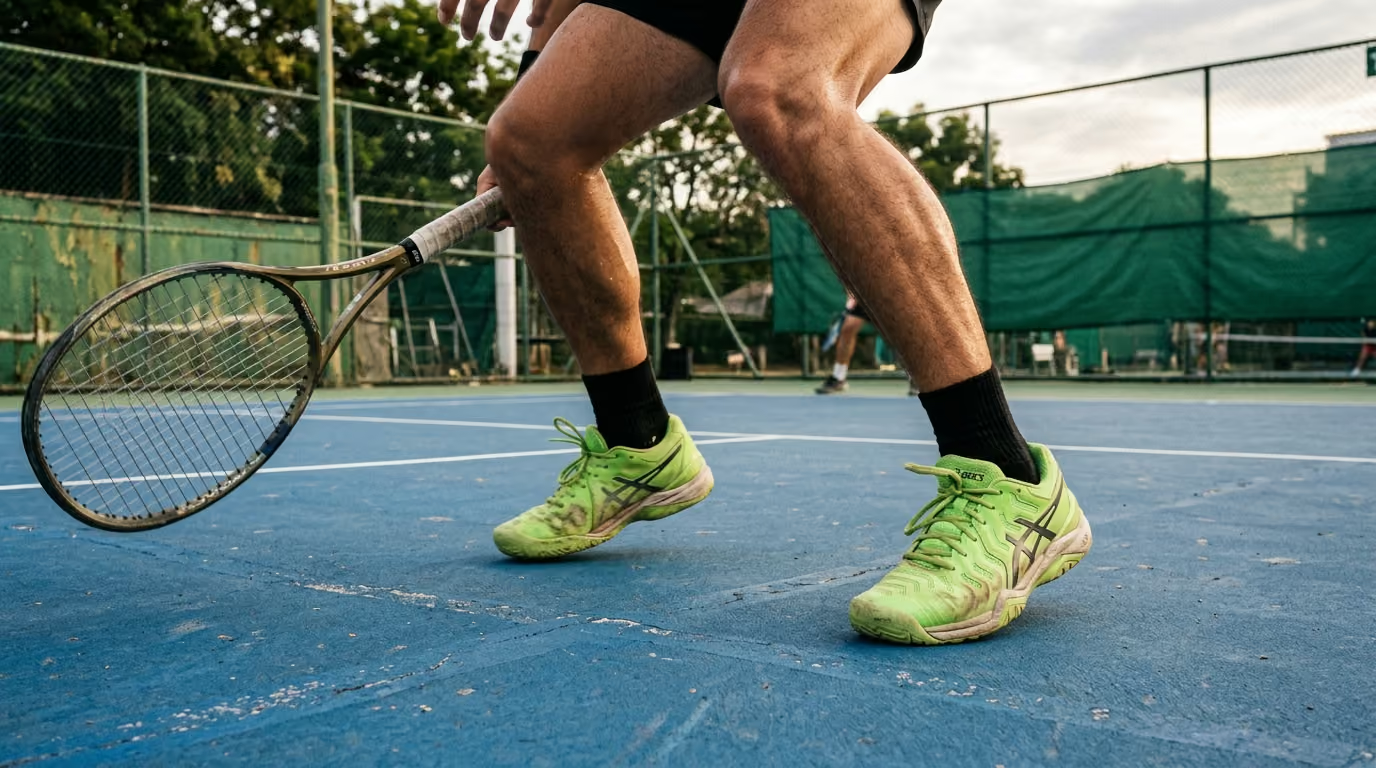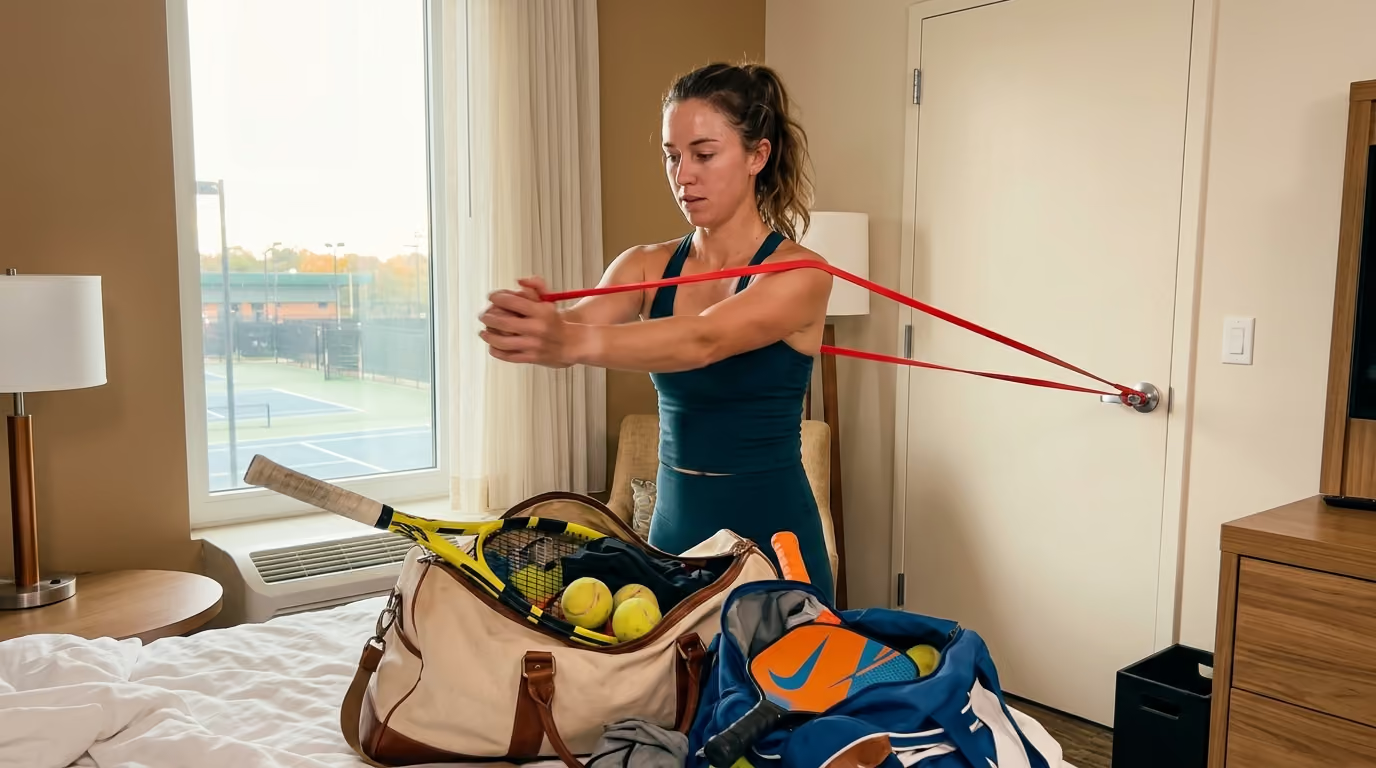

This playbook offers 10, 20, or 30-minute structured sessions to maintain physical capabilities for tennis, pickleball, and padel players while traveling.




Travel training is not a substitute for a full strength and conditioning program. Instead, it is a focused maintenance and readiness system. It is designed to preserve the physical qualities that deteriorate during travel, tournament weekends, or vacations.
These qualities include joint range of motion, tissue tolerance, and force production. Travel also impacts trunk control, shoulder stability, and your ability to perform short repeated efforts.
The primary programming rule of travel training is the minimum effective dose. You must perform enough targeted physical work to maintain athletic qualities. However, you should avoid creating excessive soreness or recovery debt before your next match.
This playbook provides a structured approach to maintaining your physical capabilities while away from your home court. Whether you are staying in a hotel room or preparing for an away tournament, this system keeps you moving well. Let us examine how you can stay strong, mobile, and ready to play without access to a full gym.
To maintain athletic readiness and prevent physical decline during travel, racket athletes should use a minimum effective dose of low-fatigue mobility, targeted isometrics, and short movement drills. Rather than seeking to build new fitness, this system preserves joint range of motion and tissue tolerance. By choosing between 10, 20, or 30-minute structured sessions, players can match their training volume to their daily physical readiness and match demands.
Traditional strength programs focus on progressive overload to build muscle, power, or endurance. Travel training has a much simpler objective. It aims to protect what you have already built while keeping your joints moving freely.
During long travel days, your body undergoes significant physical stress. Sitting in cars, trains, or planes can cause your hip flexors to tighten. It can also cause your gluteal muscles to become less responsive and your posture to slump.
When you arrive at your destination, you do not need a high-fatigue gym workout. A demanding session can compromise your court performance and increase your susceptibility to injury. According to a collegiate tennis study by Tendero-Ortiz et al. (2024), selected neuromuscular and perceptual recovery markers were most improved two days after competition rather than one day afterward.
This recovery curve shows that adding heavy workouts immediately after competition or travel is counterproductive. Your nervous system is already processing the stress of travel and match play.
Furthermore, travel fatigue can alter how your body responds to exercise. A systematic review of long-haul travel in elite athletes by Rossiter, Warrington, and Comyns (2022) examined the physical impact of transit. The researchers found that while long-haul travel increased subjective jet lag, its direct effect on physical performance was highly individual.
This means you must remain flexible with your training schedule. You should not force a hard workout if your body feels stiff or unresponsive.
Instead, your travel workouts should focus on active preparation and gentle tissue maintenance. By utilizing a minimum effective dose, you can preserve joint range of motion and muscle tone. You will finish these short sessions feeling physically prepared and alert rather than exhausted. For more detailed training strategies, you can explore our strength and conditioning resources for court athletes.
Every racket sport imposes a unique set of physical stresses on the human body. To design an effective travel program, you must understand these specific movement demands.
Tennis is characterized by repeated, high-intensity efforts. Research by Kovacs (2009) outlines that these bouts generally last between 4 and 10 seconds. They are followed by brief recovery periods of 10 to 20 seconds, with longer rests during changeovers.
A tennis player must cover a large court area. This requires rapid accelerations, heavy decelerations, and multi-directional footwork.
In a typical match, players cover approximately 8 to 15 meters per point. This movement pattern requires exceptional single-leg strength and lateral stability.
Your travel training should prioritize posterior chain strength, hip mobility, and rotational core stability. This focus helps your body manage the high deceleration forces of the sport. For further tennis-specific advice, you can read our tennis-specific movement patterns articles.
Pickleball is played on a smaller court, but it still places significant demands on your joints. The game requires constant split-stepping, low lunging, and rapid lateral shifts.
Because the paddle is short and the ball is light, players must react quickly near the kitchen line. This court position demands excellent ankle mobility and quad endurance.
In a study of older pickleball players by Kim et al. (2025), researchers found that 32.1% of participants reported a pickleball-related injury during the previous year. Within this group, 57.9% of the injuries occurred in the lower extremities. Furthermore, 61.8% of these issues involved muscle or tendon tissue.
This data highlights the importance of calf and ankle conditioning. Your travel program must maintain lower-limb tissue capacity to handle these sudden, repetitive lunges. You can read more about safe preparation in our pickleball conditioning strategies section.
Padel combines elements of tennis with wall-play dynamics. The sport requires frequent changes of direction, turning, and overhead striking.
Because of the court walls, players often find themselves in unusual physical positions. This requires high levels of rotational core control and lateral hip strength.
A scoping review of padel injuries revealed that the elbow is the most common site of upper-limb issues. This is closely followed by the shoulder, with tendinous injuries being highly prominent. In the lower body, the knee and ankle are the most vulnerable joints, often involving ligament sprains.
To prepare for padel, your travel plan must include shoulder rotation work and wrist care. It must also feature single-leg landing control and adductor strength. To learn more about managing these unique court demands, examine our padel articles and guides.
Before you begin any travel workout, you must determine your physical readiness. You can do this by analyzing your external load and your internal load.
External load refers to the objective physical work you have completed. This includes your match hours, travel duration, steps accumulated, and the temperature of your environment.
Internal load describes how your body has responded to those stressors. This includes your sleep quality, muscle soreness, perceived fatigue, and general joint stiffness.
To simplify this process, our team recommends using a basic traffic-light system. This self-assessment helps you make sensible, conservative decisions about your daily training volume.
Using this system prevents you from overtaxing your body when it is already under stress. It teaches you to listen to your physical signals rather than blindly following a rigid workout schedule.
You do not need a lot of heavy equipment to stay in shape while traveling. A small, lightweight kit can easily fit into your carry-on luggage or racket bag.
These elastic bands are excellent for activating your gluteal muscles and lateral hips. They can be placed around your knees or ankles to add gentle resistance to lateral walks. They are light, cheap, and take up virtually no space in your suitcase.
A long band allows you to perform upper-body movements. You can use it for chest presses, rows, and shoulder external rotations. If you have a secure door anchor, you can perform a wide range of pulling exercises in your hotel room. Always use these anchors exactly as directed by the manufacturer.
A firm ball is an excellent tool for myofascial release. You can use it to roll out tight arches in your feet, stiff calves, or tense shoulders. It is a highly effective, low-space recovery tool.
If you have a secure door frame, a suspension trainer offers exceptional bodyweight resistance. It allows you to perform rows, squats, and core exercises. This helps you maintain upper-body pulling strength when you do not have dumbbells.
A skipping rope is the ultimate portable conditioning tool. It is perfect for maintaining calf stiffness and ankle elasticity. You can use it for quick, low-impact warm-ups on carpeted surfaces or travel mats.
A thin travel mat provides a clean surface for your floor-based exercises. It makes planks, glute bridges, and mobility drills much more comfortable in hotel rooms.
The 10-minute session is designed for busy travel days. Use it after a long flight, on match mornings, or when your physical readiness is in the yellow zone.
I remember finishing a tough two hour padel match on a cold Tuesday night and waking up the next morning feeling like my lower back was locked in concrete. For a long time, I just accepted this as the price of playing hard in my forties. But once I started spending just ten minutes on targeted hip mobility before heading to the club, the stiffness almost completely vanished. It taught me that we do not have to accept pain as a default state of athletic longevity.
This short routine is not a hard workout. It is a low-fatigue system designed to restore joint range of motion and wake up your nervous system.
Begin by walking slowly around your room. Focus entirely on slow, deep nasal breathing.
Perform gentle ankle pumps by rocking from your heels to your toes. Swing your arms loosely across your chest to encourage upper-body circulation. This simple routine helps lower travel-induced stress and increases your core temperature.
Perform 5 to 8 slow ankle rocks on each leg. Stand facing a wall, place your toes a few inches away, and drive your knee forward over your middle toe. Keep your heel firmly on the floor to stretch the deep calf muscles.
Next, perform 5 support-assisted hip airplanes per side. Hold onto a desk or wall, hinge at your hips, and rotate your pelvis open and closed. Finish with 5 thoracic rotations on your hands and knees, reaching one arm under your body and then up toward the ceiling.
Perform two quick rounds of this low-intensity circuit:
Perform a simple march-to-split-step pattern. March in place for 5 seconds, then drop quickly into a low, athletic split-step stance. Hold this position for 1 second, then repeat.
This drill helps prepare your nervous system for the quick, reactive movements required on court. Alternatively, perform a light side-shuffle back and forth across your hotel room at half speed.
Finish your session with 1 minute of deep, relaxed breathing. You can perform a gentle hip-flexor stretch or an overhead reach during this time.
Take a moment to assess how your joints feel. This quick scan helps you plan your court warm-up or decide if you need extra rest. To manage your recovery more effectively, check out our recovery science resources page.
The 20-minute session is your default travel workout. It is ideal for days when you have no immediate match play but want to maintain your muscle tone and strength.
Begin with a continuous, low-intensity warm-up. Perform 1 minute of light marching or shadow footwork. Follow this with 1 minute of bodyweight squats and alternating reverse lunges.
Spend the final minute performing arm circles and slow trunk rotations. This simple preparation ensures your muscles are warm and ready for resistance work.
Perform three rounds of the following four exercises. Work for 30 to 40 seconds per exercise, then rest or transition for 20 to 30 seconds. Keep your physical effort to an RPE of 6 to 8, meaning you should always leave a few clean repetitions in reserve.
Perform split squats or reverse lunges. Keep your front foot flat on the floor and lower your back knee toward the ground under complete control.
Take 3 seconds to lower your body, then drive back up to the starting position. Unilateral training is highly effective because it builds balance and mimics court movement.
Perform single-leg hip hinges or long-lever glute bridges. If using the hinge, stand on one leg and push your hips backward while keeping your spine straight.
Feel the tension in your hamstring, then contract your glute to stand up. If you have a loaded backpack, hold it close to your chest to add safe, comfortable resistance.
Perform push-ups or banded rows. If your push-up technique starts to break down, elevate your hands on a sturdy desk or bed frame.
If performing rows, loop your long resistance band around a secure door anchor or your feet. Pull your shoulder blades back and down, squeezing them together at the top of the movement.
Perform side planks or dead bugs. If doing the side plank, hold a straight line from your head to your feet for 30 seconds.
For the dead bug, lie on your back and alternate extending opposite arms and legs. Focus on keeping your lower back pressed firmly into the floor throughout the exercise.
Perform six rounds of lateral movement drills. Lateral agility is highly relevant for court performance.
This finisher exposes your lower-limb tendons to brief lateral forces without creating deep physical fatigue. It keeps your footwork sharp and responsive.
Lie flat on your back on your travel mat. Place one hand on your chest and the other on your stomach.
Inhale through your nose for 4 seconds, hold for 2 seconds, and exhale through your mouth for 6 seconds. This slow breathing pattern helps calm your nervous system and initiates the recovery process.
The 30-minute session is a complete hotel-room workout. Use this routine when you have a full rest day, low muscle soreness, and adequate hotel room floor space.
Spend 1 minute marching or performing light skipping. Follow this with 1 minute of squat-to-reach exercises.
Squat down, hold your toes, and lift one arm toward the ceiling, then repeat on the opposite side. Perform 1 minute of reverse lunges with a gentle torso rotation over your front leg.
Spend the final 2 minutes performing ankle rocks and scapular push-ups. This comprehensive warm-up ensures your joints are thoroughly prepared for the strength and elastic work ahead.
Perform three complete rounds of this maintenance circuit. Focus on slow, controlled eccentric movements to protect your joints and tendons.
Perform two to three rounds of this reactive circuit. If you have any active lower-limb pain, skip this block and perform slow calf raises instead.
Choose one of these conditioning protocols based on your available hotel space. These intervals help maintain your aerobic and anaerobic fitness levels.
Perform 10 seconds of fast shadow footwork or rapid stationary marching. Follow this with 30 seconds of quiet walking recovery. Repeat this cycle for 6 to 8 rounds.
If you have access to a secure hallway, perform 6 seconds of quick lateral shuffling. Recover with 24 seconds of slow walking. Repeat for 6 to 8 rounds.
If you are accustomed to stair climbing, walk or jog briskly up a flight of stairs for 12 seconds. Walk slowly back down to recover for 48 seconds. Perform 4 to 6 rounds.
Walk slowly around your room until your heart rate drops. Perform 1 minute of gentle calf stretching against a wall.
Follow this with 1 minute of a half-kneeling hip-flexor stretch. Finish with 1 minute of deep, relaxed breathing to promote healthy physical recovery.
When you are away from home, you must select exercises that maximize muscle recruitment with minimal external weight. Focus on these travel-friendly options to target key court-specific muscle groups.
The split squat and reverse lunge are exceptional options for racket players. They work your quadriceps, glutes, and adductors while building single-leg stability.
To increase the challenge without dumbbells, perform these exercises with a slow tempo. Lower your body over 4 seconds, pause at the bottom, and then rise.
You can also hold a static lunge position for 30 seconds. This isometric work builds muscular endurance and tendon strength with zero joint impact.
Racket sports require strong, resilient ankles. You can perform single-leg calf raises on a flat floor or off the edge of a sturdy step.
Ensure you perform some raises with a straight knee to target the gastrocnemius muscle. Perform others with a bent knee to target the deeper soleus muscle.
Additionally, perform tibialis raises by leaning your back against a wall and pulling your toes toward your shins. This exercise helps protect the front of your shins from court impact.
To target your lateral hips, perform mini-band lateral walks. Place the band around your feet to increase the activation of your outer glutes.
To build adductor strength, perform Copenhagen plank regressions. Lie on your side and place your top knee on a sturdy chair or bed.
Lift your hips so your body is in a straight line, supported by your knee and your elbow. Hold this position for 15 to 20 seconds to protect your groin muscles from rapid lateral movements.
Your trunk must transfer force from your lower body to your upper body. Rather than performing endless sit-ups, focus on anti-rotation and anti-extension exercises.
The Pallof press is an excellent choice for traveling players. Anchor your long resistance band at chest height, stand sideways, and hold the band at your sternum.
Press the band straight out in front of you. Resist the temptation to let the band rotate your torso. Hold for 2 seconds, pull it back, and repeat.
To protect your rotator cuff, use your long resistance band for shoulder external rotations. Keep your elbow tucked against your side and rotate your hand outward under control.
Perform band pull-aparts to strengthen your upper back and posterior shoulders. Pull the band apart until it touches your chest, squeezing your shoulder blades together.
These movements keep your shoulders healthy and balanced. They help counteract the repetitive stress of overhead serves and groundstrokes.
To manage repetitive gripping stress, perform wrist-extension and wrist-flexion isometrics. Hold a firm object or use your opposite hand to provide resistance.
Press upward against the resistance, holding the contraction for 10 seconds. You can also perform pronation and supination exercises using a light object, like a water bottle. These simple drills help maintain tendon health in your forearms and elbows.
Traveling often disrupts your hydration habits. Air cabins are highly dehydrating, and changes in climate can significantly increase your sweat rate. To stay healthy and maintain your athletic performance, you must manage your fluid intake carefully. You can read more about managing these physical factors on our player health articles page.
According to research by Kovacs (2009), fluid losses during tennis matches can range from 1.0 to 2.5 liters per hour. This rate varies depending on your body weight, play intensity, and the local climate.
To prevent dehydration, follow the American College of Sports Medicine guidelines. Drink 400 to 600 milliliters of water approximately two hours before you play.
During matches, consume fluids at regular intervals, such as during changeovers or game rests. While a general intake of 1.2 to 1.6 liters per hour is often recommended, you must individualize this based on your personal sweat rate.
If you are playing in a hot environment, remember that your body needs time to adapt. Full heat acclimatization can take up to two weeks of regular exposure.
When traveling to a warmer climate, do not perform high-volume conditioning sessions immediately. Keep your initial workouts short, seek shade, and prioritize fluid and sodium intake.
If you experience headaches, dizziness, nausea, or coordination loss, stop exercising immediately. These are warning signs of heat sickness and require prompt medical attention.
Avoid these frequent errors to ensure your travel training supports your performance on the court.
Many players believe a workout is only effective if they feel completely exhausted. They perform high-volume circuits of burpees, jump squats, and mountain climbers in their hotel rooms.
This approach creates deep physical fatigue and muscle soreness. It reduces your speed, court coordination, and reaction times during actual matches.
If you have just finished a demanding three-set tennis match, your body needs rest. Do not return to your hotel and perform a heavy strength circuit.
Our team recommends prioritizing gentle mobility and passive recovery instead. This allows your nervous system to recover and prepares you for your next match.
When players feel stiff after travel, they often perform deep, aggressive static stretches. This can actually aggravate sensitive nerves and tendons.
Instead, use active mobility drills, light walking, and self-massage with a lacrosse ball. This approach improves joint range of motion without overstretching irritated tissues.
Many travel programs focus exclusively on the lower body. They feature squats, lunges, and calf raises while completely ignoring the upper body.
Racket sports place significant stress on your shoulders, elbows, and wrists. You must include scapular stability and forearm care in your travel routine to maintain physical balance.
Players often use bands or backpacks without tracking their resistance. They simply perform repetitions until they are tired.
To maintain your physical capabilities, you must track your volume. Progress your exercises by slowing your tempo, adding pauses, or increasing band tension systematically.
While minor stiffness is a normal part of travel and play, you must recognize when to seek professional medical help. Consult a qualified healthcare provider if you experience any of the following warning signs:
Do not attempt to push through these symptoms with travel workouts. A professional evaluation is essential to prevent minor issues from becoming serious injuries. If you want to learn more about our editorial philosophy and research-led standards, visit our about Evercourts page.
Yes, a sturdy backpack is an excellent tool for travel training. You can load it with clothing, water bottles, or books to create safe resistance.
Hold the pack close to your chest during squats, lunges, and hip hinges. Ensure the pack is securely closed and that the weight does not shift during exercise.
If you cannot lie down on the floor, focus on standing exercises. You can perform split squats, wall sits, calf raises, and standing ankle mobility.
Loop your long resistance band around a secure door handle to perform rows and chest presses. You can complete a highly effective maintenance session using less than two square meters of space.
Skipping on hard, unyielding surfaces like tile or thin carpet can place high stress on your joints. If possible, perform your skipping drills on a thick travel mat or carpeted floor.
Keep your hops low to the ground and land softly on the balls of your feet. If you have any history of calf or Achilles tendon issues, replace skipping with slow calf raises.
If you are experiencing severe jet lag, prioritize sleep and hydration over physical training. Perform the 10-minute readiness template to encourage gentle blood flow and relieve joint stiffness.
Avoid high-intensity intervals, heavy strength work, or complex agility drills. Once your sleep patterns normalize, you can transition to the 20 or 30-minute maintenance programs.
Follow Evercourts for practical insights on tennis, pickleball and padel performance, movement, recovery and healthy ageing. Stay connected for new articles, research-led guidance and ideas to help you play well and keep playing for years.


Read practical guidance for better movement, smarter preparation and a game that keeps working for you.
explore the Blog