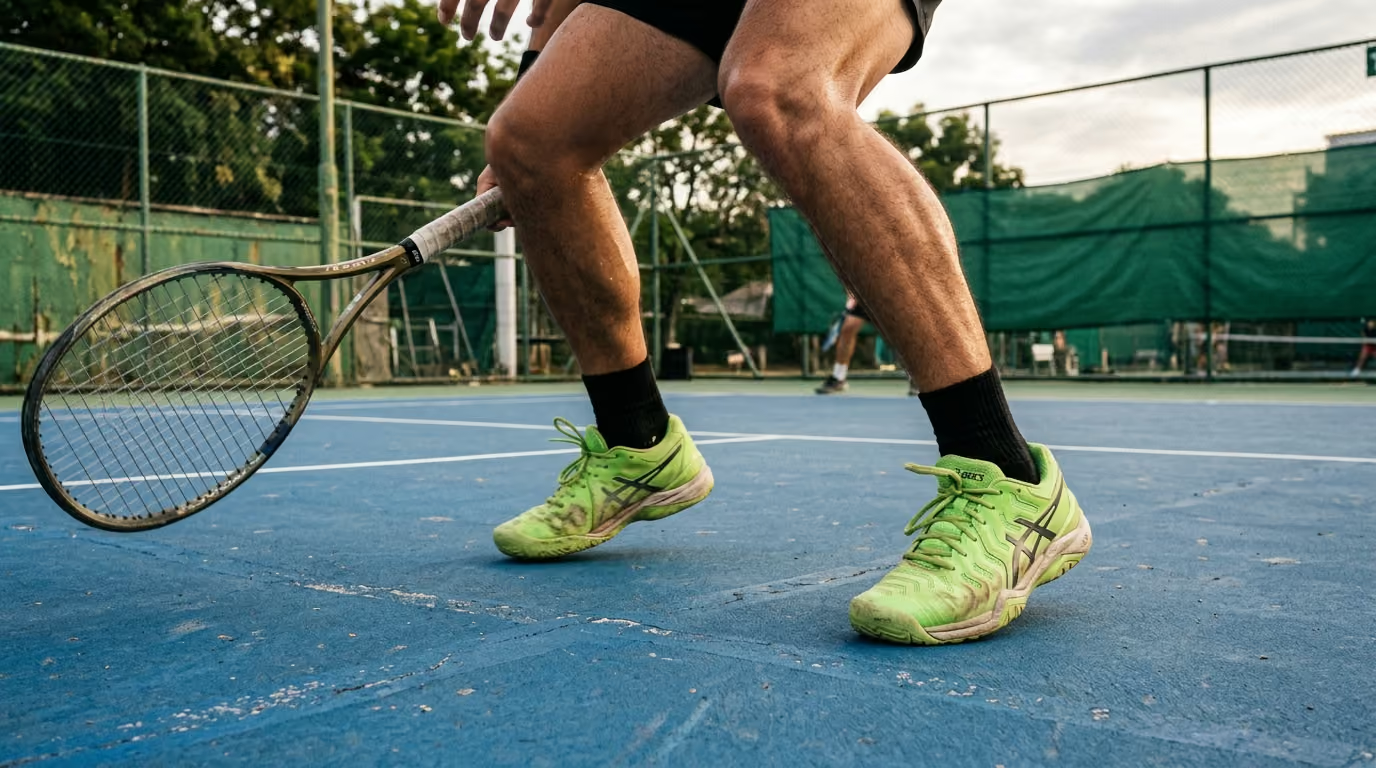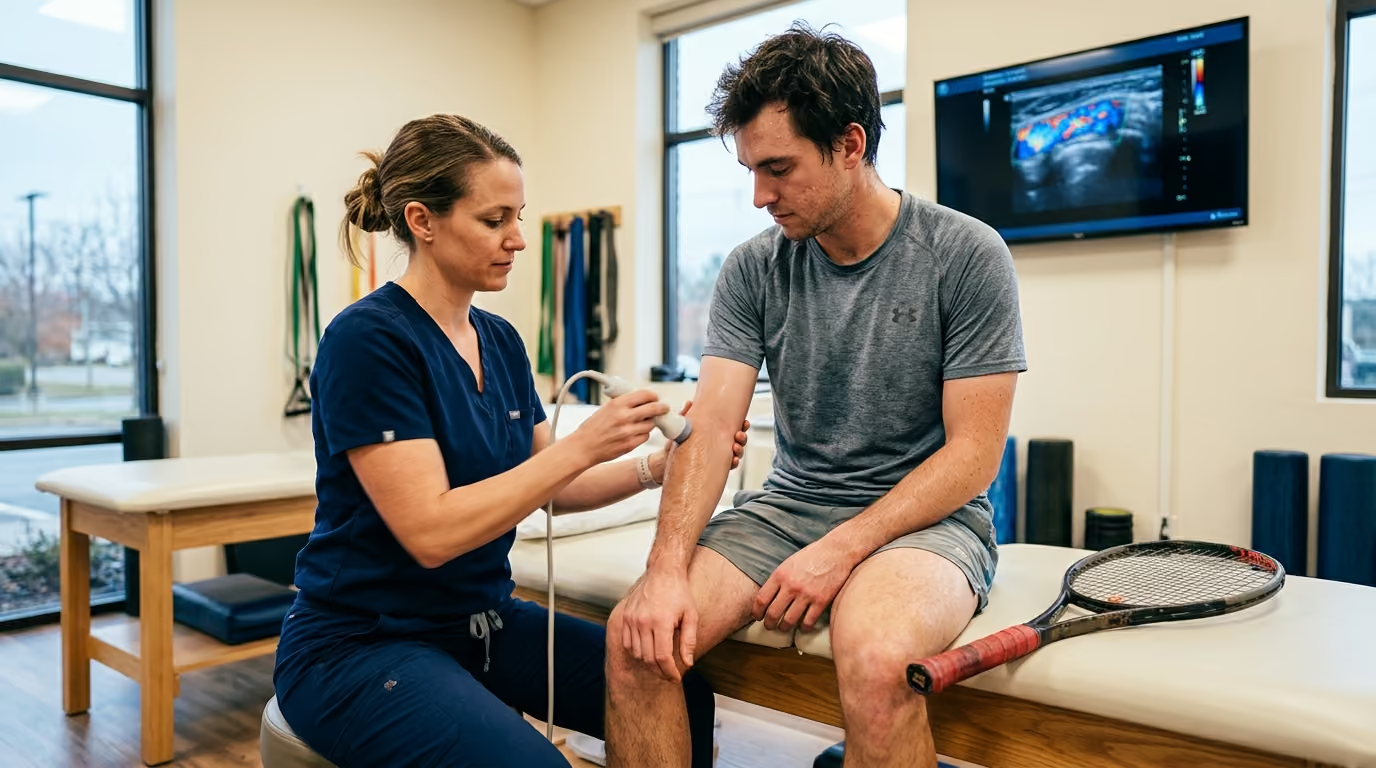

Tissue recovery and adaptation in racquet sports involve distinct timelines, with muscles recovering quickly while tendons and bones require weeks or months to remodel.




You might finish a three-set match feeling energetic, sleep soundly, and wake up without joint pain. This leads many players to believe their bodies have fully recovered and are ready for another heavy session. However, feeling ready to play is not the same as structural healing.
Complete recovery from racquet sports requires much more than just feeling ready to play again. While your nervous system and muscles can restore performance within forty-eight hours, your tendons and bones remodel at a much slower rate over weeks or months. True athletic longevity relies on matching your playing volume to these slower-adapting tissues rather than playing again as soon as you are pain-free.
I remember finishing a tough two hour padel match on a cold Tuesday night and waking up the next morning feeling like my lower back was locked in concrete. For a long time, I just accepted this as the price of playing hard in my forties. But once I started spending just ten minutes on targeted hip mobility before heading to the club, the stiffness almost completely vanished. It taught me that we do not have to accept pain as a default state of athletic longevity. Managing joint strain is a core tenet of our injury prevention resources.
To understand how your body responds to court play, you must separate recovery from adaptation. Recovery is the process of restoring your physical function back to baseline after a stressful training session. Adaptation is the process of permanently increasing your physical capacity to handle future training. When you recover, you return to where you started, but when you adapt, you build a larger physical reserve.
These two processes do not operate on the same timeline. Your nervous system and muscles are highly vascularized and adapt relatively quickly to mechanical strain. In contrast, your tendons, bones, and joint cartilage receive far less blood flow and require months of consistent work to remodel. This structural mismatch explains why you can feel completely recovered while your tissues are still vulnerable to injury.
According to research on human muscle protein synthesis, a single session of resistance exercise can increase protein production by two- to fivefold. This increased state can persist for up to forty-eight hours in fed individuals. In older men, myofibrillar protein synthesis remains elevated at both twenty-four and forty-eight hours after exercise. This is true for both resistance training and high-intensity interval training. However, the response to resistance work is consistently higher at both points.
By contrast, structural tissues like tendons do not adapt in forty-eight hours. A comprehensive meta-analysis of twenty-seven studies and thirty-seven exercise interventions examined tendon behavior. The researchers found that tendon adaptations require repeated, high-magnitude loading over many weeks. Specifically, programs lasting longer than twelve weeks produced much more favorable structural adaptations.
This creates a clear disconnect between how your muscles feel and how your tendons function. Your muscles may feel fresh and ready to sprint, but your Achilles tendons might still be adapting to the mechanical strain of your last match. Understanding this timeline is essential for players who want to maintain their health on the court. For more insights on how to optimize your post-match habits, you can view our dedicated recovery science resources.
Muscle tissue has a rich network of blood vessels, which allows for rapid delivery of oxygen, amino acids, and nutrients. When you play a match or lift weights, you create mechanical tension and metabolic stress within the muscle fibers. This stress triggers a cascade of chemical signals that instruct your body to repair and strengthen the muscle tissue.
The earliest changes you experience from training are neural. Your nervous system learns to coordinate muscle contractions more efficiently. It increases the firing rate of motor units and improves synchronization across different muscle groups. This explains why a beginner can improve their stroke power or lift heavier weights within two weeks, even before any physical muscle growth has occurred.
Over several weeks of consistent loading, the actual structure of the muscle fibers begins to change. Your body synthesizes new contractile proteins, which increases the size and force-producing capacity of the muscle. This process is highly dependent on both mechanical tension and nutritional status. If you do not consume enough protein or allow sufficient rest between sessions, this remodeling process will stall.
Court sports require repeated, explosive movements interspersed with brief recovery periods. Your muscles must adapt to this demand by improving their energy production systems. This includes increasing the density of mitochondria, storing more glycogen, and improving the buffering capacity for metabolic byproducts. These changes allow you to maintain your explosive power during a long third set.
Despite these adaptations, a hard court session will cause acute neuromuscular fatigue. This fatigue decreases your maximum force production, limits your reaction speed, and impairs your coordination. While your muscles can recover their strength within forty-eight hours, the structural tissues surrounding them may still be compromised. If you return to full-volume play before these structures catch up, you increase your risk of joint issues.
Tendons are thick bands of connective tissue that transmit the force generated by your muscles to your bones. Because tendons must tolerate extreme tensile forces, they are composed primarily of dense collagen fibers. However, this structure has a very limited blood supply compared to muscle tissue. This metabolic design means that tendon adaptation occurs on a much longer timescale.
Tendon strength is not just a matter of size. It is determined by the alignment of collagen fibers and the density of cross-links between them. Research shows that mechanical loading increases both tendon stiffness and the elastic modulus of the tissue. Stiff tendons are highly efficient because they store and release elastic energy during quick movements, which reduces the work your muscles must perform.
According to a systematic review of lower-limb tendon adaptation that analyzed sixty-one articles and seven hundred sixty-three participants, mechanical loading leads to positive changes in tendon stiffness. The greatest adaptations were associated with high-magnitude resistance training that produced high localized tendon strains. Low-load training or general stretching did not produce the same structural adaptations.
This means that to strengthen your tendons, you must subject them to high-magnitude mechanical forces. This loading must be sustained over a period of twelve weeks or more to produce measurable structural changes. If you increase your court playing time too quickly, your muscles will generate forces that your tendons are not yet stiff enough to handle safely.
Racquet-sport players subject their tendons to massive, repetitive mechanical forces. The Achilles tendon experiences high strain during sprinting, cutting, and jumping. The patellar tendon absorbs the impact of every split step and deep deceleration. In the upper body, the rotator cuff and elbow tendons must tolerate the rapid acceleration and braking of the racket during serves and groundstrokes.
If these forces exceed the tendon's current capacity, the tissue can enter a reactive state. This is often the first step in the development of tendinopathy. The tendon-continuum model describes this process as moving from a reactive response to structural disrepair, and eventually to degenerative change. Managing these stages requires careful load adjustment rather than complete rest. To build structural capacity, check out our strength and conditioning resources.
Bone is a highly active tissue that constantly reshapes itself in response to physical forces. This process is governed by a biological feedback loop described by the mechanostat theory. This theory proposes that bone cells monitor the mechanical strain placed on the skeleton and adjust bone density accordingly.
When you run, jump, or hit a ball, your bones experience mechanical strain. This strain causes tiny electrical currents and fluid movements within the bone tissue. These signals alert specialized cells called osteocytes, which trigger the deposition of new mineral crystals. This process hardens the bone in the specific areas that experience the greatest stress.
This feedback loop requires a minimum threshold of mechanical strain to stimulate bone growth. Low-impact activities like swimming or cycling do not reach this threshold, meaning they do not improve bone density. In contrast, the high-impact landings and rapid directional changes of court sports are highly effective for building bone strength.
However, bone remodeling is a slow and delicate process. When a bone experiences a new, high-volume load, it first undergoes a phase of resorption, where old bone is broken down before new bone is deposited. During this initial phase, the bone is temporarily weaker and more vulnerable to injury. This is why a sudden return to high-volume play after a layoff can lead to bone stress injuries.
Bone stress injuries, such as stress reactions and stress fractures, often develop without obvious symptoms in their early stages. A player might experience a vague, deep ache that disappears once they warm up. If they continue to load the bone, the micro-cracks will accumulate faster than the body can repair them.
Unlike muscle soreness, bone pain is a critical warning sign that should never be ignored. Continuing to play on a developing bone stress injury can lead to a complete fracture, requiring months of total inactivity. Gradual loading is the only way to allow your skeleton to adapt to the physical demands of the court.
Connective tissue is a broad category that includes ligaments, joint capsules, fascia, cartilage, and the extracellular matrix. These tissues provide the structural framework for your joints and help distribute mechanical force throughout your body. Because they have different cellular structures and blood supplies, they adapt at different rates.
Ligaments connect bone to bone, providing passive stability to your joints. Joint capsules surround the joint, holding the lubricating synovial fluid in place. Both structures contain dense collagen fibers that adapt to repeated tensile loading over time. However, because they have a limited blood supply, their adaptation timeline is much closer to that of tendons than muscles.
Repeated end-range loading, such as the extreme wrist extension used in a late backhand, can strain these tissues. If your muscles are fatigued, they cannot absorb these forces, leaving your ligaments to take the brunt of the load. Over time, this can lead to micro-instability and joint irritation.
Fascia is a continuous sheet of connective tissue that wraps around and connects your muscles, bones, and nerves. It plays a vital role in transmitting force across muscle-tendon units and coordinating complex movements. The extracellular matrix is the fluid-filled environment where these structural proteins are synthesized and repaired.
Healthy fascia requires a balance of mechanical loading, movement, and hydration. If you sit at a desk all day and then play an intense match, your fascia may be stiff and unprepared for the sudden strain. This can lead to localized restrictions, altered movement patterns, and increased joint stress. Targeted joint mobility exercises are covered in detail within our mobility and movement resources.
Articular cartilage lines the ends of your bones, allowing them to glide smoothly over one another. Cartilage has no blood vessels, nerves, or lymphatic system. It relies entirely on a process called passive diffusion to receive nutrients. When you bear weight on a joint, you squeeze metabolic waste out of the cartilage, and when you release the weight, nutrient-rich fluid is drawn back in.
This mechanism means that cartilage needs regular, low-impact loading to stay healthy. However, excessive shear forces and heavy impact can wear down the cartilage faster than it can absorb nutrients. If your muscles are strong but your joints are stiff, the joint surfaces will experience higher friction during play. Maintaining joint integrity is a vital component of healthy aging and athletic longevity resources.
Your nervous system is the commander of your physical performance on the court. It regulates how fast you move, how hard you hit, and how well you coordinate your movements. When you play a match, both your brain and your muscles experience fatigue, which changes how your body moves.
To manage your training effectively, you must understand the difference between central and peripheral fatigue. Central fatigue occurs in the brain and spinal cord, reducing the nervous system's drive to the muscles. You might experience this as a general feeling of lethargy, reduced motivation, or slow reaction times.
Peripheral fatigue occurs within the muscle fibers themselves. It is caused by metabolic changes, such as the accumulation of hydrogen ions or the depletion of glycogen. When peripheral fatigue sets in, your muscles cannot contract as forcefully or as quickly. A review of neuromuscular fatigue in racquet sports notes that both central and peripheral fatigue are highly active during competitive play.
When your primary muscles fatigue, your nervous system does not simply stop working. Instead, it alters your movement patterns to redistribute the mechanical load to other tissues. For example, if your quadriceps are tired during a long match, you may stop bending your knees when you change direction. To compensate, you will bend more at your lower back and hip joints.
These protective motor strategies allow you to maintain your playing speed and hit your shots successfully. However, they shift the mechanical load to tissues that may not be prepared to handle it. This redistribution is a major reason why pain-free performance is deceptive. You might feel fine on the court, but your nervous system is overloading secondary joints to make it happen.
A common mistake among court players is using immediate performance as proof of complete recovery. If you can still hit a hard serve or run down a drop shot, you assume your body is ready for more. However, performance recovery and structural adaptation operate on entirely different biological schedules.
Performance recovery is the restoration of your functional ability to complete a task. This can occur relatively quickly as your nervous system clears metabolic waste and restores glycogen levels. You can often return to baseline performance within twenty-four to forty-eight hours after a hard match.
Tissue adaptation is the structural remodeling of your tendons, bones, and ligaments. This process requires a repeated physical stimulus over twelve weeks or more to produce measurable changes. While your performance may recover quickly, your structural tissues remain in a state of remodeling. If you continue to load them heavily, you will eventually exceed their current capacity.
This distinction is particularly important for older athletes who want to maintain their healthy longevity on the court. As you age, your tissue remodeling processes slow down, and your structural tissues require more time to adapt to mechanical strain. Understanding this timeline is essential for preventing chronic injuries and staying active for years to come.
To help you manage your training safely, we recommend using a simple traffic-light model. This system relies on your twenty-four-hour symptom response to guide your loading decisions:
To build durable tissues, you must manage your training workload carefully. This requires tracking both the external load you place on your body and the internal load your body experiences in response.
An effective workload management program tracks four distinct layers of physical stress:
According to the International Olympic Committee consensus on load in sport, training and competition load should be monitored individually. The consensus emphasizes that load includes physical, psychological, and environmental stressors. Rapid changes in workload, congested schedules, and travel are all meaningful risk signals that must be managed.
Research demonstrates a clear connection between sudden workload spikes and injury risk in court sports. A study of competitive adolescent tennis players found that each additional workload spike in tennis training or match play was associated with a shoulder-complaint hazard-rate ratio of 1.26. The same study showed a shoulder-injury hazard-rate ratio of 1.26.
Workload spikes in fitness training were also linked to shoulder complaints and injuries, with hazard-rate ratios of 1.11 and 1.18, respectively. Another study on high-performance junior tennis players found that injury risk increased 1.62 times for every 1,858.7 arbitrary-unit increase in workload during the most recent week. However, the researchers noted that acute workload alone was a poor predictor overall, and associations with internal workload markers were relatively weak.
This tells us that while rapid increases in training volume are a meaningful risk factor, they do not provide a guaranteed prediction of injury. You must combine workload tracking with subjective monitoring of your joint symptoms and movement quality.
The International Olympic Committee consensus discusses limiting weekly increases in training load to less than 10%. It also mentions keeping your acute-to-chronic workload ratio between 0.8 and 1.3 as a general guide. This ratio compares your training volume over the past seven days to your average volume over the past twenty-eight days.
However, you should not treat these thresholds as absolute biological laws. The consensus notes that load-injury profiles differ significantly between sports and individual athletes. Use these numbers as a helpful starting point, but always prioritize your personal symptoms and joint recovery rates over a mathematical formula.
Tennis, pickleball, and padel are all racquet sports, but they place very different mechanical demands on your body. Understanding these differences allows you to tailor your training and recovery to your specific sport.
Tennis is played on a large court, requiring long sprints, sliding decelerations, and explosive changes of direction. The tennis ball is heavy and fast, demanding high racket head speed and deep trunk rotation to generate spin and power.
This movement profile places immense mechanical stress on your shoulder joints, rotator cuff tendons, and lower back. The tennis serve is particularly demanding, requiring a rapid transition from maximum external rotation to internal rotation. If your shoulder tendons have not adapted to this high-velocity strain, the repetitive motion can lead to rotator cuff tendinopathy. Tennis players also experience high-impact forces through their knees and ankles, especially when playing on hard courts.
Pickleball is played on a much smaller court, which reduces the need for long, high-velocity sprints. However, the game demands rapid, short-distance reactions and low-amplitude quickness near the kitchen line.
This requires frequent, shallow lunges and quick lateral shifts from a low, bent-knee position. This movement profile places continuous, low-amplitude strain on your patellar and Achilles tendons. The pickleball paddle is lightweight, but the ball is hard and solid. This requires repetitive, high-frequency gripping, which can overload the forearm extensor muscles and lead to lateral elbow symptoms.
Padel is played in an enclosed glass court, combining elements of tennis and squash. The game features constant multi-directional pivoting, explosive vertical jumps, and wall plays.
Because of the enclosed court, padel players must perform rapid 180-degree pivots and backward-moving overhead strokes. The padel racket is heavy and solid, which transmits significant vibration to the elbow and wrist joints upon ball contact. The high volume of overhead lobs and wall returns places continuous mechanical strain on the shoulder girdle and lower back. Additionally, the constant pivoting on synthetic turf can place high shear forces on the knee ligaments and hip joints.
To help you apply these concepts to your own training, let us examine five common case patterns that players experience on the court.
A competitive tennis player begins a new upper-body strength program. They rapidly improve their forearm and wrist strength in the gym. They feel great on the court, hit their groundstrokes with more power, and decide to increase their weekly serving practice.
However, their muscle strength has improved faster than their tendons can remodel. Within three weeks, they develop deep stiffness on the outside of their elbow that worsens the morning after playing. Even though their muscles are strong, their elbow tendons have not had the twelve weeks required for structural adaptation. The training lesson is to control the combined dose of gripping and serving, using next-day stiffness to monitor tendon tolerance.
A recreational pickleball player returns to the court after a six-week layoff. They feel rested, energetic, and completely pain-free during their first match back. Excited by how good they feel, they play for three hours and add extra overhead drilling.
This player has recovered subjectively, but their physical capacity has declined from inactivity. That first three-hour session represents a massive relative workload spike. The following morning, they wake up with severe Achilles tendon stiffness and struggle to walk comfortably. The training lesson is to rebuild your court exposure in gradual stages, even if you feel completely fresh.
A padel player completes a competitive weekend tournament without any pain during play. They feel proud of their performance and schedule a hard training session for Monday morning. However, when they wake up on Monday, their knee joints feel stiff and they struggle to grip their racket comfortably.
Their tournament performance did not prove that their tissues tolerated the total load. The next-morning stiffness is a clear sign that the mechanical load exceeded their current tissue capacity. Instead of pushing through, the player should use the traffic-light model to reduce their training intensity on Monday.
During the third set of a long tennis match, a player is still hitting deep, high-velocity groundstrokes. However, their footwork has become heavy, and they are no longer bending their knees to get low. Instead, they bend from the waist and reach for the ball with an extended arm.
Neuromuscular fatigue has set in, altering their coordination and movement strategies. Their stroke output remains acceptable, but their nervous system is redistributing the mechanical load to their lower back and shoulder. This compensation pattern increases the risk of acute strain in those secondary areas. Players should monitor their movement quality and technical consistency, not just their ball speed.
A competitive player decides to add heavy squats and deadlifts to their routine during a club tournament week. They assume that gym training is separate from court play and will not affect their matches. Within a few days, they notice progressive patellar tendon pain during their matches.
Your body does not separate gym load from court load. The total mechanical load includes every sprint, jump, lunge, and heavy lift you perform. Adding high-magnitude lifts during a congested competition week can overload the patellar tendons. The training lesson is to consider your weekly schedule as a whole and avoid overlapping high-load exposures. For more resources on court lifestyle, you can explore our court life articles.
To build long-term durability on the court, you must avoid several common training mistakes and misconceptions.
Many players believe that if they are pain-free, their tissues have fully recovered. As we have seen, pain is a complex, protective signal that does not measure tissue adaptation. Your muscles and nervous system may recover within forty-eight hours, but your tendons and bones take much longer to remodel.
Strength gains often occur through neural pathways before structural tissues remodel. Your muscles can generate more force, but your tendons may not yet be stiff enough to transmit that force safely. This imbalance can lead to joint overload if you increase your playing intensity too quickly.
When a tendon becomes painful, the default reaction is often to rest completely. However, tendons require progressive mechanical loading to heal and adapt. Prolonged rest can actually decrease a tendon's load capacity, making it more vulnerable when you return to play.
Eccentric training is popular, but research shows that high-magnitude loading of any contraction type is effective for tendon adaptation. Isometrics, heavy slow resistance, and concentric-eccentric exercises are all valuable tools. The key is applying a high enough mechanical load to stimulate tissue remodeling.
Workload formulas like the acute-to-chronic workload ratio are helpful planning guides, but they are not crystal balls. Tennis research shows that these metrics are poor individual predictors of injury. You must combine workload data with subjective feedback and symptom monitoring.
An ultrasound or MRI might show structural changes in a tendon, but this does not always correlate with pain or function. Many active players have tendon changes on imaging but perform at a high level without pain. Clinical management should focus on your symptoms and physical capacity, not just an imaging report.
Your muscles, tendons, bones, and nerves operate on different biological schedules. Treating them as a single system can lead to premature loading and joint issues. You must respect the slower adaptation rates of your structural tissues.
Increasing your weekly training volume by less than 10% is a conservative guideline, but it is not a biological law. Individual responses vary wildly depending on your training history, age, sleep quality, and stress levels. Some weeks you may need to maintain or even reduce your load, regardless of what a percentage rule suggests.
To manage your recovery and training safely, we recommend using a simple four-layer monitoring framework. This system helps you track your body's response to training and make informed loading decisions.
Monitor how your joints feel during play, immediately after, and the following morning. If you experience mild soreness that resolves within twenty-four hours, your tissues are likely tolerating the load. If the soreness persists beyond twenty-four hours, your previous session exceeded your current capacity.
Perform simple, sport-relevant tests to check your joint integrity. For example, test your comfortable grip strength, your ability to complete a single-leg hop, or your range of motion. Comparing these movements to your personal baseline can help you catch accumulating tissue fatigue before pain appears.
Pay close attention to your coordination, reaction times, and movement quality on the court. If your footwork becomes sluggish or your stroke consistency drops, your nervous system is likely fatigued. This is a sign to scale back your training intensity, even if you are not in pain.
Keep a simple log of your court hours, matches, gym sessions, and travel schedule over the past two weeks. Look for sudden spikes in playing time or intensity that might place undue stress on your joints. This historical view helps you identify trends and plan your recovery periods proactively.
To build athletic longevity, your training must respect the biological speed limits of your body. Apply these eight principles to progress your court work and strength sessions safely.
When adjusting your training, change only one major variable at a time. This means you should not increase your playing duration, session frequency, and serving volume all in the same week. By isolating your changes, you can easily identify what caused any joint irritation.
Avoid scheduling high-intensity court sessions and heavy gym workouts on the same day. If you must do both, ensure they target different areas of the body. For example, do not follow a heavy forearm strength session with a two-hour match requiring heavy gripping.
Use your joint status the morning after a session as your primary compass. If your knees or shoulders are stiff, maintain or reduce your next training load. Do not progress your volume until your next-day symptoms return to baseline.
Complete rest is rarely the answer for chronic joint or tendon issues. Instead, use relative rest by reducing the volume of provocative movements while continuing low-impact training. Tendons and bones need a controlled physical stimulus to maintain their strength and capacity.
Acknowledge that your muscles and skill levels will return faster than your structural tissues. Just because you can hit a serve at full speed does not mean your rotator cuff tendons have fully adapted to that force. Give your body several months of consistent work to build deep structural durability.
According to the American College of Sports Medicine, you should progress your gym weights by two to ten percent. Make this increase only when you can exceed your target repetitions by one or two reps on consecutive sessions. This conservative approach prevents joint overload.
The International Olympic Committee emphasizes that adaptation timelines vary significantly between individuals. Do not base your training schedule on what your playing partners are doing. Listen to your own body and adjust your progression speed to match your personal recovery rate.
For more helpful articles on maintaining your health as a court athlete, visit the Evercourts blog.
While mild muscular soreness is a normal response to training, certain symptoms require professional evaluation. You should consult a qualified healthcare provider if you experience:
These warning signs indicate that you should seek guidance from a physical therapist or sports medicine physician. They can provide an accurate diagnosis and design a personalized rehabilitation program. Managing joint health proactively is the most effective way to ensure you can continue playing for years to come.
To apply this knowledge practically, follow this simple checklist to audit your training volume and joint health this week:
Follow Evercourts for practical insights on tennis, pickleball and padel performance, movement, recovery and healthy ageing. Stay connected for new articles, research-led guidance and ideas to help you play well and keep playing for years.


Read practical guidance for better movement, smarter preparation and a game that keeps working for you.
explore the Blog