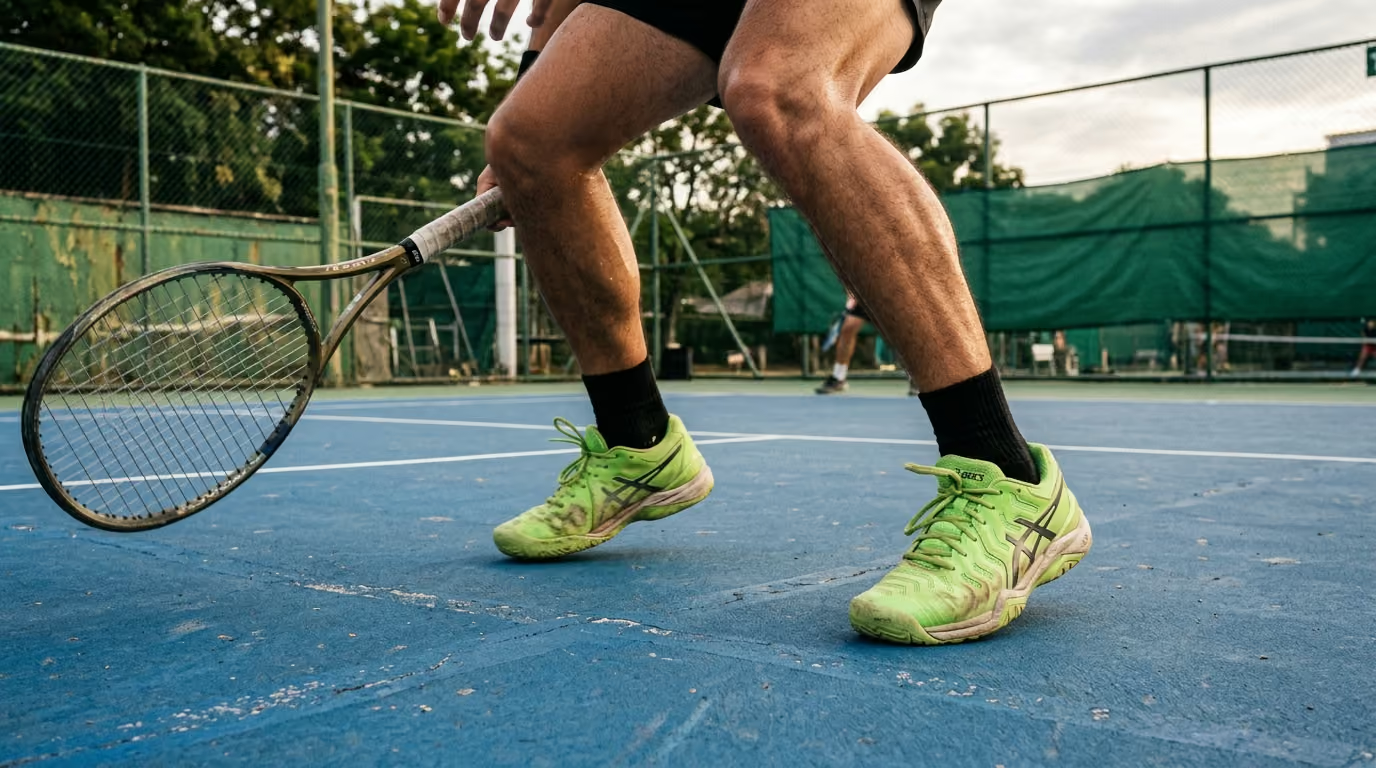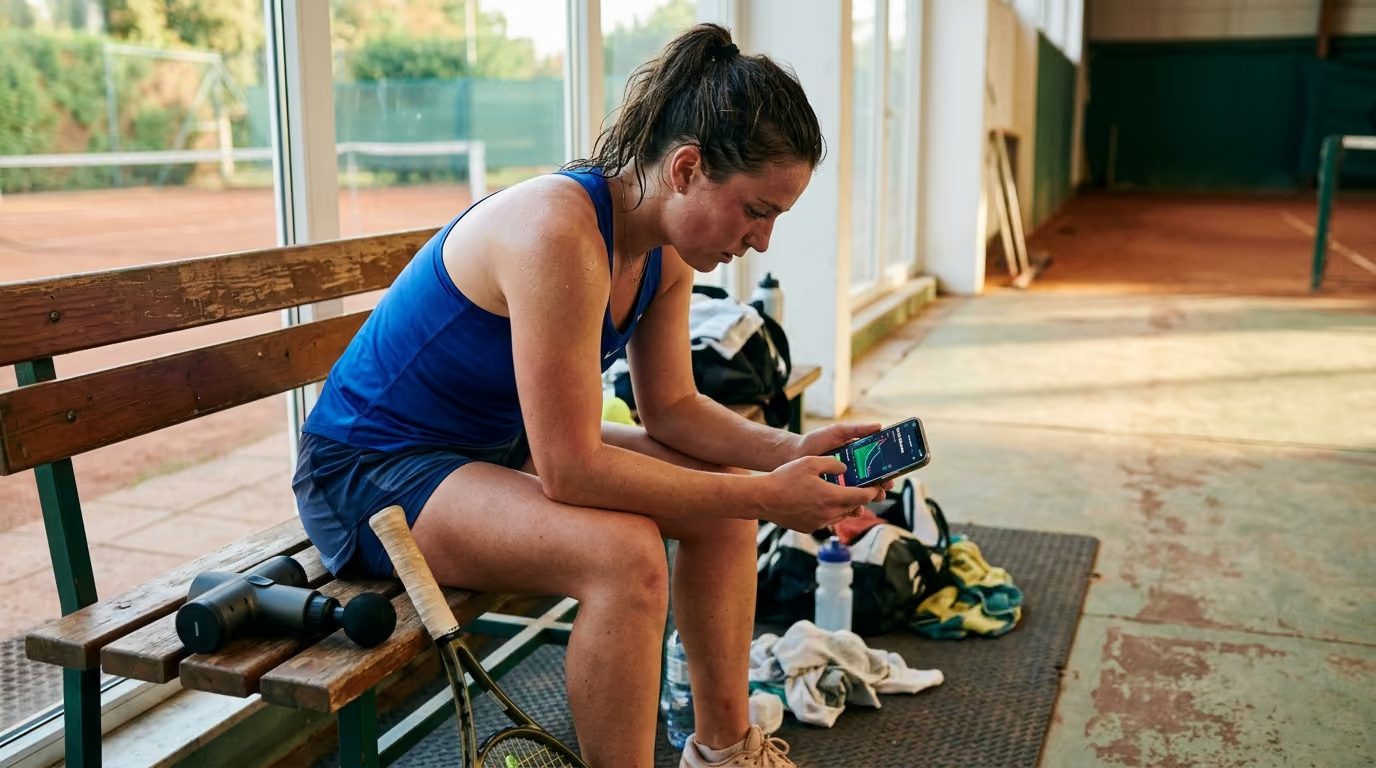

Optimal athletic performance and longevity are achieved by effectively balancing training load with recovery, preventing accumulated fatigue and overuse injuries.




If you have ever searched for answers to persistent knee soreness after a long singles match, you are likely dealing with accumulated fatigue. Many players assume that constant stiffness is the unavoidable cost of staying active. In our experience, this persistent fatigue is often a simple structural mismatch between training stress and recovery time.
To avoid accumulated fatigue on the court, players must balance their overall training load by managing both the physical volume of play and their personal physiological response to that work. This balance is achieved by monitoring weekly shifts in intensity, keeping training patterns varied, and allowing tissues time to adapt. By tracking simple daily markers of effort and readiness, you can progress your court time safely without triggering overuse injuries or persistent exhaustion.
Understanding how to manage these demands is essential for long-term enjoyment of court sports. This guide provides a clear roadmap to help you measure physical stress, design safer playing schedules, and protect your athletic longevity.
To perform well over time, we must understand how the human body adapts to physical work. Athletic training depends on a simple biological concept: you must apply a stressor to trigger an adaptation. When you play a demanding match, you temporarily disrupt your body's equilibrium. This temporary disruption is necessary to stimulate improvements in cardiovascular fitness, bone density, and muscular endurance.
However, these physical improvements do not occur during the match itself. They happen afterward, while your body is at rest. If the training stress is appropriate and you allow enough time for recovery, your body rebuilds itself to be slightly stronger than before. This positive adaptation is the foundation of physical preparation and long-term performance.
When the training stress is too high, or when recovery time is too short, this adaptive process breaks down. Instead of rebuilding, your tissues begin to accumulate micro-damage. Over several weeks, this imbalance can lead to declining performance, persistent soreness, and a weakened immune system. Understanding these scientific principles of recovery helps players avoid the trap of constant physical depletion.
Research from the European College of Sport Science and the American College of Sports Medicine emphasizes that training stress is cumulative. It is not limited to the minutes you spend running on the court. Your body processes physical training, psychological tension, poor sleep, and nutritional deficits through the same central stress response. If you add heavy court hours during a highly stressful work week, your capacity to absorb that physical load drops significantly.
To manage your training safely, you must separate physical stress into two categories: external load and internal load. Both metrics are valuable, but they tell very different parts of the story.
External load is the objective work you perform on the court. It is easily measured and quantified. Examples of external load include:
Internal load represents your body's unique physiological and psychological reaction to that external work. This is how hard your cardiovascular and nervous systems had to work to complete the physical tasks. Examples of internal load include:
A two-hour singles match on a cool evening might feel relatively easy for a highly fit player. That same match on a hot afternoon, while recovering from a mild cold, could push another player to their physical limit. The external load remains identical, but the internal load is vastly different. For this reason, successful athletic longevity relies heavily on tracking internal physical responses.
The most practical, scientifically validated way to measure internal load is the Session Rate of Perceived Exertion method. Developed by researcher Carl Foster, this method multiplies the duration of a session by a subjective rating of intensity. The scale ranges from zero to ten, where zero represents complete rest and ten represents a maximal, exhausting effort.
To calculate your daily internal load, use this simple formula:
For example, a 90-minute technical practice rated as a moderate 5 on the intensity scale produces 450 units of internal load. A highly intense 60-minute singles match rated as an 8 on the scale produces 480 units.
Research shows that logging this score 20 to 30 minutes after your session is highly reliable. Studies confirm that a 24-hour retrospective rating matches immediate ratings with a 98 percent correlation. However, waiting 72 hours to log your training causes the error rate to jump to over 35 percent. Consistent daily logging prevents you from miscalculating your weekly physical stress.
To protect your joints and muscles, you must look at how your current week of play compares to your recent history. This relationship is studied using the concepts of acute load and chronic load.
Acute load is the total workload you accumulate during a single seven-day period. This includes all singles play, doubles play, gym training, and high-intensity movement sessions. Acute load represents the immediate fatigue you are carrying.
Chronic load represents your average weekly workload over the preceding three to four weeks. This rolling average serves as a proxy for your current physical preparation. It represents the historical volume of work to which your muscles, tendons, and cardiovascular system have recently adapted.
Comparing these two values creates the Acute:Chronic Workload Ratio. To find this ratio, divide your acute seven-day load by your four-week chronic average. For example, if your acute load for the current week is 1,200 units, and your four-week average is 800 units, your ratio is 1.50.
In sports science literature, a ratio between 0.8 and 1.3 is often viewed as a stable progression. When the ratio rises to 1.5 or higher, it indicates an acute training spike. These rapid spikes mean you are performing significantly more work than your tissues are prepared to handle, which can increase your physical vulnerability.
While this ratio is a helpful guide, it is not a perfect injury predictor. It should be used as a warning signal rather than a rigid rule. If you see your weekly ratio climb above 1.5, ask yourself if you are sleeping well, eating enough, and keeping joint soreness at bay. This proactive tracking is a cornerstone of proactive injury prevention for recreational athletes.
Many players run into trouble not because they train too hard, but because they train too similarly every day. Training monotony measures the variation of your daily physical stress across a single week.
If you play moderately hard for 60 minutes every single day, your weekly volume might seem reasonable. However, your training monotony score will be exceptionally high. Your muscles and joints receive the exact same mechanical stress daily, with no dedicated windows for deep tissue repair.
To calculate training monotony, sports scientists divide the average daily workload by the standard deviation of those daily workloads. A week with high day-to-day variation yields a low monotony score. A week where every day looks identical yields a high monotony score.
Multiplying your total weekly workload by your monotony score gives you your physical strain index. High physical strain is a common contributor to tendon issues, joint irritation, and mental burnout. Ten hours of court play spread across a varied weekly schedule is much easier to absorb than ten hours of identical daily hitting.
To keep physical strain low, design a weekly schedule that alternates hard, light, and rest days. A balanced weekly structure might look like this:
This varied distribution allows your nervous system and connective tissues to recover between heavy physical exposures. It ensures that your hard training sessions remain high in quality while your light days offer true recovery.
Fatigue is not a simple on-and-off switch. It exists along a progressive physical continuum, and understanding where you land on this spectrum is critical for your long-term health.
Functional overreaching is the first stage of physical stress. This is a deliberate, short-term increase in training volume or intensity. You will feel tired, and your performance might dip slightly for a few days. After a short period of rest, your body recovers, and your fitness level increases. This is a normal and healthy part of athletic progression.
Nonfunctional overreaching occurs when you continue to train hard despite persistent fatigue. At this stage, your body can no longer adapt to the physical load. Your performance will drop, and this decline can last for several weeks or even months. You may experience disrupted sleep, mild mood shifts, and a higher susceptibility to seasonal colds.
Overtraining syndrome is the most severe end of the continuum. This is a complex clinical condition caused by months of excessive physical stress and inadequate recovery. It involves deep hormonal imbalances, chronic nervous system exhaustion, and prolonged performance impairment. Recovery from true overtraining syndrome can take several months of complete rest.
A recreational player should not assume that normal muscle soreness after a tough match is overtraining. True overtraining syndrome is relatively rare in amateur sports. However, nonfunctional overreaching is incredibly common among dedicated players who ignore the early warning signs of physical exhaustion. Paying attention to your sleep quality, morning heart rate, and overall motivation will help you stay on the healthy side of this physical continuum.
While all racquet sports share similar movement patterns, each discipline places unique physical demands on your body. Understanding these differences allows you to tailor your recovery strategies more effectively.
Tennis is played on a large court, requiring long, explosive lateral sprints and deep defensive lunges. Rallies average five to six seconds at high levels, but the effective playing time is only about 20 percent of the total match duration. This means you must endure repeated, high-intensity intervals over several hours.
The hard court surface is unforgiving on your knees, ankles, and lower back due to the high ground reaction forces. Clay courts allow for sliding, which reduces deceleration forces but extends rally lengths by over 20 percent. This extended play increases cardiovascular strain and overall physical load. The shoulder also absorbs significant stress during tennis, especially during the serve, which requires high-velocity internal rotation.
Padel is played on a smaller, enclosed court, which dramatically increases the speed and frequency of play. Because the ball bounces off the glass walls, rallies are often much longer than in tennis. This continuous action demands exceptional rotational power and constant multi-directional agility.
The sport features a high volume of overhead movements, including smash variations and defensive lobs. This constant overhead hitting can place repetitive stress on your rotator cuff and elbow tendons. Additionally, the rapid changes of direction on artificial turf can irritate the knees and Achilles tendons if your lower-body strength is insufficient.
Pickleball is played on a compact court, which reduces the need for long-distance sprints. However, the smaller space demands incredibly rapid, short-step footwork and near-constant lunging at the kitchen line. The density of deceleration is exceptionally high in pickleball, requiring your quadriceps and patellar tendons to absorb rapid braking forces on every point.
Because the paddle is short and the ball is lightweight, the game requires quick wrist and forearm reactions. This rapid paddle work can lead to elbow and shoulder tendon irritation if you grip the paddle too tightly. The constant bent-knee stance also places a continuous, low-grade demand on the lower back and hips.
To manage your physical training effectively, you do not need expensive laboratory equipment or complex monitoring software. You can build a highly effective tracking system using a simple paper notebook or a basic spreadsheet.
Set up five simple columns in your training log:
Use this dashboard to monitor your total weekly units. If your typical weekly total is 1,500 units, try to avoid jumping to 2,500 units in a single week.
To protect your joints, track your court-specific play separate from your general physical conditioning. Your joints and tendons absorb highly specific mechanical stress during lateral lunging and overhead hitting. General fitness activities like cycling or swimming do not prepare your connective tissues for these specific forces.
Keep a separate tally of your total weekly court minutes and your weekly strength or mobility minutes. If you are returning to play after a break, keep your court minutes low even if your general cardiovascular fitness is high. This approach supports racquet sports player health by ensuring your joints are not overloaded during your return.
Before you step onto the court, take thirty seconds to rate your physical readiness. Rate the following three markers on a scale from 1 to 5, where 1 is very poor and 5 is excellent:
If your combined readiness score is low, consider adjusting your upcoming session. You do not have to cancel your play, but you might choose to focus on technical drills rather than high-intensity competitive points.
The most frequent mistake recreational players make is equating total court hours with physical training load. Playing two hours of casual, cooperative doubles is not the same as playing two hours of intense, competitive singles. If you only track your hours on court, you will miss hidden spikes in physical intensity.
Another common error is failing to account for non-court physical stress. Adding a new high-intensity gym program or starting a home renovation project increases your total physical load. If you do not reduce your court time slightly when adding these external stressors, you run a high risk of developing overuse issues.
Many players also fall into the trap of using a single rest day to cure weeks of accumulated fatigue. If you have ignored rising joint pain and poor sleep for a month, one day off will not restore your tissue health. Consistent, moderate load management is far more effective than alternating between extreme physical overload and emergency rest.
Finally, relying too heavily on wearable fitness trackers can lead to poor decisions. A wrist-based tracker might tell you that your recovery score is excellent based on your heart rate variability. However, if your Achilles tendon is stiff and painful to the touch, you must prioritize your local tissue symptoms over a digital score.
When you play a demanding racquet sport, your tendons and muscles experience microscopic structural damage. This micro-damage is a normal physical response to fast, explosive movement. To rebuild these tissues, your body relies on a physiological process called collagen synthesis.
Collons synthesis requires adequate rest, proper nutrition, and quality sleep to function effectively. Tendons have a very limited blood supply compared to muscles, which means they adapt and heal much more slowly. While your cardiovascular system might feel recovered 24 hours after a tough match, your patellar and Achilles tendons may require 48 to 72 hours to rebuild completely.
I remember finishing a tough two hour padel match on a cold Tuesday night and waking up the next morning feeling like my lower back was locked in concrete. For a long time, I just accepted this as the price of playing hard in my forties. But once I started spending just ten minutes on targeted hip mobility before heading to the club, the stiffness almost completely vanished. It taught me that we do not have to accept pain as a default state of aging. Incorporating structured mobility work into your weekly routine is a highly effective way to support your joints as you age.
While self-monitoring is highly valuable, you must know when to step away from the court and seek professional medical advice. Self-treatment of persistent pain often leads to chronic joint irritation.
Consult a qualified healthcare provider if you experience any of the following warning signs:
Working with a sports physiotherapist or medical doctor ensures you receive an accurate diagnosis and a safe, structured rehabilitation plan. Early intervention is always the fastest path back to the court.
To put these physical training concepts into action this week, use this simple checklist:
Follow Evercourts for practical insights on tennis, pickleball and padel performance, movement, recovery and healthy ageing. Stay connected for new articles, research-led guidance and ideas to help you play well and keep playing for years.


Read practical guidance for better movement, smarter preparation and a game that keeps working for you.
explore the Blog