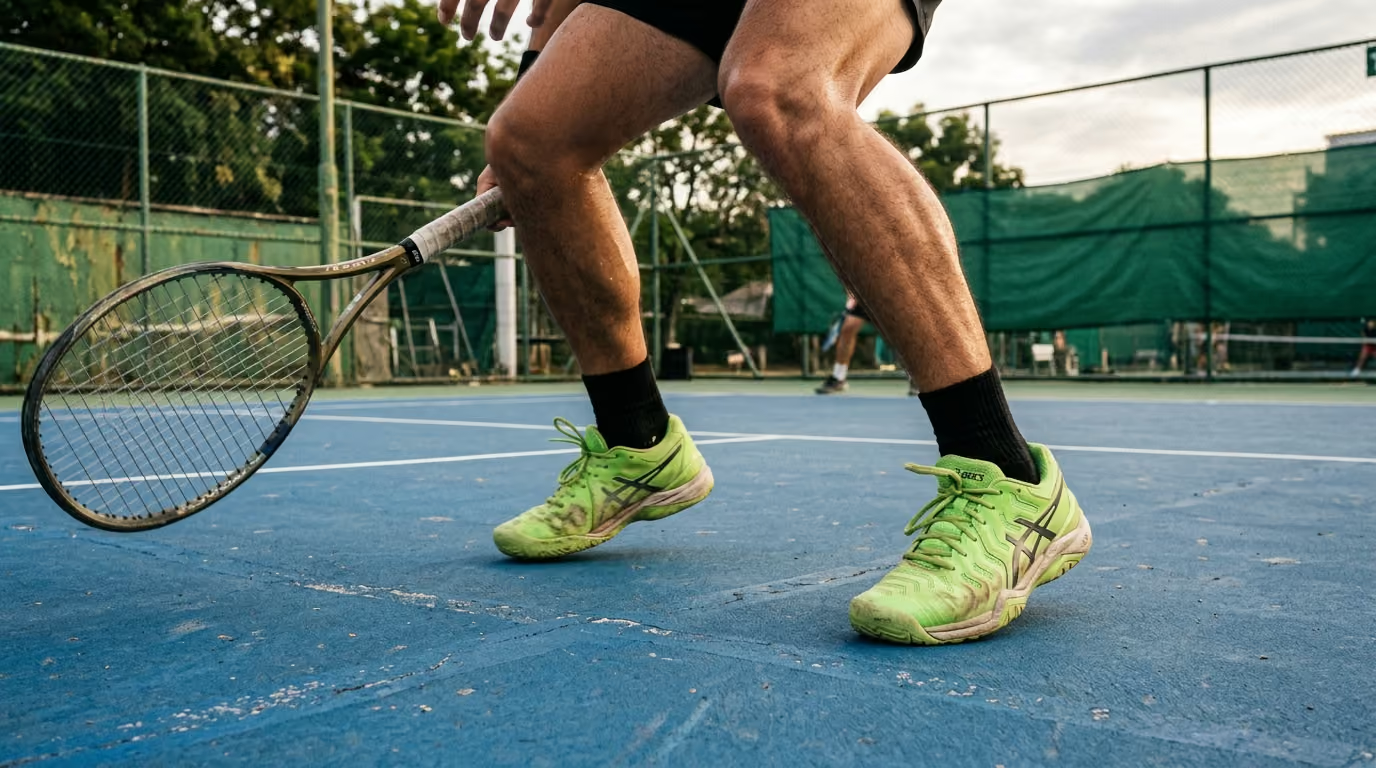
An average ACWR of 1.57 was observed in junior tennis players before an injury, highlighting the complexities of training load management for racket sports athletes.




Imagine stepping onto the court for a weekend match only to feel your knees throbbing and your shoulders resisting every swing. Many recreational and competitive racket sports players accept this chronic soreness as an unavoidable tax of playing the game they love. However, constant fatigue and nagging joint irritation are usually not the result of aging. Instead, they are the predictable consequences of poor training load management.
Training load management is the systematic organization of play, strength training, and recovery to help your body adapt without breaking down. By balancing demanding court days with lighter technical sessions and rest, you can keep playing for years. This approach focuses on adjusting the volume and intensity of training based on how your body actually feels.
To manage training effectively, we must first distinguish between external and internal loads. External load is the physical work you perform on the court or in the gym. This includes your total playing time, the number of balls hit, or the distance you cover. It also includes the specific number of sets, repetitions, and weights you lift during a strength and conditioning session.
Internal load represents your physiological and psychological response to that physical work. It is determined by how hard your cardiovascular system worked, how much fatigue you feel, and your psychological stress. Two players can complete the exact same singles match but experience very different internal loads. A well-conditioned competitor might finish with minimal fatigue, while a less prepared player might feel completely exhausted.
For many years, sports scientists used a metric called the Acute to Chronic Workload Ratio, or ACWR, to predict injury risk. This formula compares your training volume over the last seven days to your average volume over the previous four weeks. In a study on junior tennis players, researchers found that players had an average ACWR of 1.57 in the week before an injury occurred. Early interpretations of this research suggested that keeping this ratio between 1.3 and 1.5 would protect players from getting hurt.
However, contemporary research has highlighted major flaws in this approach. Methodological reviews show that the ACWR cannot reliably predict injuries on its own. It is a helpful descriptive tool to identify sudden spikes in training, but it is not a perfect safety formula. No single ratio can account for your sleep, stress, or individual movement patterns. Therefore, at Evercourts, we view load management as a flexible decision-making system rather than a strict mathematical equation.
Many players rely on GPS watches or heart rate monitors to measure their workouts. While these tools are excellent for straight-line runners, they often fail court athletes. Standard wearable devices struggle to capture the complex, multi-directional demands of racket sports.
A tennis match involves rapid changes of direction, side-to-side shuffling, and sudden deceleration. A padel player might cover only two kilometers during a match, but they will perform hundreds of split-steps and lunges. A pickleball player may have a low heart rate during a doubles match, but their knees and ankles still experience massive mechanical forces.
We must understand that general cardiovascular fatigue is different from localized mechanical stress. Your heart and lungs might feel completely recovered a few hours after a light doubles match. However, your Achilles tendons, rotator cuffs, and lower back muscles may still be carrying substantial tissue micro-trauma.
If you only track cardiovascular metrics, you might schedule a hard training session when your joints are actually vulnerable. This is why a complete load management system must look beyond heart rate and total distance. It must account for localized muscular fatigue, tendon stiffness, and repetitive joint impact.
Each racket sport places unique physical demands on your body, requiring a tailored approach to load management.
Let's look at tennis first. Tennis is an intermittent sport characterized by brief, high-intensity sprints followed by short recovery periods. Research shows that typical rallies last between four and ten seconds, with rest intervals of ten to twenty seconds between points. A standard match can easily last ninety minutes, but the actual playing time is often only twenty percent of that duration.
A systematic review reported mean rally durations of 5.5 seconds for international male players and 6.4 seconds for international female players. The same analysis reported average running distances per point of 9.6 meters for men and 8.2 meters for women. This pattern means tennis players require exceptional eccentric lower-limb strength to handle constant acceleration and braking.
The physical toll increases on different surfaces, as clay-court rallies are typically twenty-two percent longer than hard-court rallies. These extended rallies demand greater cardiovascular endurance and lead to higher blood lactate levels. Tennis-load management must account for these surface changes, match duration, and the extreme mechanical stress of the serve.
Now consider padel, which is played on a smaller, enclosed court. Padel matches generally last sixty to ninety minutes and players cover approximately 2,000 meters per match. Most movements are forward or sideways, requiring rapid transitions and quick reactions off the glass walls.
A systematic review of padel match play included twelve studies and 203 players across different competition levels. The review found moderate physiological responses, a relatively low contribution from anaerobic glycolysis, and moderate-to-high perceived effort. This means padel can feel less continuously exhausting than singles tennis, yet it still imposes significant joint stress.
I remember finishing a tough two hour padel match on a cold Tuesday night and waking up the next morning feeling like my lower back was locked in concrete. For a long time, I just accepted this as the price of playing hard in my forties. But once I started spending just ten minutes on targeted hip mobility before heading to the club, the stiffness almost completely vanished. It taught me that we do not have to accept pain as a default state of aging. In padel, you may cover relatively short distances, but the frequent lateral shuffling and high overhead volume can place immense strain on your shoulders and spine.
Finally, pickleball presents its own distinct movement profile. Although the court is smaller than a tennis court, the proximity of the non-volley zone requires constant, quick reactions. Players must perform rapid lateral slides, deep forward lunges, and repetitive wrist actions.
The available pickleball literature is less mature than the tennis and padel literature. However, scoping reviews of pickleball injuries and emergency department data show a high prevalence of overuse issues. Because pickleball is highly accessible, players often spend three or four hours on the court without a break.
This high-volume play can lead to overuse injuries in the Achilles tendon, elbows, and knees. Tracking your time on the court and the total number of games played is crucial for avoiding these common issues. Because the court is small, total running distance will always underestimate the mechanical stress on your lower joints.
You do not need expensive laboratory equipment to manage your training load effectively. A simple, consistent tracking method is often more powerful than a complex digital system.
The most reliable method for recreational athletes is the Session Rating of Perceived Exertion, or session-RPE. After each training session or match, wait about thirty minutes. Then, rate the overall difficulty of the session on a scale from zero to ten. Zero represents complete rest, while ten represents a maximal, exhausting effort.
To calculate your daily training load, multiply the duration of the session in minutes by your rating. For example, a sixty-minute technical practice rated at a five produces a load score of three hundred arbitrary units. A ninety-minute singles match rated at an eight produces a score of seven hundred and twenty units.
Keep a simple log of these numbers in a notebook or on your phone. Over time, you will identify your personal threshold for weekly volume. If you notice your weekly total climbing more than fifteen percent above your recent average, it is time to schedule a recovery day.
Along with your session scores, perform a brief daily wellness screen each morning. Rate your sleep quality, physical energy, muscle soreness, and mental stress on a scale of one to five. If multiple categories show low scores, use a traffic-light system to adjust your day.
The traffic-light system helps you make objective decisions about your training based on daily physical feedback.
Using this system ensures that you do not push through warning signs of injury. It shifts your focus from blindly following a schedule to listening to your body's actual needs.
A common mistake among court athletes is maintaining a moderate level of intensity every single day. They play three times a week, lift weights twice, and run on their rest days. This creates a state of chronic, moderate fatigue where the body never fully recovers or adapts.
To avoid this, structure your week so that your hard days are truly hard, and your easy days are truly easy. This approach allows your nervous system and muscle tissue to recover completely.
Here is a practical weekly template you can adapt for your personal schedule.
When you must perform both court work and strength training on the same day, consider your priorities. If your main goal is improving your skill or speed, do your court work first when your mind and muscles are fresh. If you are focusing on building raw physical power, complete your strength work first. Always avoid heavy lower-body lifting immediately before a competitive match.
Tournament weekends and league play often require you to compete on consecutive days, or even twice in one afternoon. Handling these high-stress periods requires careful preparation before, during, and after the event.
In the forty-eight hours leading up to a competition, reduce your overall training volume by half. Avoid any novel exercises in the gym that might cause lingering muscle soreness. Focus on short, high-quality technical hits to keep your coordination sharp without exhausting your energy reserves.
Between back-to-back matches, your immediate priority is restoring your physical resources. Consume a mix of easily digestible carbohydrates and clean protein within thirty minutes of stepping off the court. Rehydrate with water and electrolytes, and change into dry clothing to help your body cool down.
Instead of static stretching, which can temporarily reduce muscle power, use gentle mobility drills to keep your joints loose. Check yourself for any localized pain, swelling, or signs of heat exhaustion. If you have another match later that day, keep your secondary warm-up brief, focusing on movement quality rather than building up a sweat.
Once the tournament or league weekend is over, give your body time to rebuild. The day after heavy competition should not be a training day. If your muscles feel exceptionally sore, choose complete rest over active recovery. Your tendons and joints need quiet time to repair the microscopic damage caused by intense competition.
Even the best training plans must adapt to real-world interruptions. Rain delays, late tournament additions, or sudden travel can throw your weekly schedule into chaos.
If an extra match is added to your week, do not simply add it on top of your existing plan. You must remove another major stressor to keep your total workload balanced. Cancel your next conditioning session, or reduce your lower-body strength training to a light maintenance routine.
If a scheduled match is unexpectedly canceled, resist the temptation to run to the gym for an intense workout. Instead, use this open slot for a controlled, moderate technical session or some targeted mobility work. This preserves your recovery window and keeps you on track for your next scheduled peak performance.
When you find yourself experiencing unusual fatigue or poor sleep, apply the minimum effective dose principle. Reduce your planned session volume by thirty to fifty percent. You can still complete your warm-up and practice your technical skills, but avoid high-velocity sprints and exhausting live-ball drills.
Finally, remember that travel is a form of physiological stress. Prolonged sitting, disrupted sleep, and changes in nutrition all drain your recovery capacity. When traveling for a match, reduce your first on-court training session to a light, exploratory hit to help your nervous system adjust to the new environment.
Many dedicated players fall into predictable traps that lead directly to overuse injuries and chronic fatigue.
One major error is training with high monotony. This occurs when you perform identical, moderately difficult sessions day after day. Without clear peaks and valleys in your training volume, your tissues never receive a strong signal to adapt, nor do they get a chance to recover. Training strain is calculated by multiplying your weekly load by your monotony score, and high strain is a primary driver of tissue breakdown.
Another mistake is relying entirely on subjective recovery. Feeling energetic on a Friday morning does not mean your shoulder tendons or knee ligaments have completely healed from Wednesday's match. Overuse injuries build up silently over weeks of repetitive impact, even when your general energy levels feel excellent. This is why tracking your actual court hours and stroke volume is so important.
Many players view strength training as a separate, optional activity that does not count toward their weekly physical total. They fail to realize that heavy squats, lunges, and medicine ball throws impose a significant physical cost. If you do not adjust your court time to account for your gym work, you will quickly find yourself overtrained.
Finally, many court athletes make the mistake of comparing their training capacity directly to others. Your ideal training volume is highly individual. It is shaped by your playing style, injury history, sleep quality, and occupational stress. Trying to match the schedule of a younger or more experienced player is a direct path to the physical therapy clinic.
Managing your training load is not just about injury prevention; it is also the most effective way to improve your recovery. When you organize your training logically, you give your muscular and skeletal systems the precise time they need to rebuild.
Different tissues in your body recover at vastly different rates. Your cardiovascular system and metabolic pathways can bounce back within twenty-four hours of a hard session. Your muscle fibers typically require forty-eight hours to repair after intense, eccentric work like lateral braking.
However, your tendons, ligaments, and joints have a much poorer blood supply than your muscles. These structural tissues can take up to seventy-two hours to adapt to high-velocity impacts, such as serving in tennis or smashing in padel. If you play hard every forty-eight hours, your tendons are constantly catching up, leading to chronic issues like Achilles tendinopathy or tennis elbow.
By implementing a hard-day and easy-day sequence, you allow these slow-recovering tissues to complete their natural healing cycles. This targeted rest prevents micro-tears from accumulating into painful, long-term degenerative conditions. Over time, this consistent recovery cycle builds stronger, more resilient joints that can handle the physical demands of your favorite sport.
While tracking your training load can help you manage minor fatigue, it is not a replacement for medical expertise. You must know when to step off the court and consult a professional.
If you experience sharp, localized pain that does not improve after forty-eight hours of rest, seek a clinical evaluation. Do not attempt to play through pain that alters your natural movement mechanics or force output. Compensating for an injury by changing how you run, swing, or land will only create new, more complex issues in other joints.
Other red flags include joint instability, swelling, or a feeling that a joint is catching or giving way during movement. If you experience numbness, tingling, or radiating pain down your arm or leg, stop playing immediately. These neurological symptoms require a thorough assessment from a qualified physical therapist, sports physician, or orthopedic specialist.
A professional can help you identify the root cause of your physical limitations and design a structured path back to the court. They can also offer personalized advice on mobility and movement to ensure your recovery is safe and complete.
To keep enjoying the physical and social benefits of tennis, pickleball, and padel, you must treat your body like the finely tuned system it is. Managing your training load is not about doing less work; it is about doing the right work at the right time. By listening to your body, planning your weekly training sequences, and prioritizing structural recovery, you can enjoy athletic longevity on the court for years to come.
When to revisit this resource: Review this guide at the start of every new competitive season, or whenever you experience a sudden change in your weekly playing schedule.
By applying these practical principles of load management, you can step onto the court with confidence, knowing your body is fully prepared for every sprint, lunge, and stroke.
Follow Evercourts for practical insights on tennis, pickleball and padel performance, movement, recovery and healthy ageing. Stay connected for new articles, research-led guidance and ideas to help you play well and keep playing for years.


Read practical guidance for better movement, smarter preparation and a game that keeps working for you.
explore the Blog