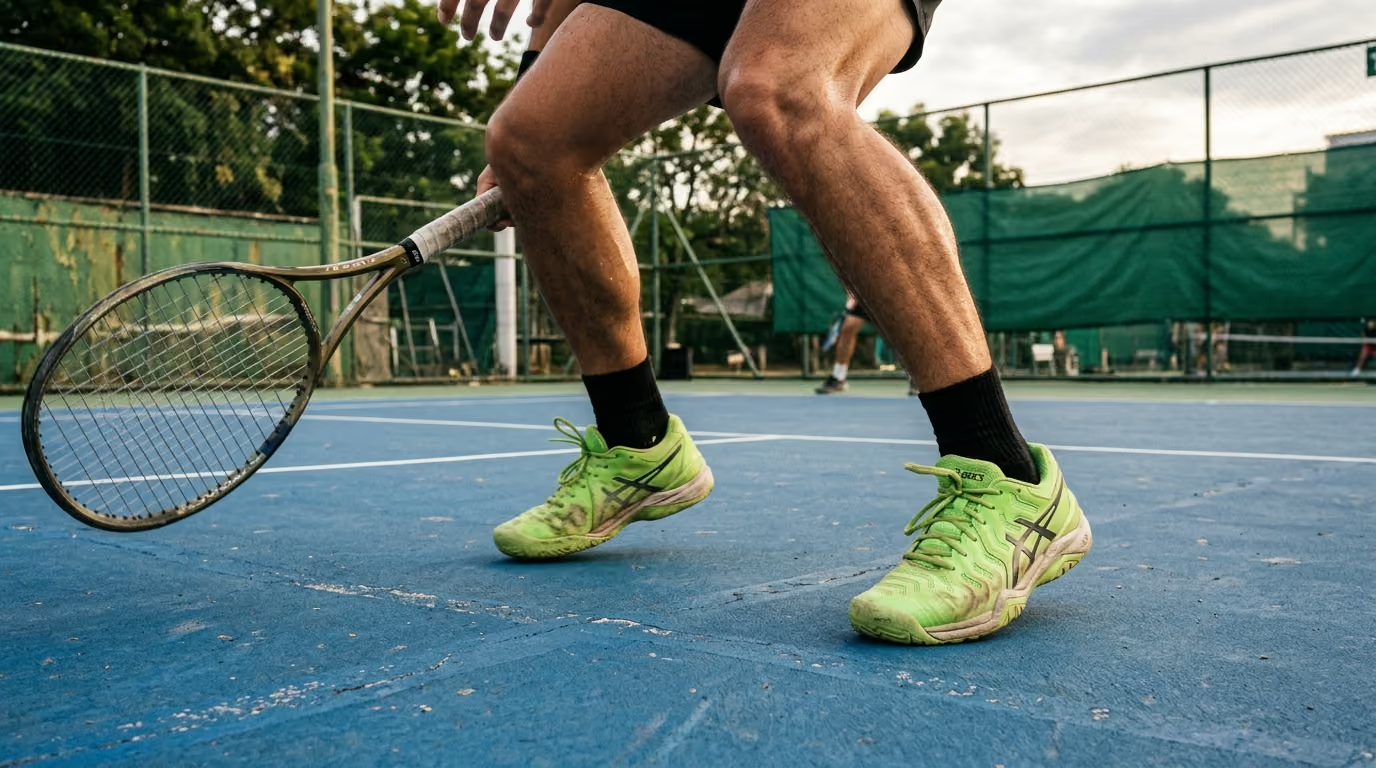
Twelve vertebrae make up the thoracic spine, which plays a crucial role in transferring power from the lower body to the shoulders for racquet sports.




Many court players search for ways to resolve a stiff neck, sore shoulders, or a loss of power on their overhead shots. They often search online for quick chest stretches or shoulder mobilizations to fix these issues. This guide provides a complete, research-backed strategy to build a strong upper back for racquet sports.
A strong and mobile upper back provides the mechanical foundation for your shoulders, neck, and torso to move efficiently during racquet play. By developing both strength and movement capacity in this region, you can improve your overhead reach, transfer more power from your legs, and maintain better posture during long matches. This approach supports your overall movement efficiency without relying on quick fixes.
The thoracic spine consists of twelve vertebrae in the middle of your back. This region connects directly to your rib cage and serves as the structural bridge between your lower body and your shoulders. In court sports, this area must balance two opposing needs. It must remain mobile enough to allow rotation and extension, but it must also be strong enough to transfer high forces.
Research shows that thoracic movement is directly linked to shoulder function. A systematic review published in physical therapy literature shows that thoracic extension and side-flexion are critical during overhead arm movements. When you raise your arm to hit an overhead or a serve, your thoracic spine must extend and flex sideways to allow full reach. If your middle back is stiff, your shoulder joint must work harder to achieve the same position.
However, we must avoid viewing thoracic stiffness as the sole cause of shoulder problems. The human body is complex and highly adaptable. For instance, scapular dyskinesis, which is an alteration in normal shoulder blade movement, is common among healthy athletes. A systematic review of overhead sports found that scapular dyskinesis alone was not a reliable predictor of future shoulder injuries. Instead of trying to fix a single movement pattern, you should build broad physical capacity across the entire upper body.
True movement health involves training the thoracic spine alongside the rib cage, shoulder blades, and pelvis. This region works as a unified system during sport-specific tasks. When you rotate to hit a forehand, that movement is shared among your hips, thoracic spine, and shoulder girdle. By training these areas to work together, you build a body that handles the repetitive demands of court play. For structured guidance on this type of preparation, explore our specialized mobility and movement resources.
The concept of the kinetic chain describes how forces travel through your body during athletic movement. When you hit a tennis serve or a padel smash, force does not start in your arm. It begins when your feet push against the court surface. This ground reaction force travels up through your legs, hips, pelvis, and trunk before reaching your shoulder, arm, and racquet.
A scientific review of the tennis serve highlights the massive coordination required during this process. The trunk must undergo rapid rotation, side-flexion, and extension to accelerate the racquet. This movement must then reverse quickly during the follow-through. If there is a weak link in your upper back or trunk, this force transmission is disrupted. Your arm must then work harder to generate ball speed, which can lead to fatigue.
Trunk movement and timing are also crucial for performance. Biomechanical studies have shown that trunk angular velocity is directly associated with ball speed in tennis serves. Furthermore, the timing of the transition between pelvis rotation and trunk rotation plays a major role in shot accuracy. This demonstrates that upper-back strength is not just about protection. It is a critical component of precise and powerful racquet control.
Once the stroke is complete, your body must safely slow down. The muscles of your upper back act as a braking system. During the follow-through, your external shoulder rotators and upper-back muscles work eccentrically to decelerate your arm. If these muscles lack endurance, fatigue sets in quickly. Building this eccentric strength is essential for long-term athletic longevity on the court. To learn more about structuring your workouts for these specific demands, you can review our strength and conditioning resources.
To build an upper back that performs well on the court, you should organize your training around five distinct physical qualities. These qualities ensure you do not just stretch your muscles, but actually train them to handle the realities of play.
You must be able to access the necessary ranges of motion in your thoracic spine and shoulder girdle. This does not mean achieving extreme flexibility. It means having enough comfortable movement to reach overhead without arching your lower back. Exercises in this category teach your nervous system how to coordinate the ribs, spine, and shoulder blades.
Your upper back must be strong enough to pull, push, and rotate against resistance. This requires active strength in the latissimus dorsi, rhomboids, middle trapezius, and rotational muscles of the trunk. Strong muscles in these areas help hold your torso steady when you hit a ball at high speed. They also provide the structural foundation for your shoulder joint to function smoothly.
It is easy to focus only on creating power, but stopping power is equally important. When you swing a racquet, your muscles must absorb high amounts of eccentric force to protect your joints. Training this capacity involves slow lowering phases, catch-and-brake drills, and exercises that resist rotation. This helps your tissues stay healthy through thousands of repeated impacts.
Your upper back must maintain its capacity over the course of a multi-hour match. When fatigue sets in, players often slump forward, which limits their shoulder clearance and visual tracking. Building endurance in the postural muscles of the spine and shoulder blades helps you maintain your movement quality from the first point to the last. For deeper insights into managing court-related fatigue, check out our recovery science resources.
Once you have built strength in controlled positions, you must connect it to athletic movement. This means training your upper back while you are lunging, shifting your weight, or rotating your hips. Integrated exercises prepare your body for the chaotic, multi-directional nature of real court play.
To apply these concepts, you need a clear progression of exercises. You can perform these movements in a gym or at home with minimal equipment. Always prioritize control and movement quality over the amount of weight you lift.
This phase focuses on identifying your upper-back positioning and improving active movement. These exercises are excellent as a warm-up before a match or as a daily mobility routine.
The wall-supported thoracic reach is an ideal starting exercise. Stand with your back, buttocks, and head gently touching a wall. Place your feet a few inches away from the baseboard. Keep your lower ribs flat and slowly raise both arms overhead. Try to touch the wall with your thumbs without letting your lower back arch or your ribs flare up. This movement teaches you to separate arm elevation from lower-back extension. Perform two sets of ten repetitions.
Next, use the quadruped thoracic rotation to improve active twisting. Start on your hands and knees with your spine in a neutral position. Place one hand gently behind your head. Rotate your elbow and upper chest toward the ceiling while keeping your hips completely still. Avoid using your lower back or shifting your weight sideways. Return to the starting position and repeat for two sets of eight repetitions per side.
The side-lying thoracic rotation is a gentler option that allows gravity to assist the movement. Lie on one side with your hips and knees bent to ninety degrees. This position helps lock your lower back in place. Extend both arms straight in front of your chest. Slowly rotate your top arm up and over toward the floor behind you while keeping your knees together. Watch your moving hand with your eyes to involve your neck. Complete two sets of eight repetitions on each side.
This phase introduces resistance to build muscular endurance and structural strength. These exercises target the muscles that control your shoulder blades and support your posture.
The anchored band row is a fundamental movement for court athletes. Secure a resistance band at chest height. Stand with a slight bend in your knees and hold the band handles. Pull your elbows back toward your ribs, allowing your shoulder blades to squeeze together naturally. Do not pull your shoulders up toward your ears. Slowly return to the starting position. Aim for three sets of twelve to fifteen repetitions.
For a more focused strength option, perform the chest-supported dumbbell row. Set an adjustable gym bench to a thirty-degree incline. Lie face down on the bench with your chest supported and your feet firmly on the floor. Hold a dumbbell in each hand with your arms hanging straight down. Pull the dumbbells toward your lower ribs, keeping your elbows tucked close to your sides. Squeeze your upper back at the top, then lower the weights under control. This exercise prevents you from using momentum or arching your lower back to lift. Perform three sets of eight to ten repetitions.
Prone Y, T, and W variations are excellent for targetting the smaller muscles of the upper back. Lie face down on a flat bench or a comfortable mat on the floor. Arrange your arms in a Y shape with your thumbs pointing toward the ceiling. Raise your arms slightly by squeezing your lower shoulder blades together. Lower them slowly, then repeat in a T shape and a W shape. Keep these movements light and controlled. Complete two sets of ten repetitions in each position.
To integrate your shoulder blades with your rib cage, perform the serratus wall slide. Place your forearms against a wall with your elbows bent at ninety degrees. Gently push your forearms into the wall to spread your shoulder blades apart. Slowly slide your arms up the wall in a V shape while keeping contact. Do not let your lower back arch as your arms rise. Slide back down to the starting position. Perform three sets of ten repetitions.
This phase combines upper-back strength with core stability. These exercises require your upper body to produce or resist force while your lower body remains stable.
The single-arm cable row is highly effective for court athletes. Stand in a split stance with your left foot forward and hold a cable handle in your right hand. Pull the cable toward your right ribs while keeping your torso stable. Allow a small, controlled rotation of your upper chest toward the cable machine as you extend your arm. This mimics the rotation used in groundstrokes. Perform three sets of ten repetitions on each side.
To build lateral stability, use the suitcase carry. Hold a heavy kettlebell or dumbbell in one hand beside your thigh. Stand tall and walk slowly in a straight line for thirty to forty meters. Do not let the weight pull your torso to the side, and do not lean away from the load. Keep your shoulders level and your gaze straight ahead. Switch sides and repeat. Perform three sets of forty-meter carries per side.
The half-kneeling cable press helps coordinate shoulder strength with hip positioning. Kneel on your right knee with your left foot flat in front of you. Hold a cable handle or resistance band in your right hand at shoulder height. Press the handle forward until your arm is fully extended. Keep your torso upright and do not let your lower back arch. This exercise teaches your hips and trunk to stabilize while your upper body moves. Complete three sets of ten repetitions per side.
The Pallof press is an excellent tool for training anti-rotation. Stand perpendicular to a cable column or band anchor. Hold the handle against your chest with both hands. Slowly press the handle straight out in front of you. The resistance will try to twist your torso toward the anchor point. Resist this movement using your core and upper back. Hold for two seconds, then bring your hands back to your chest. Perform three sets of ten controlled repetitions.
For a transition toward overhead work, use the landmine press. Place one end of a barbell in a landmine swivel or a secure corner. Stand facing the bar, holding the top end in your right hand at shoulder height. Press the bar forward and up at an angle. This angled path is gentler on your shoulder joint than a vertical press. It also requires your serratus anterior and upper back to support the load. Perform three sets of eight repetitions per side.
This phase uses fast movements and sport-specific positions. Only progress to this phase once you can perform the earlier phases with excellent control and no discomfort.
The medicine-ball rotational throw develops explosive power. Stand in an athletic stance perpendicular to a solid wall, holding a light medicine ball. Rotate your hips and torso away from the wall to load your back leg. Quickly turn your hips and throw the ball into the wall using your core and upper back. Catch the ball on the rebound and repeat immediately. Focus on speed and smooth coordination. Perform three sets of five throws per side.
To train overhead mechanics, perform the medicine-ball scoop toss. Hold a light medicine ball between your knees in a slight squat. Drive your feet into the floor and explode upward, tossing the ball high and backward over your head. This movement coordinates your lower-body drive with thoracic extension and arm release. It closely resembles the movement pattern of a tennis serve. Perform three sets of five tosses.
The split-stance cable row-to-rotation links pulling strength with torso rotation. Stand in a split stance facing a cable machine. Hold the cable handle with your opposite hand. Pull the cable back while turning your chest toward the pulling side. This exercise trains your upper back to coordinate with your hips during rotation. Perform three sets of ten repetitions on each side.
To connect footwork with upper-body stability, try the shuffle-to-press. Hold a resistance band that is anchored to your side. Perform two quick lateral shuffles away from the anchor point, stop in a stable stance, and execute a quick press. Return to the starting position and repeat. This drill teaches you to stabilize your trunk immediately after moving on the court. Complete three sets of six repetitions per side.
Finally, the overhead carry builds dynamic stability. Hold a light dumbbell or kettlebell straight overhead. Keep your elbow locked and your shoulder blade active but not shrugged. Walk slowly in a straight line for twenty to thirty meters. Ensure your lower ribs stay down and your lower back does not arch. This carry trains your upper back and trunk to support your arm in an overhead position. Perform three sets of twenty meters per side.
While all racquet sports share some physical requirements, the mechanical loading of your upper back depends heavily on your specific sport. Understanding these differences allows you to customize your training.
Tennis involves a high volume of high-velocity, full-range overhead movements. The tennis serve requires significant thoracic extension and side-flexion to position the racquet behind your head. During the acceleration phase, your trunk must rotate rapidly to generate ball speed. This is followed by intense eccentric decelerating forces on your upper back during the follow-through.
To support these demands, tennis players should focus heavily on high-velocity eccentric strength and rotational power. Exercises like medicine-ball tosses and heavy row variations are highly beneficial. These movements prepare your upper back to absorb the forces of hitting a heavy ball. For more information on tennis-specific physical preparation, read our articles on tennis training.
Pickleball is played on a smaller court, which changes the physical demands. There are fewer full-velocity overheads, but players spend a lot of time in a low, crouched position. During dink rallies, you must maintain a forward-leaning posture while keeping your head up to watch the ball. This position puts a constant isometric demand on your upper back and neck.
Pickleball players should prioritize upper-back muscular endurance and neck stability. Exercises like the suitcase carry, wall slides, and prone Y-T-W variations are excellent. These movements help you maintain a strong posture during long rallies without developing neck tension. To learn more about staying healthy on the pickleball court, visit our section on pickleball training.
Padel is characterized by continuous overhead shots, such as the bandeja and the smash, often played off the glass walls. These shots are played from various body angles and require excellent shoulder mobility and thoracic rotation. The ball bounces unpredictably, forcing you to make sudden, reactive adjustments in your upper body.
Padel players need a balanced mix of rotational mobility and multi-directional stability. The split-stance cable row-to-rotation and the Pallof press are highly relevant for padel movement. These exercises help you control your trunk during rapid changes of direction. For specific strategies on training for padel, explore our padel resources.
Your neck and head orientation play a vital role in your court performance. Your eyes must track a fast-moving ball while your body is sprinting, lunging, or rotating. Your cervical spine must remain stable to support your visual system and maintain balance.
A progressive neck program should focus on building isometric strength and endurance. You do not need to lift heavy weights with your neck. Instead, you should train your muscles to resist movement and maintain a steady head position.
Begin with supine chin nods to target the deep neck flexors. Lie on your back on a flat surface with your knees bent. Gently tuck your chin as if making a slight double chin, keeping the back of your head on the floor. Hold this position for five seconds, then relax. Complete two sets of ten repetitions.
Once this is comfortable, progress to isometric holds against your own hand. Sit tall and place your palm against your forehead. Push your head gently into your hand while resisting any movement. Hold for five seconds, then repeat on the back and sides of your head. This simple routine builds strength in all four directions. Perform two sets of five holds in each direction.
It is important to avoid making unsupported claims about neck training. For example, some fitness programs claim that neck strengthening prevents concussions in amateur sports. However, a systematic review found no clear evidence that neck exercises reduce cervical spine injuries or concussions in adult amateur athletes. Focus on neck training as a tool to improve your visual tracking, head control, and post-match comfort.
When training your upper back, it is easy to fall into habits that limit your progress or cause unnecessary tension. Identifying these errors early will help you get the most out of your exercises.
The first common mistake is the constant cue to "pull your shoulders down and back." Many players are told to pin their shoulder blades together during every movement. While retraction is useful during some rowing exercises, your shoulder blades must move freely during overhead tasks. If you hold them rigidly down and back, you restrict normal upward rotation. This can lead to shoulder pinching and limited reach when you swing overhead.
Another common pitfall is over-relying on light resistance bands. High-repetition band exercises are excellent for warming up or building local endurance. However, they do not provide enough resistance to build true muscular strength. To create lasting changes in your tissues, you must progress to heavier loads. Dumbbells, cable machines, and bodyweight exercises like pull-ups are necessary to stimulate muscle growth and structural resilience.
A third mistake is ignoring the role of your lower body in upper-back movement. Some players try to fix their stiff shoulders by only stretching their upper chest. However, your upper-back rotation is heavily dependent on your hip mobility and leg drive. If your hips are tight, your thoracic spine must twist further to compensate. A complete training program must address your entire movement system. For a wider look at athletic preparation, check out our blog.
Training your upper back has a profound effect on your recovery and overall tissue health. Strong muscles are more resistant to the microscopic damage that occurs during intense play. This means you will experience less post-match soreness and stiffness in your shoulders and neck.
Upper-back strength also supports better breathing mechanics. Your thoracic spine and rib cage house your lungs and diaphragm. When your upper back is strong and mobile, your chest can expand fully during deep breathing. This improves your oxygen intake during long rallies and helps your heart rate recover faster between points.
Furthermore, a strong upper body helps protect your lower back. When your thoracic spine can extend and rotate freely, your lumbar spine does not have to twist excessively. This reduces the rotational stress on your lower back, helping you avoid common spinal aches. Investing in your upper-back strength is a practical way to support your physical longevity. To read more about protecting your body from common court issues, explore our injury prevention resources.
While progressive training is highly beneficial, it is important to know when to seek medical advice. Some symptoms require a professional assessment rather than a change in your workout routine.
You should consult a qualified healthcare provider if you experience any of the following warning signs:
An experienced physical therapist or sports physician can provide an individualized assessment. They will help identify the specific cause of your symptoms and create a safe recovery plan. Never try to push through severe or worsening pain in search of performance gains.
To help you get started, here are two sample weekly templates. These programs are designed to fit into a busy playing schedule without causing excessive fatigue.
This plan is ideal for players who want to maintain their mobility and core stability at home. It requires only a resistance band and a flat surface. Perform this routine twice a week on your non-playing days.
Session A (20 to 30 minutes):
Session B (20 to 30 minutes):
This program is designed for intermediate players who want to build maximum power and tissue resilience. Perform these sessions twice a week, allowing at least forty-eight hours of rest between workouts.
Session A (40 to 50 minutes):
Session B (40 to 50 minutes):
To apply this information this week, use this simple checklist:
Follow Evercourts for practical insights on tennis, pickleball and padel performance, movement, recovery and healthy ageing. Stay connected for new articles, research-led guidance and ideas to help you play well and keep playing for years.


Read practical guidance for better movement, smarter preparation and a game that keeps working for you.
explore the Blog