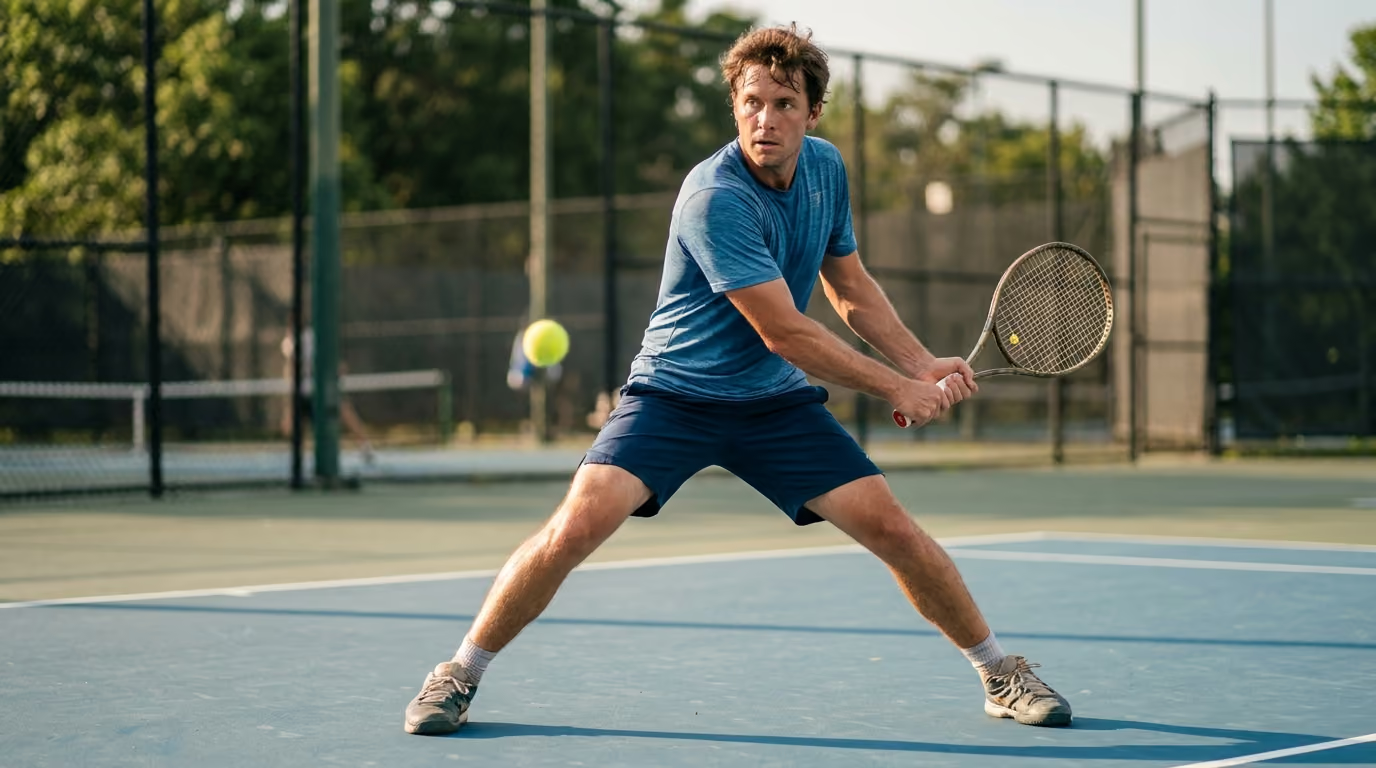

Vision and movement are deeply connected processes that allow players to track the ball, adjust their bodies, and maintain balance on the court.




Court movement is not just a matter of running toward a bouncing ball. It is a highly coordinated process of extracting visual details from your opponent, predicting the ball's path, and organizing your body. Many players focus entirely on the mechanics of their feet, yet footwork is merely the execution of what the brain perceives. If your visual processing is slow or disorganized, your movement will be late, frantic, and unstable.
To track the ball and stay balanced on court, players must integrate early visual cues from the opponent's body with late tracking of the ball. This visual input directly regulates head stabilization and footwork adjustments, allowing you to establish a stable base of support before striking. By organizing your gaze and movement together, you prevent late rushes, awkward reaches, and postural collapse.
Understanding how vision guides movement is essential for long-term athletic longevity. Improving this connection helps recreational and competitive players move with greater ease, reducing unnecessary strain on the joints. By focusing on visual-motor coordination, you can maintain your physical capabilities and continue playing for years to come.
In popular coaching, players are often told to keep their eyes on the ball at all times. While this advice is well-intentioned, it oversimplifies how the human brain and motor system interact during a fast exchange. Visual information on court is much broader than the single point of the ball. It includes several distinct streams of data that your brain must process simultaneously.
First, you process ball-flight information, which tells you the speed, direction, height, and spin of the object. Second, you gather opponent-generated information. This includes the opponent's body posture, shoulder rotation, arm path, and racket face orientation before contact.
Third, you use environmental information. This includes the court lines, the height of the net, the position of the walls in padel, and the location of your partner. Finally, you rely on self-motion information. This is the visual feedback that tells you whether you are drifting, rotating, leaning, or approaching the ball at a controlled speed.
Skilled players do not treat all this information as equally important. Instead, they filter the data, focusing on the most useful details at the right time. They use their eyes to build a map of the court, predicting where the ball will land before it is even hit.
The connection between vision and balance is deeply rooted in your nervous system. Your eyes work closely with your vestibular system, which is located in your inner ear, to tell your brain where your body is in space. When you move across the court, your head must transition through various planes of motion.
If your eyes are jumping erratically from place to place, your brain receives conflicting signals about your balance. This conflict can cause micro-hesitations in your footwork, making you feel unstable. By stabilizing your gaze, you help your nervous system regulate your posture, allowing for smoother lateral and forward movement.
To build a movement system that lasts, you can access our mobility and movement resources to find structured guides on physical preparation. Integrating visual training with physical movement is a practical way to protect your joints and keep your movement fluid.
Anticipation is the ability to use early visual cues to predict where the ball will travel before the opponent even strikes it. It is not a psychic ability or a random guess. Instead, anticipation is a highly developed skill based on reading human movement mechanics.
Research on badminton anticipation reveals that expert players focus on very specific areas of an opponent's body. A study by Alder, Ford, Causer, and Williams in 2014 examined how expert and novice players anticipated serves. The researchers used temporal-occlusion testing, where videos of serves were cut off at specific frames.
The study showed that expert players were significantly more accurate at predicting serve direction than novices. This accuracy was directly linked to where the experts looked. Instead of just watching the shuttlecock, experts focused on the opponent's arm, shoulder, and racket kinematics. They look at the parts of the body that transfer force to the racket, as these movements reveal the shot direction first.
Novice players, by contrast, tended to watch the ball or shuttlecock exclusively. Because they waited for the ball to leave the racket before reacting, their movement was delayed. By the time they identified the path of the ball, they had to rush their split-step and take larger, less controlled chase steps.
Anticipation allows you to start your movement cycle early. When you recognize a familiar preparation pattern in your opponent, your brain instantly calculates a probability map. You do not commit your entire body to a single spot immediately, as this would make you vulnerable to deception.
Instead, you use this early information to initiate a light split-step and orient your hips toward the likely target. This reduces the time it takes to make your first explosive step. If the opponent changes their shot at the last millisecond, your base is still organized enough to brake and redirect your weight.
In sports science, the quiet eye is a well-documented phenomenon that distinguishes elite performers from recreational players. It is defined as the final fixation or tracking gaze directed toward a relevant target before a critical movement begins.
Joan Vickers, a leading researcher in motor behavior, has documented this concept extensively. In a comprehensive review in 2021, Vickers explained that the quiet eye represents a window of cognitive processing. During this final gaze, the brain organizes the motor program, calculates the required force, and stabilizes the body.
The impact of the quiet eye is supported by a major meta-analysis. In 2016, Gong and colleagues analyzed 27 studies on the quiet eye. They reported a large difference in quiet-eye duration between expert and novice athletes, with an effect size of 1.04.
Furthermore, when looking at successful versus unsuccessful attempts within the same athlete, they found a moderate effect size of 0.58. This means that even within a single player, a longer and more stable quiet eye correlates with better performance. The research also showed that quiet-eye training had a very large effect on performance improvements, with an effect size of 0.84.
On the court, the quiet eye is not about staring blankly. It is about locking your focus onto a specific target, such as the contact zone of the ball or the exact spot on your opponent's court, just before you swing. This brief pause in visual scanning allows your motor system to run its program without visual noise.
If your gaze is shifting from the ball to the net, and then to the opponent as you swing, your quiet-eye period is disrupted. This disruption often leads to off-center hits, poor depth control, and loss of balance. Developing a consistent quiet-eye routine can greatly improve your striking consistency and movement control.
A common coaching instruction is to keep your head perfectly still. While minimizing unnecessary head motion is useful, the human head must move to track a ball through a wide range of motion. The relationship between head movement, eye tracking, and postural stability is dynamic.
A study investigating postural control while tracking visual targets analyzed how head movements affect body sway. The researchers tested participants in both unipedal, which is one-legged, and bipedal, which is two-legged, stances. They found that visual tracking demands directly alter how balance is regulated.
Under challenging visual tracking conditions, participants in a one-legged stance showed a reduction in their stability boundaries. However, this reduction was accompanied by a decrease in visual tracking error. This suggests that the body will sacrifice some postural stability to ensure the eyes stay locked on a difficult target.
During two-legged support, head movement and foot stability operated more independently. Higher frequencies of head movement during static visual tasks were associated with a longer time-to-contact stability boundary. This indicates that some head movement is not only natural but can actually assist the body in maintaining balance, depending on the stance.
Research using optic-flow stimulation has also shown that head motion can reliably predict variations in overall body sway. In a study using head-mounted displays, researchers found that measuring head motion was an effective way to track changes in postural control.
On the court, this means your head acts as a primary weight regulator. If your head tilts too far backward or sideways during a wide lunge, your center of mass shifts with it. This shift makes it incredibly difficult to brake your movement and transition back to the center of the court.
To maintain balance during fast movements, players should check our strength and conditioning guidelines for hip and core stability exercises. A strong midsection helps keep the pelvis and shoulders stable, allowing the head to move naturally without pulling the entire body off balance.
To apply these scientific principles to your practice, you should use a structured, phase-based framework. This framework integrates visual processing with physical footwork, helping you move more efficiently.
Before the ball is even struck, your visual attention should be on your opponent. Avoid staring at the ball while it is on their side of the net. Instead, look at their posture, their shoulder alignment, and their racket path.
Ask yourself if their body is balanced or if they are lunging. A lunging opponent has fewer shot options, which allows you to narrow down your predictions. Look at their racket face orientation, as this provides the earliest cue for ball height and direction.
Do not wait for the ball to cross the net before you start moving. Once you recognize the opponent's swing path, initiate your split-step. Use this early information to begin your transition toward the expected zone.
Remember that this initial movement is based on probability, not complete certainty. Keep your weight distributed on the balls of your feet so you can change direction if the ball takes an unexpected bounce.
As the ball leaves the opponent's racket, transition your focus to its flight path. Track the ball's trajectory while keeping your head as stable as possible.
Allow your head to rotate naturally to follow the ball, but avoid tilting your head sideways or letting it drop toward your chest. Keeping your head upright helps your vestibular system maintain balance, which makes your footwork feel much lighter.
As you near the ball, transition from large, explosive strides to small, quick adjustment steps. These micro-adjustments are essential for aligning your body with the ball's bounce.
Many recreational players make the mistake of taking one large stride and reaching for the ball with an unstable base. By using small adjustment steps, you can position your feet so that you strike the ball from a balanced stance, preserving your joints from unnecessary stress.
Right before you begin your swing, lock your gaze onto a specific point on the ball. Maintain this visual fixation through the contact zone.
Avoid the temptation to look up early to see where your shot is going. Keeping your eyes on the contact point for a fraction of a second after contact ensures a clean hit and prevents your head from pulling your shoulders out of alignment.
As soon as you complete your follow-through, your movement cycle resets. Do not watch your own shot as if you are a spectator.
Instead, transition your gaze back to your opponent. Observe how they move to cover your shot, and use that information to start positioning yourself for the next exchange. This continuous cycle of perception and action is the foundation of high-level court movement.
To find more articles on how to improve your overall court presence, explore the Evercourts blog for actionable tips and strategies.
While all racket sports require visual-motor integration, the specific demands vary significantly between tennis, pickleball, and padel. Understanding these differences allows you to tailor your training to your specific sport.
Tennis is a game of high ball speeds and deep court positioning. Because the court is large, you must track the ball over long distances. This requires excellent depth perception and the ability to process high-velocity ball flight.
In tennis, you must also contend with external environmental factors such as wind, sun, and varying court surfaces. If you want to dive deeper into court conditions, you can read our guide on court surfaces and movement.
Tracking a ball on clay requires different visual and physical adjustments than tracking on a fast hard court, as the bounce is often less predictable. Your visual system must constantly recalibrate to accommodate these changes.
Pickleball is played on a much smaller court, and the distances between players are very short, especially during exchanges at the non-volley zone line. The visual demands here are incredibly fast-paced, requiring rapid reflexes and quick gaze transitions.
Because you are standing just feet away from your opponents, you have very little time to track ball flight. You must rely heavily on reading the opponent's paddle angle and wrist flick before contact.
Additionally, you must maintain sharp peripheral vision to keep track of the non-volley zone line. If you step into the kitchen during a volley, you commit a fault, so your brain must map your foot position relative to the court lines without you looking down at your feet.
For more insights on managing the physical demands of this fast-growing sport, visit our pickleball articles.
Padel introduces a unique visual challenge, which is the glass walls. In padel, you do not just track the ball as it comes toward you. You must also track it as it passes you, hits the glass, and rebounds back into the court.
This rebound tracking requires you to turn your head and body while maintaining your spatial awareness inside a cage. You must calculate the angle of the rebound based on the ball's incoming spin and speed.
Furthermore, padel involves a high number of overhead lobs, forcing you to track the ball straight up against varying background lighting and court structures. This demands exceptional head-eye coordination to avoid losing your balance while moving backward.
To learn more about mastering these specific mechanical skills, explore our dedicated padel articles.
Many recreational players struggle with movement because they fall into common visual traps. Recognizing these mistakes is the first step toward correcting them.
The most common mistake is focusing exclusively on the ball from the moment the opponent prepares to hit it. By staring only at the ball, you miss all the early kinematic cues from your opponent's body.
This delay in information means you will start your movement late, forcing you to sprint frantically to make contact. Instead, practice reading the opponent's movement first, then transition your focus to the ball once it is struck.
Some players take the advice to keep their head still to an extreme, trying to lock their neck and freeze their head. This excessive tension reduces your visual field and makes it harder to use your peripheral vision.
It also restricts your natural balance mechanisms. Your head must be allowed to move naturally to track the ball, as long as it remains upright and stable relative to your shoulders.
Another frequent error is raising the head and eyes before completing the stroke. Players often do this because they are anxious to see where their shot is going or where the opponent is moving.
When you look up early, you pull your head and shoulders back, which alters the swing path and often causes an off-center hit. Keeping your eyes locked on the contact zone until the swing is fully complete is essential for clean ball-striking.
For detailed strategies on how to protect your body from the strain of poor movement mechanics, check our injury prevention resources.
Most players think of fatigue as a purely muscular issue, believing that tired legs are the only reason they slow down late in a match. However, physical fatigue has a profound impact on your visual processing and attentional efficiency.
A real-game badminton study using mobile eye tracking by Panchuk and colleagues in 2021 examined how acute physical fatigue alters gaze behavior. The researchers found that when players became physically fatigued, their visual search patterns degraded significantly.
In fatigued states, players showed a dramatic increase in the number of fixations on empty areas of the court and on the ball after the stroke was completed. Essentially, their eyes began to drift to non-informative areas, indicating a breakdown in attentional control.
Conversely, points won and successful strokes were associated with longer fixation durations on key targets, such as the racket, the upper body of the opponent, and specific court boundary lines. When fatigued, players lost the ability to maintain these efficient gaze patterns, which directly led to delayed reaction times and poor positioning.
Because fatigue degrades visual processing, physical conditioning is just as important for your brain as it is for your muscles. Maintaining cardiovascular fitness allows you to preserve your cognitive sharpness late in a match, keeping your visual search efficient.
If you are recovering from a demanding session, you can find helpful tips in our recovery science resources to restore your nervous system and maintain visual focus for your next match.
While training your visual-motor integration can improve your court performance, some visual and balance challenges require professional medical attention. It is important to distinguish between poor coordination and underlying medical conditions.
You should consult a qualified healthcare provider if you experience any of the following symptoms:
These symptoms can indicate issues with your vestibular system, binocular vision, or neurological health. A qualified professional, such as a neuro-optometrist, vestibular physical therapist, or physician, can perform a comprehensive evaluation to address these concerns safely.
To learn more about the scientific approach we take to player safety and athletic longevity, read about Evercourts on our dedicated page. If you have questions about our resources, feel free to contact us directly.
Yes, you can practice quiet-eye techniques during solo drills or wall practice. Focus on identifying a specific detail on the ball, such as the logo or the seams, and try to keep your eyes locked on that detail until contact. Avoid looking at where you want the ball to go until after your swing is complete.
Wind introduces unpredictable movement to the ball and creates visual noise in your surroundings, such as moving trees or banners. This extra visual data forces your brain to work harder to separate useful information from background noise. Additionally, wind requires more frequent adjustment steps, which can tire your muscles and degrade your balance faster.
Polarized sunglasses are excellent for reducing glare, especially on bright days, which can help prevent eye fatigue. However, some players find that polarization alters depth perception slightly on certain court surfaces. It is best to test both polarized and non-polarized sports-specific lenses to see which option provides the clearest contrast and tracking performance for you.
Poor lighting, such as dim indoor courts or flickering artificial lights, reduces contrast, making it harder for your brain to calculate ball speed and spin. Under low-contrast conditions, your reaction time naturally slows down because your visual system needs more time to process the ball's path. Ensuring good court lighting is a simple way to maintain high movement efficiency and safety.
Follow Evercourts for practical insights on tennis, pickleball and padel performance, movement, recovery and healthy ageing. Stay connected for new articles, research-led guidance and ideas to help you play well and keep playing for years.


Read practical guidance for better movement, smarter preparation and a game that keeps working for you.
explore the Blog



