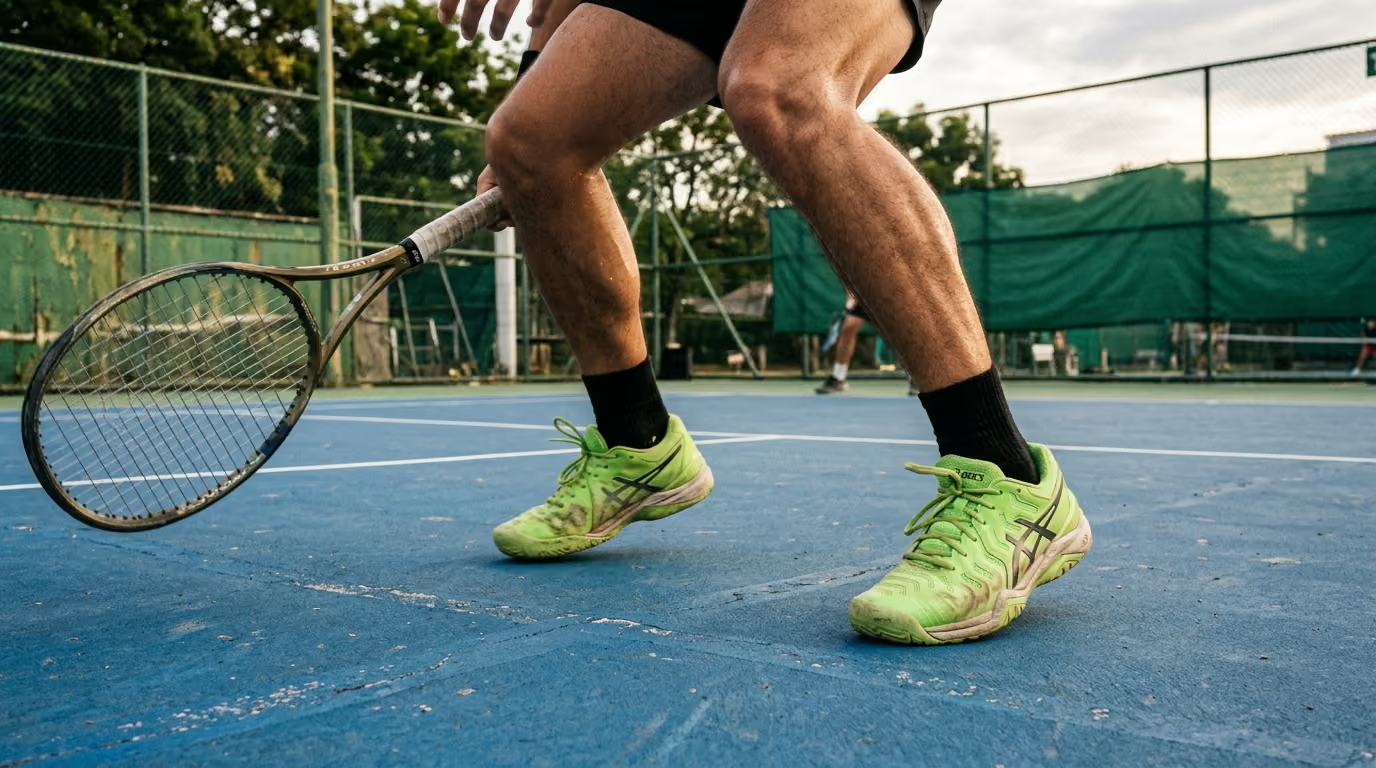
Racquet sports performance relies on complex perception and visual prediction skills, not just raw physical reaction speed.




Many players believe that raw physical reaction speed is the ultimate metric of court performance. They assume that as they age, their ability to compete will naturally decline as their reflexes slow down. This is an incomplete perspective that misses how racquet sports are actually played. Real-world court performance relies on complex perception rather than isolated muscle reflexes. Preserving athletic longevity requires learning how to read the game earlier.
You can preserve and improve your court responsiveness as you age by training your visual prediction skills, optimizing your tactical positioning, and making decisions earlier. While raw physical reflexes naturally slow down over time, experienced players can fully compensate by picking up visual cues from their opponent's body movements. This targeted approach allows you to arrive at the ball early, balanced, and ready to execute a controlled stroke.
To maintain your performance over a long playing career, you must understand that court speed is not just about muscle fiber contraction. In a laboratory, simple reaction tests measure the time between a single predictable stimulus, such as a flashing light, and a simple response, like pressing a button. On the court, however, you never face a single predictable stimulus. You face a choice reaction scenario, where you must select the correct movement from several possibilities.
A study on age-related choice reaction time found that central processing time in the brain accounted for more than 80% of age-related slowing. The actual physical movement of the muscles made up only a small fraction of the delay. This means that when a player seems slow on the court, their muscles are rarely the primary bottleneck. Instead, their brain is taking longer to process the visual information and select the appropriate response.
This finding is highly encouraging for older athletes. It shows that training should not focus on futile attempts to speed up basic muscle reflexes. Instead, training should focus on the central processing phase. By learning to interpret visual information more efficiently, you can significantly reduce your overall response time.
Experienced players routinely use this strategy to outperform younger, faster opponents. This phenomenon is known as the compensation hypothesis. A study published in the Journal of Aging and Physical Activity compared older tennis players with older non-players. The researchers examined their ability to coordinate actions with a moving target, which is known as coincidence timing.
The study found that the age-related increase in visuomotor delay was strongly correlated with poor timing performance in older non-players. However, this correlation was not present in the older tennis players. Active players remained as accurate as younger participants despite having less efficient underlying physical processes.
This confirms that regular court play helps maintain timing accuracy through anticipation and experience. You do not need the raw reflexes of a teenager to hit a clean, timed stroke. You need a systematic way to read the ball and the opponent. To build a solid foundation for this training, you can explore our resources on healthy aging and athletic longevity.
To design an effective training program, we must first look at how the visual and motor systems change as we age. Visual processing speed, which is the time required to make a correct judgment about a visual event, tends to decrease over time. One study reported that visual processing speed can be halved between the ages of 70 and 85.
On the court, this slower processing speed can show up in several ways. You might find it difficult to identify the direction of a fast serve. You might struggle to pick up the ball against a busy background of spectators or wind screens.
Additionally, older adults often experience a reduction in contrast sensitivity. This makes it harder to see objects clearly when they are similar in color to the background. Research shows that older observers have poorer contrast sensitivity at higher spatial frequencies, especially when objects appear in the peripheral vision.
These changes are often compounded by the challenges of divided attention. On a busy court, you must monitor multiple sources of information at once. You have to watch the ball, the opponent's racket, your partner's position, and the court boundaries.
Older adults are generally more affected by the presence of irrelevant visual information and distractors. When there are too many things happening in your visual field, your brain takes longer to filter out the noise and focus on the ball. If you try to process too much information at once, your reaction time actually slows down.
A laboratory study demonstrated that increasing the visual processing load through magnified feedback significantly slowed reaction times in older adults. This is a critical lesson for coaches and players. More visual information is not always better.
If you try to analyze every detail of your opponent's technique during a fast rally, you will overload your brain. The goal of visual training is to simplify what you look at. You must train your eyes to focus only on the most valuable cues while ignoring the rest.
Finally, physical changes in muscle mass and joint mobility can affect your ability to execute a quick step. This is why visual training must be integrated with general physical conditioning. The Centers for Disease Control and Prevention recommends that adults aged 65 and older perform weekly aerobic, muscle-strengthening, and balance activities.
Maintaining your physical strength and balance ensures that once your brain makes a decision, your body can execute the movement safely. For those looking to protect their bodies from movement-related strains, our injury prevention resources offer helpful guidance.
Every rally on the court is governed by a strict time budget. The time you have to hit a comfortable stroke is determined by a simple equation. Your available time equals the total flight time of the ball, minus the sum of your perception, decision, movement, and stroke execution times.
If your total processing and movement time exceeds the flight time of the ball, you will arrive late. When you arrive late, you are forced to hit the ball at full stretch, which often leads to errors. To prevent this, you must find ways to increase your available time.
You cannot easily change the speed of the opponent's shot. However, you can significantly reduce your own perception and decision times. This is accomplished through the perception-action loop.
This loop is a continuous process that occurs during every shot. First, you orient yourself on the court. Next, you detect the early cues of the opponent's movement.
Then, you interpret these cues to predict the trajectory of the ball. After making a prediction, you select your response, act by moving into position, and update your strategy based on the outcome.
By improving your skills at the early stages of this loop, you can make decisions much sooner. For example, skilled tennis players do not wait for the ball to cross the net to decide where to move. Instead, they watch the opponent's trunk rotation, shoulder preparation, and racket path.
This pre-event information allows them to initiate their movement before the ball is even struck. This is not guessing. It is an evidence-based prediction built on repeatable visual cues.
If you can predict the shot direction just 100 milliseconds earlier, you gain valuable time to prepare. This extra time allows you to move at a controlled, comfortable pace rather than scrambling in a panic. It also reduces the need for emergency deceleration, which protects your joints from excessive stress.
Furthermore, you can improve your time budget by standing in a tactically sound position. Many recreational players stand in locations that leave them vulnerable to deep angles or short drops.
By understanding court geometry, you can position yourself to cover the opponent's highest-probability shots. This reduces the distance you need to travel, which effectively gives you more time to execute your stroke. You can learn more about movement efficiency by reading our articles on mobility and movement resources.
To train your visual and anticipatory systems effectively, you should avoid complicated gadgets like reaction lights or virtual reality headsets. These tools often lack ecological validity, meaning they do not translate well to actual court play. Instead, you should use a representative training model that keeps your perception and action coupled.
An effective training program should progress through three distinct layers. Layer one focus on basic visual function, training your eyes to track the ball and shift focus efficiently. Layer two targets perceptual cognition, which helps you interpret the cues you see.
Layer three combines these skills with actual movement and decision-making on the court. To implement this, you can use the following eight progressive drills.
The purpose of this drill is to train early cue recognition. The player stands in a ready position on one side of the court, while a coach or partner prepares to hit a shot from the other side. As the hitter starts their forward swing, but before they make contact with the ball, the player must call out the predicted direction.
You can start this drill with simple choices, such as calling out "forehand" or "backhand." As you improve, the hitter can add disguise, requiring you to read subtler body cues.
This drill trains your brain to focus on the hitter's body alignment, shoulder tilt, and racket face orientation. It prevents you from being a passive observer who only starts tracking the ball after it has left the racket.
This drill helps you train anticipation when you are off the court. You can watch recorded match videos of players from a camera angle positioned behind the baseline. The video should be paused or cut off at the exact moment of racket-ball contact.
Your task is to predict the final destination of the ball based on the preparatory movements of the player on screen. Research shows that this type of training is highly effective for improving anticipation.
However, studies also warn that the benefits of video training can be highly specific to the player on screen. To get the best results, use video footage of opponents you play against frequently.
This drill combines visual detection with choice reaction and movement. Place two different colored cones on the opposite side of the court, representing different target zones. The coach feeds a ball and, just before you make contact, calls out one of the colors.
You must quickly adjust your body position and direct the ball to the called target. This drill forces you to keep your head up and maintain peripheral awareness during your swing.
It prevents you from locking your eyes onto a single spot on the court. It also trains your ability to make last-second adjustments based on changing visual information.
This drill helps you monitor the court environment without losing sight of the ball. During a controlled cross-court rally, a third person stands near the net post and occasionally raises a hand or a colored card.
Your goal is to maintain the rally while calling out when the hand is raised or identifying the card color. You should not stare at the person at the net.
Instead, you must rely on your peripheral vision to detect the movement. This drill is highly useful for doubles players who need to track the ball while keeping an eye on the opposing net player.
The split-step is a brief preparatory hop that allows you to move dynamically in any direction. Many players split-step too early or too late, which negates its benefits.
To train this, have a partner feed balls from the opposite side of the court. Your goal is to initiate your hop as the partner starts their forward swing, and land just after they make contact.
Focus on landing with a wide, balanced stance and active ankles. This timing ensures that you can use the ground reaction force to propel yourself toward the ball instantly.
This drill connects anticipation with tactical court positioning. Play a practice set where you are graded on your recovery position after every shot.
A coach or partner stands off the court and monitors your location. If you recover to the correct geometric center of the court before your opponent hits the ball, you earn a bonus point.
This drill teaches you to prioritize recovery movement immediately after your stroke. It shows you how proper positioning reduces the physical effort required to reach the next ball.
This drill helps you maintain decision quality when you are physically tired. Perform a moderate-intensity movement sequence, such as lateral shuffles across the baseline, for thirty seconds.
Immediately after the sequence, the coach feeds a live ball into a random area of the court. You must quickly assess the ball's depth and make a high-percentage decision, choosing to attack a short ball or defend a deep one.
This drill simulates the pressure of a long rally. It teaches you to avoid making impulsive, high-risk choices when your body is fatigued.
This drill is designed specifically for doubles players. Play a practice point where you must call out the position of the opposing net player before you hit the ball.
For example, you must shout "stay" if they remain in their alley, or "poach" if they move across the center line.
This constraint forces you to divide your attention between the incoming ball and the movements of the net player. It builds the habit of scanning the court rather than staring blindly at the ball. For more tactical ideas, you can check out the Evercourts Blog.
While the basic principles of vision and anticipation apply to all racquet sports, each game has unique physical and spatial demands. Understanding these differences allows you to tailor your training to your specific sport.
In tennis, you play on a large court where ball flight times are relatively long. However, the ball can travel at very high speeds, and spin can cause unpredictable bounces.
Your visual focus must be on detecting the opponent's racket angle to anticipate spin and depth. Because of the large court dimensions, split-step timing is critical.
You must use the long ball flight time to recover to the optimal baseline or net position. This prevents you from being caught in no-man's land, where making a clean stroke is exceptionally difficult.
Pickleball is played on a much smaller court, and players often stand just feet apart at the non-volley zone line. This proximity drastically reduces the flight time of the ball during fast exchanges.
In this environment, you do not have time to make complex, conscious decisions. You must rely on rapid choice reactions and shorter, more compact strokes.
Visual training for pickleball should focus on reading the opponent's paddle angle during dink rallies. You must look for subtle clues that indicate a speed-up shot, such as a slightly open paddle face or a faster backswing.
Because space is limited, keeping your paddle up and in front of your body is essential. This physical preparation reduces the distance your paddle needs to travel to meet the ball, which helps save valuable milliseconds.
Padel introduces a unique visual challenge because of the surrounding glass walls. You must track the ball as it travels toward you, past you, and off the back or side glass.
This requires excellent spatial awareness and dynamic visual tracking. You cannot simply watch the ball; you must anticipate how its spin and speed will interact with the wall.
When playing padel, you must often turn your body and run backward with the ball as it travels toward the glass. This movement requires a stable gaze to prevent dizziness and maintain balance.
Training for padel should include drills where you practice turning your head and body while keeping your eyes focused on the ball's rebound path. This helps you stay oriented on the court and prepare your racket for a clean return.
To learn more about sport-specific movement and strategies, you can read our player health articles.
When players try to improve their reaction speed, they often fall into common traps that can hinder their progress. Recognizing these pitfalls is key to keeping your training safe and effective.
Many players purchase flashing light pods, believing that tapping these lights as they illuminate will make them faster on the court. This is a mistake.
These devices train simple reaction time to a generic visual stimulus. They do not teach you to read a racket face, evaluate ball spin, or anticipate court positioning.
While they can be fun, they do not transfer well to actual match play. Your training time is much better spent on the court with a partner, responding to realistic ball flights and opponent movements.
Another common mistake is moving too early based on a guess. Some players are so eager to be fast that they commit to a direction before the opponent has hit the ball.
If the opponent disguises their shot or hits to the opposite side, the player is caught completely out of position. This is known as a false start.
Moving quickly in the wrong direction is highly inefficient and physically taxing. You must train yourself to wait for visual confirmation before committing your weight. A controlled, slightly later step in the correct direction is always better than a fast step in the wrong direction.
Some players try to analyze every detail of the court during a rally. They watch the opponent's feet, their hips, their shoulders, their grip, and the ball all at once.
As mentioned earlier, overloading your brain with too much visual feedback can actually slow down your reaction time. You must learn to ignore irrelevant details.
For example, your opponent's facial expression or foot placement during preparation is rarely useful. Focus your attention on the key indicators, such as the path of their racket and the initial flight of the ball.
No amount of reaction training can compensate for uncorrected vision problems. Some players struggle with ball tracking simply because their glasses prescription is outdated, or because they are developing cataracts.
If you find yourself constantly losing the ball in the sun or struggling to see under indoor lights, you should consult an eye care professional. Regular eye exams are crucial for healthy aging and athletic longevity.
Always ensure you are playing with appropriate corrective lenses, and consider using high-contrast eyewear designed specifically for outdoor sports.
To achieve long-term benefits, your vision and anticipation training should be integrated into your regular weekly routine. You do not need to dedicate hours to isolated visual drills. Instead, you can weave these concepts into your warm-ups and practice sessions.
This sample plan combines on-court practice with general physical conditioning to support your overall athletic longevity.
To ensure your training is effective, you should monitor your progress using practical, on-court metrics. Do not worry about laboratory reaction scores. Instead, track the following indicators during your practice sessions:
While training can significantly improve your visual processing and anticipation, it cannot correct structural or medical issues within the eye. As we age, the risk of developing vision-related conditions increases.
It is vital to distinguish between a need for on-court training and a need for professional medical care. You should schedule a comprehensive dilated eye exam with an optometrist or ophthalmologist regularly.
The National Eye Institute recommends that adults aged 50 and older receive regular comprehensive eye exams to detect potential issues early. This is because many eye conditions, such as glaucoma or macular degeneration, can develop slowly without early warning signs.
You should seek immediate medical attention from a qualified healthcare provider if you experience any of the following warning signs:
Maintaining your visual health is the foundation of athletic longevity. Protecting your eyes ensures you can continue to play the sports you love safely and effectively for many years to come.
By training your mind to read the court earlier and positioning your body to move more economically, you can easily offset physical changes and continue playing at a high level for years to come.
Follow Evercourts for practical insights on tennis, pickleball and padel performance, movement, recovery and healthy ageing. Stay connected for new articles, research-led guidance and ideas to help you play well and keep playing for years.


Read practical guidance for better movement, smarter preparation and a game that keeps working for you.
explore the Blog