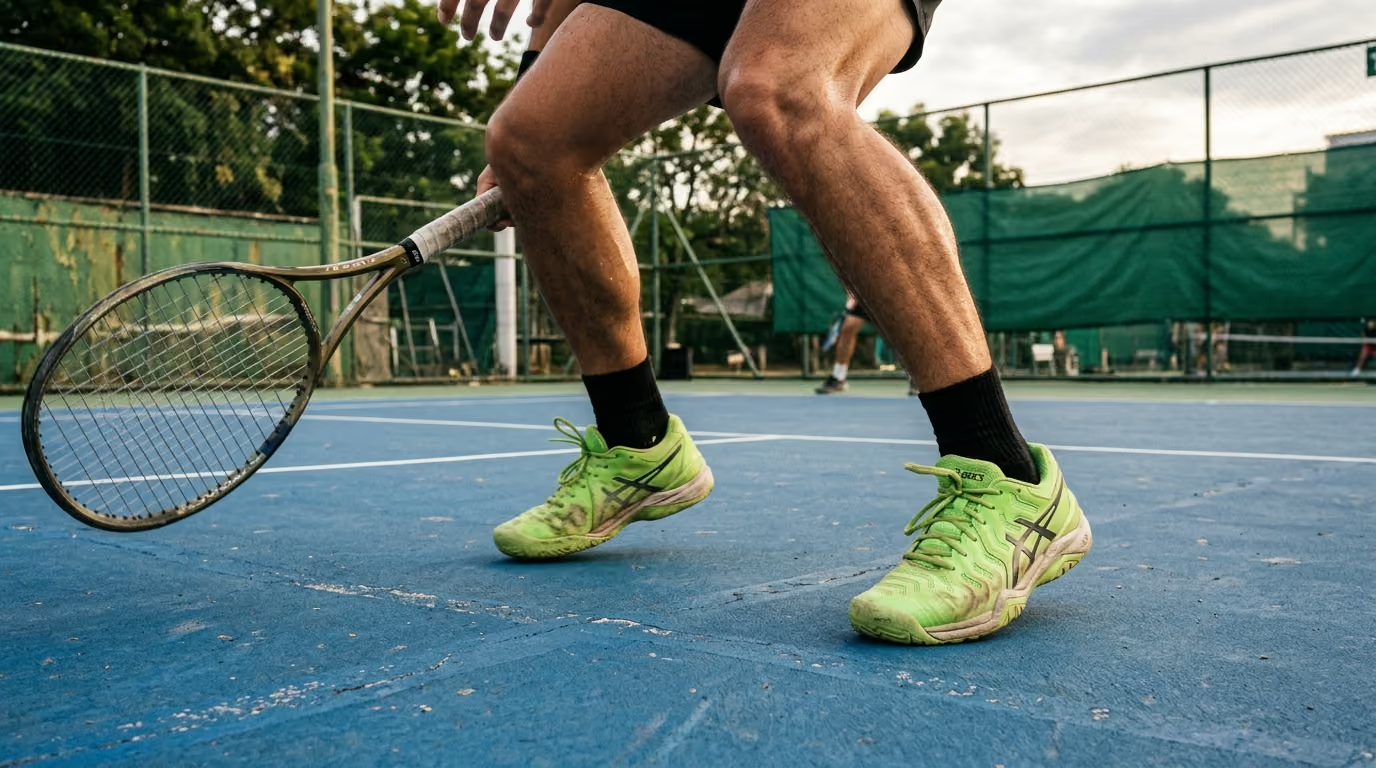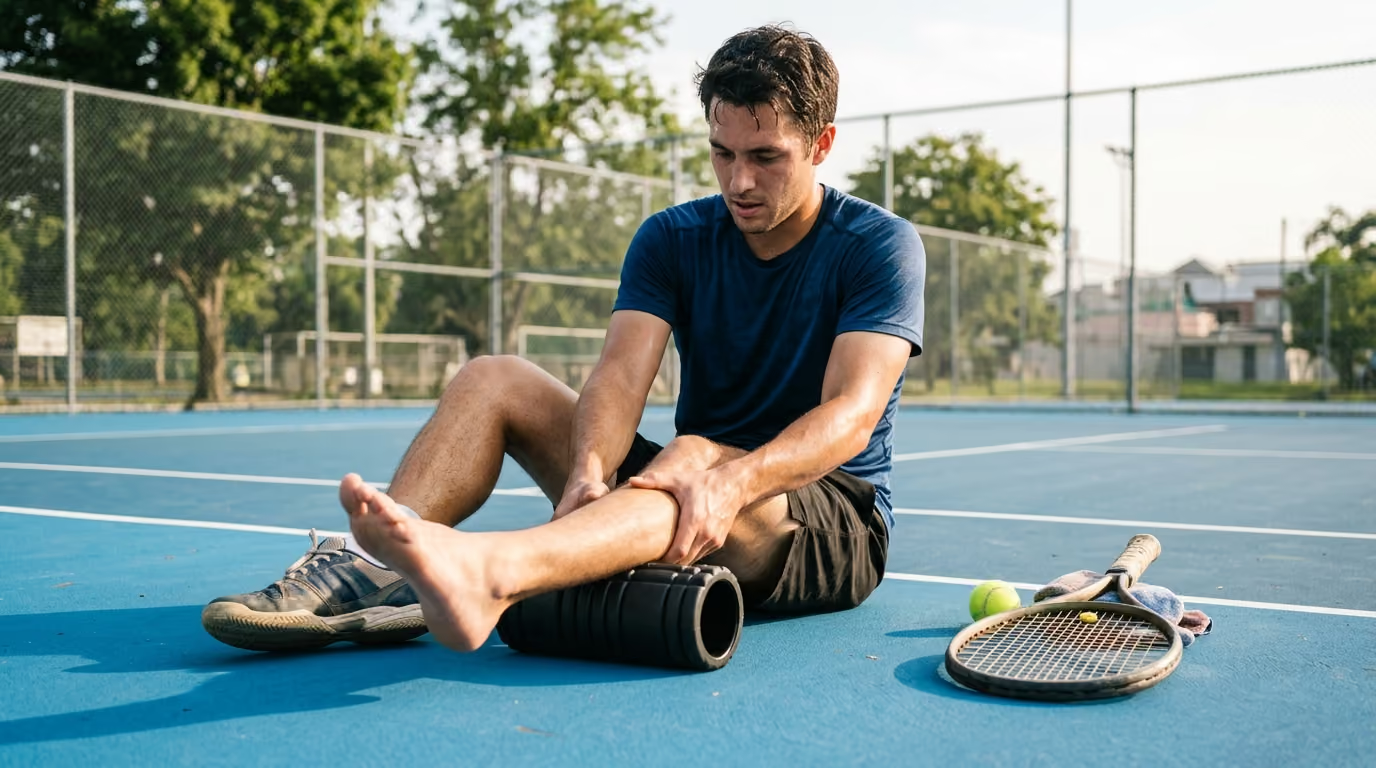

Three distinct strategies for mobility work, including pre-match, post-match, and rest-day approaches, optimize performance and protect joints for racquet sports players.




Every racquet sports player knows the feeling of stepping onto the court with stiff joints. Whether you are warming up for a singles tennis match, preparing for a fast-paced pickleball session, or stepping onto a padel court, your movement capacity dictates your performance. Yet, players often treat all stretching, rolling, and mobilization exercises as if they serve the exact same purpose. Understanding when to perform specific types of movement work is the key to moving fluidly and protecting your joints over a lifetime of play.
To optimize your performance on the court, you should perform dynamic, sport-specific mobility work directly before playing to prepare your tissues for rapid movement. Save intensive, passive stretching and strength-through-range training for rest days or dedicated training sessions to build permanent structural capacity without fatiguing your muscles. Post-match mobility should remain gentle, focusing entirely on comfort, joint downregulation, and subjective relaxation.
By organizing your training around these principles, you can ensure that your warm-up actually prepares you to move, your cool-down helps you transition to recovery, and your rest-day training builds lasting movement capacity.
To design an effective weekly routine, we must first define what mobility is and what it is not. Many recreational players use the terms flexibility and mobility interchangeably, but they represent different physical traits.
Flexibility is the passive ability of a muscle-tendon unit or joint system to stretch to an end-range. It is commonly measured by how far an external force, such as a partner, a strap, or gravity, can push a limb. For example, lying on your back and having a trainer lift your straight leg to a ninety-degree angle measures passive flexibility. The American College of Sports Medicine describes static stretching as moving a joint slowly toward the end of its range until tension, not pain, is felt [36]. While passive flexibility is useful, it represents potential range rather than active control.
Mobility is a broader, more active capacity. It is the ability to actively control, coordinate, and produce force within a specific joint range of motion. Mobility requires your nervous system to coordinate muscle contractions to stabilize one joint while moving another. Getting low to execute a half-volley on the tennis court is not just a demonstration of long muscles. It is a demonstration of active hip and ankle mobility, where your muscles support your body weight at the very end of your available joint range.
This distinction is critical for court athletes because racquet sports require active control. Having loose joints without the muscular strength to control them can lead to poor court movement and joint irritation. To build a body that moves well and resists injury, we must focus on active mobility and strength-through-range rather than passive flexibility alone. Players looking to improve their movement can benefit from integrating structured mobility and movement drills into their broader training schedules.
For decades, standard athletic advice was simple: stretch your muscles statically before you play. However, modern sports science has painted a much more nuanced picture of how different stretching modalities affect your performance and tissue properties.
A systematic review of mobility training in sporting populations found that twenty of twenty-two included studies reported that mobility training either benefited performance or helped maintain it [10]. This indicates that mobility work is a highly useful training component when programmed with the correct timing and dosage. However, the timing determines the outcome.
Static stretching, which involves holding a position at end-range for fifteen to thirty seconds, temporarily reduces the stiffness of the muscle-tendon unit. While this increases passive range, it can also temporarily decrease the muscle's ability to produce force rapidly. A 2024 review of gymnasts found that while static stretching did not significantly impair lower-limb power in highly flexible athletes, dynamic stretching was far more effective for power-related and dynamic performance [1]. For court athletes who rely on explosive sprinting, split-steps, and overhead smashes, relying solely on long, passive static stretches before a match can be counterproductive.
Conversely, dynamic stretching uses controlled movement through an active range without holding a fixed end position. A systematic review of upper-body warm-ups found strong support for high-load dynamic warm-ups improving power and strength performance [4]. Dynamic stretching increases core body temperature, improves nerve conduction velocity, and prepares your cardiovascular system for intense effort.
When it comes to injury prevention, the evidence is often misunderstood. A systematic review of static stretching for injury prevention found that routine static stretching does not reduce overall injury rates [14]. However, warm-ups incorporating dynamic activity and dynamic stretching show reductions in acute muscle strains across several studies [15]. This suggests that a dynamic warm-up is superior for preparing your body to absorb the high-speed forces of a match. Incorporating these findings is essential for anyone interested in healthy aging and athletic longevity strategies on the court.
The primary objective of your pre-match mobility routine is to raise your tissue temperature and prepare your nervous system for explosive movement. It should make you feel warm, coordinated, and loose without inducing physical fatigue. A progressive, four-phase sequence is the most effective way to prepare for court play.
Begin with five to ten minutes of low-intensity aerobic movement. This can include light jogging, side-shuffling, skipping, or low-intensity court movement. The goal is simple: raise your core body temperature and start producing synovial fluid to lubricate your joints. You should finish this phase with a light sweat, but you should not feel winded or tired.
Next, transition to controlled, dynamic movements that target the major joints used in racquet sports. Perform each movement through a comfortable, pain-free range, gradually increasing the speed and depth as your joints loosen.
Once your joints are moving through their full ranges, you need to turn on the muscles that support those joints. This phase uses low-volume, bodyweight exercises to wake up your glutes, core, and shoulder stabilizers.
The final phase bridges the gap between your warm-up and the match itself. Progress toward the actual speeds, forces, and reaction times of your sport. Perform a series of short, near-maximal accelerations, rapid decelerations, shadow swings, and lateral split-steps. You should step onto the court feeling highly responsive, warm, and ready to compete from the very first point.
If you have a specific joint restriction that interferes with your technique, you can use a brief static stretch before this sequence. However, keep the hold under fifteen seconds, and always follow it with dynamic movements to restore muscle readiness.
I remember finishing a tough two hour padel match on a cold Tuesday night and waking up the next morning feeling like my lower back was locked in concrete. For a long time, I just accepted this as the price of playing hard in my forties. But once I started spending just ten minutes on targeted hip mobility before heading to the club, the stiffness almost completely vanished. It taught me that we do not have to accept pain as a default state of aging.
Many players use post-match stretching as a ritual to prevent muscle soreness. However, we must separate the subjective feeling of relaxation from measurable physiological recovery.
A systematic review and meta-analysis found that post-exercise stretching used as a standalone recovery intervention did not significantly improve soreness, strength, or tissue healing [16]. A Cochrane review similarly concluded that stretching before, after, or before and after exercise did not produce clinically important reductions in delayed-onset muscle soreness (DOMS) in healthy adults [19].
This does not mean that post-match mobility is useless. It means its purpose is neural downregulation and temporary relief from the sensation of stiffness. After a competitive match, your nervous system is highly stimulated, and your muscles are under high tension. Gentle post-match movement acts as a signal to transition your body from a state of high stress to a state of rest and digest.
A practical post-match sequence should be easy and restorative:
Do not perform aggressive, high-intensity stretching after a match. Your muscle fibers have just experienced thousands of micro-tears from playing, and pulling on them with extreme force can cause further irritation. For more information on post-match strategies, explore our scientific recovery resources.
If your goal is to make long-term improvements to your joint ranges, your rest days or dedicated training blocks are the ideal times to do the work. When you are not preparing to compete, you do not have to worry about the temporary performance decreases associated with deep stretching. Your nervous system is rested, and your tissues are receptive to positive structural adaptations.
Building chronic mobility requires a combination of tissue tolerance, nervous system adaptation, and muscular strength. A single session of stretching will only provide a temporary increase in range of motion that fades within a few hours. To create lasting changes, you must convince your brain that it is safe to allow your muscles to stretch further. You achieve this by building strength and control in those newly accessed ranges of motion.
A systematic review of range-of-motion resistance training supports this approach. A meta-analysis of sixteen studies found that full-range resistance training produced greater adaptations than partial-range training for both strength and lower-limb muscle growth [8]. This means that performing strength exercises through a full, controlled range is one of the most effective ways to build lasting mobility.
Consider integrating these exercises into your rest-day strength and mobility sessions:
For a dedicated rest-day mobility session, follow the American College of Sports Medicine guidance. Perform flexibility work two to three days per week, holding static stretches for ten to thirty seconds to accumulate sixty seconds of total stretch time per target muscle group [32, 38].
You can structure your rest-day programming based on your experience level:
To complement these sessions, players can refer to our strength and conditioning guidelines to balance flexibility with muscular power.
While all racquet sports require agility, coordination, and rapid movement, each sport places unique biomechanical demands on your body. Tailoring your mobility work to your specific sport can improve your on-court comfort and movement efficiency.
Tennis is played on a large court, requiring long sprints, high-velocity decelerations, and deep lateral sliding, especially on clay courts. To handle these demands, tennis players need exceptional hip internal and external rotation. Without adequate hip rotation, the rotational forces of your groundstrokes will transfer directly to your lower back and knees, leading to irritation over time.
Additionally, the serving motion in tennis requires significant thoracic spine extension and shoulder external rotation. A tennis player's mobility routine should emphasize rotational mobility in the mid-back and stability in the glenohumeral joint to protect the rotator cuff during high-velocity serves.
Pickleball is played on a smaller court, which reduces the need for long-distance sprinting but increases the frequency of quick, shallow lunges. Players spend a significant portion of the match in a low, squatted stance at the kitchen line, waiting to react to fast volleys.
This sustained low position requires excellent ankle dorsiflexion and deep hip flexion. If your ankles are tight, your heels will lift off the ground when you get low, shifting your center of mass forward and placing excessive stress on your knees and lower back. Pickleball players should prioritize calf flexibility, ankle mobility, and deep groin stretching to stay low comfortably.
Padel is played in an enclosed glass court, featuring high-speed rebounds, wall play, and a high volume of overhead smashes. The ball bounce is often unpredictable, requiring players to constantly twist, turn, and pivot to defend off the back glass.
This constant rotation demands exceptional mobility in both the thoracic spine and the hips. Padel players must also perform frequent overhead actions, such as the bandeja and vibora, which require excellent shoulder flexion and thoracic extension. A padel-specific mobility routine should focus heavily on open-book stretches, standing torso rotations, and pectoral stretches to keep the shoulders moving freely.
Even well-intentioned players can fall into common training traps that limit their progress or increase their risk of joint irritation.
Many players believe that if they feel a deep, intense stretch in their hamstrings or shoulders, they are successfully preparing their body to play. However, intense static stretching right before a match can desensitize your stretch receptors. This temporary reduction in muscle stiffness can make your muscles slower to contract, reducing your power and reaction speed during the first few games. Before a match, focus on movement and blood flow rather than seeking an intense stretching sensation.
When a joint feels tight, the natural instinct is to stretch it harder. However, joint tightness is often a protective response from your nervous system, designed to prevent you from entering a range of motion that your muscles cannot stabilize. Pushing into pinching sensations, sharp pain, or joint discomfort can cause muscle guarding and joint inflammation. If a movement hurts, back off the intensity and work in a comfortable, pain-free range of motion.
Sometimes, a muscle feels chronically tight because it is weak and overworked. For example, many players complain of tight hamstrings and stretch them constantly, only for the tightness to return the next day. In many cases, the hamstrings are tight because they are working overtime to compensate for weak glutes. Stretching a weak, overloaded muscle repeatedly can make it weaker, compounding the problem. To resolve chronic tightness, you often need to strengthen the muscle through a full range of motion rather than stretching it in isolation. Incorporating proactive injury prevention strategies can help you identify these subtle muscle imbalances.
While a structured mobility routine can resolve minor joint stiffness, it is not a substitute for professional medical care. If you experience persistent, sharp, or worsening pain, you should consult a qualified physiotherapist or sports medicine physician.
You should seek professional medical evaluation if you experience any of the following signs:
A qualified professional can perform a comprehensive movement assessment, identify the root cause of your restriction, and design an individualized rehabilitation program to help you return to the court safely.
Foam rolling and other self-myofascial release tools are excellent for temporarily reducing the sensation of muscle tightness and improving blood flow. However, foam rolling is a passive modality that does not build active joint control or muscular strength. Use a foam roller for five minutes to loosen up a tight area, but always follow it with active movements to teach your brain how to control that newly accessed range of motion.
Proprioceptive neuromuscular facilitation (PNF) stretching involves contracting a muscle against resistance before stretching it further. While PNF is highly effective for improving flexibility, performing it on your own without proper instruction can lead to muscle strains. If you are new to PNF, work with a certified trainer or physiotherapist to learn the correct contraction intensity and positioning before trying it independently on your rest days.
Temporary changes in your range of motion happen immediately after a mobility session due to increased tissue temperature and altered nervous system sensitivity. However, creating permanent structural changes in muscle length and joint tolerance takes consistent work over six to twelve weeks. To maintain these gains, you must continue your mobility and strength-through-range training as a regular part of your weekly athletic routine.
If you are experiencing severe delayed-onset muscle soreness (DOMS), aggressive stretching can cause further micro-damage to your recovering muscle fibers. Instead of deep static stretching, perform light, low-intensity recovery movements such as a gentle walk, easy cycling, or very light dynamic mobility. This promotes blood circulation, which delivers essential nutrients to your muscles to support the natural healing process without placing additional stress on your tissues.
Follow Evercourts for practical insights on tennis, pickleball and padel performance, movement, recovery and healthy ageing. Stay connected for new articles, research-led guidance and ideas to help you play well and keep playing for years.


Read practical guidance for better movement, smarter preparation and a game that keeps working for you.
explore the Blog