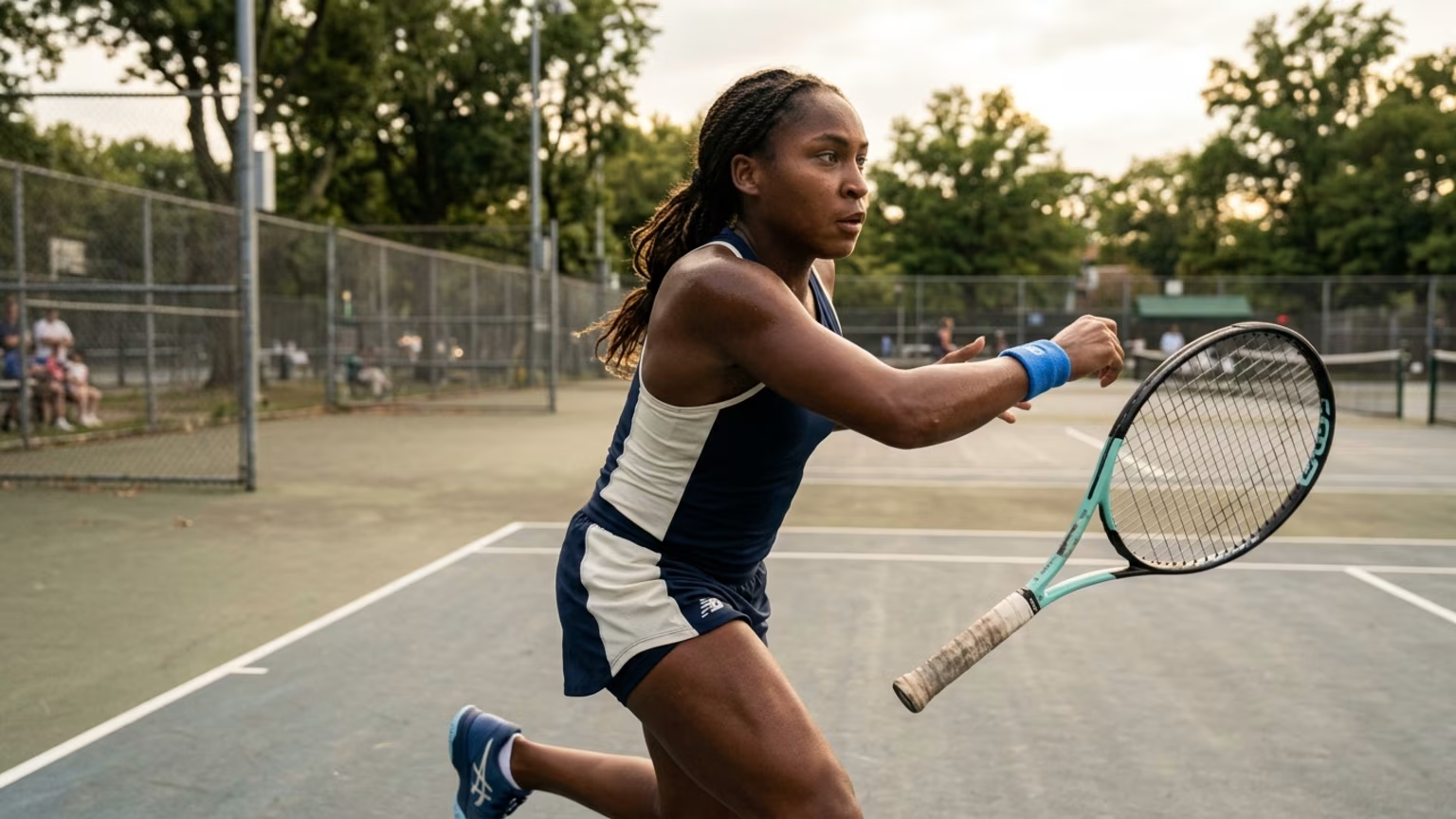

Coco Gauff defeated Iva Jovic to reach the 2026 US Open quarterfinals. Her recent major run highlights key match management lessons for adult players.




Coco Gauff defeated Iva Jovic 6-1, 6-4 in the US Open round of 16 on September 7, 2026. The victory secured her place in the tournament's quarterfinals for the first time since winning the title in 2023. Gauff closed the match in one hour and 33 minutes. This straight-set win secured her 12th career Grand Slam quarterfinal appearance.
The fourth-round victory extended Gauff's current winning streak to 10 matches. The official WTA account also noted she extended her streak of consecutive sets won to 20. She has now won nine consecutive matches in straight sets, which marks the longest such streak of her entire career. With this progression, the 22-year-old achieved a notable historical milestone. She became the youngest American woman since Serena Williams in 2003 to reach three major quarterfinals in a single season.
This recent straight-set result followed a much heavier physical toll in the previous round. Before facing Jovic, Gauff survived a three-hour match against Alexandra Eala. Gauff recovered from a 2-4 deficit in the deciding set to win 7-5, 3-6, 7-5. This contrast between an exhausting comeback and a controlled win demonstrates effective tournament progression.
Against Jovic, Gauff actually dropped her serve in the opening game. She then found her rhythm and won the next six games to claim the first set. Jovic made the second set highly competitive by leveling the score at 3-3. Gauff responded calmly by breaking serve at 5-4, and she then successfully served out the match.
A deep run at a major tournament looks incredibly smooth on television. However, adult recreational players should never try to replicate professional tournament workloads. Adult success relies on durable movement patterns and smart match management. Competitive amateurs can learn plenty from how elite players handle score pressure and match transitions. Understanding these concepts helps support long-term athletic longevity on the court.
For adults balancing work and competition, physical durability matters just as much as technical skill. Building a sustainable approach to the sport requires careful planning and realistic expectations. Amateurs who prioritize match management often enjoy longer and more rewarding playing careers. These strategic adjustments keep players on the court year after year.
One crucial lesson is the importance of a reliable mental reset. After her victory, Gauff said she was doing a good job of putting missed opportunities behind her. She emphasized her focus on staying in the present moment during the match. This mindset prevents early mistakes from completely derailing a competitive performance.
This philosophy helps prevent one unforced error from ruining the next three games. Adult players can adopt a simple routine by turning away from the baseline and regulating their breathing. Choosing one clear tactical intention before beginning the next point creates a reliable competitive anchor. Taking these few seconds helps clear frustration and improves decision-making.
Managing score pressure is another essential skill for recreational players. Gauff did not panic when Jovic leveled the second set at 3-3. She evaluated the high-value moments and secured the crucial break at 5-4. Amateurs often tighten up during these exact scenarios, which frequently leads to costly unforced errors.
A more effective strategy involves rehearsing specific closing situations during weekly practice sessions. Serving for a set at 5-4 requires converting an advantage before physical fatigue creates an opening. Players must also treat between-match recovery as an active performance requirement rather than an afterthought. Properly comparing recovery demands across different match formats helps competitors allocate their energy wisely.
Transitioning from a grueling three-hour match to a clean straight-set win requires serious physical preparation. Our team understands this specific physical challenge firsthand. I remember finishing a tough two hour padel match on a cold Tuesday night and waking up the next morning feeling like my lower back was locked in concrete. For a long time, I just accepted this as the price of playing hard in my forties. But once I started spending just ten minutes on targeted hip mobility before heading to the club, the stiffness almost completely vanished. It taught me that we do not have to accept pain as a default state of aging.
Adult players need movement patterns that remain reliable under heavy fatigue. The match reports highlighted Gauff's ability to combine strong returning with excellent athletic movement. For recreational competitors, this means training balanced positioning and controlled deceleration on the court. Players should focus on split-step timing and smooth recovery to a neutral position.
Building these foundational habits often proves more valuable than training for maximal sprint speed. When players establish a smart and sustainable tournament calendar, they can better manage these movement demands. Competing with heavy legs significantly increases the risk of adopting poor technical habits. Prioritizing movement quality over raw speed helps protect the joints during long weekends.
Tactical flexibility also plays a vital role in long-term tournament success. Gauff demonstrated this flexibility by adjusting her court position after dropping the opening game. Adult players should recognize when their primary game plan is failing and make timely adjustments. Sticking stubbornly to a losing strategy wastes energy and increases physical strain.
Players should clearly separate professional inspiration from medical prescription. Gauff's current performance demonstrates what elite tournament consistency looks like on a hard court. However, this media coverage does not establish a universal injury-prevention formula for amateur athletes. Players experiencing recurring pain or sharp declines in movement quality should seek individualized advice from a qualified clinician.
The statistics from the round of 16 match highlight effective execution during critical momentum shifts. According to the official WTA report, Gauff won 25 of 30 points during a crucial stretch. This dominant sequence lasted from midway through the first set until 0-30 in the second set. This run allowed her to establish firm control over the match rhythm after a slow start.
A separate match report from Yahoo Sports detailed the final offensive production. Gauff finished the contest with 18 winners and 15 unforced errors. In contrast, Jovic recorded nine winners and 30 unforced errors. These figures show Gauff combined steady offensive output with strict error control on the night.
While one match does not prove a permanent technical advantage, these numbers reflect strong tactical discipline. Limiting unforced errors remains a proven strategy for navigating high-pressure tournament rounds. The broader tournament context also points to a remarkably competitive environment in New York. BBC Sport and the WTA noted that the top six seeds reached the women's quarterfinals.
This specific seeding milestone has not occurred at the US Open since 1998. Reaching the latter stages of such a strong draw requires consistent execution against elite opposition. Gauff's progress through this section of the bracket required constant problem-solving. Overcoming both early deficits and strong opponent momentum highlighted her tactical adaptability.
Looking ahead, Gauff was scheduled to face fifth-seeded Mirra Andreeva in the quarterfinals. Gauff currently holds a five-match unbeaten record against Andreeva across their previous meetings. However, four of those victories took place on clay courts. Only one of their prior encounters occurred on a hard court, making this upcoming surface dynamic an important variable to watch.
As the 2026 US Open progresses, the physical demands on the remaining field will steadily increase. Consecutive high-pressure matches test the durability and focus of every remaining player. Managing workload and recovery demands remains just as critical as raw shot-making ability on these fast courts. The competitors who can maintain their movement quality under fatigue will be best positioned for success.
We expect the upcoming rounds to further emphasize the importance of match management. Players who efficiently close out sets will save valuable physical energy for the later rounds. Those who get drawn into prolonged battles will need exceptional recovery protocols to survive. Watching how these athletes handle consecutive days of intense competition offers valuable lessons for any serious player.
Follow Evercourts for practical insights on tennis, pickleball and padel performance, movement, recovery and healthy ageing. Stay connected for new articles, research-led guidance and ideas to help you play well and keep playing for years.


A grounded look at lower-body strength and balance for racquet sports, with simple supported examples and clear limits on injury-prevention claims.

The Dink reported a warning about suspected fake Life Time pickleballs. Here’s the practical takeaway for recreational players and bulk buyers.

Understand how coverage, playing format and wall rebounds shape tennis, pickleball and padel movement, with research context for long-term play.
Read practical guidance for better movement, smarter preparation and a game that keeps working for you.
explore the Blog
