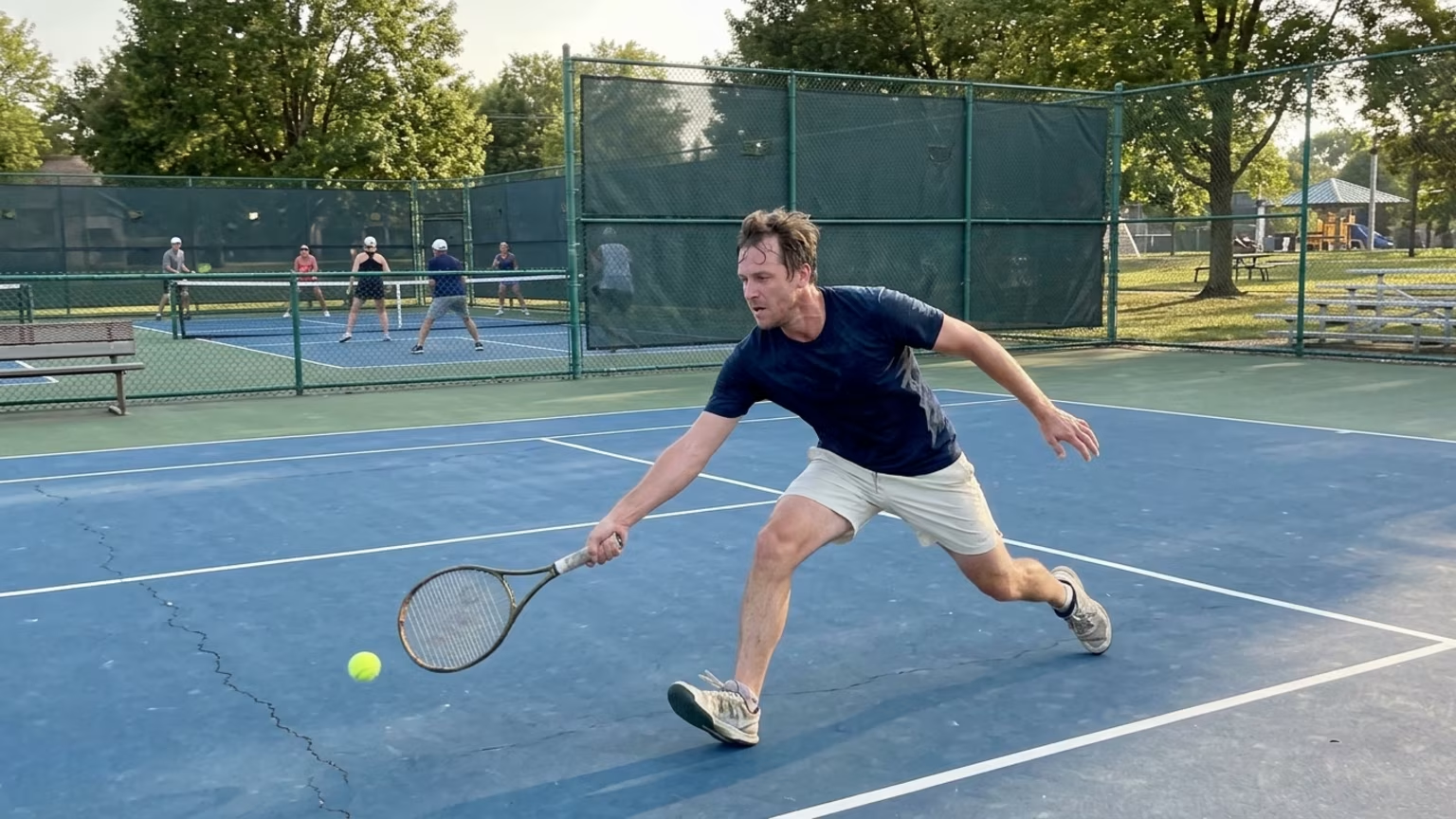

Understand how acceleration, controlled stops and recovery movement differ across tennis, pickleball and padel, with practical context for adult players.




Court movement is the sequence of starting, stopping and repositioning that gets a racquet-sport player to the ball and ready for the next shot. Acceleration is the short build-up of speed toward the ball. Controlled braking brings that travel into a stop or change of direction. Recovery movement is the repositioning that follows your shot.
Picture a short approach, a balanced stop and a move into position for another exchange. That whole sequence matters here, rather than the fastest step in isolation. Recovery in this context means moving into the next useful position, not resting between points.
Tennis, pickleball and padel all involve repeated short bursts rather than uninterrupted running. Moving toward the ball is only part of the task. Players must also stop or redirect their movement before responding to another shot.
Court geometry helps explain the differences. Format and playing style also shape what happens within those boundaries.
A comparison of standard court dimensions lists a tennis doubles court as 78 by 36 feet and a pickleball court as 44 by 20 feet. Those measurements describe available space, not a fixed workload for every match.
In tennis singles, one player handles the court coverage on their side. Doubles shares that responsibility with a partner. A movement pattern intended for singles therefore needs a different context from one intended for doubles.
Understanding how coverage changes when a partner shares the court gives practice a more relevant starting point than simply copying someone else's running pattern.
A secondary overview of pickleball activity describes forward and backward movement alongside lateral movement, reaching and direction changes. A smaller court does not remove those tasks.
Rapid exchanges can involve quick repositioning rather than a long run. Singles and doubles also distribute court coverage differently. For practice purposes, the useful question is which movements occur in the format being played rather than whether the sport looks demanding from outside the court.
A secondary account of padel's playing demands describes wall play as part of the sport. It also reports longer rallies and more volleys than tennis doubles in the comparison it summarizes.
That makes movement after a ball played in relation to the walls a relevant part of padel practice. A short approach and stop are not the whole sequence. The recovery direction needs a purpose within the next exchange.
The available research offers examples of movement demands rather than a ranking of which sport is hardest.
A secondary summary of a 2025 comparison reports that eight national-level male players took part in 40-minute padel and tennis doubles matches. It reports 1,393 metres covered per player during padel. The same account describes more distance and higher speeds in tennis doubles, alongside more sprints and longer rests.
A separate secondary report of recreational pickleball research describes 53 players with an average age of 62. Reported hourly step counts averaged 3,322 in singles and 2,791 in doubles. That finding illustrates a format difference within the reported group.
These findings come through secondary summaries rather than the original study pages. The padel sample was small and highly trained, while the pickleball sample describes one recreational group. Neither establishes a universal workload target or proves that a particular drill prevents injury or preserves long-term capacity. The practice ideas below are editorial applications of the movement descriptions, not a tested training protocol.
The practical interpretation is straightforward: a sport's name does not fully describe its demands. The format and the exchanges being played also matter. A distance or step count offers context, but it does not describe the complete movement sequence.
For adult players, athletic longevity provides a useful purpose for movement practice: keeping the tasks needed for continued play in focus. Those tasks include approaching the ball, controlling the stop and moving into another useful position.
Understanding that sequence gives practice a clearer purpose than chasing speed alone. It also provides a vocabulary for describing a difficult part of play. “I struggle with the change of direction after my shot” is more specific than “my movement feels off.”
Court lines can provide reference points for a short movement sequence. The distances and routes should reflect the player's ability and playing context rather than a universal routine.
A simple editorial framework links the following actions:
This connects with a broader view of practical court footwork: the approach and the movement after contact belong in the same discussion.
For tennis, practice context includes whether court coverage is individual or shared. For pickleball, it includes quick repositioning in several directions despite the compact playing area. For padel, it includes recovery after a ball played in relation to the walls.
Playing style matters too. The same court lines can frame different exchanges, so a single route need not represent every player's needs.
A useful reflection is whether the rehearsal resembles actual points. Does it include the approach that commonly occurs? Does it continue beyond the imagined shot? These questions keep attention on the demands of continued play without turning a study average into a personal target.
Recurring aches or stiffness that interfere with approaching the ball, stopping or repositioning are reasons to consult a qualified physiotherapist or healthcare provider. Individual advice is also appropriate when a player is unsure how their health history affects suitable practice.
A useful conversation can describe where difficulty appears in the sequence. That might be the approach or the stop. It might instead be the direction change or the recovery movement. This describes the playing problem without trying to diagnose its cause.
The short approach, balanced stop and move toward the next ball remain the same basic picture. When recurring discomfort or uncertainty about health changes that picture, qualified advice is the appropriate next step.
Follow Evercourts for practical insights on tennis, pickleball and padel performance, movement, recovery and healthy ageing. Stay connected for new articles, research-led guidance and ideas to help you play well and keep playing for years.


Put tennis in a realistic healthy aging plan, with a clear look at longevity research, strength, balance, recovery and when to seek qualified advice.

Understand court reactions, anticipation and split-step timing, with coaching-informed partner practice and a clear role for solo rehearsal.

Plan an all-day tournament with familiar food and fluids, practical packing, and flexible match gaps for tennis, padel or pickleball.
Read practical guidance for better movement, smarter preparation and a game that keeps working for you.
explore the Blog
