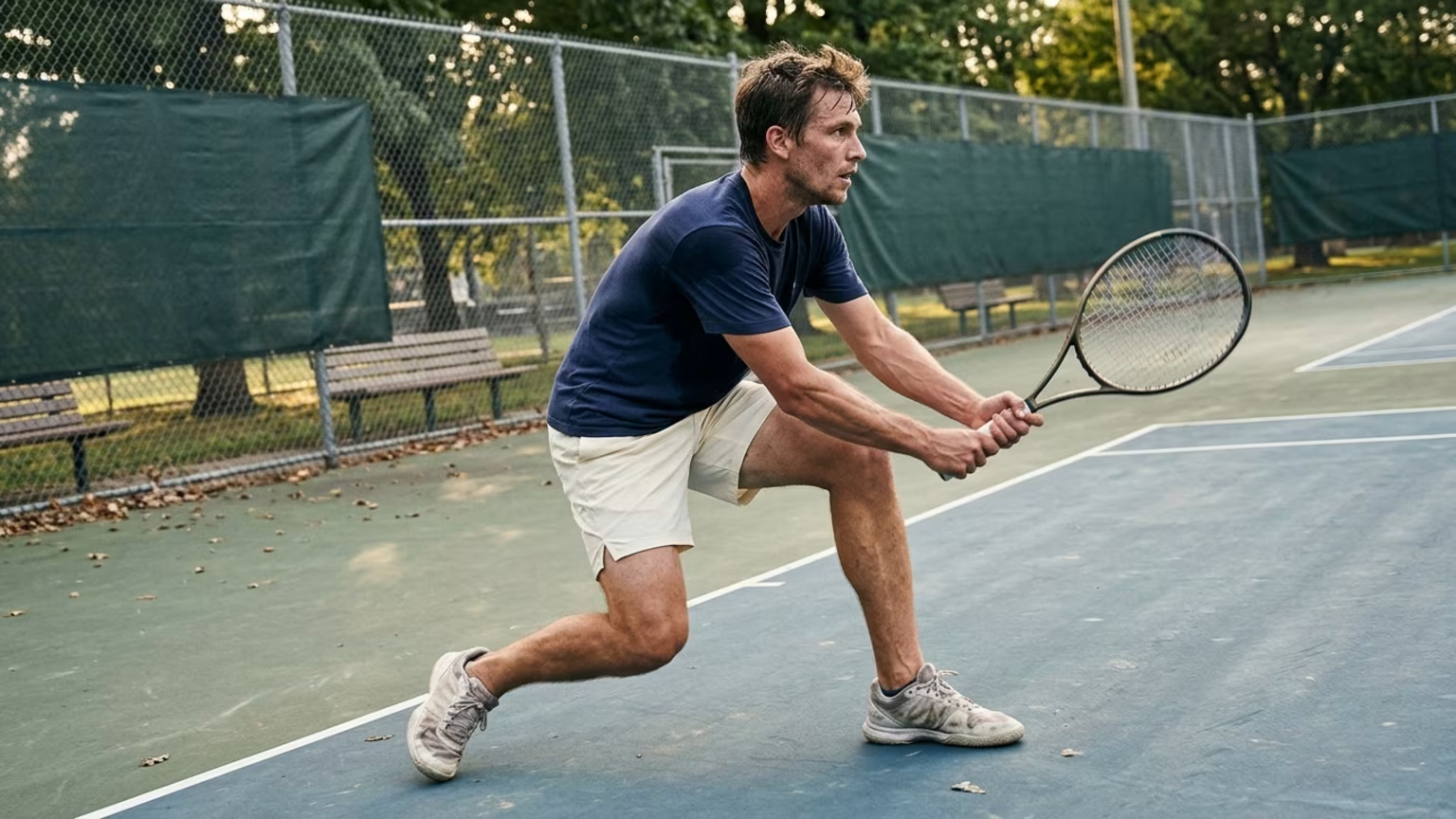

Understand deceleration in tennis, the research on braking strength, and how controlled movement practice fits long-term court preparation.




Deceleration is the act of slowing your body down so you can control where and how you arrive. In tennis, getting within reach of the ball is not the same as arriving ready to hit it. The ball may be close enough while your body is still travelling past the position you wanted.
A tennis coaching analysis separates court movement into acceleration, braking, the shot transition and recovery. That is a useful way to think about footwork: reaching the ball is part of the movement rather than its finish line.
The same analysis distinguishes controlling movement during braking from producing force to move again during recovery. Seen this way, the stop and the next push belong in the same conversation as the chase.
Tennis asks players to repeat that sequence across a rally: move toward the ball, slow down, strike and recover. Repeated explosive efforts and changes of direction therefore involve more than the ability to accelerate. The coaching question is whether the player can manage the movement between those efforts.
A player might reach a shot yet struggle to organize the strike or the recovery. That observation is a coaching prompt rather than a diagnosis. It directs attention toward arrival and control instead of treating every difficult ball as a reason to become faster.
A useful coaching question is whether the arrival sets up the next action. Getting a racquet on the ball answers one question. Being ready to strike and recover answers another. This keeps deceleration connected to playing the point rather than treating a stop as an isolated trick or making every footwork session a test of speed.
For pickleball and padel, the useful shared lens is the repeated need to move, stop and move again. In pickleball, consider the control between one quick response and the next. In padel, consider how slowing for a shot connects with the following change of direction.
The shared coaching question is how to connect one movement with the next. Our guide to how court movement differs across the sports provides sport-specific context. A shared task does not require an identical training plan.
The most relevant research here concerns eccentric capacity: the ability of muscles to control force while lengthening. A secondary evidence brief summarizes a peer-reviewed study involving a pooled sample of 196 tennis and basketball players.
It reports that eccentric measures explained 25.1% of the variance in 90-degree change-of-direction performance and 37.4% in 180-degree performance. These percentages describe a statistical relationship across the group. They are not the amount by which strength training made players faster.
This matters because it gives braking-related strength a place in the discussion of court movement. It does not identify a particular exercise or establish that increasing one strength measure will improve an individual player's movement. The evidence also does not establish that tennis findings transfer unchanged to pickleball or padel.
Injury prevention is a separate question. A secondary account of the TennisReady trial describes an online program studied in 579 adult recreational tennis players over 12 weeks. It reports injury prevalence of 37% in the program group and 38% in the comparison group, alongside low adherence.
That result concerns one online program rather than all strength training or movement practice. Read together, these findings support a distinction between preparing physical capacity and proving an injury-prevention effect. No exercise routine guarantees that a player will avoid injury.
Practical recommendations need their own label too. A practitioner article in World Tennis Magazine favors slow, controlled single-leg strength work over simply chasing heavier lifting. That is a coaching recommendation based on the demands of eccentric control rather than a tested prescription for every adult player.
Likewise, a practitioner's warm-up example progresses from easy movement and mobility toward low-speed starts and stops. It also includes lateral movement and changes of direction. It is a practical example rather than a universally validated protocol.
For adult players, the long-term value of understanding deceleration is having a clearer picture of what playing requires. The goal is not to become preoccupied with every foot placement. It is to recognize that slowing down and moving again deserve attention alongside getting to the ball.
A useful approach to athletic longevity connects court demands with physical preparation. Based on the coaching recommendations and research above, that conversation can include three areas:
These are areas for planning rather than a fixed workout. The appropriate exercises and progression should reflect the player's abilities and circumstances. Our discussion of fitting strength work around court time offers related context for that planning.
Warm-up preparation can follow the same logic. The practitioner example starts with easier movement before introducing court-specific actions at low speed. Our guide to building toward the first point looks at preparation through that gradual progression.
The aim is preparation that has a clear purpose. If a session is described as movement work, it is reasonable to ask which part of the approach, stop or recovery it addresses. That question does not require a complicated drill. It requires a connection between the practice and the task being prepared for.
For a player thinking about years of tennis ahead, this changes the question from “How much more should I do?” to “Which part of the movement am I preparing for?” That is a more useful starting point for an informed conversation with a coach or qualified physiotherapist than assuming that more speed is always the answer.
Seek advice from a qualified physiotherapist or healthcare provider if pain or stiffness repeatedly changes how you stop, strike or recover. Difficulty controlling stops that keeps recurring is also worth discussing rather than repeatedly testing through match play. Questions about returning after an injury call for individual advice rather than a generic progression.
Describe what happens during the movement and whether discomfort affects it. That gives the conversation a concrete focus without requiring you to identify the cause yourself.
The ball being within reach is still only part of the picture. If pain or a recurring movement difficulty keeps you from arriving under control, the next useful step is an individual assessment rather than simply chasing harder.
Follow Evercourts for practical insights on tennis, pickleball and padel performance, movement, recovery and healthy ageing. Stay connected for new articles, research-led guidance and ideas to help you play well and keep playing for years.


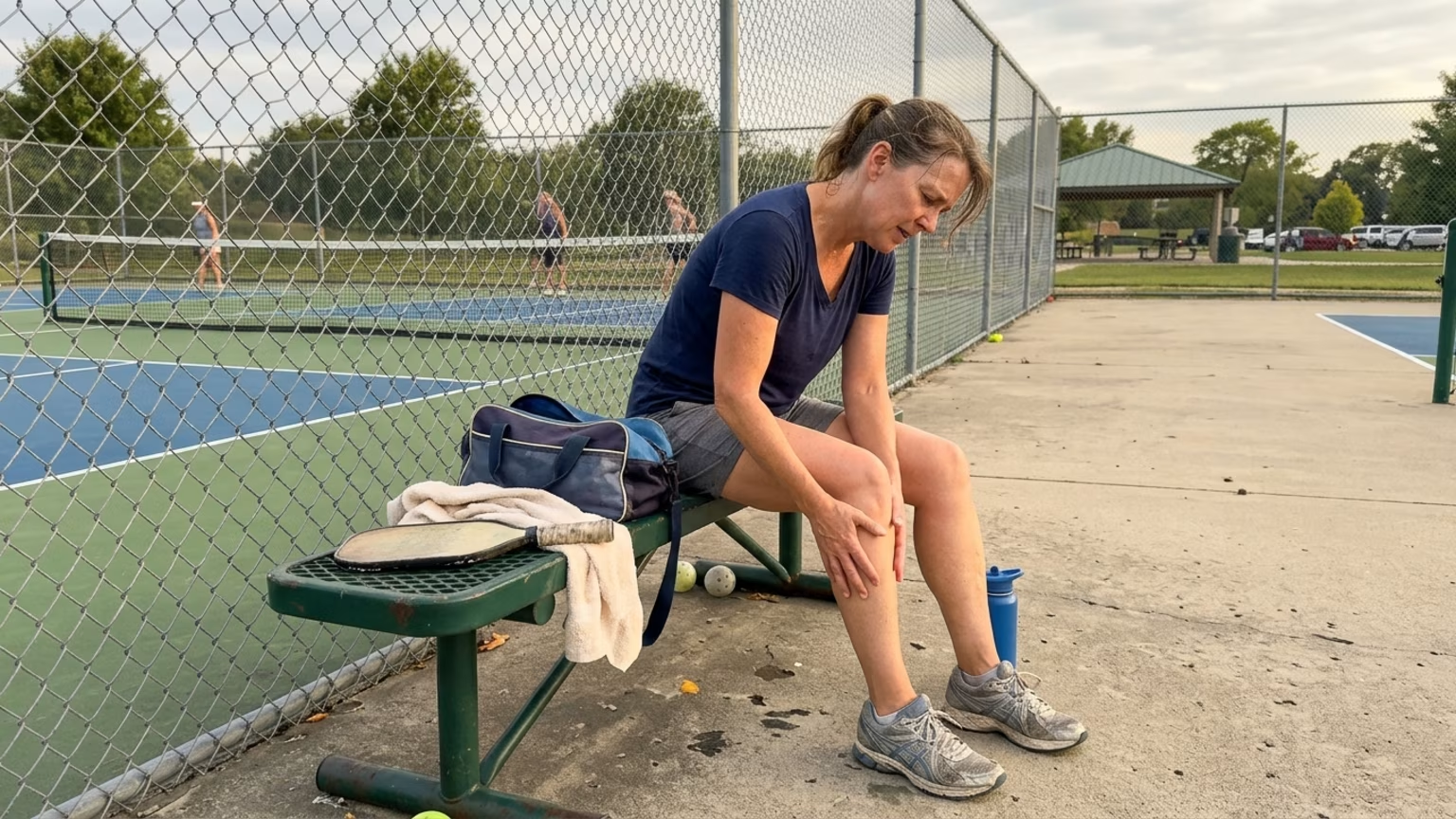
Four practical answers on post-play soreness, warm-up decisions, recurring pain and warning signs for tennis, padel and pickleball players.

Agassi and Graf’s company has proposed a pickleball and padel club network. Here is what traveling players should watch before changing memberships.

Pleasanton is considering residential sport-court design standards. Here is what players should monitor before planning a private court.
Read practical guidance for better movement, smarter preparation and a game that keeps working for you.
explore the Blog
