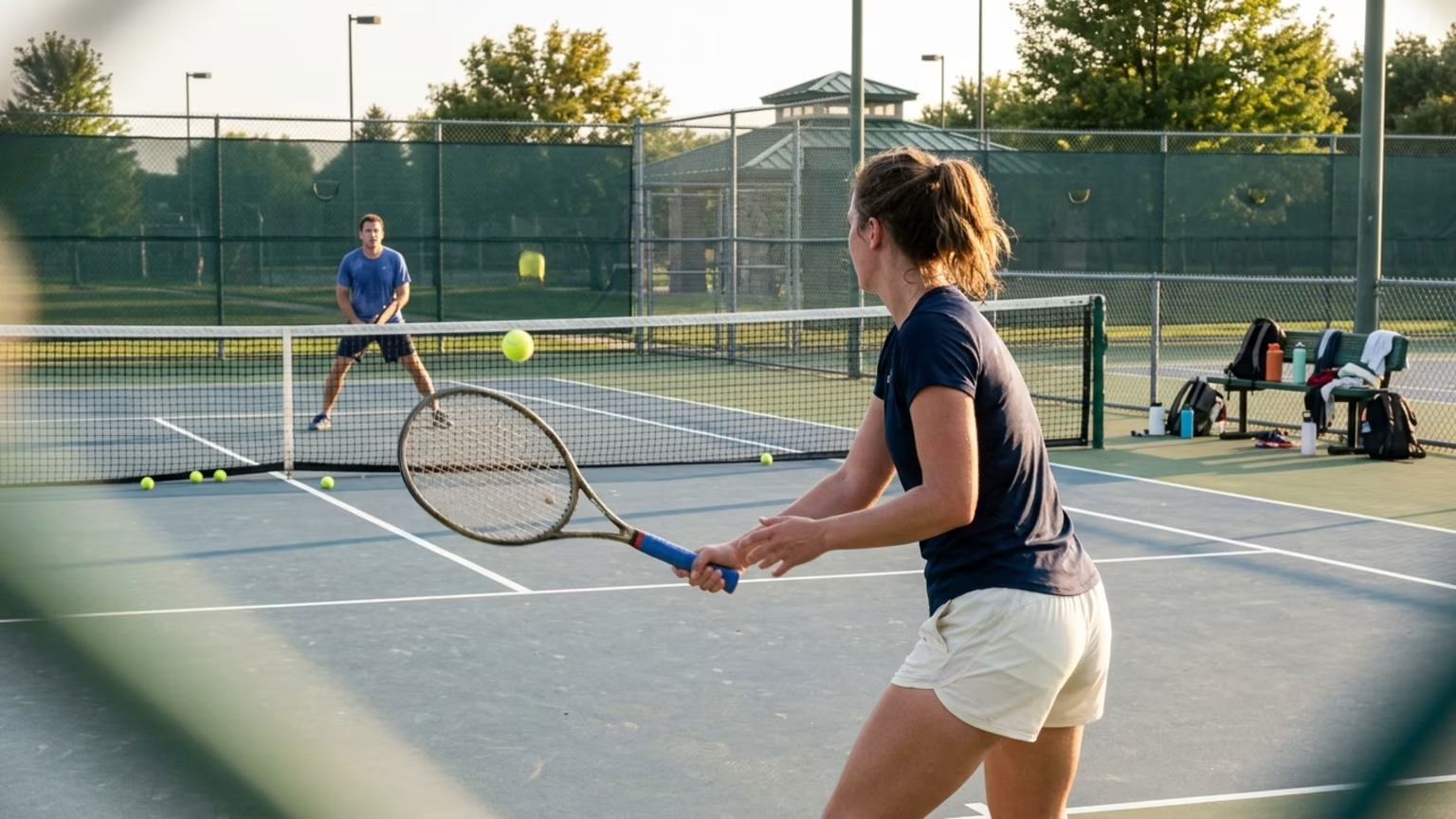

A progressive tennis warm-up from general movement to footwork, short-court hitting and serves, with clear limits on injury-prevention claims.




A tennis warm-up needs to bridge the gap between arriving at court and playing at match intensity. This progression moves from comfortable general activity to dynamic preparation and tennis-specific movement, then builds through controlled hitting toward the first point.
The goal is readiness to move and hit, not to complete another workout before the match. For an active or aging player, that means organising preparation around the game ahead and aiming to finish feeling ready rather than tired.
A 2026 scoping review in Sports Medicine - Open included 964 warm-up studies. It found that research focused more on acute performance readiness than on injury reduction. The practitioner routine used below is a practical recommendation rather than a universally validated protocol. Neither source establishes one ideal duration or effort level for every adult recreational player.
That distinction matters for athletic longevity. A warm-up is preparation for play, not a guarantee against injury or a substitute for individual care. Decisions about pain or an existing health condition belong with a qualified professional rather than a general court-side routine.
The practical target is straightforward: move generally before moving specifically, then introduce strokes before match-like hitting. A gradual transition into court play gives the routine its structure without turning it into a race against the clock.
A tennis-focused practitioner routine recommends movement and dynamic mobility followed by footwork and shadow strokes. Its hitting phase starts near the service line and progresses toward baseline rallies and serves. The sequence below follows that order.
Begin with comfortable general movement before adding tennis-specific actions. In the practitioner progression, general activity comes before dynamic mobility and stroke preparation.
The distinction is between starting to move and immediately asking for match-like tennis. This first stage begins the build-up. It should remain part of preparation rather than becoming a separate workout before play.
Dynamic mobility follows general movement in the practitioner routine. This is movement-based preparation before footwork and shadow strokes.
Its place in the sequence matters more here than an elaborate exercise list. Keep it connected to what comes next: increasingly tennis-specific movement followed by hitting. Mobility is one stage of the warm-up rather than the whole routine.
This stage brings tennis footwork and stroke patterns into the routine before the hitting becomes more demanding. Shadow strokes are rehearsals of the stroke movement without striking a ball.
The practitioner recommendation includes both elements rather than treating preparation as hitting alone. As a practical interpretation, this is the point where the routine begins to resemble tennis more closely. Footwork and shadow strokes form the link between general preparation and the ball-based part of the sequence.
Begin the hitting phase with controlled shorter-court exchanges near the service line, as described in the practitioner routine. Baseline rallies and serves come later in the progression.
The useful distinction is between starting to hit and starting to compete. These opening exchanges belong to preparation. Build the hitting demands gradually rather than treating the first ball as a match point. That keeps the court-based sequence consistent with the earlier build-up from general movement to tennis-specific actions.
From shorter-court hitting, the routine progresses toward baseline rallies and serves. Rally pace increases as the preparation moves toward match-like tennis.
Serving belongs in this final part of the sequence alongside more demanding hitting. The aim remains to finish ready to play rather than tired. A warm-up does not need to become a contest of its own.
For a consistent match-day plan, keep the order recognisable even when the session changes. The organising habit is the progression itself: general movement first, then dynamic preparation and tennis-specific work before graduated hitting.
The sources do not establish how the biomechanical demands of tennis, pickleball and padel differ. The adjustments below are editorial adaptations of the preparation order, not claims about sport-specific joint or muscle loading.
For tennis, the practitioner example provides a court-based sequence: shorter exchanges near the service line followed by baseline rallies and serves. Keep that hitting progression connected to the movement and footwork stages that came before it.
The transferable idea is the order of preparation rather than tennis court landmarks. As an editorial adaptation, retain general movement and dynamic preparation before introducing pickleball-specific footwork and strokes. Do not treat the tennis service-line-to-baseline sequence as a fixed requirement for another sport.
Apply the same distinction to padel: transfer the gradual build-up, then make the movement and stroke preparation relevant to padel. The tennis hitting sequence is an example rather than the template for every court. For related context, see preparing for the opening padel rally.
Follow Evercourts for practical insights on tennis, pickleball and padel performance, movement, recovery and healthy ageing. Stay connected for new articles, research-led guidance and ideas to help you play well and keep playing for years.



Holger Rune withdrew from the European Open with a back problem. The facts behind his decision and a grounded perspective for recreational players.

The Dink’s October 17 guide emphasizes deep returns, ball-height decisions and positioning against faster pickleball opponents.

A new report outlines padel and tennis gear trends. Learn how to assess adjustable rackets, sensor feedback and smart-court claims.
Read practical guidance for better movement, smarter preparation and a game that keeps working for you.
explore the Blog
