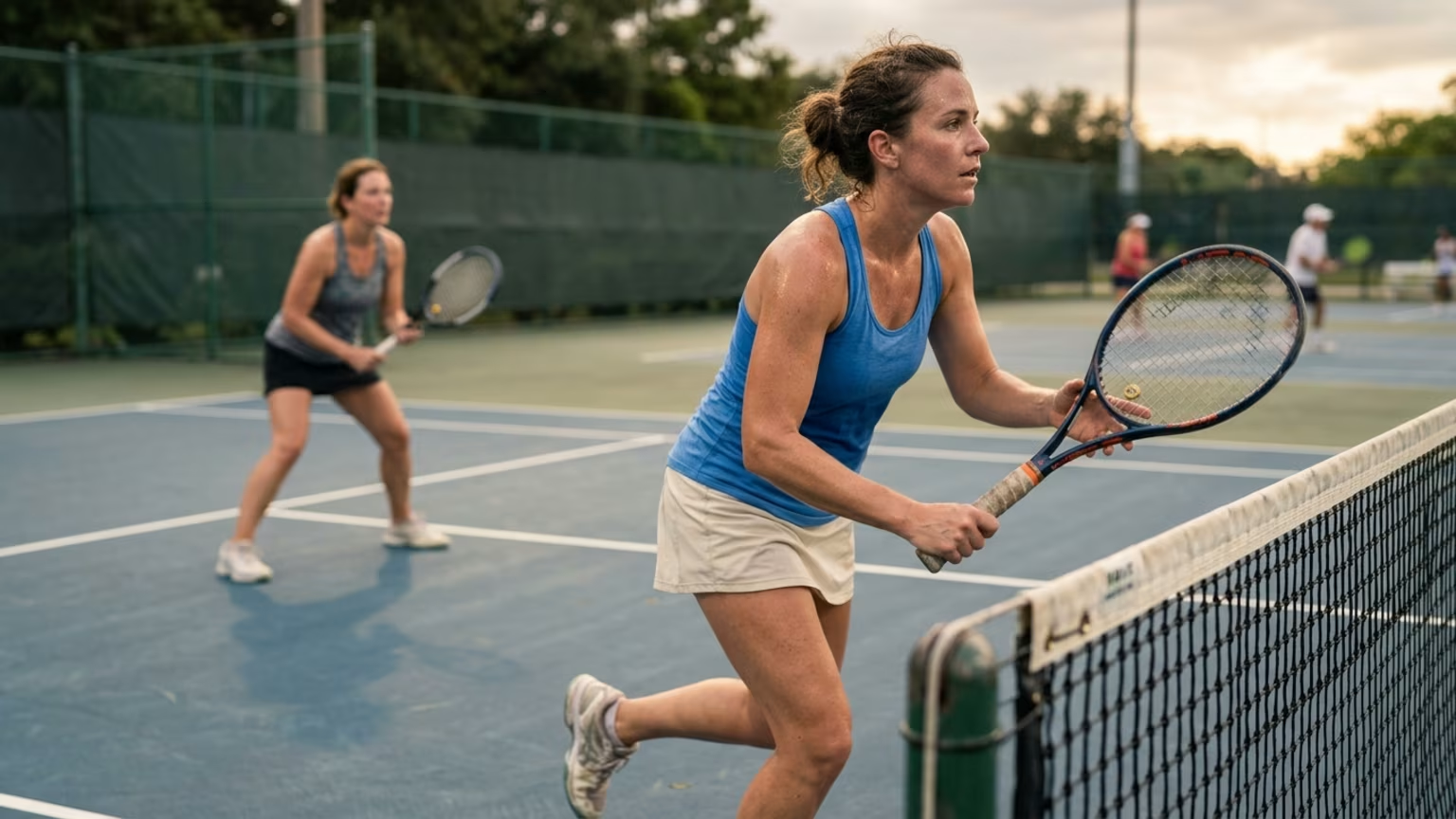

Learn how proper spacing, early communication, and role clarity improve doubles court coverage and support athletic longevity in tennis, pickleball, and padel.




Good doubles play has absolutely nothing to do with reading your partner's mind. It relies entirely on explicit agreements and repeatable habits. Effective court coverage is a trained system of shared spacing, deliberate positioning, and early communication that treats two players as a single moving unit. When partners understand their roles, they eliminate the hesitation that costs points.
Tennis, pickleball, and padel specifically challenge the lower body and energy systems due to repeated explosive efforts and rapid changes of direction. When a doubles team lacks a coordinated movement plan, players are forced into unpredictable, emergency reactions. A partner out of position forces the other player to scramble across a wider gap. This uncoordinated movement multiplies the number of sudden lunges and hard stops required to keep the ball in play.
Over a long match, these extra bursts of effort rapidly deplete energy reserves and tax the joints. Unplanned scrambles also increase the risk of overextension when reaching for unexpected shots. A team that moves poorly essentially plays a much more physically demanding version of the sport.
Strategy guides consistently emphasize that spacing and role clarity are trainable skills rather than innate talents. Tennis instruction recommends that partners recover toward the center of their shared space and move forward together. This is much more efficient than automatically returning to each player's individual singles sideline. Leaving one player near the net while the other remains deep creates huge gaps.
In padel, Mouratoglou Padel advises partners to agree before the point on middle coverage, lob responsibility, and their serving plan. PadelUp presents the forehand player as a useful middle-coverage default while emphasizing that pairs must adapt to the situation. Clear verbal triggers remove the guesswork from these fast-paced decisions. You should establish these basic rules before you even begin the warm-up.
Useful communication is specific and happens early. Players should rely on a few simple calls like mine, yours, leave, or switch. The switch call should mean that both players commit to the new arrangement, not merely that one player changes direction. Calling the ball early allows your partner to adjust their positioning immediately.
Each sport features unique spacing geometry. In tennis, instructional guidance notes that players may sometimes take a lob out of the air to preserve their positioning. Hitting an overhead stops the opponents from taking control of the net. However, players must be balanced and prepared to make this decision.
The pickleball non-volley zone extends 7 feet from the net on each side, and a player cannot volley while touching it or its line. This makes lateral sliding as a connected pair incredibly important. Partners should move left or right together to maintain consistent spacing. This sliding action protects both the dangerous middle area and the outside lanes.
Padel court guides describe the standard internal court as 10 meters wide by 20 meters long. Because walls keep the ball in play, padel coaching sources recommend staying in the same general depth band and coordinating who handles the lob. One player stepping too far forward can open a clean passing angle. Moving together creates an imposing defensive wall against your opponents.
A poach is a planned interception rather than a random guess. The net player can signal a poach before the serve, and the server should know whether to hold position, move across, or cover the line. This ensures the court remains balanced and protected. Crossing without a proper rotation leaves an obvious open lane for your opponents to exploit.
You can actively train these decisions during practice sessions. One effective method is the connected-pair movement drill. Partners stand in their normal formation and move left, right, forward, and backward together on a command. The objective is to preserve a consistent relationship rather than sprint independently.
Another great tool is middle-ball decision training. Before a practice rally begins, partners state their default rule aloud. This could be assigning the middle to the forehand or asking the closest player to call it. The goal is to make your decision fast, audible, and adaptable.
Training your lob response is equally critical for a solid defense. When opponents lob, the pair should decide early who turns and who covers the next ball. If one player moves back, the partner must adjust to protect the middle area. Both players must call the ball before taking a single step backward.
Understanding court coverage helps adult players maintain their physical capabilities and stay on the court for years to come. Efficient positioning reduces the sheer volume of high-intensity sprinting required during a match. When you move as a connected unit, you rely on anticipation rather than raw physical recovery to stay in the point. This systematic approach directly supports healthy aging by minimizing unnecessary strain on the hips, knees, and ankles.
Proper planning off the ball is just as important as the physical swing itself. I used to think a tough conditioning block was the only way to improve my court endurance. Then I started tracking my sleep. I noticed that on days I slept less than six hours, my reaction time at the net was noticeably sluggish, and I felt gassed by the second set.
Prioritizing consistent rest did more for my late match stamina than any extra sprints ever did. Recovery is the true foundation of performance. Managing your energy through restorative habits and smart court positioning is a reliable strategy for playing longer. Good tactics save energy, and adequate sleep replenishes it.
Even with perfect tactics, the repetitive demands of racquet sports can eventually cause physical irritation. If you experience persistent, localized pain after matches that does not improve with basic rest, it is time to seek an evaluation. Sharp joint pain during changes of direction or lingering stiffness that impacts your daily mobility are clear warning signs. A qualified physio or healthcare provider can assess your movement mechanics and address underlying weaknesses.
Catching these issues early prevents minor aches from sidelining your season. Professional guidance helps you rebuild strength and correct any movement compensations you might have developed. Do not ignore warning signs, and always prioritize long-term physical health over pushing through discomfort.
Instead of hoping to read your partner's mind, build a reliable system together. When you trade silent assumptions for explicit communication, the game becomes simpler and significantly less exhausting.
Follow Evercourts for practical insights on tennis, pickleball and padel performance, movement, recovery and healthy ageing. Stay connected for new articles, research-led guidance and ideas to help you play well and keep playing for years.


Holger Rune withdrew from the European Open with a back problem. The facts behind his decision and a grounded perspective for recreational players.

The Dink’s October 17 guide emphasizes deep returns, ball-height decisions and positioning against faster pickleball opponents.

A new report outlines padel and tennis gear trends. Learn how to assess adjustable rackets, sensor feedback and smart-court claims.
Read practical guidance for better movement, smarter preparation and a game that keeps working for you.
explore the Blog
