

Understand pickleball lob footwork, what injury research shows, when to consider a bounce and when balance concerns call for professional advice.




Court balance is the ability to stay in control of your body while moving, stopping or changing direction. When a pickleball lob goes overhead, the relevant question is not just whether you can reach it. It is whether you can reach it with enough control to choose your next shot.
Backpedaling means taking backward steps while continuing to face the net. It is one response to a lob, but it is not the only response worth considering.
Turning to move toward the ball, allowing a bounce or leaving an uncontrolled chase are alternatives described in pickleball coaching guidance. The useful starting point is to separate getting to the ball from being ready to play it. An overhead attack does not have to be the answer to every lob.
Think of this as a repeated-effort problem rather than simply an overhead technique problem. In tennis, pickleball and padel, players repeatedly make quick efforts and change direction. The movement question is how to respond to the next ball without remaining committed to the previous direction.
A lob makes that question clear. A player facing the net now needs to cover space behind them. Continuing backward and turning to move are different ways of answering that problem.
For pickleball, the available coaching guidance favors turning before moving back. For tennis and padel, the same situation provides a useful movement question to discuss with a coach rather than a sport-specific injury finding.
The practical focus is control through the transition: moving for the ball and deciding what shot remains available. Our article on balance while moving between shots provides related context for thinking beyond the ability to stand steadily.
A 2024 study by Jones and Hammig, available through the University of Arkansas repository, used U.S. National Electronic Injury Surveillance System data to examine pickleball injuries and their reported mechanisms. The researchers reported different injury patterns across age groups. The wider pickleball injury research also identifies falls as a relevant injury mechanism.
The study abstract does not quantify lob-related or backward-motion falls. The available sources do not establish that looking up independently causes loss of balance or that beginners and returning players face a specific extra risk during lob pursuit. The movement suggestions below come from instructional guidance and practical interpretation rather than trials comparing injury rates. The evidence reviewed here also provides no validated controlled-fall protocol for these racquet sports.
That leaves a useful distinction: injury records describe injuries that reached emergency care, while coaching material offers options for handling a ball. Neither establishes a guaranteed safe response to every lob.
One pickleball instructional guide recommends turning sideways and using a drop step before moving back with crossover or side steps. This describes an alternative to continuing backward with the chest facing the net.
The practical discussion with a coach is about how that movement fits your play. The goal is not to force a particular step sequence into every situation. It is to have an option other than extending a backward shuffle as the ball travels farther behind you.
Another instructional guide on overhead play recommends moving toward the likely landing area and considering a bounce on a deep lob. It also supports declining to chase a ball already beyond safe reach.
Those choices change the objective. Instead of treating an overhead attack as compulsory, the player can consider whether a different response offers more control. Reaching the ball and being ready to attack it are separate decisions.
This is the most useful practical message from the coaching material: turning, allowing a bounce and leaving a ball are all legitimate options. The choice should reflect the situation rather than a fixed expectation that every lob must become a smash.
For adult players, athletic longevity does not have to mean stepping away from competition. A useful editorial principle is to value the next point and the next playing session as well as the current rally. That keeps the discussion focused on continued participation rather than fear.
Applied to lobs, this means leaving room for more than one successful response. A well-judged bounce can be a deliberate tactical choice. Declining an uncontrolled chase is also a decision rather than a failure of effort.
In doubles, court awareness can become an explicit agreement before the first lob arrives. As a practical suggestion, partners can agree who calls for a ball and leave each other room to move. The aim is to make the decision shared rather than assumed.
Our guidance on clearer agreements with a doubles partner offers a related way to think about shared space. For this situation, a useful agreement is that either player can leave a chase they no longer feel able to control.
Players learning the sport or returning after time away can bring specific questions to a coach. Which response are they choosing when a lob goes deep? Are they treating the bounce as an option or feeling obliged to attack? These questions keep attention on observable decisions rather than assumptions about age or experience.
Repeated loss of balance, a fall or discomfort that changes how you move are reasons to discuss your situation with a qualified physio or healthcare provider. So is feeling unable to move confidently enough to participate in normal play. These are prompts for an individual assessment rather than diagnoses.
A coach can discuss tactical choices and observe your lob footwork. Questions about symptoms, the effects of a fall or your own health belong with a healthcare professional. A general footwork article cannot make those personal decisions.
If controlled-fall practice interests you, discuss whether it is appropriate with a qualified healthcare provider and a qualified coach. Do not treat a written description or a general recommendation as a reason to begin practicing falls independently.
Today, if recurring unsteadiness is affecting your play, contact a qualified physio or healthcare provider to discuss it.
Follow Evercourts for practical insights on tennis, pickleball and padel performance, movement, recovery and healthy ageing. Stay connected for new articles, research-led guidance and ideas to help you play well and keep playing for years.


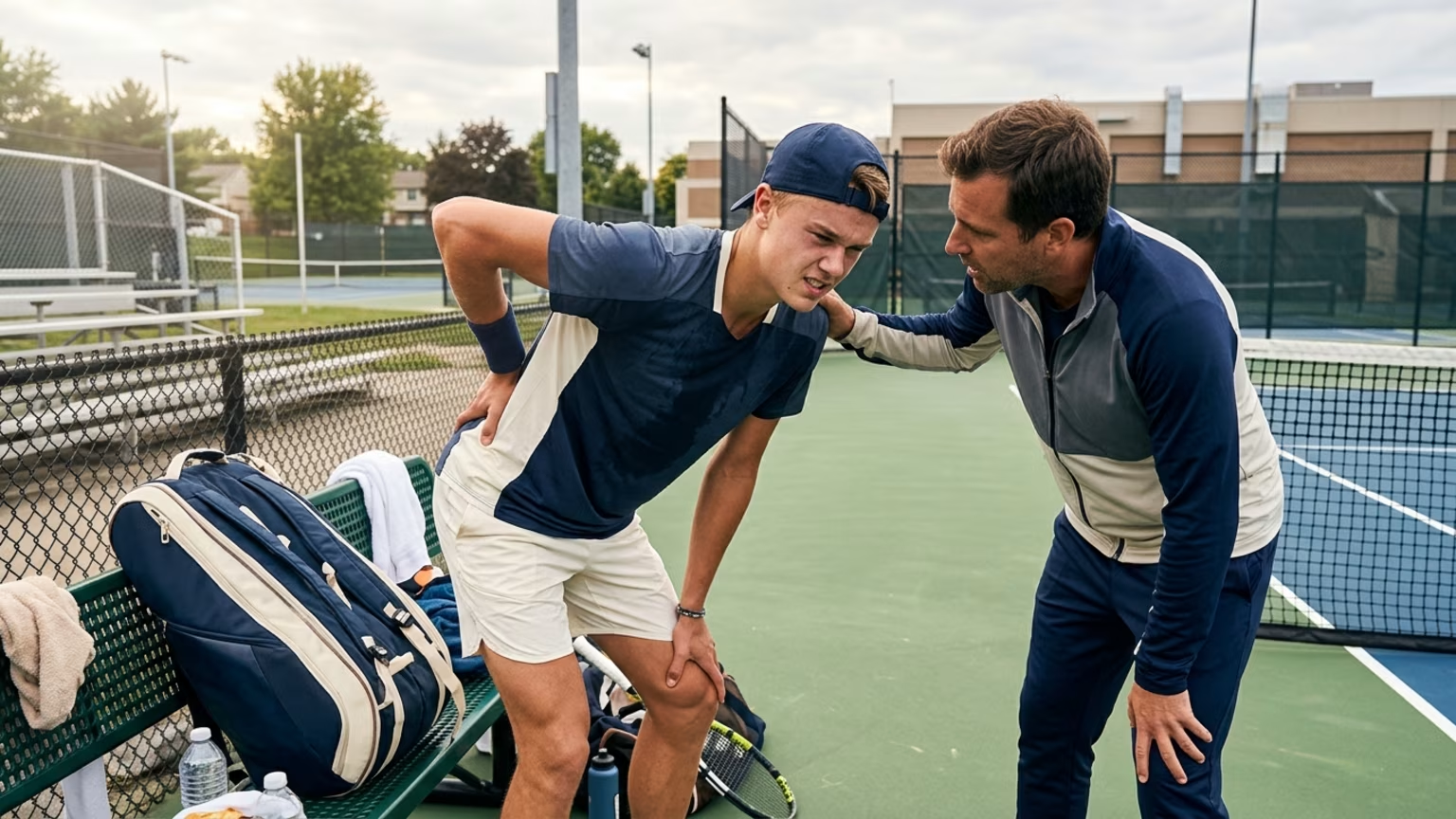
Holger Rune withdrew from the European Open with a back problem. The facts behind his decision and a grounded perspective for recreational players.

The Dink’s October 17 guide emphasizes deep returns, ball-height decisions and positioning against faster pickleball opponents.

A new report outlines padel and tennis gear trends. Learn how to assess adjustable rackets, sensor feedback and smart-court claims.
Read practical guidance for better movement, smarter preparation and a game that keeps working for you.
explore the Blog
