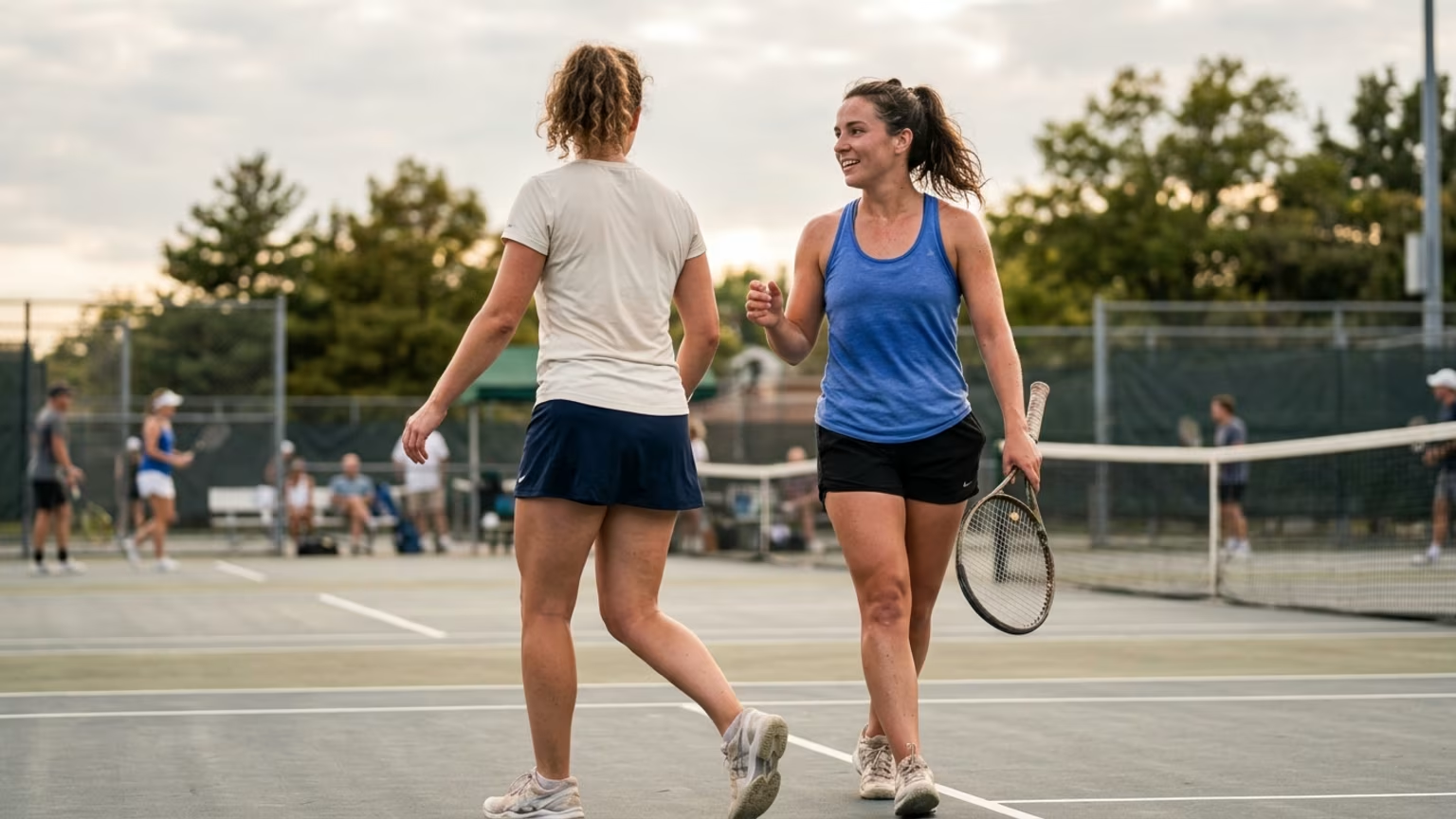

Master the unwritten rules of adult doubles across tennis, pickleball, and padel with practical communication strategies and evidence-backed teamwork habits.




In a 2026 study of pickleball-related injuries, researchers reported that 38.1% of participants experienced at least one injury during the preceding 12 months. This statistic highlights a practical reality of court sports where two people share the same fast-paced space. When partners fail to communicate their movements clearly, the resulting confusion creates physical risks and leads to preventable lost points.
The broader challenge across racquet sports involves partners coordinating decisions, expectations, and emotional responses in real time. On August 10, 2026, researchers published a multidimensional model examining athletes' commitment to interdependent sport teams. This recent publication emphasizes that performance in team settings relies heavily on structured social architecture. Padel and pickleball specialists consistently point out that players must establish pre-point planning to avoid costly on-court confusion.
Team GB padel coach Ben Farquharson recently advised players to treat their partner exactly as they would want to be treated. He stressed the importance of communicating about tactics not only during points but also in the moments between them. Doubles is inherently interdependent, meaning any hesitation or duplicated movement can quickly leave the open court vulnerable. Players must decisively choose who takes middle balls, defensive lobs, wide shots, and accessible balls.
The continuing growth of organized competition creates more situations where partners must align on specific standards before play begins. Players need to agree on their scoring format and specific service order before the match starts. They must also align on their intended court position, tactical risk levels, and preferred communication style. A partner who makes numerous errors is not necessarily a poor partner, as their mistakes can reflect unfamiliar court positioning or a mismatched skill level. A technically stronger player is also not automatically the better partner if they lack emotional steadiness and basic punctuality.
Punctuality acts as a fundamental form of respect and a highly practical necessity for safe recreational play. Arriving early allows partners to confirm the exact match format, discuss serving orders, and complete a progressive physical warm-up. For older players managing their athletic longevity, rushing directly into competitive points is a terrible substitute for preparing the lower extremities and joints. Ensuring adequate preparation time helps directly mitigate the injury risks associated with sudden, aggressive competitive movements.
Elite racquet sport competitors build their structured positioning and movement habits through daily practice. High-performance sport research identifies competitive cohesion and psychological safety as features associated with athlete thriving. The same research points to compassion, transparent communication, and collaboration as vital elements for team success. A 2026 study of collegiate soccer players also found that intrateam communication mediated the relationship between transformational leadership and team commitment. Adult recreational players rarely have the time to develop such deep organizational frameworks or complex leadership structures.
Weekend league participants must instead rely on practical, immediate agreements to manage their shared court space effectively. The most useful strategy for amateur partners is agreeing on the partnership parameters before hitting the first ball. Players should use a brief conversation to settle who serves first, which side each prefers, and who covers lobs. Padel coaching guidance commonly recommends that partners advance and retreat together to maintain similar spacing.
One of the most heavily debated topics in recreational play is who should cover the center of the court. Pickleball guidance offers a specific decision hierarchy for this exact situation. This framework may prioritize the player with the stronger forehand, the player actively moving toward the ball, or whoever reads the shot first. Padel guidance similarly recommends agreeing in advance on who covers the middle, proving that there is no universal right answer. The correct choice always depends on handedness, court positioning, and the pair’s tactical plan.
During a fast-paced rally, players have fractions of a second to decide who takes a middle shot. Padel guidance recommends using clear directional calls to manage these split-second decisions. These calls include the words "mine", "yours", "leave it", and "out". These words must be delivered loudly and early enough to affect the play. A specialist padel communication guide recommends using five-second tactical conversations between points to establish a clear system for shared tactics.
With a new partner, players should over-communicate initially to establish their preferred tactical rhythms. Advice can easily become counterproductive when it is unsolicited, vague, or emotionally loaded. The available pickleball guidance says that successful partners acknowledge messages and establish expectations before any problems occur. Feedback should describe the next necessary action rather than diagnose a partner’s technical ability or character.
The physical case for continuing to play doubles is strongly supported by recent intervention data. A 2026 study listed by the Chinese University of Hong Kong reported that an eight-week pickleball intervention reversed pre-frailty in its study population. The same eight-week program successfully improved functional fitness and enhanced quality of life for the participants. For older adults, the social and interdependent format of doubles provides a highly compelling way to maintain athletic longevity.
The ITF World Tennis Masters Tour actively supports this format by offering doubles events across age increments from 30-plus through 90-plus. Further supporting the value of racquet sports, distinct observational research has shown powerful associations with long-term health. A 2018 British Journal of Sports Medicine study associated racquet-sport participation with a 59% lower risk of cardiovascular-disease mortality. The identical study also reported a 47% lower risk of all-cause mortality compared to sedentary behavior.
Maintaining these robust health benefits requires players to manage their physical workload intelligently on the court. In traditional pickleball scoring, the serving team changes sides after winning a point while serving. USA Pickleball instructional material emphasizes communication and shared responsibility when retrieving defensive lobs. Clarifying these movement roles helps partners avoid unnecessary sprinting and reduces the immediate risk of collisions.
Reviewing practical safety and injury prevention methods ensures both players can compete comfortably throughout the entire season. Stacking is a legal pickleball doubles tactic where partners arrange themselves to preserve preferred court sides. Because this arrangement can be confusing, partners must use clear signals to satisfy formal serving and receiving-position requirements. Tennis has its own formal procedures, and USTA guidance notes that an incorrect receiving order remains in place until the game ends.
Looking ahead to the next season of local competition, structured expectation setting will become standard practice among recreational players. As formal instructional guidance from organizations like USA Pickleball expands, amateur teams will increasingly adopt explicit tactical frameworks. Players will realize that discussing who covers the middle or how to handle lobs is not an overly serious endeavor. Instead, it is a highly practical requirement for a safe and physically rewarding recreational session.
Finding a compatible teammate will continue to matter more than simply finding the most athletic individual available. Players who want to learn how to select a suitable teammate should prioritize clear communication and shared expectations above pure shot power. A partner who calls shots early and moves collectively with the pair is infinitely more valuable than a silent player. By establishing a shared vocabulary and respecting sport-specific rotations, adult players can build sustainable partnerships that last for years.
The social payoff of these habits matters significantly for long-term participation in any court sport. Research on high-performance sport environments clearly links transparent communication with athlete thriving. While that specific evidence comes from broader sporting contexts, the core psychological principles translate perfectly to adult recreational doubles. Players who feel respected and clearly directed by their partners are far more likely to continue returning to the court week after week.
The 38.1% injury prevalence seen in recent pickleball research serves as a final, critical reminder of why coordination matters. When partners speak clearly and move as a connected unit, they actively protect their health and improve their match results. Good doubles is simply a continuous conversation that happens both during the rally and in the spaces between the points.
Follow Evercourts for practical insights on tennis, pickleball and padel performance, movement, recovery and healthy ageing. Stay connected for new articles, research-led guidance and ideas to help you play well and keep playing for years.


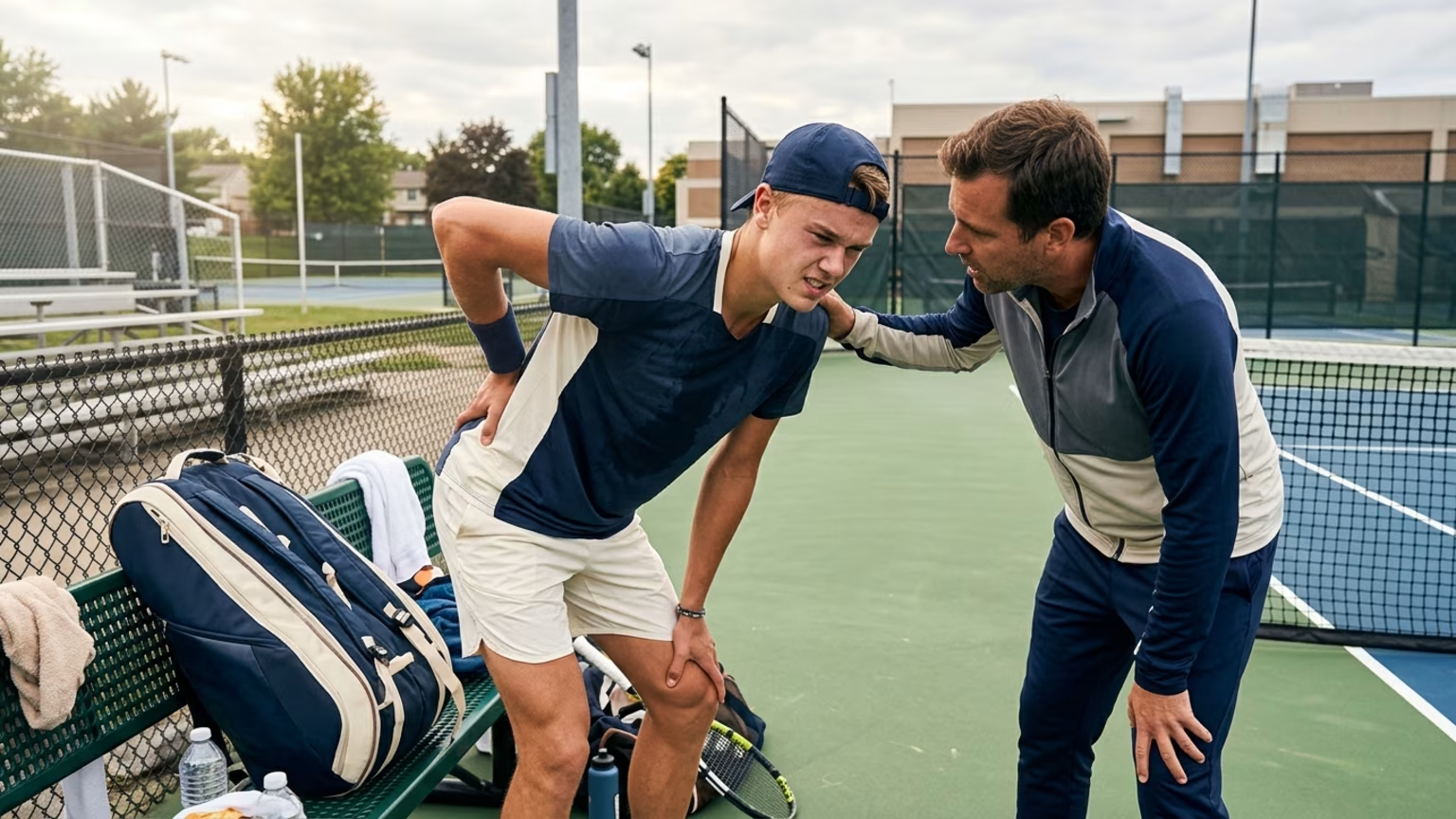
Holger Rune withdrew from the European Open with a back problem. The facts behind his decision and a grounded perspective for recreational players.

The Dink’s October 17 guide emphasizes deep returns, ball-height decisions and positioning against faster pickleball opponents.

A new report outlines padel and tennis gear trends. Learn how to assess adjustable rackets, sensor feedback and smart-court claims.
Read practical guidance for better movement, smarter preparation and a game that keeps working for you.
explore the Blog
