

Use tennis movement demands to guide flexible strength priorities, adjust gym work around court play, and recognize when to seek qualified advice.




Off-court strength training is resistance work done away from the court to develop your ability to produce and control force. For tennis players, a useful image is the stop before the next stroke: arriving at the ball is only part of the movement.
Tennis conditioning sources describe repeated acceleration, braking and changes of direction. They also describe strokes that use connected movement through the body. Those demands give strength work a clearer purpose than simply lifting more weight.
The useful question is which movement qualities deserve attention alongside your tennis. Lower-body control belongs in that conversation. So do trunk capacity and upper-body work that suits your shoulders. Together, they provide a framework for choosing exercises without turning the gym into a separate competitive sport.
A coaching-focused article in World Tennis Magazine highlights braking as an off-court priority. Its argument is straightforward: repeated stops and direction changes deserve attention alongside acceleration.
The article emphasizes eccentric control. In plain language, that means controlling force while a working muscle lengthens. It points to slow, controlled single-leg work as one way to address that quality.
That changes how an exercise can be judged. The amount of resistance matters less than whether the exercise addresses the intended movement quality. In this coaching framework, a controlled lowering phase has a purpose beyond making the exercise feel harder.
For tennis, the connection is repeated lateral movement and braking before another action. For pickleball and padel, the practical application is to examine those same qualities within each sport's repeated quick efforts and direction changes. The exercise choice should follow the movement demand rather than the sport's name alone.
A useful off-court discussion therefore includes both producing movement and controlling it. Thinking only about the first step leaves out the stop that follows.
A published summary of a 2026 systematic review and network meta-analysis reports findings from 20 tennis studies involving 606 players. It says resistance training, plyometric training, core training and multimodal training improved serve velocity relative to regular tennis practice.
The summary did not establish significant differences in serve accuracy or upper-body power. That distinction matters: a faster serve is a particular result rather than evidence that every aspect of tennis performance improved.
These findings concern serve performance and upper-body power. They do not establish improved match results or a universally best program. They also do not prove injury prevention or longer participation, and their application specifically to older recreational players remains unestablished. Applying this tennis evidence to pickleball or padel is a practical interpretation rather than a direct research finding.
The programming advice comes from a different evidence category. World Tennis Magazine's braking discussion and the tennis conditioning guide are practitioner guidance rather than trials of a longevity program. The available material also does not establish an ideal weekly schedule.
The practical message is still useful. Several training approaches have evidence for a specific tennis outcome. Exercise selection can then be organized around relevant movement demands without presenting a single approach as the answer for everyone.
For an adult player, athletic longevity is a sensible aim for training rather than an outcome to promise. Understanding court demands helps make that aim concrete: identify the qualities the game asks of you and give them a place in off-court planning.
The conditioning guide recommends choosing movement patterns to suit the player. Its examples include squat and hinge patterns alongside single-leg work. It also includes upper-body pushing and pulling plus trunk control.
Use those categories as a menu for discussion with a qualified coach or physiotherapist. They are more adaptable than copying an exercise list without considering your court workload or current needs.
Squat and hinge patterns provide categories for organizing lower-body strength work. Single-leg patterns offer another option within that framework. The selection can reflect the player's needs rather than a requirement to include every category in every session.
The braking emphasis adds a separate question: does the chosen work include attention to control? World Tennis Magazine's recommendation for slow single-leg work is one coaching answer. The important editorial distinction is that the purpose is controlled movement, not simply collecting more exercises.
Controlled lateral or braking work also fits this movement-based approach. Its place should follow the player's demands and the wider training plan rather than an assumption that every session needs to reproduce a rally.
The tennis sources describe strokes as connected actions through the body's kinetic chain. Put simply, that means movement involving linked body regions rather than the hitting arm acting alone.
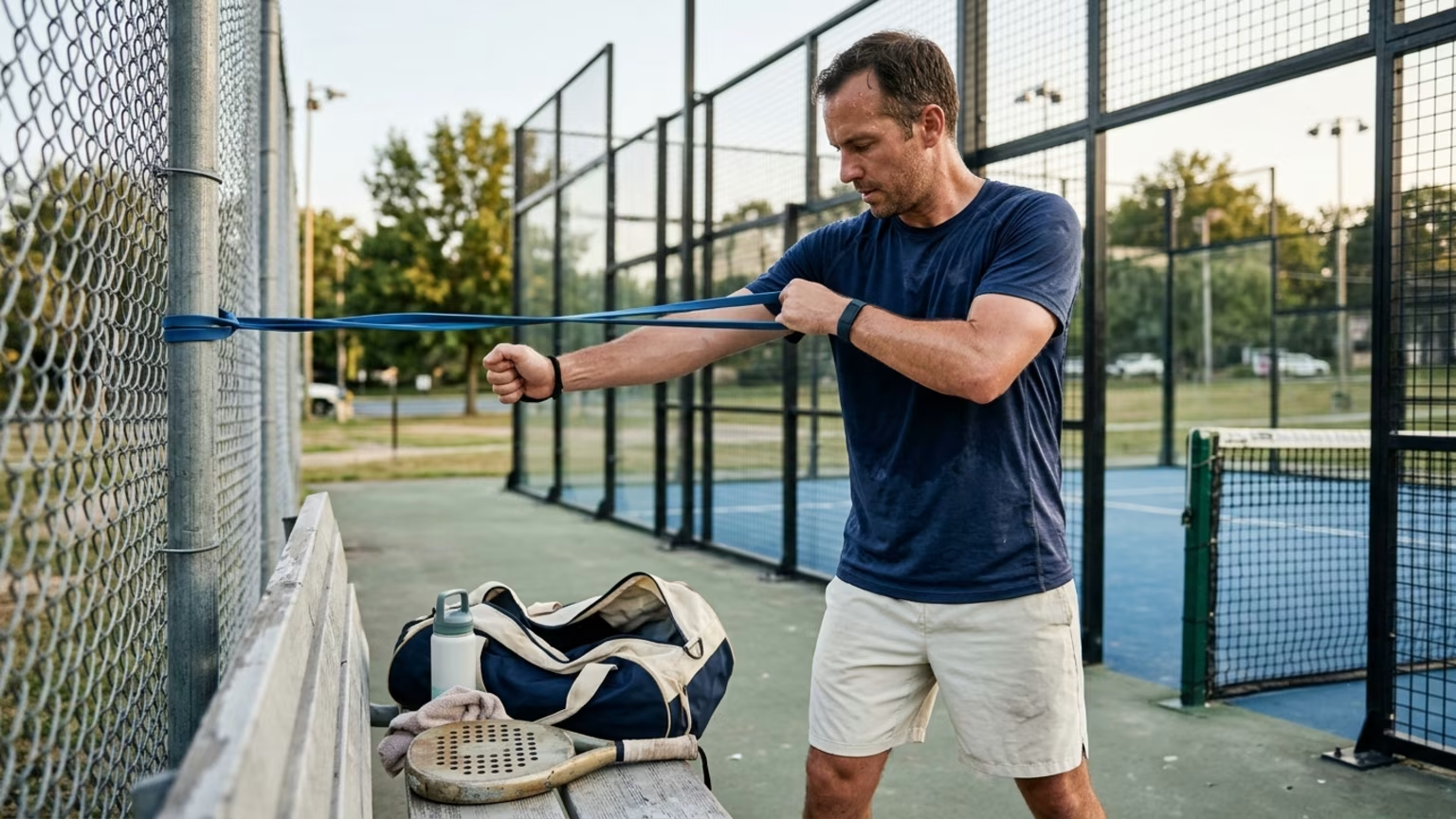
Trunk control and rotation therefore belong in the planning conversation. So do upper-body push and pull patterns selected around shoulder tolerance. This keeps the discussion broader than either leg strength alone or isolated work for the serving arm.
These priorities sit alongside the wider question of building capacity beyond match play. The useful connection is between what happens on court and what the off-court session is intended to train.
The conditioning guide recommends establishing movement quality before increasing resistance. That offers a clear organizing principle without requiring a particular weight or progression timetable.
In practice, the conversation starts with the intended pattern and how it is performed. Adding resistance comes within that context. A heavier version is not automatically a better choice for the purpose of that session.
Scheduling belongs in the same conversation as planning around court demands. The conditioning guide advises reducing gym volume around tournaments and heavy match weeks. It also includes long practice blocks among the reasons to trim that workload.
That makes the court calendar relevant to strength planning. A demanding tennis week should prompt a review of the gym plan rather than an automatic attempt to complete an unchanged workload.
For players thinking about years of participation, this is a constructive perspective. Strength work has a role within court life. Its purpose is to address relevant physical qualities while leaving room to adjust as playing demands change.
Recurring pain or stiffness that changes how you move is a reason to consult a qualified physiotherapist or healthcare provider. Seek individual advice when discomfort limits your usual court play or repeatedly makes a chosen exercise uncomfortable. An existing health concern that leaves you unsure about training choices also deserves a personal discussion.
Useful details to bring include which movements are uncomfortable and how your court workload has changed. Describe what happens rather than trying to name the problem yourself.
Return to the image of stopping before the next stroke. The aim is controlled movement that serves your game. If pain is changing that movement, qualified assessment matters more than finding another exercise.
Follow Evercourts for practical insights on tennis, pickleball and padel performance, movement, recovery and healthy ageing. Stay connected for new articles, research-led guidance and ideas to help you play well and keep playing for years.


Balance for tennis, pickleball and padel, with controlled off-court practice ideas, research context and signs to seek professional advice.
Understand padel shoulder demands, gradual preparation and workload management, plus the recurring symptoms that call for qualified advice.

Understand the whole-body demands of tennis serving, put serving volume in context and recognise shoulder symptoms that need professional care.
Read practical guidance for better movement, smarter preparation and a game that keeps working for you.
explore the Blog
