

A grounded look at pickleball movement demands, gradual preparation and why recreational games do not need to become fitness tests.




Pickleball movement capacity is the ability to start, stop and change direction to reach a shot and prepare for the next one. It is about managing the movement a point asks for, not simply covering a large distance.
According to Quartz, a standard pickleball court measures 20 by 44 feet, or 880 square feet. Those dimensions describe the playing area. They do not describe the sequence of movements within it.
A player can move sideways near the kitchen or travel forward and back as a point develops. The practical question is whether preparation reflects those patterns. A compact court is not a reason to overlook movement preparation or to assume that every game provides the same physical challenge.
The Butler Eagle account of a movement-focused pickleball project describes repeated lateral movement near the non-volley zone, along with forward-and-back movement. A small playing area still leaves room for repeated changes in position.
A useful way to understand that demand is to separate three tasks:
The sideways movement near the kitchen makes this sequence particularly relevant. Reaching one position does not end the movement task if the next shot asks for movement elsewhere. Preparation based only on distance leaves that part of the game out of the picture.
For tennis and padel players, the same movement lens is useful: consider repeated explosive efforts and direction changes when thinking about preparation. Here, pickleball provides the specific example. The useful question is how preparation relates to the actions of a point rather than how impressive a workout looks away from the court.
In its report on FITTER Pickleball, Butler Eagle described how exercise-science professor Michael Holmstrup and player Gino Cicconi considered 13 shots and their associated movements. They used those observations to select exercises intended to resemble actions seen in play.
Holmstrup described using “large movements that mimic what’s really happening in pickleball.” The report included compound exercises and stretching chosen around common movements. For side-to-side work, his message was gradual progression: “You gradually build up range of motion and intensity moving side to side.”
The useful idea is the connection between a recognizable court action and its preparation. Lateral movement near the kitchen informed the exercise selection. That provides a specific rationale for choosing movements rather than selecting work simply because it feels demanding.
A secondary summary of recreational-player research reports 3,322 steps per hour in singles and 2,791 in doubles in one study. It also notes that fitness and rally length affect the activity experience. Rest periods and competitive intensity matter too.
Keep the evidence boundaries clear:
Within those boundaries, the practical message is straightforward: preparation can be organized around recognizable court movements, with side-to-side range and intensity developed gradually.
For adult players, athletic longevity gives movement preparation a clear purpose. The aim is to keep participating in an enjoyable sport while paying attention to what its movements require. That is a more useful editorial focus than treating exhaustion as the measure of a worthwhile session.
The reporting supports several principles for thinking about preparation.
The FITTER example began with shots and their associated movements. Controlled lateral movement and forward-and-back movement belong in that discussion because they resemble the reported actions of play.
This keeps the conversation connected to the court. Instead of asking only whether an exercise is difficult, the more relevant question is which movement task it is intended to prepare. Our look at connecting shot patterns with movement practice develops that movement-first perspective.
Holmstrup’s advice centered on gradually building side-to-side range and intensity. The practical emphasis is progression that remains connected to a recognizable movement task.
That is different from making the largest movement or hardest effort the automatic goal. In this approach, the reason for progressing is to prepare for the movement being considered. Difficulty alone does not explain why a particular exercise belongs in a pickleball preparation plan.
A recreational game can remain a recreational game. The FITTER example treats targeted preparation as something that can be considered separately, rather than assuming match play addresses every physical need.
The activity summary also gives players a reason to consider the session in context. A game’s format and conditions belong in that conversation alongside the player’s fitness. That perspective is useful when adapting preparation between singles and doubles, without turning either format into a fixed workload label.
For healthy aging, the practical value is having a clear question to return to: which movements matter to the game a player wants to keep enjoying? That question gives preparation a purpose beyond simply doing more. It also leaves room for social play and deliberate conditioning to have different roles.
Pain, health concerns or a substantial period away from sport are reasons to consult a qualified physiotherapist or healthcare provider before treating a training example as a personal plan. Those circumstances call for advice suited to the individual.
If pain is part of the movement a player wants to improve, the conversation needs to go beyond choosing an exercise that resembles a shot. A news account cannot provide an individual assessment. Describing the movement that feels difficult and the demands of usual play can help keep that conversation grounded in the sport.
The purpose of preparation is not to make every session harder. It is to keep the movements of the game part of a life that still has room for the court.
Follow Evercourts for practical insights on tennis, pickleball and padel performance, movement, recovery and healthy ageing. Stay connected for new articles, research-led guidance and ideas to help you play well and keep playing for years.


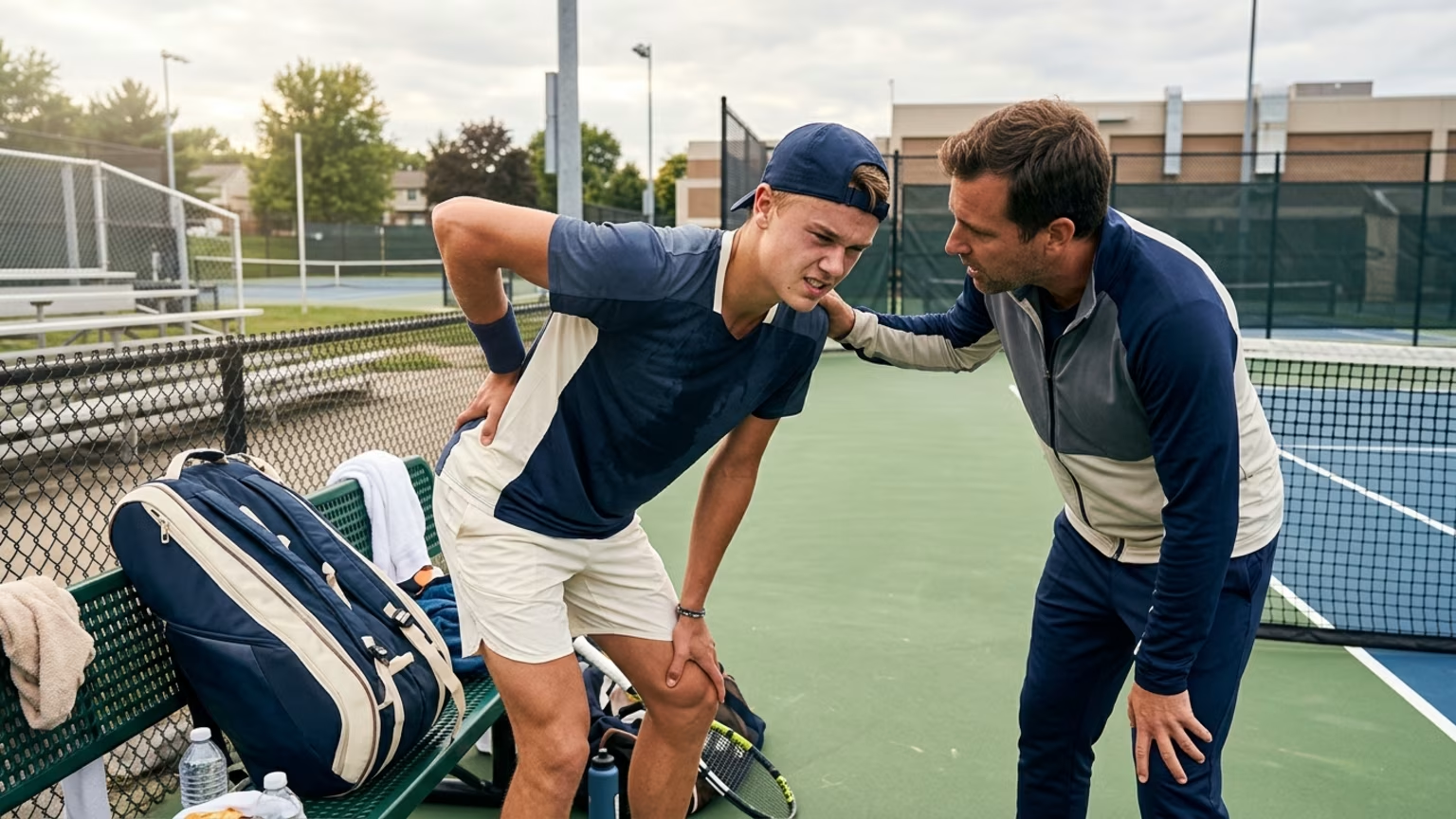
Holger Rune withdrew from the European Open with a back problem. The facts behind his decision and a grounded perspective for recreational players.

The Dink’s October 17 guide emphasizes deep returns, ball-height decisions and positioning against faster pickleball opponents.

A new report outlines padel and tennis gear trends. Learn how to assess adjustable rackets, sensor feedback and smart-court claims.
Read practical guidance for better movement, smarter preparation and a game that keeps working for you.
explore the Blog
