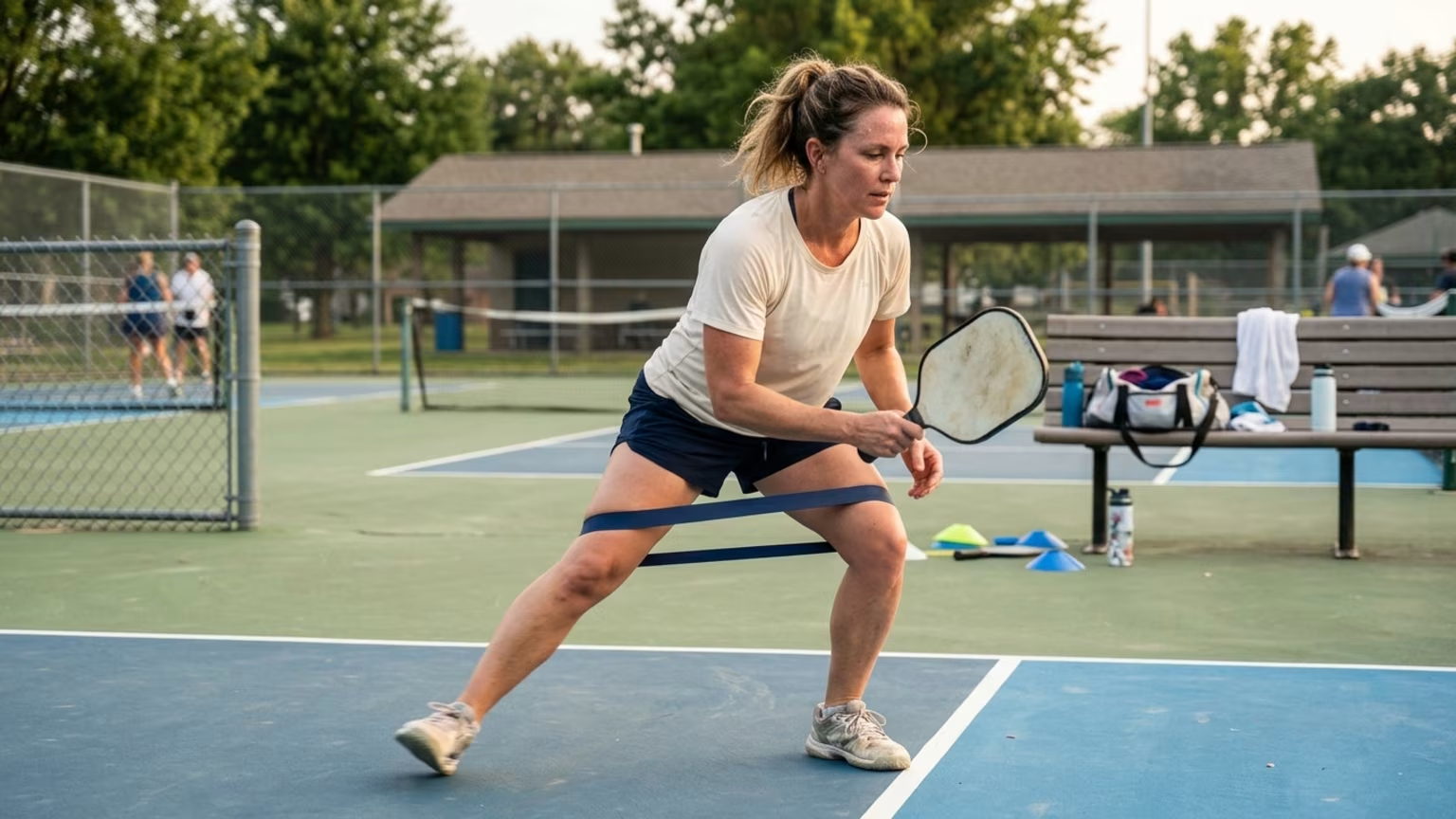

Connect pickleball movements with hip, leg, calf and trunk exercises, gradual progression and signs that call for professional guidance.




Court-movement strength is the capacity of your hips, legs, calves and trunk to support the movements you use during play. For pickleball, that means thinking about side steps and lunges as well as reaching for a shot and returning to a ready position.
Strength work and court skills are related but different. A controlled split squat resembles part of a lunge, while getting back into position remains a skill to practise on court. The exercise provides a way to work on physical capacity rather than a replacement for movement practice.
A useful plan therefore starts with a movement question: which areas are involved in the actions you repeat? The exercise menu below connects those areas with options from published pickleball guidance. It is a starting framework to adapt, not a requirement to complete every exercise.
Pickleball involves repeated lateral movement near the kitchen line. In a report from the Butler Eagle, a pickleball training project described selecting exercises to resemble that side-to-side movement and common shot patterns. The approach broke shots down into joint movements before making exercise and stretching recommendations.
As a practical interpretation, repeated explosive efforts and changes of direction make strength relevant across tennis, pickleball and padel. The question is not simply whether a player can hold a position. It is how that position relates to moving, reaching and preparing for the next shot.
The movement reference can differ by sport:
Within that framework, hips and legs relate to side steps and lunges. Calf work relates to push-off, while trunk work relates to control during reaching. These are movement parallels rather than a claim that one exercise reproduces an entire rally.
For a broader discussion of the skill itself, see our guide to moving with purpose on court.
In a 2024 University of Arkansas study, Jones and Hammig analyzed pickleball-related injuries using the U.S. National Electronic Injury Surveillance System, known as NEISS. Its abstract reported activity-related overuse among players aged 26-50 and greater cardiovascular concerns among players over 50. The authors encouraged pickleball as physical activity while recommending age-specific precautions.
The evidence has distinct limits. The injury study describes patterns rather than testing a strength routine. The clinic recommendations below are practice guidance, while the training-project report provides a movement rationale rather than measured outcomes. None establishes that this exact exercise combination improves speed or reduces injury rates, and there is no validated set-and-repetition prescription for it.
With those boundaries established, the sources provide a useful exercise menu and a clear principle: gradual strengthening within a controlled, tolerable range.
One clinic's pickleball exercise guidance lists glute bridges, side steps, step-ups and controlled split squats for hip and leg strengthening. These are options to select from when building a plan, rather than a mandatory sequence.
Side steps have an obvious movement connection with lateral shuffling. Controlled split squats relate to a lunge or split stance. Bridges and step-ups provide additional ways to include hip and leg work without asking every exercise to look exactly like a pickleball shot.
The clinic guidance recommends progressing calf raises from double-leg to single-leg work. Double-leg calf raises provide the starting version described in the source. Moving toward single-leg work is presented as a progression when the movement remains comfortable and controlled.
The court connection is push-off. That gives calf strengthening a place in the framework without turning the exercise into a promise of quicker footwork.
Bird-dogs, dead bugs and planks are among the clinic's suggested exercises for the trunk and lower-back region. They offer different options for including trunk work alongside the hip and leg exercises.
The practical connection is control while reaching. A player still needs to practise the timing and positioning of a shot on court. Trunk strengthening belongs alongside that practice rather than standing in for it.
For someone returning after a long break, a lower-demand starting menu could include bridges, supported step-ups and double-leg calf raises. A trunk exercise from the listed options could complete the framework. This is a cautious editorial adaptation of the exercise list, with support added to the step-up as a starting option.
Side steps and controlled split squats remain other choices when shaping the plan. Exercise selection should reflect the player's current movement and health context rather than pressure to include everything.
The clinic advises gradual progression, particularly for people who have been sedentary or recently increased their court time. The useful benchmark is whether movement stays controlled and tolerable. Personal loading decisions belong with a qualified professional when pain, balance concerns or health conditions complicate the choice.
For athletic longevity, the practical value is having a way to organize preparation around the actions you want to keep doing. Instead of collecting unrelated exercises, a player can connect each choice to lateral movement or lunging. Calf and trunk work round out that movement-based framework.
This also keeps strength work in perspective. Returning to ready position is a court skill that the exercises may support, not an exercise outcome to assume. Confidence in that movement includes the practice of getting there as well as the physical preparation behind it.
The clinic's emphasis on gradual progression is especially relevant when court participation changes. A return after a break or a recent increase in playing time is useful context when discussing a strength plan. The starting point can be adjusted without treating that adjustment as a setback.
Our guide to fitting strength work around court time provides a broader planning perspective. The goal here is simpler: give strength work a clear purpose while keeping individual needs central.
A qualified physio or healthcare provider is appropriate when an exercise menu is no longer enough to answer a personal question. Relevant reasons to seek individualized guidance include:
For people at risk of heart conditions, Jones and Hammig specifically recommended physician approval. That recommendation concerns cardiovascular risk rather than age alone. Their overall message remained supportive of pickleball participation.
Today, if persistent pain or balance concerns are affecting your movement, arrange a review with a qualified physio or healthcare provider.
Follow Evercourts for practical insights on tennis, pickleball and padel performance, movement, recovery and healthy ageing. Stay connected for new articles, research-led guidance and ideas to help you play well and keep playing for years.



Holger Rune withdrew from the European Open with a back problem. The facts behind his decision and a grounded perspective for recreational players.

The Dink’s October 17 guide emphasizes deep returns, ball-height decisions and positioning against faster pickleball opponents.

A new report outlines padel and tennis gear trends. Learn how to assess adjustable rackets, sensor feedback and smart-court claims.
Read practical guidance for better movement, smarter preparation and a game that keeps working for you.
explore the Blog
