
Understand braking, balance and direction changes in racquet sports, with evidence-aware practice ideas and guidance on when to seek professional advice.




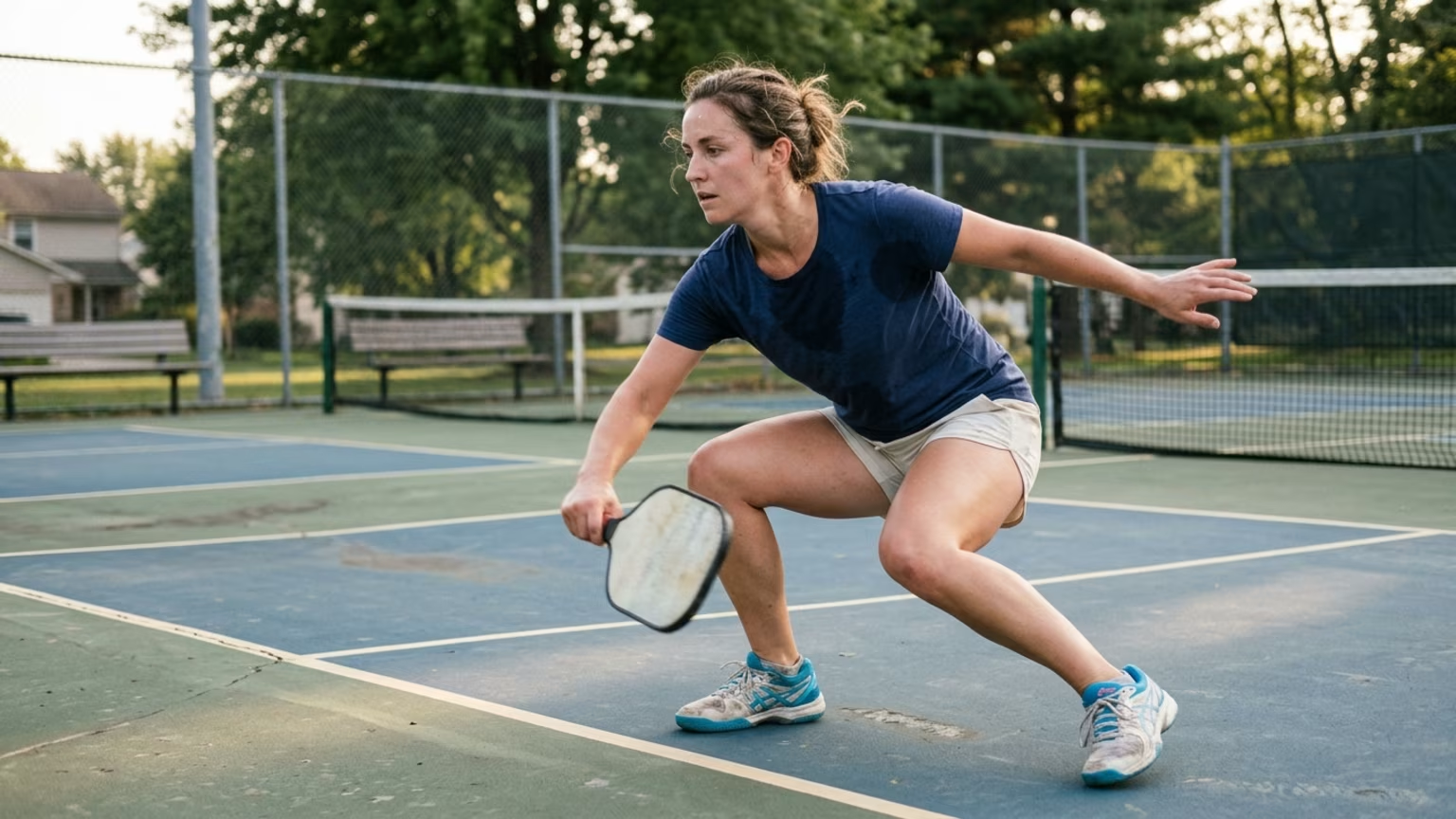
Deceleration means slowing your body down so you can stop or change direction under control. Picture a sideways step toward the ball. Getting there is only part of the task: you also have to manage the stop and organise the next push.
That middle part deserves attention. A player can practise moving quickly without giving the same thought to how the movement finishes. For adult tennis, pickleball and padel players, braking offers a useful way to think about court movement beyond foot speed alone.
The practical question is not simply, “How quickly can I reach the ball?” It is also, “How well can I control my arrival and move again?”
Tennis, pickleball and padel involve repeated explosive efforts and changes of direction. Each new movement asks more than another quick start. There is also speed to manage before moving somewhere else.
A tennis-training practitioner writing about mature players describes deceleration as a combination of strength, balance, coordination and eccentric control. In plain language, that last term concerns muscular control during the slowing phase rather than only the push that gets you moving.
The court context gives that idea different settings:
These examples shift the focus from busy feet to a complete movement. Speed matters, but it is not the only quality worth practising.
Our broader discussion of movement into and out of a shot provides another way to consider that whole sequence.
According to a secondary evidence brief, a 2022 PeerJ study examined how lower-limb eccentric muscle capability relates to change-of-direction speed in tennis and basketball players. That makes braking-related capability a relevant research question rather than merely a coaching preference.
Separately, tennis exercise guides list split squats, lateral band walks and controlled lateral bounds as examples addressing lower-body strength and movement control. They frame controlled landing and balance as useful parts of lateral movement training.
The evidence needs a clear boundary. An association study does not prove that a particular exercise improves court movement or prevents injury. Coaching examples and clinic advice are not validated return-to-play programmes, and these sources do not establish a universal training dose or longer playing career. The progression below is an editorial synthesis of their examples and advice rather than a tested protocol.
The starting theme is controlled lateral and single-leg strength. Split squats and lateral band walks are examples offered by the tennis training resource, not a compulsory exercise list for every player.
Their place in this discussion is straightforward: preparation can address strength and control rather than consist entirely of faster footwork. For someone building court activity again, that distinction makes the training conversation more useful than simply asking for greater speed.
A practical question for a coach or qualified physio is which examples fit the player's current situation. This article supplies the categories to discuss, not an individual exercise prescription.
The next theme is stopping and holding balance. Controlled lateral bounds appear in the tennis exercise guidance as one example of lateral movement and landing work.
Useful editorial cues include “land under control” and “hold the stop.” They direct attention toward the finish of a movement instead of treating the landing as an unimportant gap before the next repetition.
The held stop is a practice idea, not a demand to pause during every rally. It creates a simple distinction between arriving somewhere and being organised enough to move again. For related context, consider how balance changes during court movement.
The final theme is faster, more court-like changes of direction. Here the focus returns to the complete sequence: move, manage the stop and push away again.
“Push off only when balanced” is a useful cue for controlled practice. It keeps the next acceleration connected to the quality of the preceding stop. It should not be mistaken for an instruction to freeze during a live point.
This is also where the original question becomes more specific. Instead of asking whether the feet look quick, consider whether the player is practising both sides of the direction change. The move into the stop deserves attention alongside the move out of it.
For adult players, athletic longevity is a reason to think beyond the next match. Understanding braking gives strength, balance and movement control a place in that longer view. It also provides a clearer language for discussing preparation with a coach or healthcare professional.
Returning to court activity adds another consideration: how much playing time sits alongside that preparation. A foot-and-ankle clinic's pickleball guidance recommends shorter sessions and rest days for new or returning players. It also includes balance work and heel raises among its suggested preparations.
The practical message is to rebuild court time gradually rather than immediately resume frequent or long sessions. Recovery between sessions belongs in that discussion too. For tennis and padel players, gradual rebuilding is an editorial planning principle here rather than a claim that the pickleball advice has been tested across all three sports.
There is no need to make every practice a test of maximum quickness. A session can have a clear movement theme, such as controlled stopping, without treating speed as the only measure of worthwhile work.
That perspective respects experience rather than assuming that every adult player needs the same starting point. The useful goal is preparation that makes sense for the person and the court activity they want to maintain.
Recurring aches or stiffness that keep changing how you stop are reasons to consult a qualified physio or healthcare provider. So are symptoms that repeatedly interrupt your attempts to rebuild court activity. Questions about pain during an exercise belong in that conversation rather than being settled by a generic drill description.
Describe the movement that concerns you and how it affects your play. If you are unsure whether a suggested exercise suits your situation, seek individual advice before using it as a progression.
Return to that sideways step toward the ball. The aim is not simply to arrive faster. When aches or stiffness are changing the way you arrive, the next useful move is a conversation with a qualified professional rather than another speed drill.
Follow Evercourts for practical insights on tennis, pickleball and padel performance, movement, recovery and healthy ageing. Stay connected for new articles, research-led guidance and ideas to help you play well and keep playing for years.


Holger Rune withdrew from the European Open with a back problem. The facts behind his decision and a grounded perspective for recreational players.

The Dink’s October 17 guide emphasizes deep returns, ball-height decisions and positioning against faster pickleball opponents.

A new report outlines padel and tennis gear trends. Learn how to assess adjustable rackets, sensor feedback and smart-court claims.
Read practical guidance for better movement, smarter preparation and a game that keeps working for you.
explore the Blog
