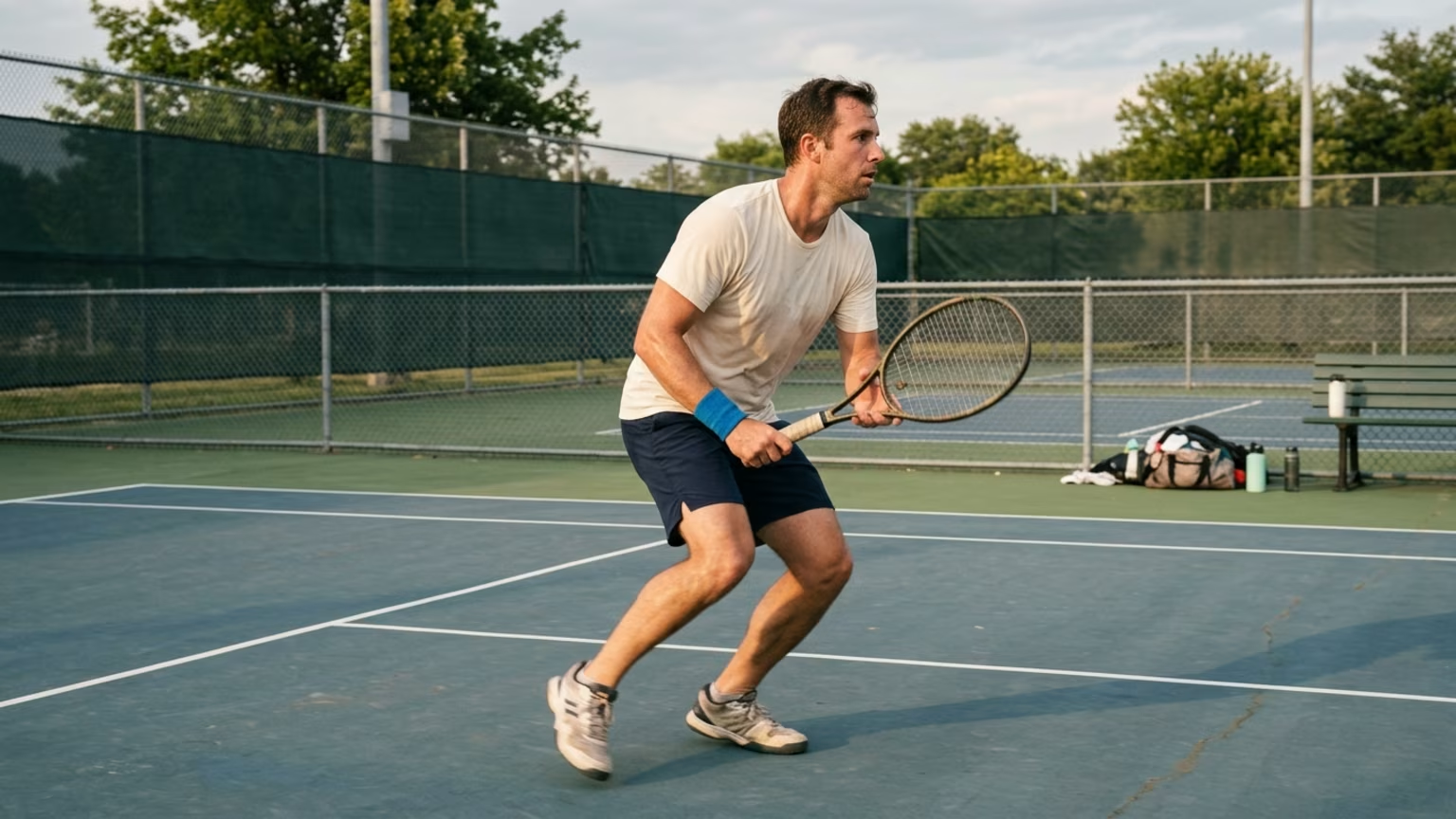

Understand anticipation, split-step timing and recovery through controlled tennis and pickleball practice ideas, without promises of faster reflexes.




Anticipation is using an opponent’s preparation and the ball’s early flight to get ready for your next move. It is not the same as guessing where the ball will go. The useful skill is gathering information while keeping your movement ready to change.
A first step also belongs to a longer sequence: preparation, movement toward the ball, the stroke and recovery. Coaching material for tennis and pickleball treats these as connected actions. That gives adult players a more practical focus than trying to produce a faster reflex in isolation.
Tennis, pickleball and padel repeatedly ask players to start moving and change direction. Each explosive effort is followed by another positioning problem. Being quick toward one ball is only part of the task; the next exchange asks whether you are ready to move again.
In tennis, a footwork coaching article connects the split step with movement toward the ball and recovery after the stroke. It also includes shorter adjustment steps near the hitting position. The emphasis is on the whole sequence rather than the first burst alone.
Pickleball creates a different positioning task when advancing toward the kitchen line. The Dink’s senior-player guidance recommends moving forward in stages: advance, split step, respond and then advance again. That approach treats readiness for the next ball as part of forward progress.
For padel, keep the discussion at the level of movement questions rather than importing a tennis or pickleball formula. Where does your first movement leave you? What happens after your shot? Those questions fit a broader look at connecting preparation with recovery in padel.
The evidence here is mainly coaching material rather than a systematic research review. It provides direct guidance for tennis and pickleball but does not establish a padel-specific method. It also does not demonstrate that these drills improve everyone’s reflexes, prevent injuries or extend playing careers.
A tennis coaching explainer discussing anticipation research reports an important distinction. Under the most representative first-serve conditions, a review did not find consistent evidence that experts began moving toward the eventual serve direction before racket contact. Reading the game therefore need not mean committing to a direction early. Information continues to arrive around contact and during early ball flight.
Split-step timing also deserves more care than a single slogan. The Dink advises getting the feet down before contact, while a tennis split-step explainer describes a partner drill that lands around contact. That tennis source reports averages from a cited 2022 study: first-foot contact at 131 milliseconds after server contact and lateral movement beginning at 177 milliseconds. Those are reported study averages rather than individual targets; the coaching cues are not one universal landing deadline.
The practical interpretation is to practise the relationship between the opponent’s action and your movement. A split step is a small preparatory hop or settling movement used to get ready to respond. Its role in these coaching suggestions is readiness around contact, not a promise to change your underlying reaction speed.
The tennis footwork article describes a shadow sequence that includes the movement before and after an imagined stroke:
The final part matters because recovery is tactical. A useful ready position is not automatically the geometric center of the court. The coaching emphasis is on being available for the next shot rather than returning to a fixed spot regardless of the situation.
The suggested progression moves from shadow practice to gentle, predictable feeds before adding pace. This keeps the movement sequence at the center of the exercise instead of turning it immediately into a test of speed.
The Dink’s drive-counter coaching article identifies a high backswing, shoulder turn and low contact point as possible signs of a drive. It recommends partner-fed baseline drives to rehearse getting set before contact.
A cooperative version pairs that observation with an adjustable read. Watch the partner’s preparation and call the likely shot, then update the read as the ball leaves the paddle. The call is a working prediction rather than a commitment to move in one direction regardless of what follows.
The tennis split-step source offers a related partner-feed pattern: begin the hop on the feeder’s forward swing, land around contact and then move. Keep the preparatory movement small and controlled. The point of the exercise is to connect what you see with a balanced response.
For pickleball, The Dink’s staged approach gives forward movement a clear rhythm. Advance toward the kitchen line, make the split step and respond to the incoming ball. Continue advancing when the exchange allows it rather than treating the entire journey as one uninterrupted run.
This is also a useful observation task during cooperative practice. Notice whether forward travel continues through the moment when a response is needed. The coaching question is not simply how quickly you reached the line but whether you were ready for the ball along the way.
For adult players, athletic longevity is a reason to value repeatable movement over an impressive-looking drill. The practical aim is to give preparation and recovery as much attention as reaching the ball. That is a training priority rather than a prediction about future health.
Use the connected sequence as a way to describe your game. Perhaps the read feels clear but recovery gets forgotten. Perhaps the first movement is rushed because preparation happens late. These are more specific observations to discuss with a coach than simply saying that your reactions are getting worse.
This perspective also belongs alongside considering your readiness for a court session. Movement practice does not have to become a contest against your younger self or a younger opponent. It can remain focused on the demands of the next ball and the quality of the response.
Understanding the sequence gives each practice repetition a purpose: notice information, respond and recover. For players who want to keep enjoying their sport, that is a grounded way to think about improvement without making age the explanation for every missed ball.
If pain changes your step or recurring stiffness restricts your movement, take that concern to a qualified physiotherapist or healthcare provider. Feeling unsteady or noticing an unexplained change in your usual movement is also worth discussing with a professional rather than treating it as a reflex problem.
Personal questions about symptoms or suitable activity belong in that conversation. A shadow sequence or partner feed is a practice idea, not a way to diagnose why movement feels different.
Give your movement attention, not pressure.
Follow Evercourts for practical insights on tennis, pickleball and padel performance, movement, recovery and healthy ageing. Stay connected for new articles, research-led guidance and ideas to help you play well and keep playing for years.



Holger Rune withdrew from the European Open with a back problem. The facts behind his decision and a grounded perspective for recreational players.

The Dink’s October 17 guide emphasizes deep returns, ball-height decisions and positioning against faster pickleball opponents.

A new report outlines padel and tennis gear trends. Learn how to assess adjustable rackets, sensor feedback and smart-court claims.
Read practical guidance for better movement, smarter preparation and a game that keeps working for you.
explore the Blog
