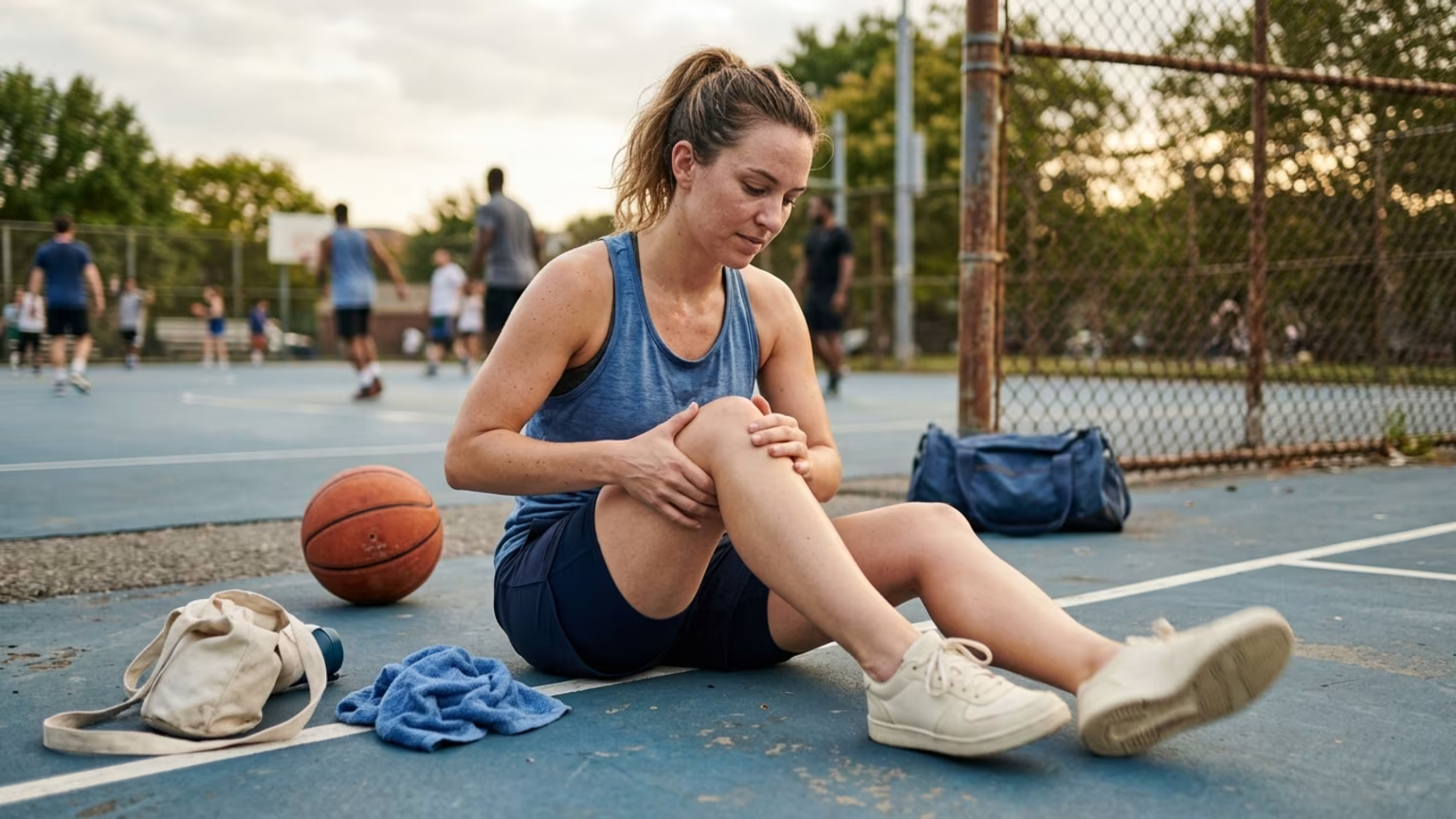

Learn how to assess your physical readiness for tennis, pickleball, and padel using a simple green, yellow, and red framework to adjust your court intensity.




You step onto the hardcourt on a sunny afternoon. Your legs feel unusually heavy from a challenging match two days ago. The first few warm-up volleys feel sluggish and uncoordinated.
How do I know if my body is ready for court time today? You can evaluate your readiness by checking your sleep, soreness, energy, and movement quality to adjust your session accordingly.
Monitoring your body helps manage the workload required for athletic longevity. Racquet sports demand rapid starts, abrupt stops, deep lunges and constant changes of direction. These repeated movements place significant stress on your joints and muscles over time. Without a basic readiness check, it is easy to overplay and invite overuse issues.
The evidence points heavily toward proper load management rather than blanket activity avoidance. In a 2026 study of recreational pickleball players in Korea, approximately two in five participants reported an injury during the previous 12 months. Lower-extremity and overuse injuries predominated in this group. The researchers behind that study recommended progressively increasing weekly play time, scheduling recovery periods and modifying play volume.
A multidimensional approach is particularly suitable for recreational players. The same planned session can impose very different demands depending on your recent sleep, accumulated fatigue, soreness and daily stress. The most useful question is not whether you are fit enough to play. Instead, you should ask what type of session matches your current physical capacity.
Older adults should pay close attention to accumulated sessions and sudden increases in court exposure. According to an analysis reported by KCUR, adults aged 50 and older accounted for approximately 125,000 pickleball-related emergency visits between 2018 and 2025. This figure represents more than four in five visits during that period, highlighting the need to autoregulate mobility training based on how you feel.
A practical way to assess your capacity is to categorize your state as green, yellow or red. Green means you can proceed with your planned session without hesitation. You might have mild, familiar post-exercise soreness, but basic movements look controlled and your energy feels typical. In this state, you can proceed with your normal technical work and planned match intensity.
A green day does not mean you are completely injury-proof. It simply means there is no obvious reason from the check-in to reduce your planned session. You should still perform a proper warm-up to confirm that your body continues to move well. If you feel great, enjoy the harder physical work.
A yellow day requires you to modify your session on the court. This signal is appropriate when one or more inputs are meaningfully worse than your usual baseline. You might have poor sleep combined with low energy, or recent increases in weekly court time. The best adjustment is usually reducing your intensity, taking longer breaks or avoiding repeated maximal sprints.
A red signal indicates you need to stop, rest or seek a professional assessment. Warning signs include sharp or localized pain, a clear loss of function or the inability to decelerate safely. Severe soreness, functional loss and pain during exercise are strong reasons not to repeat high-intensity work. This is a deliberate decision to stop loading the area and obtain appropriate medical advice.
Emergency symptoms always fall into the red category and require immediate attention. These include chest pain, faintness, severe shortness of breath or unusual weakness. A red day is not an excuse to quit exercising forever, but rather a temporary pause to protect your body.
Each racquet sport imposes unique mechanical demands on your body. Your specific preparation and movement mistakes will differ depending on the court you choose. For tennis, a yellow day may call for fewer full-court points and less serving volume. This is especially true if shoulder, elbow or lower-body soreness changes your serving mechanics.
You can easily substitute heavy serving with controlled cross-court drilling. Pickleball requires a different focus during your physical readiness check. The sport involves frequent short accelerations, fast lunges and very quick direction changes. You should pay special attention to your braking capacity, lateral movement and overall balance.
The 2026 Korean study found that greater weekly playing volume was independently associated with injury occurrence. This makes your court frequency and accumulated sessions highly important context for your planning. Padel players must consider the cumulative effect of repeated matches, tight directional changes and overhead shots. If your energy is low or your shoulders are stiff, you might struggle with the repeated overhead work.
Understanding these specific demands helps you build a more effective court-ready warm-up sequence. Older players should be especially cautious about balance loss, persistent pain and sudden increases in exposure across all three sports. Across all three sports, the most actionable adjustment is usually intensity before complete inactivity. You can shorten the session, reduce maximal efforts or simply extend rest intervals.
You should stop completely if symptoms worsen during play. This approach is perfectly consistent with recommendations favoring progressive increases in play, recovery periods and modification of volume.
Start by evaluating your sleep and overall energy levels relative to your personal normal. Ask yourself if your sleep was reasonably restorative and if you feel alert enough to track the ball. It is useful to note if one poor night of sleep is an isolated event or part of a larger pattern. Low energy matters most when it appears alongside recent heavy play, poor sleep or deteriorating movement.
Next, separate ordinary muscle soreness from clear warning symptoms. Mild, symmetrical soreness that improves during a gradual warm-up may justify an easier session. Sharp, focal, joint-related or progressively worsening pain should move your decision toward yellow or red. You should never dismiss localized joint pain or pain that worsens with movement as normal soreness.
Finally, evaluate your movement quality right before stepping onto the court. Walk, jog and stop under control to see how your body handles sudden braking forces. Make several easy lateral steps, perform controlled single-leg movements and notice if one side feels substantially different from the other. The goal is to observe whether you can control your balance and direction changes before adding competitive intensity.
The goal is not to count repetitions or create a complex laboratory score. It is a quick observation of how well your body absorbs force on that specific day. Sport-specific guidance for pickleball emphasizes controlled lateral hops, single-leg capacity and deceleration as useful readiness considerations. If these basic movements feel unsteady, you should immediately switch your plan to a yellow day.
Taking time to understand how court geometry changes the physical toll will guide these specific movement checks.
Assessing your readiness before every session helps you maintain your physical capabilities and stay active on the court for years to come. By simply listening to your body and adjusting your intensity, you can consistently play the sports you love with confidence.
Follow Evercourts for practical insights on tennis, pickleball and padel performance, movement, recovery and healthy ageing. Stay connected for new articles, research-led guidance and ideas to help you play well and keep playing for years.


Holger Rune withdrew from the European Open with a back problem. The facts behind his decision and a grounded perspective for recreational players.

The Dink’s October 17 guide emphasizes deep returns, ball-height decisions and positioning against faster pickleball opponents.

A new report outlines padel and tennis gear trends. Learn how to assess adjustable rackets, sensor feedback and smart-court claims.
Read practical guidance for better movement, smarter preparation and a game that keeps working for you.
explore the Blog
