

New 2026 research clarifies why a perfect MRI is not required for a safe return to racquet sports after a hamstring strain.




In 2026, the journal Frontiers in Sports and Active Living published new research by Wang and Zhao detailing how residual imaging abnormalities affect return-to-sport decisions after an acute hamstring strain. The article appears in the Injury Prevention and Rehabilitation section. It addresses a common scenario where athletes reach clinical recovery but still show persistent abnormalities on a magnetic resonance imaging scan. The findings clarify that these lingering issues do not automatically make a return to the court unsafe.
The central issue examined by the researchers is the mismatch between how an athlete feels and what a follow-up scan shows. An athlete might feel completely ready to resume playing tennis or padel while an MRI still displays edema-like signal, low-signal fibrosis, or abnormalities involving the intramuscular tendon. The authors conclude that these three specific findings are common at the point of clinical recovery. Standing alone, they are insufficient to rule out a safe return to competitive sport.
However, the research does identify specific warning signs that require closer clinical attention. Persistent or new connective-tissue gaps and intermuscular edema have shown exploratory associations with reinjury. The authors caution that this evidence remains limited. These associations come mainly from small cohorts and predominantly nonoperatively managed, non-complete tears. Furthermore, these potentially higher-risk findings have not been independently validated as stand-alone clearance criteria.
The paper also distinguishes between the utility of different imaging tools during the recovery process. MRI is better suited to characterizing deep and tendon-related anatomy. Ultrasound may be useful for targeted and standardized serial assessment of accessible lesions. Despite these uses, the evidence supporting ultrasound specifically at the return-to-sport stage is notably limited.
The researchers emphasize that current evidence does not prove that an MRI can reliably distinguish incomplete healing from a state of safe readiness. Persistent signal changes might represent incomplete healing, normal tissue remodeling, or structural features that are only relevant if the athlete also experiences pain. Because of this ambiguity, Wang and Zhao proposed a comprehensive decision framework. Their model incorporates seven specific functional and clinical factors to guide the final clearance decision.
First, clinicians must evaluate symptoms and the pain response of the athlete at rest and during progressively faster activities. Second, flexibility and range of motion require close evaluation. Any residual restriction in flexibility may indicate that the athlete is not yet ready for unrestricted competition. Third, strength should be evaluated directly rather than inferred from the visual appearance of an imaging scan.
Fourth, the athlete must undergo progressive exposure to high-speed running demands. Fifth, sport-specific performance requires the athlete to demonstrate the ability to perform the intensity demands of their intended game. Sixth, any previous injury history should heavily influence clinical judgment and load progression. Finally, psychological readiness to perform demanding movements is explicitly required.
For professional athletes, return-to-sport decisions often involve comprehensive resources like serial MRI assessments, force-plate testing, and high-speed running analysis. Adult recreational players rarely have access to that level of constant physiological monitoring. The findings from this 2026 publication validate a highly practical approach for weekend league competitors. A functional and criteria-based progression is more important than chasing a perfect MRI before stepping back onto the court.
Court sports demand repeated accelerations, unpredictable decelerations, wide lunges, and rapid changes of direction. Returning to these specific demands requires more than just the absence of pain at rest. Recreational players should focus on how their hamstring responds to a structured progression of sport-specific movements. Proper readiness testing involves executing split steps, open-stance recovery steps, and repeated lateral shuffles. If a player can handle these movements without pain or hesitation, they are likely ready for the next level of intensity.
Psychological readiness is another critical factor highlighted by the authors that directly impacts the recreational experience. A lack of confidence often causes amateur players to hesitate before sprinting or reaching for a wide ball. This hesitation can alter mechanics and prevent the athlete from properly loading the recovering leg. While hesitation does not guarantee a reinjury, it is a clear sign that graded exposure to match play should continue. Returning to competitive league play should happen when a player trusts their body under fatigue.
Adult recreational athletes face a unique challenge when translating clinical findings to the local tennis club. Without a dedicated coaching staff, the responsibility of determining match readiness often falls on the player. The Frontiers article clearly advises against using a calendar-only approach to plan a return. A return date should follow demonstrated capacity rather than the simple disappearance of pain at a low intensity.
A structured progression is essential for players recovering from a hamstring strain. Recreational players should start with predictable movements like controlled linear running before attempting unpredictable drills. Proper rehabilitation requires adding multi-directional reaction drills, lateral lunging, and eventually full point-like workloads under fatigue. If you want to understand how this structured approach applies broadly, our guide to returning to court after an injury layoff details similar criteria-based steps.
Warning signs during this progression still require professional attention. A new increase in pain, a sudden loss of strength, or reduced range of motion should prompt an immediate reassessment. Difficulty with high-speed running or a newly palpable physical defect also warrants evaluation by a qualified clinician. While a perfect MRI is not required, ignoring obvious functional deficits will increase the risk of a secondary injury.
The need to look beyond imaging is heavily supported by available clinical data on hamstring recovery. A clinical evidence summary reports on one sample of 176 athletes who were assessed with MRI early after their injuries. In that group, MRI classification systems explained only 7.6% to 11.9% of the variation in time to return to sport. This finding confirms that scan-based grading alone is a very weak basis for predicting an individual athlete’s specific return date.
The specific content of a rehabilitation program also heavily influences reinjury rates once an athlete does return to play. A 2004 trial by Sherry and Best published in the Journal of Orthopaedic & Sports Physical Therapy compared two different rehabilitation approaches. The trial involved 24 athletes who completed the relevant programs. One group focused on hamstring stretching and strengthening, while the other group followed a program emphasizing progressive agility and trunk-stabilization exercises.
The differences in early recurrence between the two groups were notable. In the first two weeks after returning to sport, 6 of 11 athletes in the stretching-and-strengthening group experienced a recurrent hamstring strain. During that same timeframe, none of the 13 athletes in the progressive-agility and trunk-stabilization group suffered a recurrence. This early return window is widely considered a high-risk period for athletes resuming competitive play.
These differences persisted during long-term follow-up assessments. At one year, 7 of 10 athletes in the stretching-and-strengthening group had suffered a recurrence. By comparison, only 1 of 13 athletes in the progressive-agility and trunk-stabilization group experienced a recurrence at the one-year mark. These results should be interpreted cautiously due to the small size of the study, and they should not be treated as a universal recurrence rate for all sports. However, they reinforce the value of trunk control and agility work for court athletes. Implementing a structured recovery and reloading framework that includes dynamic movement can help manage this risk.
Over the next season, the management of acute hamstring strains will likely continue moving away from rigid timetables toward criteria-based clearance protocols. Sports medicine professionals are increasingly expected to prioritize objective strength metrics, high-speed running exposure, and psychological readiness over the simple resolution of tissue edema on a scan. As this functional approach becomes the standard of care, adult court athletes will benefit from more personalized and movement-focused recovery plans.
The demand for prospective and sport-specific studies will also shape future clinical guidelines. The current evidence base relies heavily on nonoperatively managed injuries and non-complete tears in overlapping study populations. Future research is expected to clarify exactly how imaging can best complement functional testing for older recreational athletes. Until those specific guidelines arrive, players should rely on progressive movement tolerance and expert clinical assessment to guide their return to competition safely.
Follow Evercourts for practical insights on tennis, pickleball and padel performance, movement, recovery and healthy ageing. Stay connected for new articles, research-led guidance and ideas to help you play well and keep playing for years.


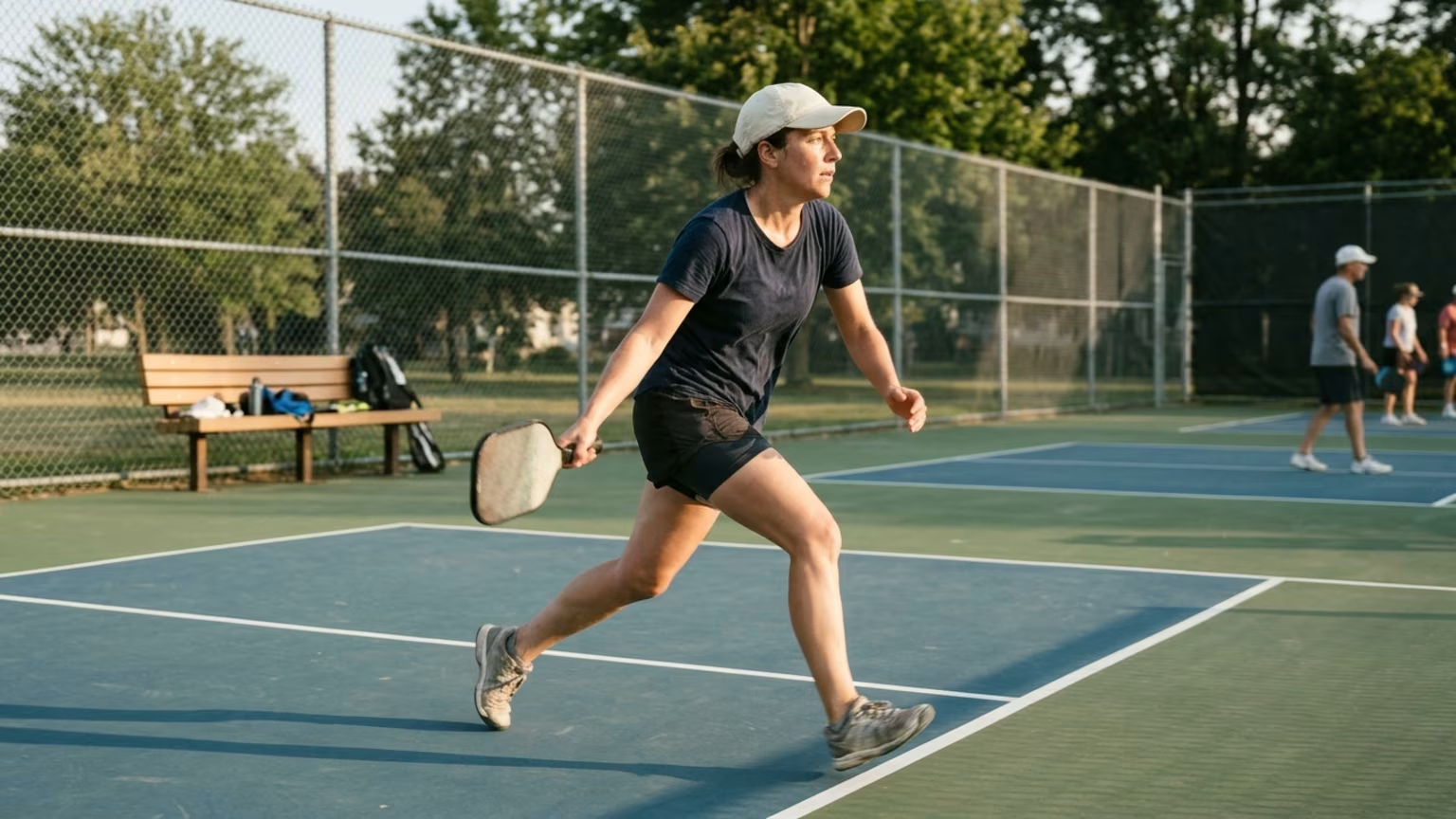
An evidence-led look at pickleball lunges, balanced recovery, movement practice and when to seek professional advice.

A practical tournament-day mailbag covering schedules, venue rules, food, fluids and flexible plans for tennis, pickleball and padel.

Understand tennis's strength, power, balance and braking demands, with a cautious framework for off-court preparation and long-term play.
Read practical guidance for better movement, smarter preparation and a game that keeps working for you.
explore the Blog
