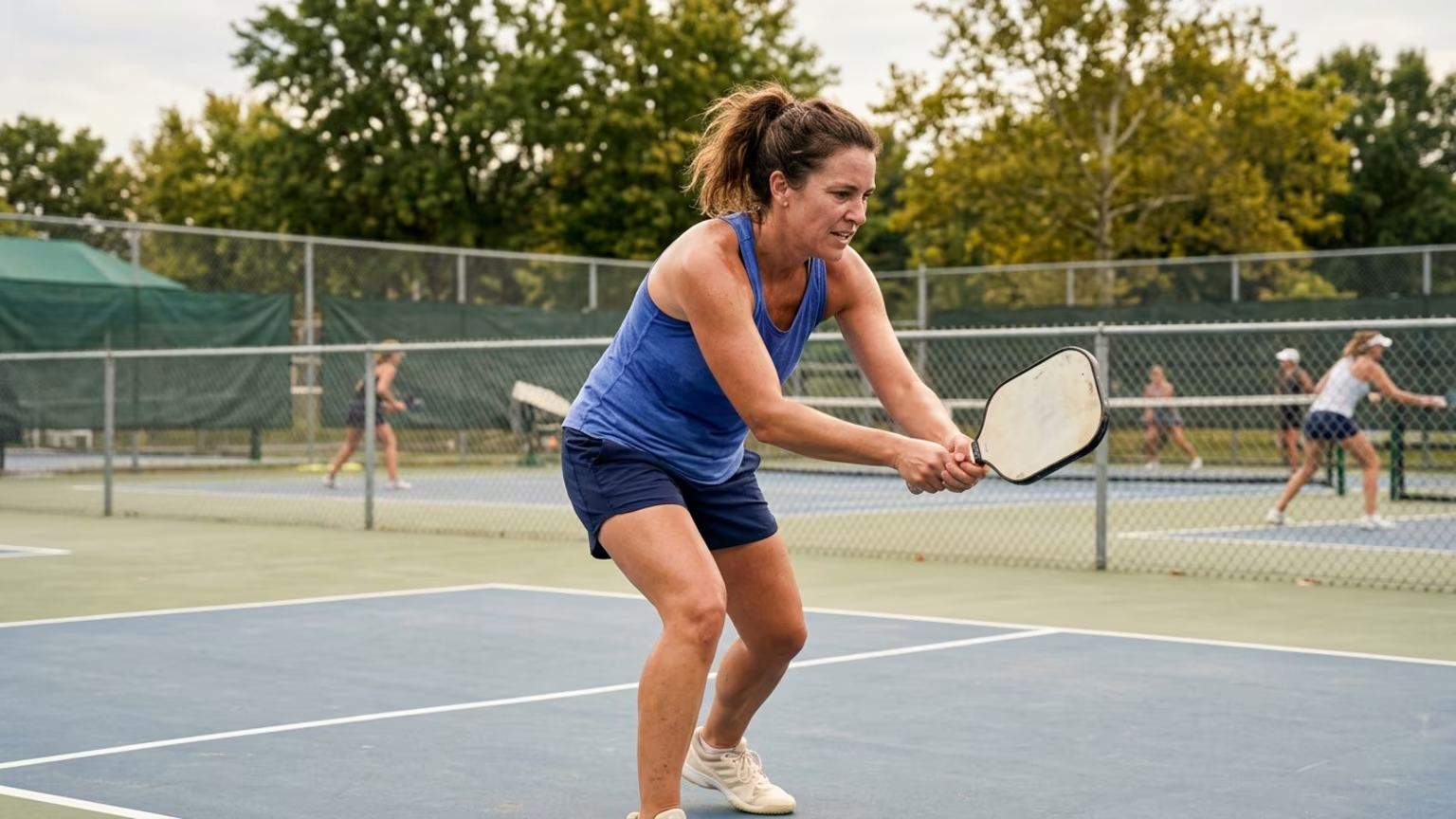

Learn why adopting a two-handed volley in pickleball can improve stability and protect your dominant arm without relying on exaggerated fitness hype.




A player crowds the non-volley zone line and reaches out wildly with their dominant arm to stab at a passing shot. The paddle makes contact, but the player's shoulder absorbs the entire shock of an off-balance swing. We see this exact scenario play out every day on local courts. The common fix is usually buying a lighter paddle or wearing a compression sleeve.
Here is the truth about overuse injuries in modern racquet sports. Adopting a two-handed volley will not magically shield your shoulder from the consequences of poor positioning. Hitting every ball at the net with two hands is a tactical mistake that limits your reach and slows your reactions. However, strategically deploying a two-handed backhand volley is a highly effective mechanical adjustment that players ignore at their own peril. A two-handed stroke distributes the load across your core and hips rather than isolating your fragile shoulder joint.
Online coaching tutorials frequently market new paddle grips and swing paths as guaranteed solutions for joint pain. They promise that holding the paddle differently will completely prevent injuries associated with using one hand alone. The reality of athletic longevity on the court is far more complex than a single stroke adjustment. Older players face broader risks, and technique alone cannot offset the physical demands of hard courts.
When I first started playing pickleball, I noticed how many people skipped warming up entirely. They would jump straight out of their cars and right up to the kitchen line. I tried doing that and immediately pulled a calf muscle. Pickleball requires just as much explosive lateral movement as tennis, just in a tighter space.
Since then, I always spend five minutes doing dynamic lunges and ankle rolls. It changes everything about how confident I feel pushing off the baseline. A stroke change is only valuable when combined with proper physical preparation and court awareness. Players often search for technical quick fixes when they should focus on foundational movement quality.
A University of Texas Health Science Center at San Antonio summary identifies older adults as a major injury-risk group. The summary reports that fractures were particularly common among women over 60, especially in the arm and wrist. Managing those risks requires dedicated attention to warm-up routines, sensible footwear choices, and safe movement on the court. Relying solely on a two-handed backhand to save your joints ignores the broader picture of how bodies actually age. True injury prevention requires a comprehensive approach to healthy aging through injury prevention.
A 2026 mapping study describes pickleball research as splitting between health-promotion topics and injury-risk topics. The sport clearly supports functional fitness, but it also exposes players to sprains and falls. An eight-week pickleball intervention reported by the Chinese University of Hong Kong was associated with improvements in pre-frailty status, functional fitness, and quality of life. Regular participation clearly offers measurable physical benefits for older adults.
The U.S. Centers for Disease Control and Prevention notes that regular physical activity supports cognitive function, cardiovascular health, and bone strength. The CDC also highlights that consistent activity can help prevent or manage type 2 diabetes. Maintaining those benefits means keeping players healthy enough to stay on the court without experiencing chronic pain. According to a UTHSC San Antonio summary, one study analyzed 1,110 cases representing an estimated 66,350 pickleball-related injuries from 2013 through 2022.
Most of these recorded injuries occurred among players aged 65 to 80. To mitigate upper-body strain, coaching experts suggest involving the kinetic chain through a two-handed volley. An August 2026 coaching column published by Yahoo Sports and originally appearing in The Desert Sun outlines how players can use this technique. The column presents greater power, core involvement, and reduced one-arm strain as potential benefits of the two-handed volley.
Instructor James Ignatowich advises players to turn the shoulders, use the non-dominant arm, and incorporate the hips and core. This shifts the effort away from trying to generate the shot entirely with the dominant arm. For the swinging volley, instructor Tanner Tomassi recommends using the hips, obliques, and shoulders to support a relaxed-arm movement. By moving the force generation to the trunk, players avoid muscling the ball with just the arm.
The coaching guidance favors a one-handed response close to the chest. A two-handed backhand volley is suggested when a right-handed player receives the ball outside the left shoulder. These mechanical adjustments help players safely leverage their core strength. Proper technique helps players maintain their mobility for better play while actively managing upper-body loads.
Instead of treating the two-handed volley as a rigid rule, players should implement sensible habits that protect their joints. At the non-volley zone, right-handed players should keep a one-handed option for balls arriving close to the chest. This preserves reaction time and keeps the paddle positioned firmly in front of the body. When the ball moves outside the left shoulder, players can safely bring the second hand onto the grip.
Players should also utilize the transition zone differently than the non-volley line. Because you often have more time and space away from the net, you can step into the ball during a transition-zone swinging volley. This allows for a more complete hip-and-shoulder movement that safely generates power. The goal is to keep contact close to the body to improve balance and rotation.
Reaching out at full extension drastically reduces your control and places intense leverage on the shoulder joint. If you find yourself constantly lunging, focus on improving your footwork rather than just changing your grip. A useful drill should require players to identify whether the ball is close to the chest or outside the backhand shoulder before choosing a shot. Practicing this decision process builds tactical awareness and reinforces safer mechanics.
Developing a reliable stroke requires patience and consistent practice. You cannot expect to master a two-handed backhand during a competitive match on your first attempt. Spend time on the practice court feeding balls to your backhand side. Focus on rotating your shoulders and keeping your grip relaxed before slowly increasing the pace.
Another practical alternative is reviewing your paddle weight and grip size with a knowledgeable professional. Sometimes, a paddle that is too heavy contributes significantly to upper body fatigue. A lighter paddle can help you maintain proper paddle position without placing undue stress on your arm. Combining proper equipment with smart mechanical habits offers a realistic path to athletic longevity.
Finally, listen to your body and adjust your play when pain and warning signs appear. A clinical exercise-therapy article advises reducing stroke volume, intensity, range of motion, repetitive movements, or match duration when particular movements aggravate symptoms. Pushing through acute pain often leads to chronic inflammation and longer recovery periods. If your shoulder hurts during play, reducing your court time is smarter than simply playing through the pain.
Adopting a two-handed volley for wide shots is a practical way to engage your core and protect your dominant arm, provided you pair the technique with sensible conditioning and smart workload management.
Follow Evercourts for practical insights on tennis, pickleball and padel performance, movement, recovery and healthy ageing. Stay connected for new articles, research-led guidance and ideas to help you play well and keep playing for years.


Holger Rune withdrew from the European Open with a back problem. The facts behind his decision and a grounded perspective for recreational players.

The Dink’s October 17 guide emphasizes deep returns, ball-height decisions and positioning against faster pickleball opponents.

A new report outlines padel and tennis gear trends. Learn how to assess adjustable rackets, sensor feedback and smart-court claims.
Read practical guidance for better movement, smarter preparation and a game that keeps working for you.
explore the Blog
