

Rusedski’s advice to Alcaraz puts readiness first. How adult players can approach tournament choices without copying a professional calendar.




On October 15, 2026, Yahoo Sports reported that former US Open finalist Greg Rusedski had advised Carlos Alcaraz to consider a more selective tournament schedule following his wrist-injury comeback and defeat in Shanghai.
Rusedski’s recommendation was to put physical and mental readiness ahead of appearance fees and prize money. According to Yahoo Sports, he argued that Alcaraz should consider missing events when he does not feel ready. That could mean accepting fines or lost ranking points.
“Sometimes don't worry about losing out on money and points if you're not ready to play,” Rusedski said.
His argument also covered the commitments around the main tournament calendar. He urged caution about adding exhibitions and Davis Cup ties. The central point was to find a schedule that suited the player rather than treating every opportunity to compete as something that had to be accepted.
The debate had already surfaced before Shanghai. Sky Sports reported that Alcaraz believed players were being pushed to compete in too many tournaments and matches. Alcaraz linked that pressure to injuries, expressing his own concern about the direction of the schedule.
The useful recreational takeaway is not to copy a professional’s calendar. It is to treat tournament entry as a decision rather than an obligation. Rusedski’s readiness-first argument offers a sensible question for adult competitors: does this event fit how you feel and what you have recently asked of yourself?
At professional level, his advice involves a direct trade-off between participation and potential financial or ranking consequences. A weekend league player should not assume those incentives make the professional decision a model for their own. The principle can transfer without the tour’s financial calculations transferring with it.
For tennis players coming back after an injury, the practical discussion can stay focused on the next commitment. Instead of asking whether another player managed a rapid sequence of events, consider whether entering the next tournament makes sense in your own circumstances.
A scheduling check-in can centre on these questions:
These are prompts for reviewing a plan. They are not pass-or-fail criteria, and no answer here establishes medical clearance. For persistent or worsening pain, seek advice from a qualified healthcare professional rather than using a professional player’s comeback as a return-to-play standard.
Our resource on thinking through a return to competition provides a place to continue that discussion. Keep the scheduling question tied to your own situation rather than to the event you most want to enter.
There is also a distinction between being selective and trying to play as little as possible. Rusedski was arguing for a calendar that works for the player. Applied cautiously to adult competition, that means giving each entry a reason beyond its availability.
An event can matter to you without becoming mandatory. Equally, choosing to compete need not mean committing to every event that follows. The editorial lesson is to keep those decisions open to review rather than treating an earlier plan as a promise that cannot change.
Mental readiness belongs in that review because it was explicitly part of Rusedski’s advice. The question is not only whether the tournament is attractive. It is also whether competing now matches how prepared you feel physically and mentally.
The same planning question can be useful to adult pickleball and padel players. That is an editorial application of a tennis scheduling debate, not evidence about injury patterns or recovery needs in those sports. The transferable idea is choice, not a shared tournament limit or recovery timetable.
For players weighing a comeback, separating match readiness from the desire to return keeps the discussion focused. Wanting the next event on the calendar and deciding that it is a sensible commitment are different judgments.
The official Rolex Shanghai Masters report provides important balance. It said Alcaraz missed four-and-a-half months of the 2026 season with a wrist injury. He returned at the US Open and reached the quarter-finals before defending his Japan Open title.
Zizou Bergs then beat him 7-5, 7-6(4) in Shanghai. The tournament report said that result ended Alcaraz’s seven-match winning streak. Citing the Infosys ATP Win/Loss Index, it also recorded that he had won 11 of 13 tour-level matches since returning.
Alcaraz’s own assessment was not simply a complaint about scheduling. According to the official report, he described his performance as poor while crediting Bergs for his level and for taking his chances. He planned to review matches with his coach and team before returning to practice.
Rusedski’s comparison with Roger Federer also needs its attribution kept intact. In the Yahoo Sports report, he described Federer as playing 12 events a year and winning seven of them. He said Federer held a ranking of No. 1 or No. 2 while winning majors.
Those figures were Rusedski’s characterization rather than an independently verified season-by-season comparison. They do not establish an ideal event count for other players. Likewise, the Shanghai defeat does not show that Alcaraz returned too soon or that scheduling caused the loss. His successful comeback results do not establish that his wrist was fully recovered either.
At the time of its report, the Rolex Shanghai Masters listed the Rolex Paris Masters in November as Alcaraz’s next scheduled tournament. That was the next calendar marker, not an announcement that he would follow Rusedski’s advice or reduce his schedule.
Over the next season, the more useful story to follow will be how Alcaraz chooses his commitments and explains those choices. A single defeat should not settle the scheduling debate. Nor should a successful run automatically make every additional event the right decision.
For adult competitors, the worthwhile development would be a clearer distinction between ambition and obligation. A selective calendar should be judged by whether it makes sense for the player, not simply by how many tournament entries it contains.
Rusedski has offered an opinion rather than a universal formula. The lasting editorial point is still useful: readiness deserves a place in the calendar discussion before entry becomes expectation. Next season’s scheduling choices will be more informative than turning one Shanghai result into a verdict on an entire comeback.
Follow Evercourts for practical insights on tennis, pickleball and padel performance, movement, recovery and healthy ageing. Stay connected for new articles, research-led guidance and ideas to help you play well and keep playing for years.


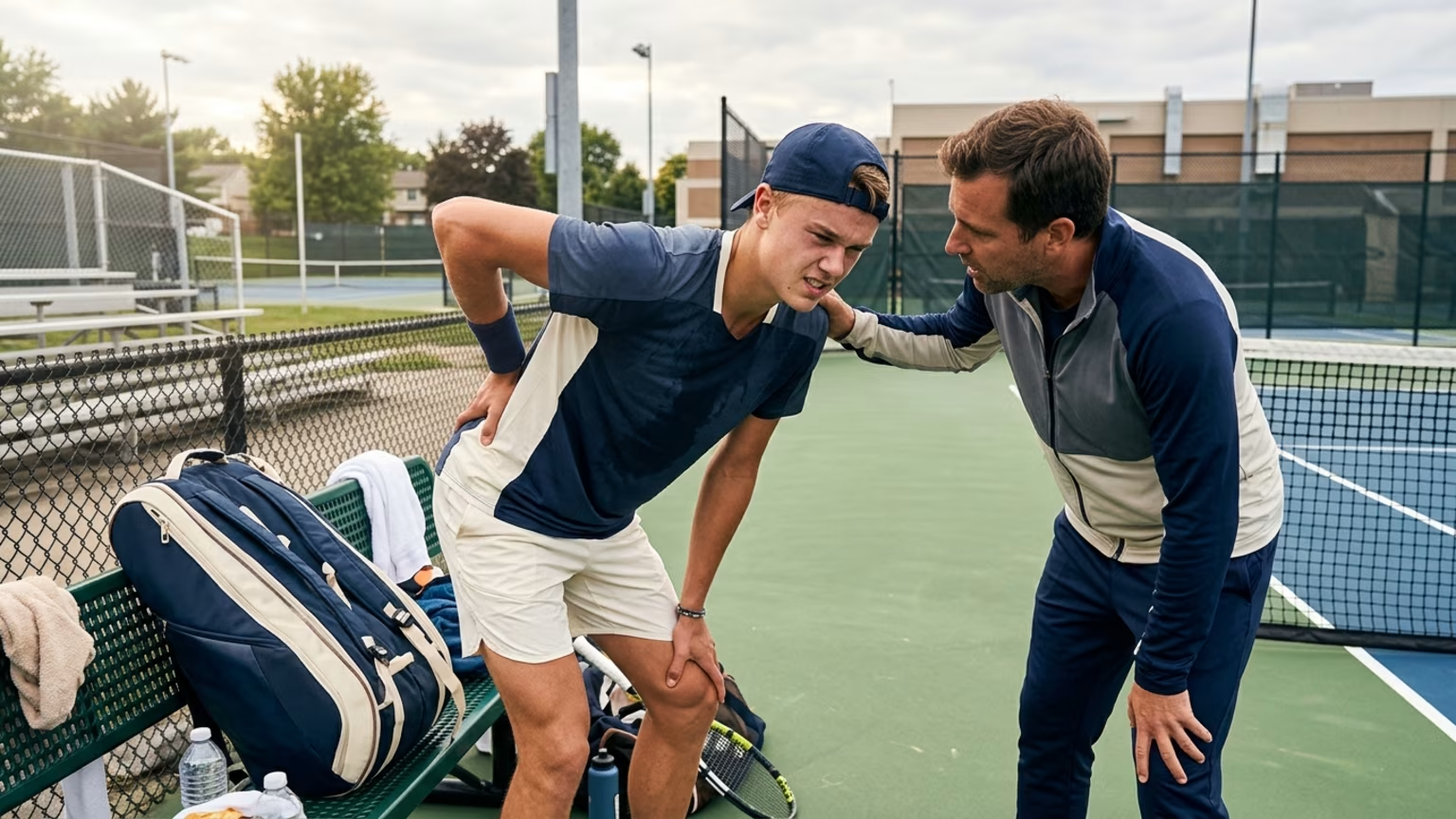
Holger Rune withdrew from the European Open with a back problem. The facts behind his decision and a grounded perspective for recreational players.

The Dink’s October 17 guide emphasizes deep returns, ball-height decisions and positioning against faster pickleball opponents.

A new report outlines padel and tennis gear trends. Learn how to assess adjustable rackets, sensor feedback and smart-court claims.
Read practical guidance for better movement, smarter preparation and a game that keeps working for you.
explore the Blog
