

Answers to players’ questions about post-match soreness, movement-changing pain, when to stop playing and when to seek medical care.




Is this just post-match fatigue, or is pain a sign that I should stop and get advice?
Banner Health advises stopping exercise for sharp, worsening or movement-changing pain and considering sports-medicine care when symptoms persist or keep returning with activity.
Start with what the symptom is doing rather than the label you give it. Saying “I’m sore” does not explain whether pain is improving, returning whenever you play or changing how you move.
Ordinary post-session tiredness does not automatically require an injury diagnosis. Equally, calling something soreness does not make persistent or movement-changing pain less important. Banner Health’s sports-medicine guidance places the emphasis on the pattern of symptoms and their effect on movement.
There is an important boundary to this advice: it is general sports-medicine guidance rather than a validated protocol for racquet players. It provides no soreness score, fixed recovery timeline or return-to-play test. The court examples below are practical applications of its decision cues rather than sport-specific clinical findings.
A useful way to organise what you notice is:
These questions help describe the problem without assigning it an injury name. They also keep the discussion more useful than a broad statement such as “everything feels tired.” Our guide to stiffness and changes in movement offers related reading on that distinction.
Improvement is useful context. It should not be treated as permission to ignore another concerning sign, such as pain that is making you limp.
Banner Health says to stop exercising when pain is sharp or worsening, changes movement, causes limping or comes with concerning symptoms. You do not need to identify the exact cause before responding to those signs.
For a practical court-side check, keep the questions concrete:
Pain that changes movement is not simply a technical problem to solve during the match. If you are adjusting your movement because something hurts, that change belongs in the decision about stopping. Finding another way to make the shot does not remove the original concern.
The distinction matters because “I can still play” answers a different question from “Does continuing fit this guidance?” A player may be able to complete a point while also meeting Banner Health’s stated reasons to stop exercise.
Keep the immediate decision about stopping separate from the broader question of how pain affects training choices. Decisions about modifying activity when symptoms are ongoing belong in a conversation with a qualified professional.
For that conversation, describe what happened rather than guessing at a diagnosis. Explain which movement changed and whether the pain improves or returns with activity. Those observations match the features highlighted in Banner Health’s guidance.
Use the same symptom-based questions in different playing situations. The useful distinction is what pain does to your movement, not which racquet or paddle you are holding.
Consider a serve, a groundstroke or movement toward the ball. If pain changes the action, the movement change is the relevant cue. Treating it only as a stroke problem would miss the reason Banner Health gives for stopping exercise.
Being able to choose a different shot does not answer whether the painful activity should continue.
Apply the same lens to a swing or movement to meet the ball. If pain is making you change how you move, staying involved in a rally is not the deciding factor.
The practical question remains whether pain is sharp, worsening or altering movement. There is no need to turn that question into a judgment about toughness.
Consider reaching for a shot or moving between points. If pain leaves you limping, you have reached one of Banner Health’s explicit reasons to stop exercising.
Focus on the movement change rather than whether you can still make contact with the ball. Completing the shot is not the decision cue in this guidance.
Across these examples, Evercourts’ view is straightforward: enjoying your sport over time matters more than finishing an individual session at any cost. Taking a symptom seriously is compatible with a capable and optimistic approach to playing.
Banner Health separates sports-medicine assessment from emergency care.
Consider sports-medicine care when pain lasts more than a few days or is not improving. Other reasons include pain that returns with activity, changes movement or limits movement or weight-bearing. Swelling or bruising also warrant consideration, as do pain following a pop and symptoms such as numbness, tingling or weakness.
Seek emergency care for the potentially serious symptoms Banner Health identifies. These include severe pain, chest pain and trouble breathing. The guidance also lists fainting, head injuries and suspected fractures.
“A few days” is not a minimum waiting period for concerning symptoms. Emergency signs belong in the emergency-care category rather than a plan to reduce court time and see what happens.
For personal decisions about ongoing symptoms or returning to activity, seek advice from a qualified healthcare professional.
The question after a match is not whether every ache means injury, but whether pain is persisting or returning, changing movement or arriving with concerning symptoms. Leaving the court with a sensible next step can be a confident decision that respects both today’s symptoms and your wish to keep playing for years.
Follow Evercourts for practical insights on tennis, pickleball and padel performance, movement, recovery and healthy ageing. Stay connected for new articles, research-led guidance and ideas to help you play well and keep playing for years.


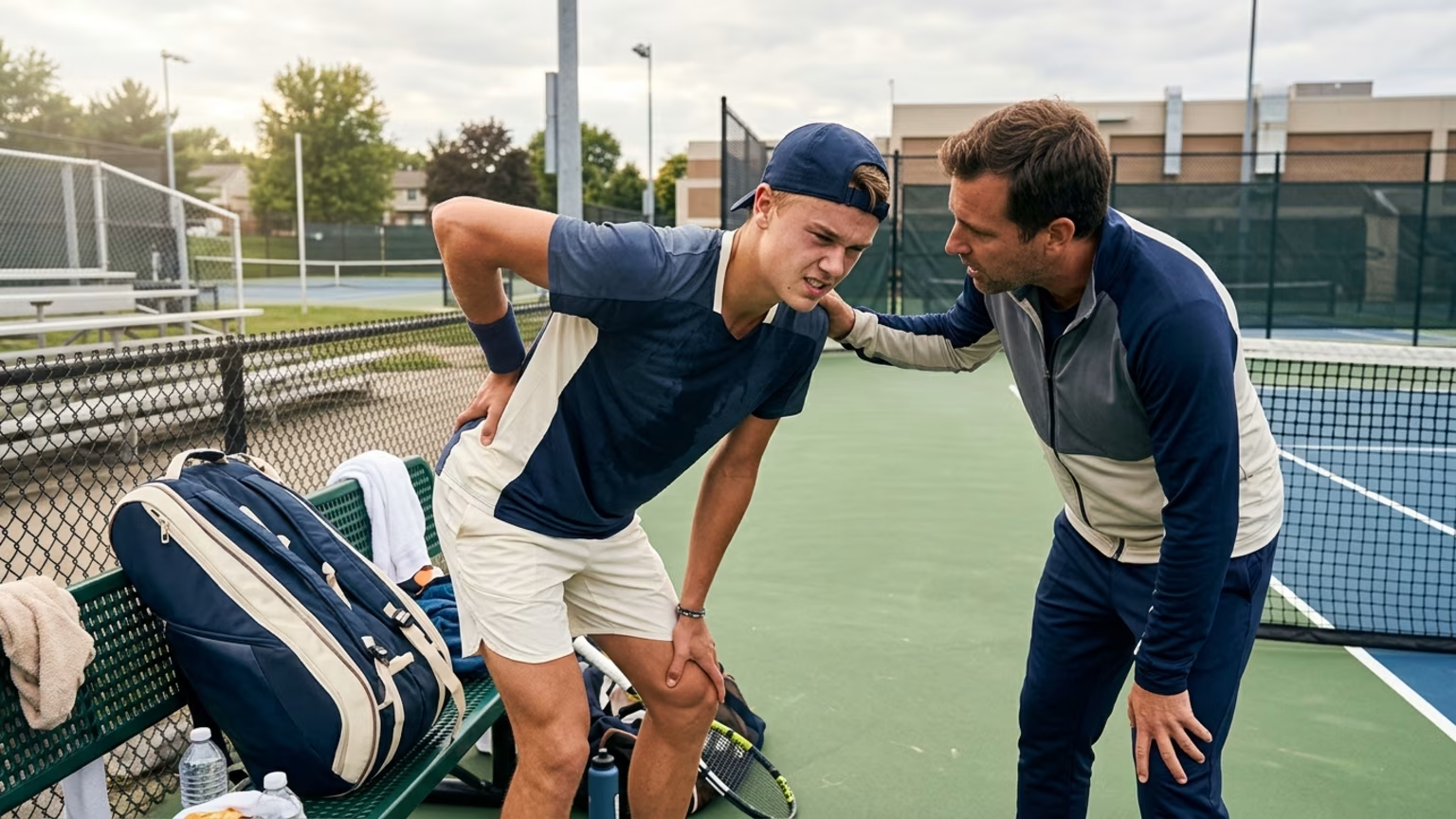
Holger Rune withdrew from the European Open with a back problem. The facts behind his decision and a grounded perspective for recreational players.

The Dink’s October 17 guide emphasizes deep returns, ball-height decisions and positioning against faster pickleball opponents.

A new report outlines padel and tennis gear trends. Learn how to assess adjustable rackets, sensor feedback and smart-court claims.
Read practical guidance for better movement, smarter preparation and a game that keeps working for you.
explore the Blog
