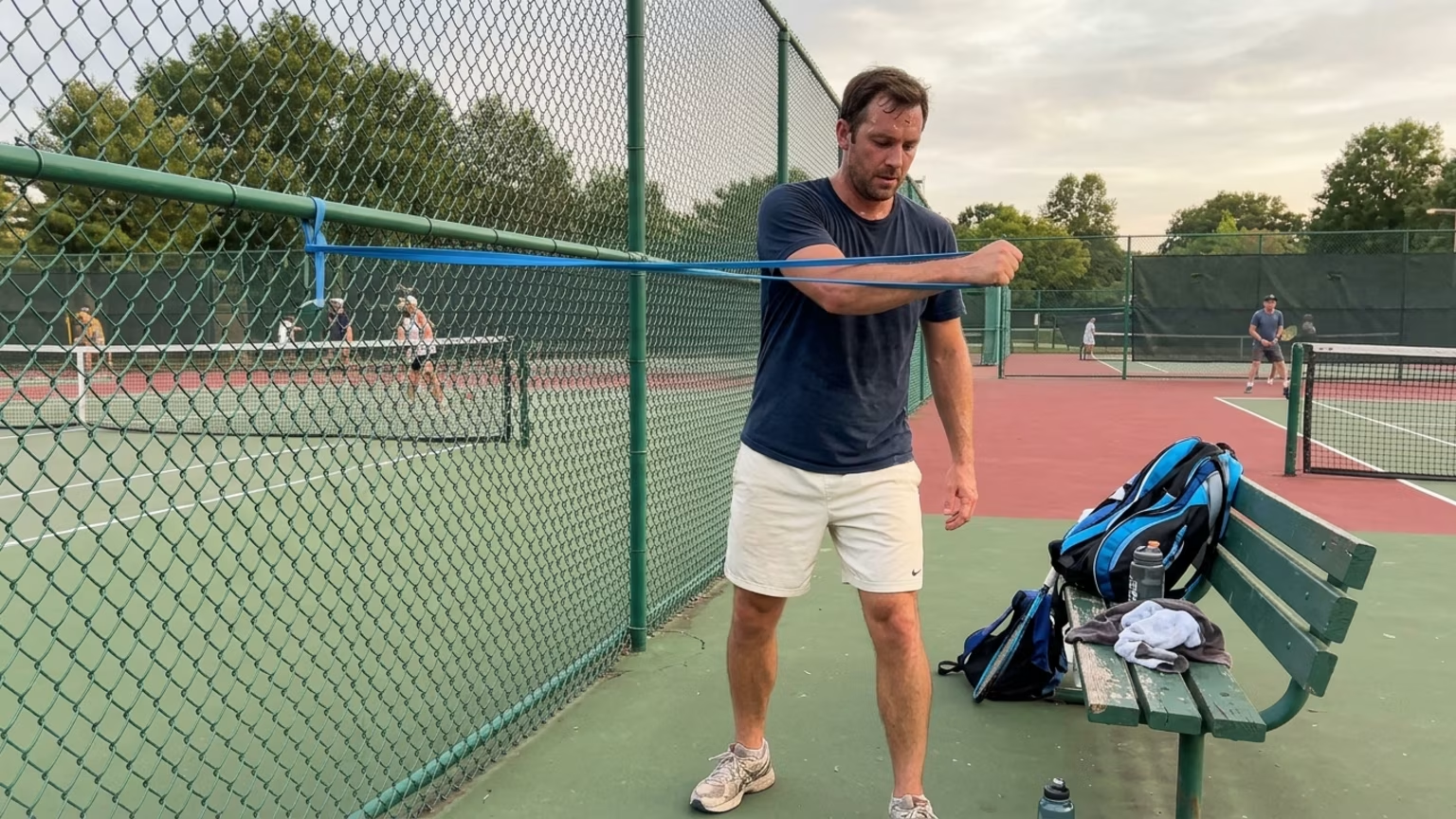

Understand tennis shoulder demands, the role of whole-body preparation, the limits of prevention claims and when persistent pain needs professional attention.




Shoulder capacity means being able to handle the repeated work your shoulder is asked to do on court. For a tennis player, that makes off-court preparation a question of preparing for repeated strokes rather than simply collecting shoulder exercises.
The useful starting point is the movement task. The shoulder contributes to the stroke, but the arm does not work separately from the rest of the body. A tennis-conditioning summary describes contributions from the legs and trunk alongside shoulder-blade control.
That whole-body view offers a sensible framework for preparation. It also helps keep the conversation focused on physical capability rather than the appeal of a particular exercise.
A tennis-conditioning summary describes the serve as a whole-body action involving the legs, trunk and arm. It identifies shoulder-blade control as another conditioning consideration. This is a movement model for understanding the stroke, not an assessment of an individual player.
The research summary also describes the dominant shoulder's repeated role in accelerating and slowing the arm. That gives off-court preparation a clear subject: the repeated work involved in producing and controlling strokes.
The practical interpretation is to look beyond the hitting arm. A preparation plan can consider general strength and movement control across the body while still paying attention to the shoulder. The question is whether the plan reflects the task being prepared for.
Repeated explosive efforts and changes of direction belong in that planning conversation too. Rather than treating them as separate reasons to add more shoulder work, consider how shoulder preparation fits alongside the broader movement demands of court play.
For tennis, pickleball and padel players, this is a useful question to ask. It is not a reason to treat their strokes as interchangeable or copy a tennis shoulder plan unchanged. Each sport deserves its own preparation context.
Understanding a movement demand and proving an injury-prevention method are different scientific tasks. A description of how the serve works can inform the aims of conditioning. It does not establish which exercise programme produces better health outcomes.
A secondary account of an adult recreational tennis trial reported similar injury prevalence in the exercise and comparison groups. That finding is worth noting because it challenges the assumption that offering a programme automatically produces a protective effect.
The evidence has specific limits. The conditioning account is a secondary summary of a cited review, while the trial account is also secondary and reports low adherence. These accounts do not establish a standard shoulder routine that prevents injury or validate the same approach across tennis, pickleball and padel.
Low adherence also complicates interpretation. Being offered a programme is not the same as consistently completing it. The reported result should not be turned into a verdict that strength work is pointless or that a different routine must work.
The practical conclusion is narrower: general strength and movement practice are reasonable preparation aims. They should be presented as preparation for tennis demands, not as a proven promise of shoulder health.
For an adult player, athletic longevity means maintaining the physical capability to keep participating. That gives off-court work a clear purpose. The aim is to support the tennis you want to continue playing rather than pursue exercise difficulty for its own sake.
As an editorial principle, favour progressive preparation over an abrupt search for the hardest routine. This is a planning approach rather than a prescribed progression. Decisions about appropriate exercises and demands remain individual.
The whole-body model offers several useful questions for reviewing an off-court approach:
These questions are not a screening tool. They are a way to keep preparation connected to its intended purpose without turning an exercise list into a medical claim.
For more context, our discussion of strength work beyond match play places off-court preparation within the wider demands of adult racquet sport.
A longer-term view also leaves room for professional input. Players do not need to interpret every uncomfortable shoulder sensation through a theory about weak legs or poor shoulder-blade control. The whole-body model is a framework for preparation, not a way to identify the cause of pain.
Persistent or worsening shoulder pain is a reason to consult a qualified physiotherapist or healthcare provider. It should not become a prompt to keep adding exercises in the hope of finding the right one.
Professional guidance is also appropriate when pain leaves you unsure how to approach tennis or off-court work. Those are personal decisions that a general article cannot settle. An assessment can provide a setting for discussing your symptoms and what you want to return to doing.
Our guide to recognising concerns during court play offers further reading on that distinction. Persistent or worsening symptoms still deserve individual attention rather than an exercise experiment.
You do not have to work through a painful shoulder alone.
Follow Evercourts for practical insights on tennis, pickleball and padel performance, movement, recovery and healthy ageing. Stay connected for new articles, research-led guidance and ideas to help you play well and keep playing for years.


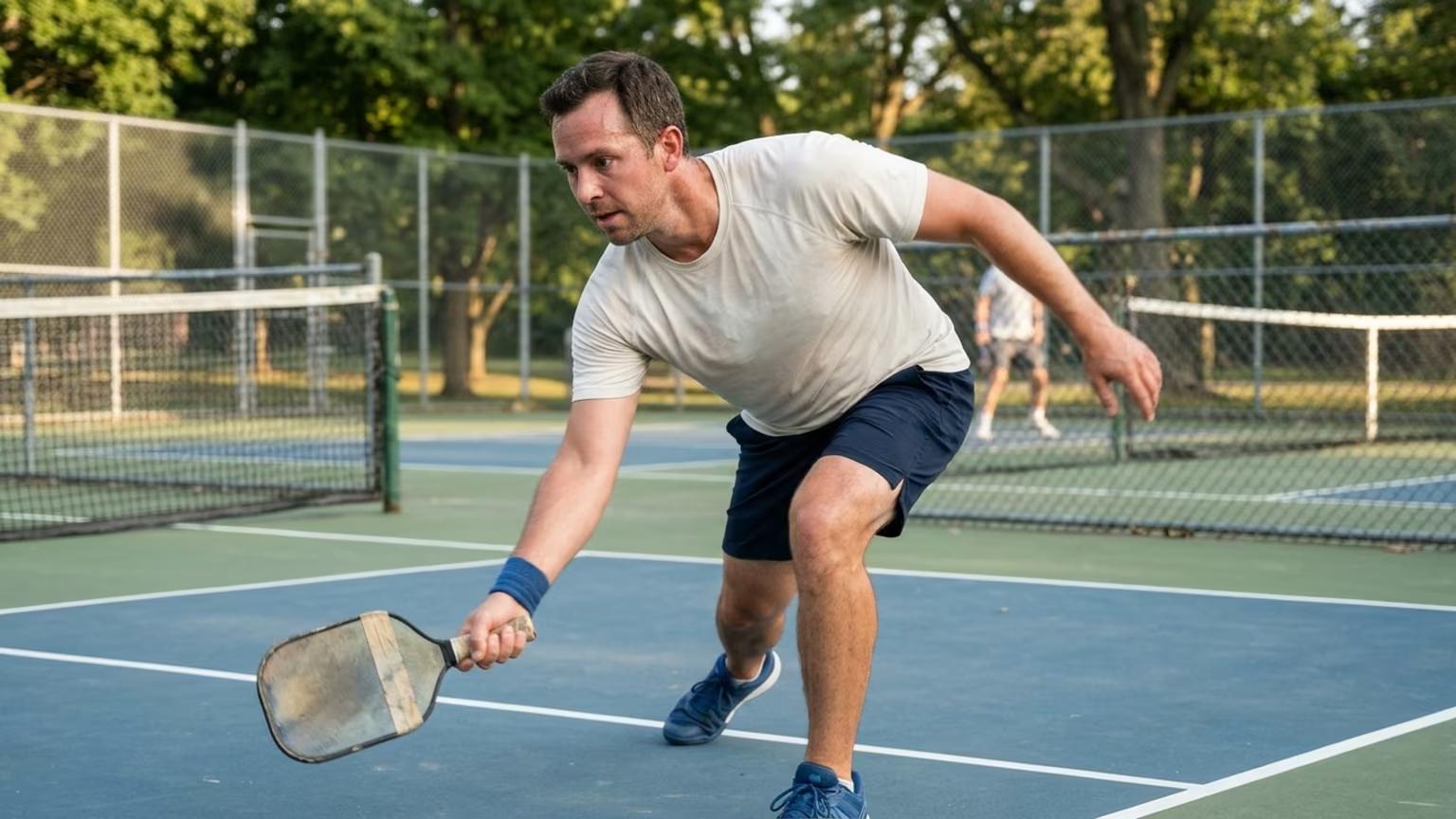
A practical strength framework for tennis, pickleball and padel, with movement-based exercise options, evidence limits and guidance on seeking help.
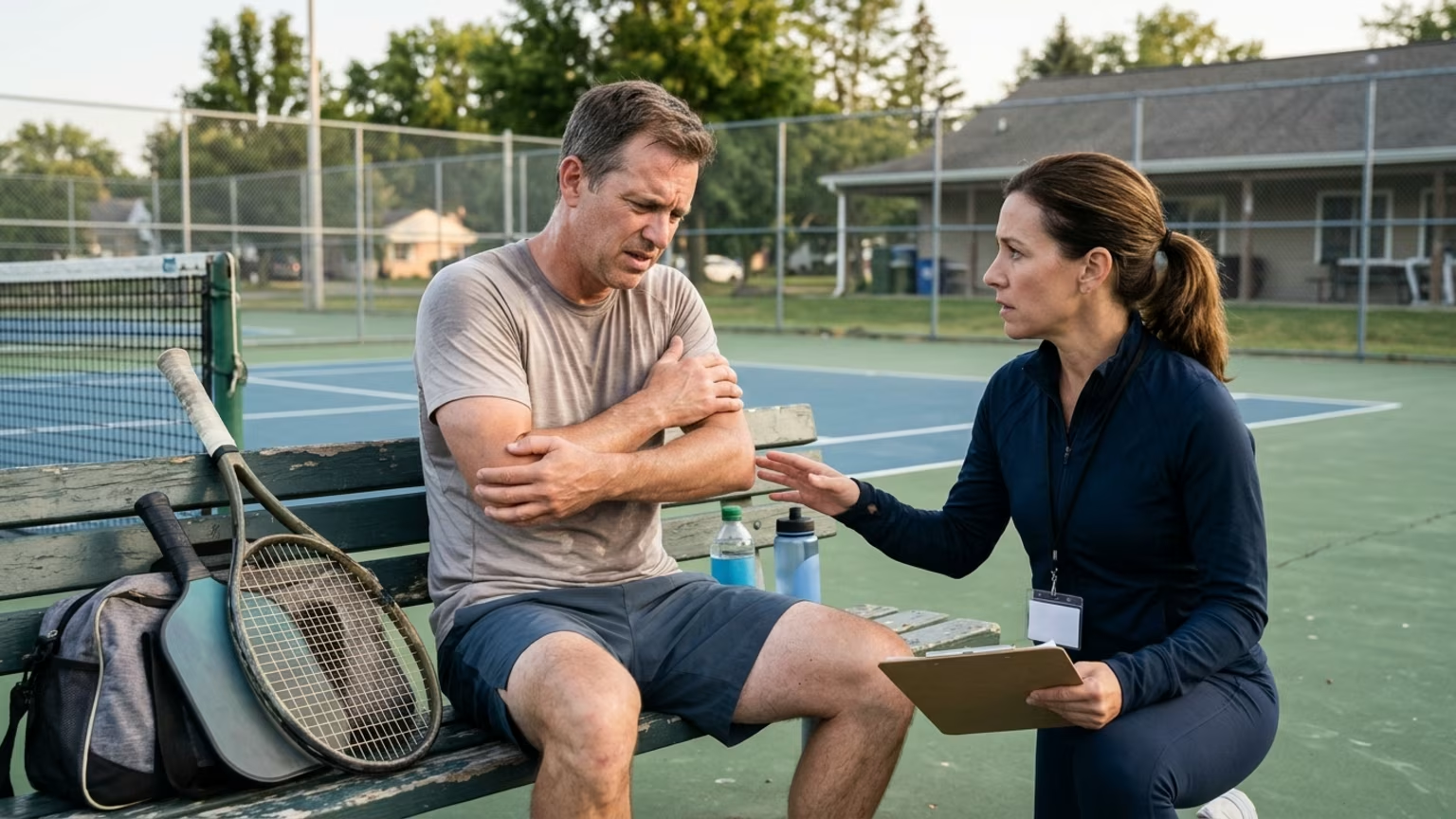
Why a specialist urges assessment for persistent pain, and how guided tendon rehabilitation differs from resting or playing through symptoms.

Compare scheduled leagues with flexible club play, using tennis, pickleball and padel examples to judge commitments, partner arrangements and fit.
Read practical guidance for better movement, smarter preparation and a game that keeps working for you.
explore the Blog
