

Off-court strength training provides a physical foundation for tennis, pickleball, and padel players. Building movement capacity supports athletic longevity.




Off-court strength training for racquet sports is the systematic practice of building the physical foundation required to accelerate, stop, and maintain balance during match play. It is not about building muscle mass for aesthetic reasons or achieving absolute peak strength. Instead, it serves as targeted support for the repetitive and explosive movements adult players execute on the court. By developing specific movement qualities off the court, players prepare their bodies to handle the physical stress of their chosen sport.
Many adult players focus entirely on their stroke technique while neglecting the physical engine required to get to the ball. A powerful forehand loses its effectiveness if the player cannot arrive at the optimal hitting position in time. Strength work bridges the gap between technical skill and physical execution. It gives players the stability to hit effective shots even when forced out of their ideal stance.
Racquet sports require players to move efficiently in multiple directions over unpredictable intervals. A single point involves sudden sprints, abrupt stops, and twisting motions while swinging a racquet. These repeated explosive efforts and quick changes of direction place heavy demands on the lower body and trunk. Every time a player reacts to a drop shot or a deep lob, they ask their joints and muscles to absorb significant force.
The movement patterns vary slightly across different court sizes, but the physical tax remains remarkably similar. Tennis demands long lateral sprints and heavy braking steps to recover back to the center of the baseline. Pickleball requires rapid reactions and repeated crouching near the non-volley zone line. Padel combines quick lateral movements with frequent turning to track balls rebounding off the back glass.
The constant repetition of these demands underscores the value of physical preparation. Every sudden lunge to the net places acute stress on the knee and ankle joints. Meanwhile, overhead smashes and heavy groundstrokes require the core to transfer power effectively while stabilizing the spine. Relying solely on playing time to build this specific durability often leaves players feeling depleted.
The Tennis Theory notes that its biomechanics platform specifically analyzes elements like split-step timing, first-step direction, and balance during open-stance shots. These specific actions highlight the unique physical requirements of modern racquet sports. Players must generate force from the ground up while moving laterally or backward. Without adequate foundational strength, sustaining these movement patterns throughout a long match becomes increasingly difficult.
This is why targeted lower body strength and lateral stability is a priority for adult recreational players. The constant need to start, stop, and rotate taxes the muscular system heavily. Building capacity outside of match play helps the body manage these repeated stresses more effectively. When muscles fatigue, coordination drops and movement mechanics often break down.
The conversation around sports conditioning often features exaggerated claims about injury prevention and instant performance gains. However, practical guidance for adult players takes a more grounded approach. According to Tennis Fitness, strength work for players over forty should serve as a physical foundation for court movement. It supports a player's ability to accelerate, change direction, hit with power, and stay stable when reaching for difficult balls.
Rather than focusing on bodybuilding goals, Tennis Fitness recommends prioritizing functional movement categories. Their guidance highlights single-leg exercises, core work, lower-body strengthening, and upper-body conditioning. They also point to rotational movements, balance drills, and deceleration work as relevant training priorities. This framework organizes off-court work around the actual demands of striking a ball while moving.
Deceleration work specifically prepares players for the harsh braking forces of racquet sports. Learning to absorb momentum safely is just as vital as learning to generate speed. Adult players who master controlled stopping often find they recover faster between points and experience less joint soreness. This focus on braking mechanics directly addresses the most taxing physical elements of competitive matches.
It is important to understand what this guidance does and does not promise. Strength training provides a broader physical foundation for moving well, but it does not guarantee an end to all aches or a perfectly injury-free season. A sensible program helps adult players manage physical demands, yet it is not a magic shield against the realities of competitive play. The goal is simply to build physical resilience that matches the demands of the sport.
Incorporating this sensible approach aligns perfectly with a reliable injury-prevention framework for ongoing play. Players should view off-court conditioning as a way to support their court time rather than a separate athletic pursuit. By focusing on the movements that matter most, adults can optimize their training time. This targeted effort yields better stability during those crucial split-second reactions on the court.
Understanding the role of off-court conditioning helps adult players maintain their physical capabilities for years to come. Athletic longevity in racquet sports depends heavily on how well the body handles the accumulated stress of regular matches. When players prioritize single-leg strength and controlled deceleration, they directly support the joint stability needed for healthy aging. This proactive approach allows players to continue enjoying their time on the court as they get older.
A practical approach involves scaling movements to match current physical capacity before adding heavy resistance. A player new to strength work might begin with supported movements in a comfortable range of motion. More experienced players with good control can then progress to less supported or more demanding variations. This steady progression ensures the training remains safe and effective for the individual.
Building strength off the court translates to better body control during a match. When a player has the strength to control their momentum, they can recover for the next shot more efficiently. This controlled movement reduces unnecessary wear on the body over a long season. For players looking to sustain their routines, a consistent functional strength program provides the necessary foundation for continuous play.
A structured off-court routine does not need to consume hours of free time. Many adult players find success by integrating short conditioning sessions into their weekly schedules. Consistency matters more than the volume of weight lifted during any single session. Focusing on regular, high-quality movement execution builds a reliable physical foundation over the course of a playing season.
Staying active in racquet sports requires realistic expectations about recovery and workload. Adult players cannot always train with the same intensity they did in their twenties. However, maintaining a baseline of strength work ensures that the structural system remains prepared for explosive movements. This sensible preparation is the cornerstone of keeping competitive players healthy and active across multiple decades.
While general strength training is highly beneficial, players must recognize when their physical limitations require expert attention. Persistent pain that does not improve with rest is a clear signal to seek help. If a specific movement consistently causes sharp discomfort, players should consult a qualified physical therapist or healthcare provider. Pushing through acute joint pain often leads to longer periods away from the court.
Players experiencing severe stiffness that affects daily life should also reach out to a professional. A physical therapist can properly assess movement restrictions and provide individualized modifications. They can identify specific weaknesses that a general training program might miss. Addressing these issues early helps prevent minor complaints from becoming chronic problems.
Sometimes, a player might struggle to perform basic single-leg balance tasks without severe wobbling or pain. This lack of stability can indicate an underlying issue that requires clinical evaluation. Professional guidance ensures that any off-court strength work correctly targets the specific deficits of the individual. Relying on an expert opinion removes the guesswork from rehabilitation and training.
Take a practical approach to your physical maintenance starting today. Assess your current off-court routine and identify where you might need more stability. Choose one simple single-leg balance exercise to practice safely. Spend a few minutes on it before your next match to begin building that foundation.
Follow Evercourts for practical insights on tennis, pickleball and padel performance, movement, recovery and healthy ageing. Stay connected for new articles, research-led guidance and ideas to help you play well and keep playing for years.


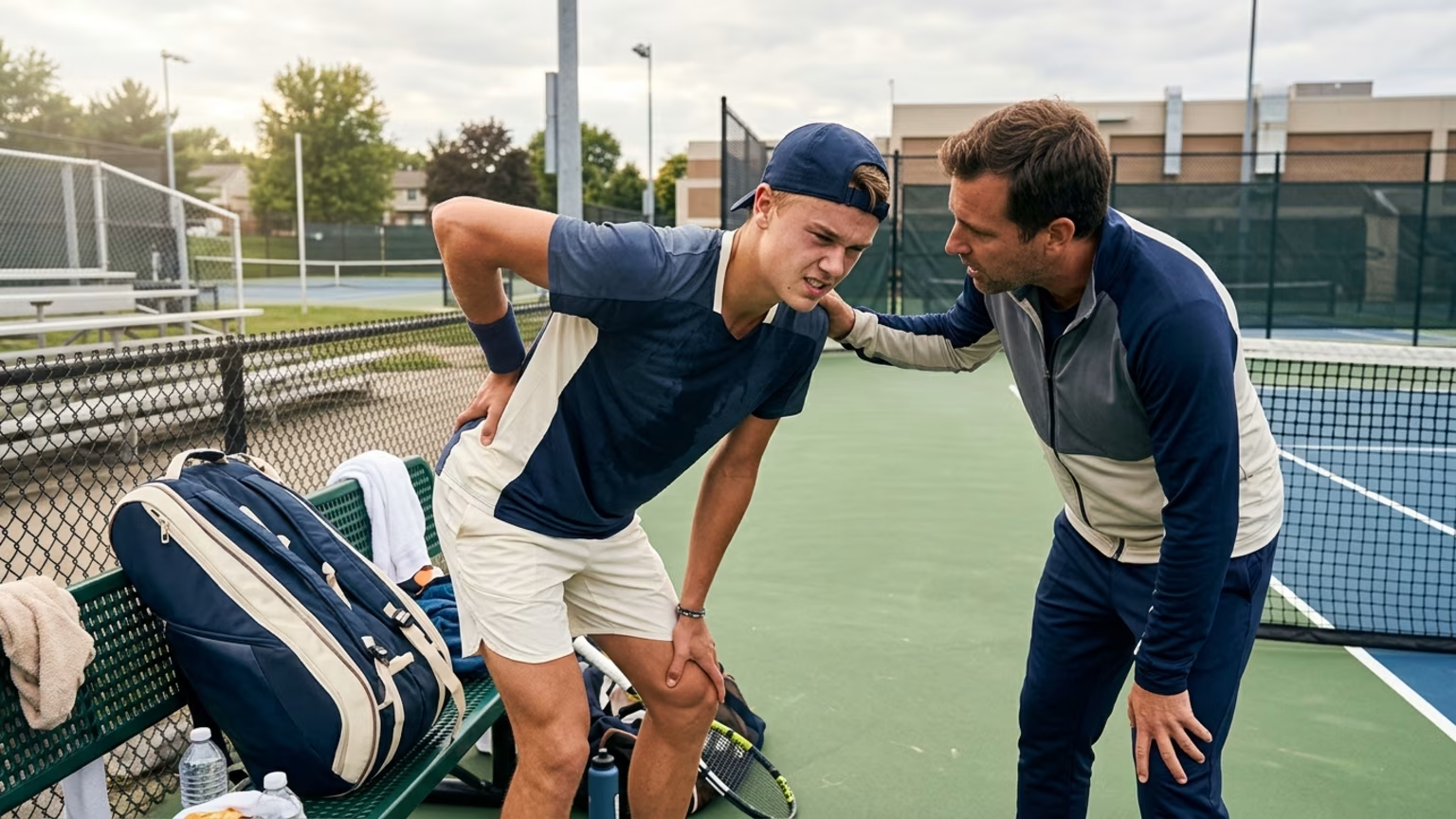
Holger Rune withdrew from the European Open with a back problem. The facts behind his decision and a grounded perspective for recreational players.

The Dink’s October 17 guide emphasizes deep returns, ball-height decisions and positioning against faster pickleball opponents.

A new report outlines padel and tennis gear trends. Learn how to assess adjustable rackets, sensor feedback and smart-court claims.
Read practical guidance for better movement, smarter preparation and a game that keeps working for you.
explore the Blog
