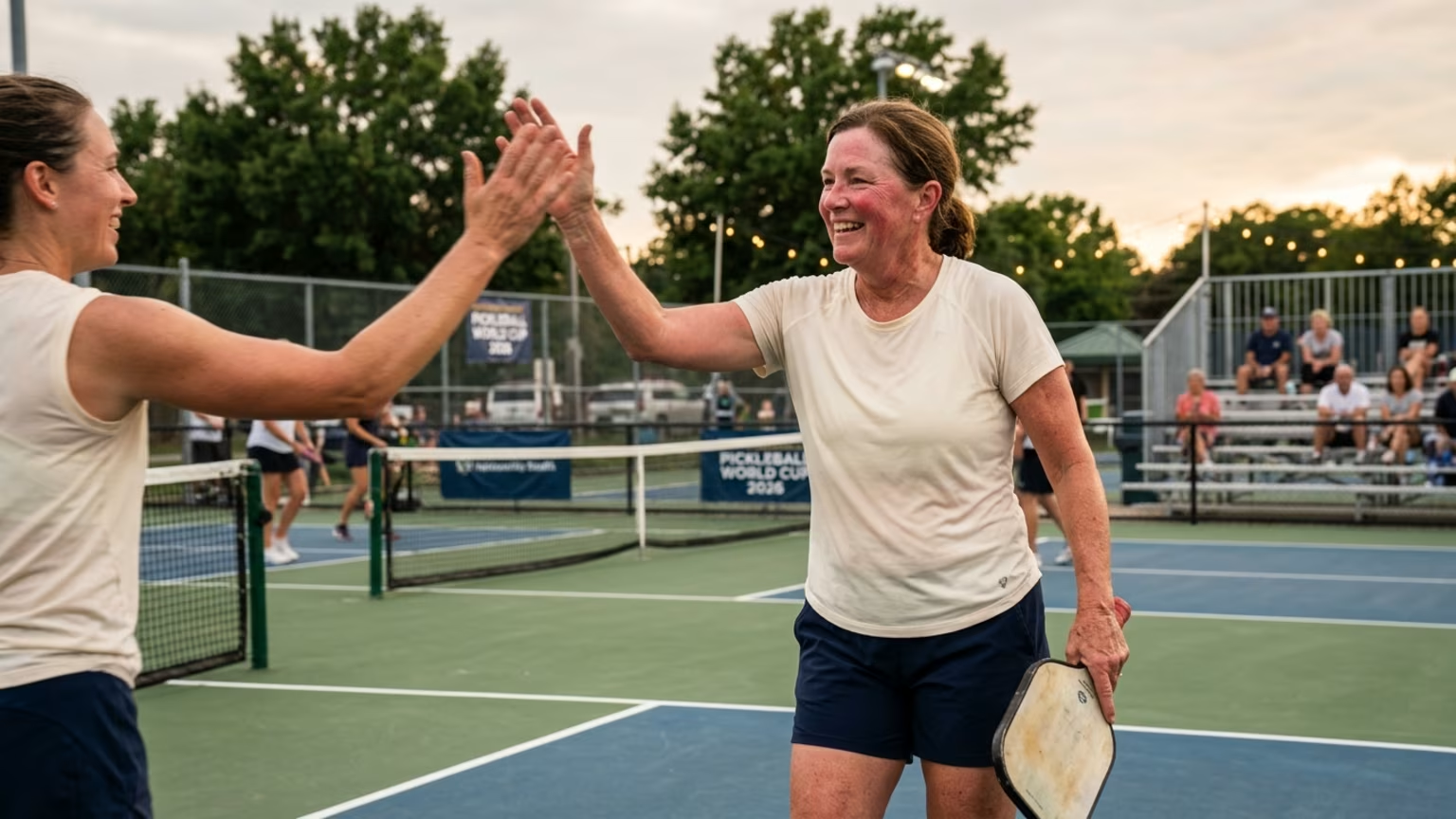

Bhushan Akut won three 60+ gold medals at the 2026 Pickleball World Cup. Learn how sensible preparation and tactics inform recreational senior play.




On August 30, 2026, the Pickleball World Cup began in Da Nang, Vietnam. This tournament was reportedly the first edition hosted in Asia. On September 1, the captain of India's 60+ team completed a remarkable sweep across multiple match formats. Bhushan Akut won 60+ gold in singles, men's doubles and mixed doubles at the World Cup.
His triple-gold performance highlights the intense physical requirements of international age-group competition. Playing three different events in a single tournament demands significant endurance and careful recovery. The results provide an excellent case study in how experienced racquet athletes prepare for repeated competition. Older competitors face unique challenges when managing tournament volume and maintaining their court movement.
India sent a 48-athlete delegation to the tournament. India finished fourth in the overall standings among 82 participating nations. They secured 41 medals with a breakdown of seven gold, 17 silver and 17 bronze. This 41-medal total represented a strong improvement over a reported seventh-place finish at the previous World Cup.
The tournament platform Pikl listed Akut with a rating of 4.496 in 60+ men's singles. His rating was listed at 4.708 in both 60+ men's doubles and mixed doubles. While these are platform-specific competition ratings rather than direct measures of fitness, they indicate a high level of consistent play. Akut faced familiar competition during his successful singles run.
He defeated his own teammate Ashok Rohira in the 60+ men's singles final to claim his first gold. Reports say Akut and Rohira then teamed up to win their men's doubles match against Australia's Brad Middleton and Graeme Clemett. They won that challenging three-game match by scores of 13 to 15, 15 to 8 and 15 to 11. Akut then completed his hat-trick by winning 60+ mixed doubles alongside his partner Elizabeth Wilcox.
India's other reported gold medallists included Fayrouz Zaidi in 40+ women's singles and Vivek Reddy in 40+ men's singles. Kiran Salian won 50+ men's singles, and Purvansh Patel won boys' under-18 singles.
Akut brings a highly specialized elite athletic pedigree to the court. Coverage describes him as a former international badminton player who had reached No. 23 in the world in men's doubles. Recreational players must separate this untransferable benchmark from practical, repeatable preparation. A former world-ranked racquet athlete possesses technical advantages and competitive habits that most club players simply do not have.
Adult amateurs should not expect a specific training plan to automatically produce gold medals. The real lesson lies in building a complete routine that supports the specific demands of tournament play. Instead of trying to copy an elite tournament workload, older players can learn from the broader principles of senior competition. Times Now reported that 62-year-old Rohira prepared with nearly two hours of daily practice alongside gym work.
His routine also included strengthening, diet control and stretching. This combination shows that senior competitors treat court work and physical conditioning as equal priorities. If you want to maintain your physical capabilities as you age, you have to support your court time with structured physical maintenance. Finding ways of adapting your movement to singles and doubles can also help players manage their energy efficiently.
Strategy also plays a massive role in athletic longevity on the court. Senior strategy guidance from The Dink emphasizes patience in neutral dink exchanges. The publication recommends moving opponents laterally and waiting rather than forcing an awkward attack. You should attack only when the ball is clearly attackable and contacted at or above net height.
Placing the ball carefully and forcing opponents to change direction often beats relying on pure speed or power. These tactical choices reduce unnecessary physical strain and lower the risk of overexertion during intense matches.
The research context around older adults and racquet sports is rapidly expanding to measure these functional benefits. A secondary report of an eight-week randomized trial recently examined pickleball's impact on older adults with pre-frailty. The study found that 42 percent of participants assigned to pickleball were no longer classified as pre-frail after eight weeks. This compared with just eight percent in the control group.
Understanding how racquet sports support healthy ageing requires looking at these functional improvements alongside sensible risk management. The data clearly shows that structured participation can yield measurable improvements in daily functional capability. However, the physical benefits of court play must be balanced with injury awareness. Recent research mapping describes the older-adult literature as spanning both health promotion and injury risk.
Studies have identified risks such as fractures, sprains and falls among older participants. A four-week pickleball intensity-coaching study has been designed to further examine changes in functional fitness and psychological well-being. Players must acknowledge that rapid changes of direction on hard courts require proper joint preparation and baseline strength. Ignoring these physical requirements can quickly lead to preventable setbacks.
Adult players should progress their court volume gradually while paying close attention to their bodies. You must monitor soreness, balance, fatigue and your next-day functional capability. Playing singles, same-gender doubles and mixed doubles creates vastly different movement and communication demands. Players should practice these formats separately to prepare for the specific physical requirements of each game.
Developing essential footwork skills for court movement is crucial for preventing falls and improving recovery between points.
The international expansion of age-group events will continue to shape how adults prepare for competition. India's Kids team also reportedly won silver after defeating Japan three to zero in the semifinals and losing to the United States. This multi-generational growth shows that the sport is building a structured, long-term competitive pipeline across all age brackets. Players of all ages will need to adapt their physical preparation to match this rising global standard.
As the level of play improves, casual weekend practice will no longer be enough for tournament success. Future senior tournaments will likely see an increased focus on athletic longevity rather than just technical repetition. Players who maintain lower-body strength, trunk control and shoulder resilience will hold a clear advantage over those who only play matches. Expect to see more competitive seniors adopting formal conditioning routines to handle the demands of repeated tournament play.
The players who prioritize recovery and high-percentage decision-making will be the ones still competing safely next season. Sensible load management and age-adapted preparation are the true foundations of a long and healthy playing career.
Follow Evercourts for practical insights on tennis, pickleball and padel performance, movement, recovery and healthy ageing. Stay connected for new articles, research-led guidance and ideas to help you play well and keep playing for years.


A recent KeepActive directory update highlights a Melbourne-area padel program offering introductory coaching and social play for adults aged 65 and over.

Understand why racquet sports injuries spike after summer and how to safely return to the court using a phased approach to frequency and match intensity.
The 2026 US Open men's semifinals highlighted how "not before" start times create unpredictable preparation windows. Learn how adult racquet players can adapt.
Read practical guidance for better movement, smarter preparation and a game that keeps working for you.
explore the Blog
