

Understand tennis starts, stops and direction changes, with evidence-led context on lower-body strength options and when to seek professional advice.




Lower-body capacity is the strength and movement control your legs can bring to starts, stops and changes of direction. For tennis players, it means considering both how you move into position and how you control your body before moving again.
That distinction matters when choosing off-court work. A list of leg exercises answers which movements you might train. It does not automatically explain how those movements relate to the changing demands of a point.
Tennis-focused practitioner guidance connects those questions through strength work, single-leg movements and controlled stopping. The useful starting point is understanding what each option is intended to address. From there, exercise selection becomes a question of experience and physical capacity rather than finding one ideal routine.
Tennis repeatedly involves acceleration, deceleration and lateral movement. A tennis personal-training article identifies those demands as reasons to include lower-body force production and movement control in preparation.
A tennis conditioning guide summarizes prior research as estimating about four direction changes per point, with reported estimates ranging from three to seven. Those are estimates summarized by that article, not a fixed description of every rally. Playing level, surface and style can affect the movement demands.
The practical distinction is between producing movement and controlling it. An explosive start asks the legs to generate force. Stopping and redirecting require control of the movement already underway. The conditioning guide therefore recommends including deceleration alongside acceleration rather than treating faster starts as the whole task.
For tennis, pickleball and padel, this provides a useful way to examine your own play:
The pickleball and padel points are applications of the movement principle, not sport-specific findings from the tennis sources. Evercourts' coverage of movement differences between singles and doubles offers another way to think about the demands of the format you actually play.
The clearest exercise guidance here comes from tennis practitioners. The personal-training article describes split squats, reverse lunges and step-ups as options alongside single-leg deadlift variations. It presents them as movements with differing balance and coordination demands.
The tennis conditioning guide also lists squats, split squats and multidirectional lunges. It includes single-leg work and associates that work with stability and braking. These recommendations help explain why tennis preparation may include several movement patterns rather than relying on one exercise.
The broader research adds context without settling exercise selection. A 2026 review of racket-sport interventions in older adults reported favorable functional outcomes in some areas. However, its evidence was concentrated in table tennis and could not establish that one racket sport was superior. It did not directly establish the effects of tennis strength training in older recreational players.
The important training limitation belongs in one place: practitioner recommendations are not controlled tests of a complete program. The reviewed material does not establish a validated sequence from split squats to step-downs to lateral drills. It also does not establish a universal training dose or prove that a particular sequence improves tennis performance or prevents injury.
The sources support thinking in categories rather than ranking exercises from essential to optional:
This is an exercise menu, not a mandatory circuit. The practical question is which option fits the player's current experience and capacity while addressing the intended movement demand.
The personal-training guidance recommends adapting controlled stopping, lateral work and faster changes of direction to the individual. Its principle is to begin with movement the player can control and consider more demanding movement when appropriate.
That makes progression a matter of matching the challenge rather than completing a fixed exercise ladder. A different balance demand and a faster change of direction are different challenges. Neither should be treated as automatically suitable simply because an exercise looks more advanced.
Evercourts' broader lower-body strength resource provides related reading on movement options. The distinction remains the same: selecting an exercise and deciding how to progress it are separate decisions.
For adult players, the value is a clearer way to think about preparation. Instead of asking only whether the legs are strong enough, the question becomes whether training considers both producing movement and controlling it. That keeps starts, stops and redirection in the same conversation.
It also provides an alternative to choosing exercises by age alone. The practitioner guidance emphasizes experience and physical capacity. A birthday is not a substitute for understanding those characteristics, and an exercise associated with advanced training is not automatically the right next step.
A useful editorial interpretation is to organize the discussion around three questions: what does your game ask you to do, which movement options address those demands and how should the challenge be adapted? These questions make room for individual differences without turning every player into a separate training theory.
They also keep match play and off-court preparation connected. Evercourts' off-court strength coverage considers that wider preparation context. The goal is not to collect increasingly difficult exercises but to make training choices relevant to continued participation.
Athletic longevity is a useful purpose for this approach, rather than a promised result. Understanding the demands gives players a better basis for discussing their preparation with a qualified professional. It leaves room to adjust the work as their experience, circumstances and capacity change.
Seek individual guidance if pain or stiffness is changing how you move on court. A recurring problem that repeatedly interrupts play is also a reason to consult a qualified physiotherapist or healthcare provider rather than keep changing exercises on your own.
Ask for assessment if you notice a change in your usual strength or balance. Professional input is also appropriate when you are unsure whether stopping drills or faster direction changes suit your situation. These are reasons to seek guidance, not a checklist for diagnosing yourself.
A useful starting point for that conversation is describing what you notice: which movement brings on the concern and how it affects your play. Personal decisions about exercise suitability belong with someone who can assess you directly.
Build capacity for the player you are, with qualified help when you need it.
Follow Evercourts for practical insights on tennis, pickleball and padel performance, movement, recovery and healthy ageing. Stay connected for new articles, research-led guidance and ideas to help you play well and keep playing for years.


Pablo Cardona played an Abu Dhabi exhibition during knee rehabilitation. His comments offer club players perspective on competition-return dates.

Practical answers on choosing tennis racquets, pickleball paddles and padel rackets by playing style, comfort and budget, with advice on demos.
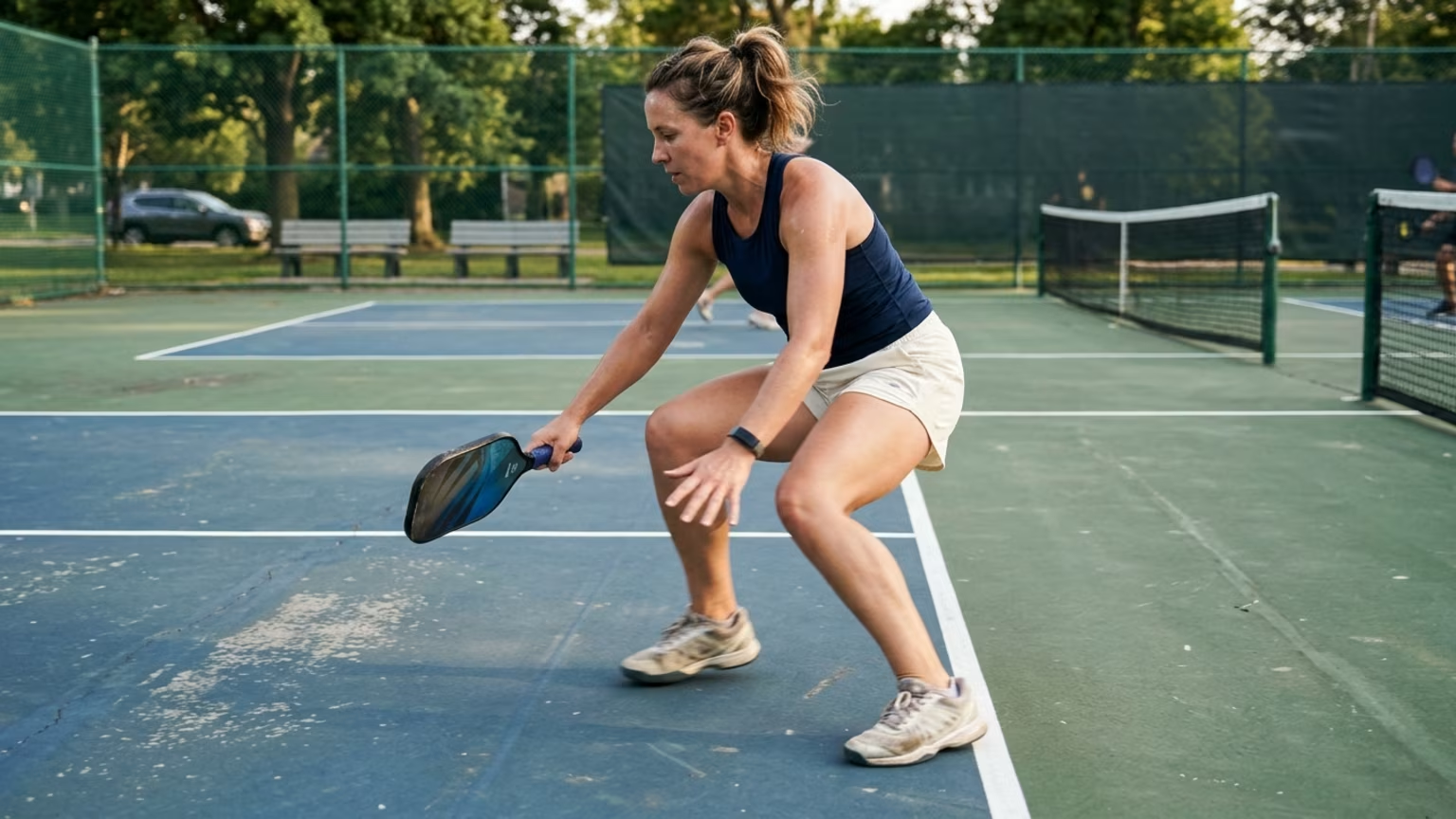
A practical look at pickleball balance, leg strength and controlled stopping, with exercise examples and clear limits on injury-prevention evidence.
Read practical guidance for better movement, smarter preparation and a game that keeps working for you.
explore the Blog
