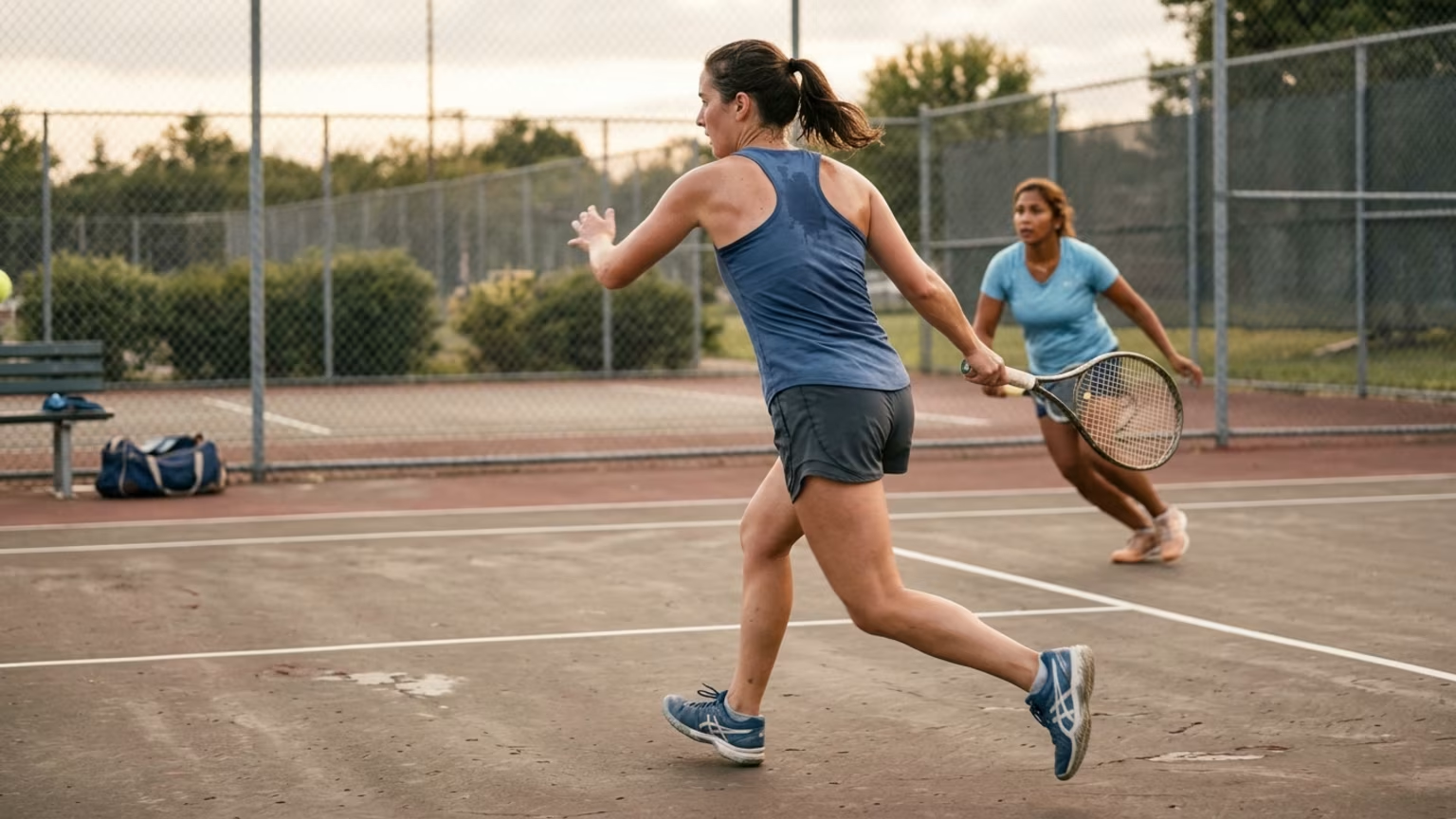

Reaching the ball on court is not about top sprint speed. Learn why the first two steps, balance, and braking matter most for your athletic longevity.




A sharp volley lands near the sideline, forcing a desperate sprint across the court. The immediate reaction is to drop the head, pump the arms, and run as fast as possible. Reaching the ball at full speed often results in arriving completely off balance and spraying the response wide.
You have heard it a million times: getting to the ball faster requires increasing your top running speed. Here is why that is outdated. Reaching a shot on the tennis, pickleball, or padel court is rarely a pure test of maximum velocity. The true determining factor is how well you perceive the shot, organize your body, and execute the first two steps. It is a sequence of reading the play, initiating movement, and braking effectively.
When a ball speeds past your paddle or racquet, the immediate sensation is simply feeling slow. We naturally assume that moving faster in a straight line is the obvious solution. This assumption drives many players to focus entirely on linear sprinting or complex footwork patterns. Coaches often prescribe endless agility ladder drills to build quickness and foot speed.
However, one practitioner review published in TennisYard argues that unpredictable partner-cue drills may be more court-specific than relying on ladder patterns alone. The same TennisYard review characterizes agility-ladder work as having warm-up value but unclear transfer to match performance. It is easy to see why players focus on sprint speed when they feel themselves losing a step. They want a simple metric to improve.
Sustained sprinting ignores the reality of racquet sports dimensions and mechanics. You rarely have enough distance to reach maximum velocity before you need to hit the ball. The physical demands of the sport require constant changes of direction. Focusing solely on top speed neglects the vital phases of deceleration and balance.
A player who reacts late or crosses their feet poorly may run quickly but still arrive stretched out. When you arrive off balance, you lose the ability to transfer weight into your shot. This forces you to rely entirely on your arm and shoulder to generate power. By the time you recover, your opponent has already taken control of the rally.
A practitioner review in TennisYard describes the true priority for recreational players as braking, balance, and the first two steps. The same review argues that recreational players over 40 should prioritize these factors over straight-line speed. The movement sequence begins with a well-timed split step that organizes your body for action. A balanced split step ensures you can move effectively in any direction.
The review reports that a 2009 study by Uzu and Oda examined split-step use in a simulated tennis choice-reaction task. They found that performing a split step shortened the time needed to complete a step-and-reach movement. Court movement also demands cognitive processing while in motion. You have to read the play and move simultaneously.
A 2026 meta-analysis published in PubMed found that cognitive training improved dual-task gait speed in older adults, but not single-task gait speed or balance. This dual-task improvement showed a standardized mean difference of 0.39 and a 95% confidence interval of 0.04 to 0.75. The ability to process information while moving is crucial for reading your opponent. Physical capacity clearly supports these mechanics and overall athletic longevity.
A separate meta-analysis summarized by PEDro reported a 0.13 m/s positive effect on preferred gait speed for resistance training performed at 70 to 80% of one-repetition maximum, with a 95% confidence interval of 0.09 to 0.16 m/s. A 2026 systematic review from PLOS One also found that sensorimotor-based interventions improved balance performance in older adults, with varying certainty across outcomes. These findings highlight the importance of targeted physical preparation over simply trying to run faster. A strong lower body helps you absorb force during rapid deceleration.
A few years ago, I realized my tennis serve speed was dropping, and my shoulder was constantly throbbing after matches. Instead of pushing through the pain, I took a month to rebuild my mechanics and focus on rotator cuff endurance. I stopped trying to hit flat aces and developed a much heavier kick serve. My win rate went up, my shoulder stopped hurting, and I learned that longevity often means outsmarting your own ego on the court.
You can improve your initial movement sequence without relying on intense sprinting routines. Training should focus on reading directions, pushing off cleanly, and controlling your deceleration. For a practical approach, start with a simple point-and-go drill. Stand in a ready position while a partner points left or right unpredictably.
Perform a small split step, push off cleanly, and take two steps toward the target. You can refine your efficient court coverage by focusing on a decisive first step. Finish the movement in a balanced stance rather than falling toward the target. This drill builds the essential link between visual information and movement initiation.
Braking is just as important as starting your run to the ball. The practitioner source from TennisYard recommends deceleration-and-hold work as a way to develop braking capacity and reduce stutter steps. The review describes this recommendation as mechanistically plausible rather than conclusively proven for match performance. Move forward for several steps, plant on one leg, and hold the landing for two seconds.
This control helps you establish a stable base for your shot and reduces joint stress. You can also practice low reactive hops to improve your split step timing. Perform 10 to 20 small hops in place while landing quietly with soft knees. The practitioner source presents these low reactive hops as plausible for shortening ground contact, while acknowledging that direct evidence remains limited.
Consistent practice of these essential footwork skills keeps your body ready for unpredictable match situations. It is crucial to adapt these movements to your specific sport and court position. In tennis, you might use a crossover step to cover a deep baseline corner effectively. In pickleball, movement often requires shorter lateral adjustments to stay balanced near the non-volley zone.
For padel, your recovery must account for the glass walls and your partner's position. Moving to a textbook location while leaving the open court exposed can be counterproductive. Matching your footwork to the specific distance ensures a better arrival and a faster recovery. When you focus on these practical skills, you build a movement foundation that lasts.
The old myth told us to constantly push for a higher top running speed. The New Golden Rule is to master the first two steps, control your deceleration, and stay balanced. Reaching the ball is about perception and early organization rather than sheer velocity. By prioritizing braking and early movement, you protect your joints and set yourself up to play smart for years to come. We look forward to seeing you on the courts.
Follow Evercourts for practical insights on tennis, pickleball and padel performance, movement, recovery and healthy ageing. Stay connected for new articles, research-led guidance and ideas to help you play well and keep playing for years.


Holger Rune withdrew from the European Open with a back problem. The facts behind his decision and a grounded perspective for recreational players.

The Dink’s October 17 guide emphasizes deep returns, ball-height decisions and positioning against faster pickleball opponents.

A new report outlines padel and tennis gear trends. Learn how to assess adjustable rackets, sensor feedback and smart-court claims.
Read practical guidance for better movement, smarter preparation and a game that keeps working for you.
explore the Blog
