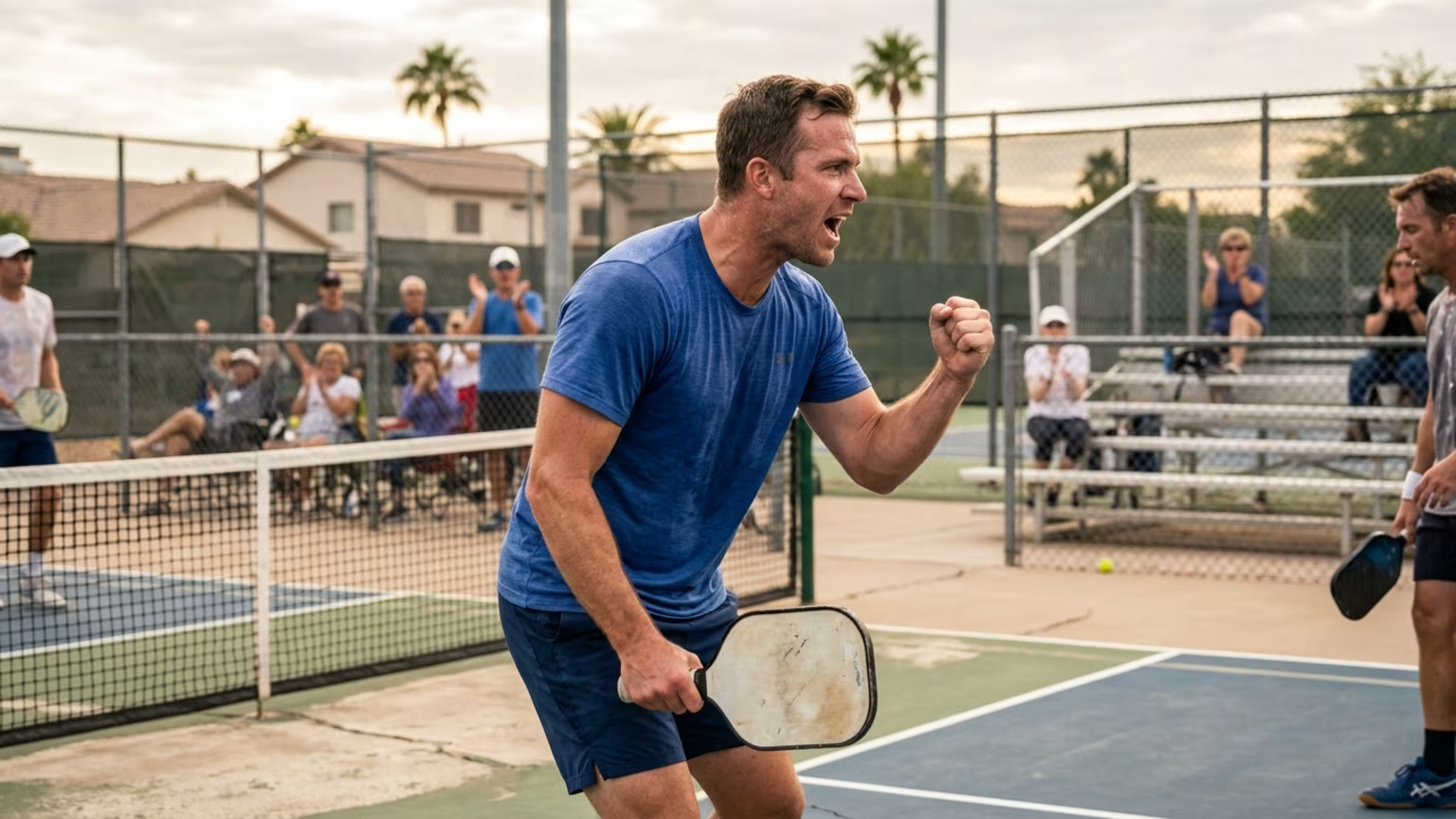

Acevedo and Funemizu's Arizona Open upset over Johns and Staksrud offers crucial tactical and preparation lessons for adult recreational pickleball players.




On September 18, 2026, No. 15 seeds Nicolas Acevedo and Yuta Funemizu defeated No. 1 seeds Ben Johns and Federico Staksrud at the Veolia Arizona Open. The upset occurred during the very first match of the newly formed Johns and Staksrud partnership. Johns was originally expected to play alongside Gabe Tardio. However, Tardio was out of the country for the scheduled event.
This roster change set the stage for a highly anticipated debut. The crowd expected a dominant performance from the top seeds. Instead, the match delivered a quick and decisive upset.
Acevedo and Funemizu secured the victory in straight games with scores of 11 to 4 and 11 to 5. The entire match lasted only 34 minutes. Following the win, the duo advanced to the men's doubles quarterfinals. They were scheduled to face No. 9 seeds Casey Diamond and Tyson McGuffin.
Quarterfinal tournament coverage was slated for PickleballTV and FS1. Pickleball.com described the match as a stark reminder of an increasingly deep professional field. Acevedo and Funemizu were not a newly assembled team testing their coordination. They had an established competitive history before arriving in Arizona.
The pair had already secured a Wilson PPA Challenger victory earlier in May. They also competed successfully as teammates for the Miami Pickleball Club in Major League Pickleball. The match report provided specific technical details regarding their recent victory. Acevedo competed effectively in crosscourt dink rallies against Johns.
He managed the tempo well and found consistent ways to attack Staksrud. Meanwhile, Funemizu utilized soft counters heavily influenced by his tennis background. Pickleball.com noted that Funemizu was nearly unattackable during the match. The top seeds simply could not break down this reliable defensive consistency.
After the doubles elimination, Johns and Staksrud were left to face each other later in the singles quarterfinals.
At the professional level, a new partnership faces immediate tactical pressure from established teams. For adult recreational players, the primary takeaway is the importance of adaptable tactics. Recreational players often build their entire game around one preferred tempo or offensive shot. The Arizona Open result demonstrates the value of having multiple responses ready.
You should practice both patient dink exchanges and controlled counterattacks to handle different opponents. Partner compatibility should always be treated as a crucial performance variable. Johns and Staksrud were making their tournament debut as a team. Amateur players should learn from this dynamic by practicing communication before entering competitive events.
You should clarify court coverage responsibilities and transition decisions with your partner. Discussing reset calls before a match can prevent confusion during fast rallies. Preparing for varied playing styles is another essential step for league competitors. You should practice with partners who attack quickly and defend patiently.
Seek out opponents who use heavy topspin or favor soft resets. This approach builds the tactical variety demonstrated in the Arizona upset. Maintaining this level of court coverage requires specific physical preparation.
When I first started playing pickleball, I noticed how many people skipped warming up entirely. They would jump straight out of their cars and right up to the kitchen line. I tried doing that and immediately pulled a calf muscle. Pickleball requires just as much explosive lateral movement as tennis, just in a tighter space.
Since then, I always spend five minutes doing dynamic lunges and ankle rolls. It changes everything about how confident I feel pushing off the baseline. Professional upsets are built on reliable movement and consistent injury prevention. Adult players must treat their bodies with the same functional respect.
Lancaster Orthopedic Institute recommends gradually building court time to reduce injury risk for players over fifty. They advise adding scheduled recovery days instead of playing daily. Players should only increase one training variable at a time. This means you should not increase frequency and duration simultaneously.
If you want to maintain tactical discipline during long matches, progressive workload management is essential. The orthopedic guidance also emphasizes movement specific warmups. Brisk walking and lateral movements prepare the body better than static stretching. Controlled calf raises and sit to stands are highly recommended before stepping on the court.
The clinical advice stresses strengthening the calves, hips, and trunk. These muscle groups directly support the stopping and redirecting required in competitive play. Do not confuse pain tolerance with effective physical conditioning. Lancaster Orthopedic Institute advises players to stop and evaluate symptoms when pain changes their mechanics.
Playing through a noticeable limp or protecting one side of the body often leads to compensatory injuries. Pain that forces you to alter a swing should be treated as a warning sign. Healthy aging on the court requires listening to these physical limits. Pickleball injuries are increasingly receiving formal sports medicine attention.
The American College of Sports Medicine recently listed a clinical report on their platform. The item was titled "Pickleball Pain: POCUS Used to Diagnose Midfoot Pain." This highlights the physical toll of sudden court movement on the lower extremities. Players playing through joint issues must prioritize recovery over extra match volume.
The efficiency of the upset stands out clearly in the match statistics. Acevedo and Funemizu needed only 34 minutes to eliminate the top tournament seed. The No. 15 seeds held the top pairing to just nine points across the entire match. This decisive scoring margin reflects a heavy tactical advantage.
While the available statistics confirm the efficiency of the win, they do not quantify the exact size of the professional talent pool. The match report highlights an increasing depth in the field. However, there is insufficient evidence to claim a measurable league wide parity shift from just one tournament. What is clear is that the gap between top seeds and mid tier pairings is narrowing.
The Veolia Arizona Open served as the second event of the 2026 to 2027 PPA Tour season. This early performance metric suggests a highly competitive season ahead. A single two game upset does not permanently rewrite the professional hierarchy. However, the severe point differential proves that lower seeded teams with established chemistry can dictate match pacing.
As the 2026 to 2027 tour season progresses, professional partnerships will likely prioritize established chemistry over raw individual talent. Teams will need to develop answers for the patient dink strategies that defined the Arizona Open upset. Opponents will likely study Funemizu's soft defensive skills to prepare better offensive counters. The early tournament results indicate that court positioning and patience will remain highly rewarded.
For amateur athletes, the evolving professional game offers a clear operational roadmap. Consistent physical preparation and adaptable shot selection will remain your best tools for court longevity. We expect to see more recreational players focusing on targeted lower body conditioning this year. Managing your competitive workload correctly will be the key to enjoying another full season of play.
Follow Evercourts for practical insights on tennis, pickleball and padel performance, movement, recovery and healthy ageing. Stay connected for new articles, research-led guidance and ideas to help you play well and keep playing for years.


An evidence check on sports supplements like tart cherry juice. Learn why racquet sports players should prioritize core nutrition over functional foods.
In late 2026, Oura analyzed wearable data to see how recreational tennis impacts heart health and recovery. Learn what this means for your athletic longevity.
Recent guidelines emphasize gradual progression, dynamic warm-ups, and scheduled recovery to help adult racquet sports players maintain athletic longevity.
Read practical guidance for better movement, smarter preparation and a game that keeps working for you.
explore the Blog
