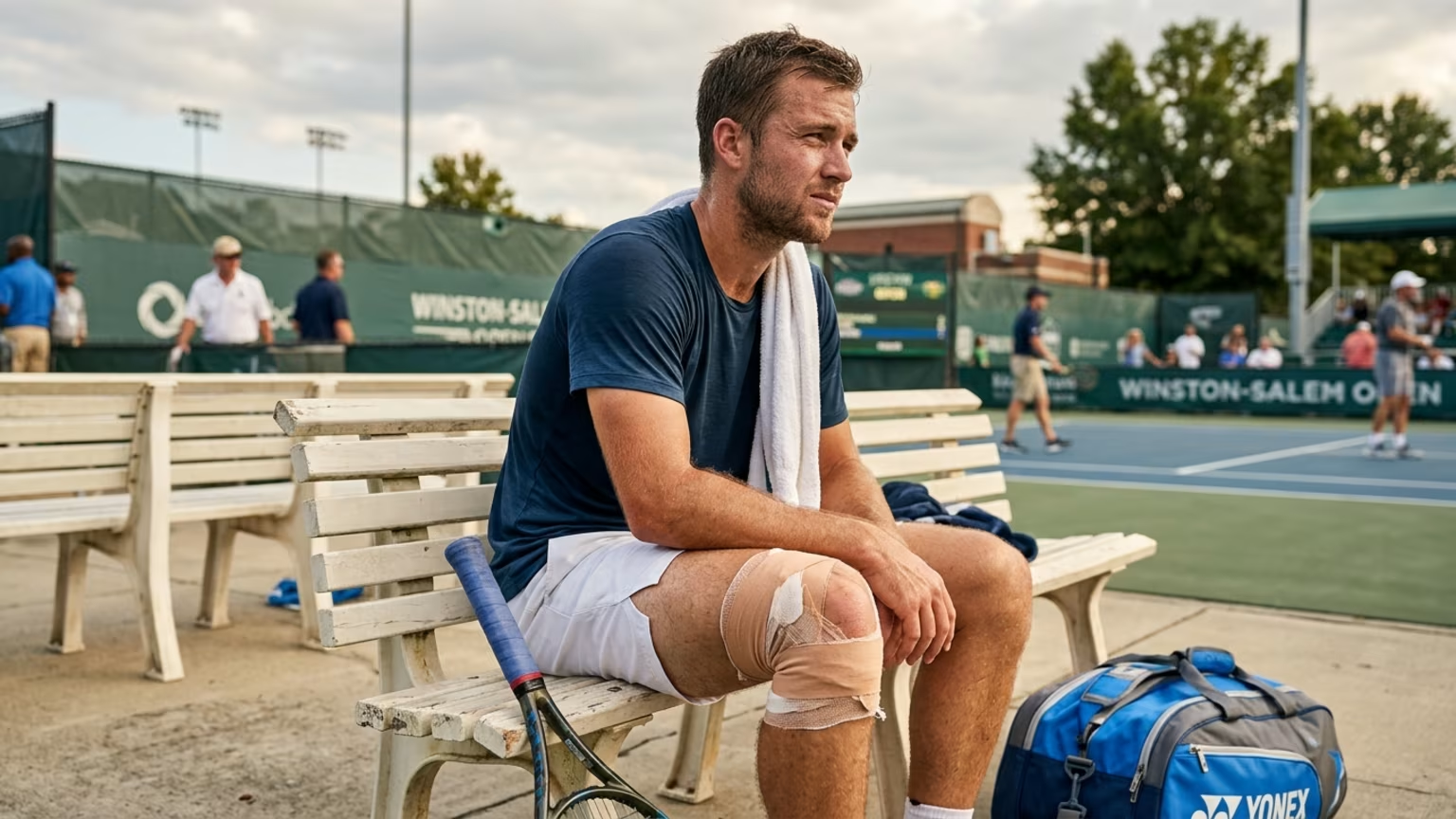

Luciano Darderi's heavily taped knee at the 2026 Winston-Salem Open highlights the risks of playing through joint issues. Learn when to sit out and recover.




"Should I still play my match if I need heavy tape on my knee just to walk on the court?"
Most players believe that strapping up a joint makes it safe for competition, but visible support is actually a mandate to assess the problem rather than a green light to ignore it. We saw this reality at the 2026 Winston-Salem Open when Luciano Darderi competed with a heavily taped left knee. He ultimately lost 6-1, 6-0 to No. 13 seed Botic van de Zandschulp in just 68 minutes. This high-profile result highlights why adult players must prioritize early load management over pushing through compromised joints.
At the professional level, athletes often take the court with heavily strapped joints. Tennis Majors reported that Darderi played with a heavily taped left knee during his match at the 2026 Winston-Salem Open. Italian outlet Ubitennis described the player as appearing to be in evident physical difficulty. However, visible tape is a sign of treatment rather than a confirmed diagnosis.
It cannot reveal whether an issue involves a tendon or a ligament. It also cannot confirm any other structural condition. A brace or tape might alter your comfort levels on the court. It does not identify the underlying condition or guarantee that continued loading is a good idea. Therefore, you should treat any need for heavy support as a prompt to evaluate the joint.
It is easy to assume that a taped joint simply resulted in a poor performance. The available reporting does not establish that the knee problem directly caused Darderi to lose. Field Level Media noted the match was tied at 1-1 before van de Zandschulp won the final 11 games. Coverage identified Darderi as the world No. 22 and van de Zandschulp as the world No. 71 at the time of the tournament.
The scoreline reflected both physical difficulty and a highly effective performance from his opponent. Van de Zandschulp produced a 12-0 advantage in aces and won 86 percent of his first-serve points. He also won 60 percent of his return points during the dominant performance. Darderi produced six winners, 17 unforced errors, and was broken five times from eight opportunities.
The clearest medical guidance distinguishes ordinary post-exercise soreness from symptoms that demand immediate attention. Medical commentary emphasizes that symptom trajectory matters greatly for adult players. Improving soreness is very different from pain that intensifies or progressively limits your function over time. You must monitor how your body responds the morning after a tough match.
Sports-medicine experts identify several warning signs that warrant greater caution. You should look out for worsening pain, substantial swelling, and joint instability. Locking, weakness, and numbness are also critical warning signs. An inability to bear weight is another major red flag that requires prompt medical evaluation. These symptoms suggest that you are dealing with more than just a routine ache.
The absence of a catastrophic injury does not mean you are ready to compete. Separate reporting on Jannik Sinner said doctors advised a period without training because knee inflammation persisted, despite no reported rupture. This illustrates a crucial point for all racquet sports enthusiasts. You do not need a completely torn ligament to justify stepping away from the court.
Many adults worry about losing their physical capabilities if they take a rest week. However, balancing match play and strength training actually protects your long-term athletic health. Resting a flared-up knee allows inflammation to subside before it alters your movement mechanics. A progressive return to play is far smarter than pushing until a joint completely fails.
The demands on your lower body change significantly depending on your chosen racquet sport. Tennis players often cover long distances and slide on hard courts or clay. Pickleball requires sharp and explosive lateral movements within a much tighter spatial area. Padel players frequently navigate sudden stops and rapid changes of direction on artificial turf.
When I first started playing pickleball, I noticed how many people skipped warming up entirely. They would jump straight out of their cars and right up to the kitchen line. I tried doing that and immediately pulled a calf muscle. Pickleball requires just as much explosive lateral movement as tennis, just in a tighter space.
Since then, I always spend five minutes doing dynamic lunges and ankle rolls. It changes everything about how confident I feel pushing off the baseline. You must adapt your warm-up and adjust your mobility strategies for different playing environments to stay healthy. These specific preparations help your body handle the unique loads of your sport.
You can actively manage your load before testing a joint in a competitive setting. Practical load management includes reducing your match intensity or shortening your practice sessions. Substituting technical work or upper-body conditioning is a great way to stay active while resting your knees. This approach keeps you engaged with the sport without risking further joint irritation.
For adult players whose priority is staying active for years, missing one event is often the best choice. Benjamin Bonzi advanced comfortably to the quarter-finals by beating Rinky Hijikata 6-1, 6-1 in the same tournament round. Bonzi’s match lasted 57 minutes and 13 seconds. Ubitennis described the Frenchman as controlling the contest from the very outset.
Bonzi was listed as world No. 109 and Hijikata as world No. 85 during their match. The quarter-final draw subsequently set up a meeting between Bonzi and van de Zandschulp. A decisive victory like Bonzi's highlights how effective a healthy and uncompromised body can be. Making an honest decision to sit out protects your ability to perform at that level.
It would be speculative to say that Darderi should definitely have withdrawn from his match. The public record does not disclose the medical advice he received in his highly supported professional environment. One Italian report noted that Winston-Salem was his 22nd tournament of the 2026 season. This heavy schedule prompted commentary about workload, though it remains an observational point rather than a medical diagnosis.
Recreational players must remember that a professional ATP match is not a direct model for club play. You should never use a professional player's decision to compete as personal clearance for your own body. We do not have the same safety nets or structured recovery programs that elite athletes rely on. Competing through joint issues often compromises your technical execution and your enjoyment of the game.
The choice to rest a painful joint is a strategic investment in your athletic future. A quiet willingness to listen to your body ensures you can keep enjoying the game for decades to come.
Follow Evercourts for practical insights on tennis, pickleball and padel performance, movement, recovery and healthy ageing. Stay connected for new articles, research-led guidance and ideas to help you play well and keep playing for years.


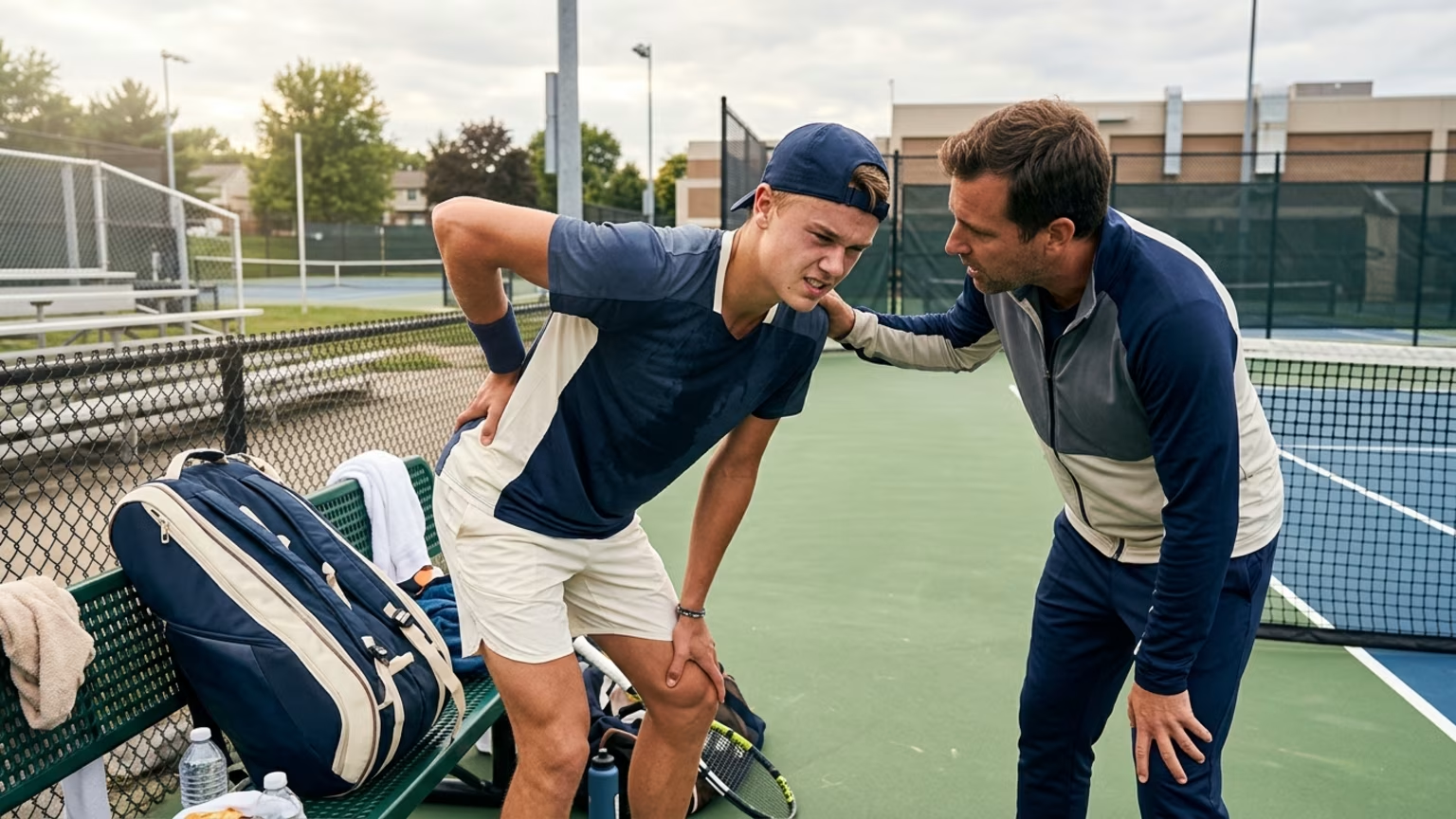
Holger Rune withdrew from the European Open with a back problem. The facts behind his decision and a grounded perspective for recreational players.

The Dink’s October 17 guide emphasizes deep returns, ball-height decisions and positioning against faster pickleball opponents.

A new report outlines padel and tennis gear trends. Learn how to assess adjustable rackets, sensor feedback and smart-court claims.
Read practical guidance for better movement, smarter preparation and a game that keeps working for you.
explore the Blog
